
Consumer behaviour studies how individuals make decisions about what to buy, how much to buy, and how they choose among different goods and services. It focuses on understanding the thought process behind purchasing choices and how consumers aim to achieve maximum satisfaction from their limited income.
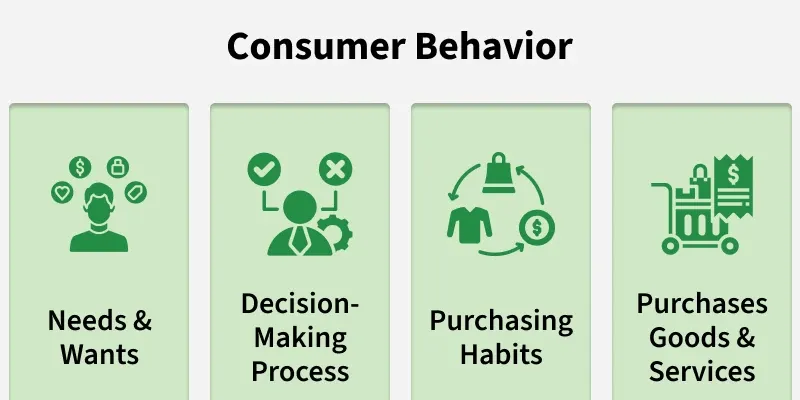
A consumer is any individual who purchases goods or services to satisfy personal needs and wants, not for resale or business use. Consumers play a central role in the economy by influencing production decisions through their demand. Their preferences, income, and spending patterns determine what products are produced, in what quantity, and at what price.
Consumer behaviour helps economists and businesses understand the motives and preferences that guide purchasing decisions. By analyzing these patterns, producers can design goods and pricing strategies that meet consumer expectations and market demand more effectively.
Understanding Utility and Consumer Behaviour
Consumer behaviour revolves around the concept of utility, which means the satisfaction or pleasure derived from consuming a product or service. Every purchase reflects a consumer’s attempt to maximize satisfaction within a limited budget. The study of utility helps explain how individuals allocate income among different goods to get the most value for money. Economists have explained this concept through two main approaches: the cardinal approach and the ordinal approach.
Cardinal Approach
Cardinal approach assumes that utility can be measured in numerical terms called “utils.” It suggests that satisfaction derived from goods can be quantified and compared mathematically. According to this view, consumers allocate their income in a way that equalizes the marginal utility per unit of money spent on each good. When this balance is achieved, total utility is maximized.
Ordinal Approach
Ordinal approach assumes that utility cannot be measured numerically but can be ranked or ordered. Consumers may not express satisfaction in numbers, but they can state preferences, such as preferring a laptop over a tablet. This approach is represented through indifference curves, which show various combinations of two goods that provide equal satisfaction to the consumer.
Thus, while the cardinal approach focuses on measuring utility, the ordinal approach focuses on comparing satisfaction levels.
Cardinal Utility vs Ordinal Utility
Cardinal Utility | Ordinal Utility |
|---|---|
The measurement of utility or satisfaction derived by a consumer after consuming goods or services in numerical terms. | The measurement of utility or satisfaction derived by a consumer after consuming goods or services in qualitative terms. |
Cardinal utility is less realistic. | Ordinal utility is more realistic. |
It is a quantitative approach. | It is a qualitative approach. |
Cardinal utility is measured in utils. | Ordinal utility is measured in ranks. |
Cardinal utility is measured by Marginal Utility Analysis. | Ordinal utility is measured by Indifference Curve Analysis. |
Total Utility
Total Utility refers to the total satisfaction a consumer obtains from consuming a certain quantity of a product. Initially, as consumption increases, total utility also increases because each additional unit adds to overall satisfaction. However, after a certain point, the increase in total utility becomes smaller, and if consumption continues beyond that point, total utility may even start to decline. This happens because human wants are limited, and once a want is satisfied, further consumption gives less satisfaction.
Marginal Utility
Marginal Utility is the additional satisfaction that a consumer derives from consuming one more unit of a product. It indicates the change in total utility that results from an increase of one unit in consumption. For example, the first cup of tea may give high satisfaction, the second may still be enjoyable but slightly less, and by the third cup, the satisfaction decreases further. This decline continues until the consumer no longer gains any pleasure from consuming another cup.
Law of Diminishing Marginal Utility
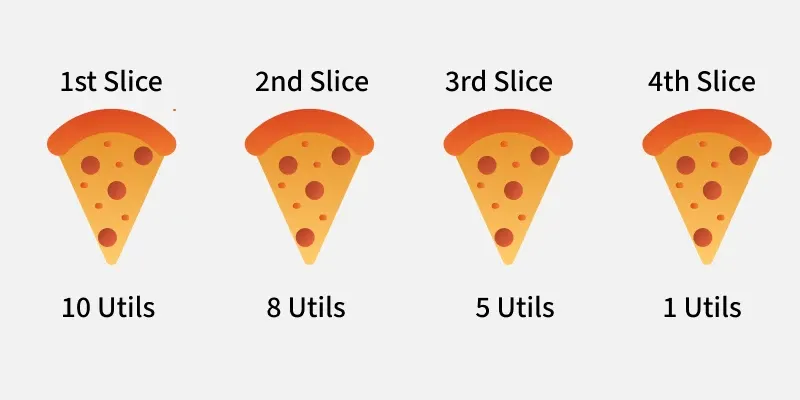
The Law of Diminishing Marginal Utility states that as a consumer consumes more and more units of a commodity, the additional satisfaction gained from each successive unit decreases.
In other words, the first unit provides the highest satisfaction, and every additional unit adds less and less to total utility. Ultimately, marginal utility may even become zero or negative when the consumer reaches full satisfaction or experiences dissatisfaction from further consumption.
This law explains an important aspect of human behaviour. People do not keep buying endlessly because their satisfaction decreases with each additional unit. It also provides the foundation for the Law of Demand, as consumers are only willing to buy more when the price falls.
Assumptions of the Law of Diminishing Marginal Utility
- The units of the commodity consumed are identical in all respects such as quality and size.
- The consumption takes place continuously without long gaps between units.
- The consumer’s taste, income, and habits remain constant throughout the process.
- The commodity should be divisible so that it can be consumed in small quantities.
- Utility can be measured in numerical terms, and the consumer acts rationally to maximize satisfaction.
When these conditions are fulfilled, the law holds true and helps in understanding real-life consumer decisions and pricing behaviour.
Consumer Equilibrium
Consumer equilibrium is the point at which a consumer achieves maximum satisfaction given their income and the prices of goods. It occurs when the ratio of the marginal utility of a good to its price is equal for all goods consumed. This condition ensures that every rupee spent gives the same level of satisfaction, leading to an efficient allocation of resources. If this balance is disturbed, the consumer can reallocate spending to restore equilibrium and increase total satisfaction.
Determinants of Consumer Behaviour
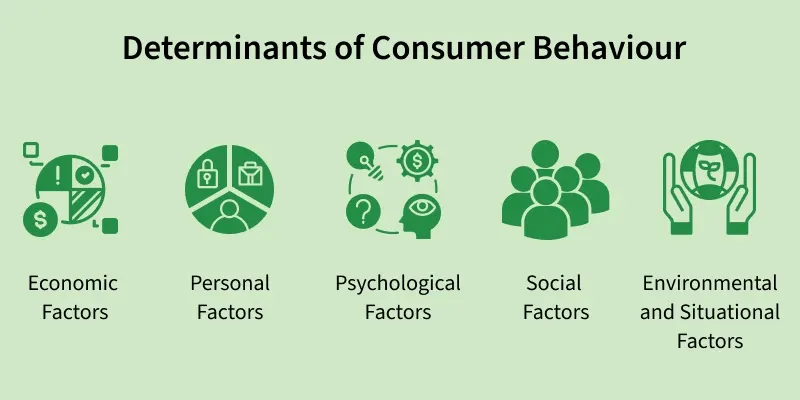
Several factors influence how consumers make decisions and behave in the marketplace. These determinants can be broadly divided into economic, personal, psychological, and social factors.
Economic Factors
Income level, prices of goods, and the availability of substitutes play a major role in shaping consumer behaviour. Higher income often leads to increased demand for better-quality goods, while rising prices can make consumers shift to cheaper alternatives.
Personal Factors
Age, occupation, lifestyle, and personality affect purchasing choices. For example, a student may prioritize affordability, while a working professional may focus more on quality and comfort.
Psychological Factors
Motivation, perception, learning, and attitudes shape how consumers view products and make decisions. Effective advertising can alter perceptions and influence choices significantly.
Social Factors
Family, friends, culture, and social status also affect what and how people buy. Many consumers prefer products that align with their social identity or are popular in their community.
Environmental and Situational Factors
Occasions, surroundings, and available time can affect buying decisions. For instance, festival seasons or discount offers often encourage higher spending.
Objectives of Studying Consumer Behaviour
The main objective of studying consumer behaviour is to understand how individuals make consumption decisions and how these decisions influence the market as a whole.
To Understand Consumer Needs and Preferences
Understanding consumer behaviour allows businesses to gain insight into what motivates buyers to choose one product over another. It helps identify their tastes, habits, lifestyle choices, and expectations from a product. By studying these patterns, companies can develop goods and services that better meet customer needs, resulting in stronger relationships and higher satisfaction levels.
To Forecast Market Trends
Analyzing how consumer choices evolve over time enables firms to predict upcoming market trends. It helps them estimate future demand, plan inventory, and make timely adjustments in production or marketing. For example, if consumers shift toward eco-friendly products, firms can introduce sustainable alternatives to stay relevant in the market.
To Enhance Customer Satisfaction
A deep understanding of consumer behaviour allows businesses to track feedback and improve product features or services accordingly. By recognizing what customers value most, firms can deliver consistent quality and create experiences that encourage repeat purchases and brand loyalty. This not only increases satisfaction but also strengthens the firm’s overall reputation.
To Support Effective Decision-Making
Knowledge of consumer psychology supports better managerial and marketing decisions. It helps businesses determine appropriate pricing strategies, design appealing packaging, and create promotions that connect emotionally with the target audience. Informed decision-making reduces risks and ensures that business strategies are aligned with consumer expectations.
To Increase Market Share
When a business understands what truly appeals to its customers, it can design marketing campaigns that attract more buyers. By addressing specific consumer needs better than competitors, the firm can capture a larger market share. Over time, this advantage builds brand recognition, customer loyalty, and higher profitability.
Types of Consumer Behaviour
Different consumers exhibit different purchasing patterns based on the nature of the product, the level of involvement, and the perceived risk. The main types of consumer behaviour include:
Complex Buying Behaviour
This behaviour occurs when consumers are highly involved in the purchase and notice significant differences among brands. Such decisions require time and research since the products are often expensive or purchased rarely, like cars, laptops, or home furniture. Consumers carefully compare features, quality, and price before making a final choice.
Dissonance-Reducing Buying Behaviour
In this case, consumers are equally involved in the purchase but find only slight differences between brands. Since the product is valuable, they may feel uncertain or anxious after buying, wondering if they made the right decision. This commonly happens in purchases like washing machines or air conditioners, where alternatives appear similar in quality and features.
Habitual Buying Behaviour
Habitual behaviour is seen when consumers make routine purchases without much thought or comparison. These decisions are guided by habit or familiarity rather than detailed evaluation. Products such as toothpaste, soap, or milk often fall into this category, where the buyer tends to pick the same brand regularly because it’s convenient and reliable.
Variety-Seeking Buying Behaviour
In this behaviour, consumers look for a change even when they are satisfied with their current brand. The goal is to experience something new or different rather than fix a problem. It is common in products like snacks or soft drinks, where consumers switch brands frequently just for variety or experimentation.