
Fiscal Policy is the government's deliberate use of taxation and public expenditure to influence the level of Aggregate Demand (AD) and achieve key macroeconomic goals. It is essentially the budgetary policy that the government employs to stabilize the economy, promote sustainable growth, and ensure equitable resource distribution.
This policy holds immense significance, particularly since the Great Depression, as it reflects the active role of the government a concept central to Keynesian Macroeconomics in managing economic fluctuations. Through its annual budget, the government articulates its fiscal stance, detailing how it plans to raise revenue (mainly through taxes) and how it plans to allocate spending to steer the economy toward full employment and price stability. The policy works by directly affecting the flow of money, either by injecting funds into the economy (through spending) or withdrawing them (through taxation), thereby managing the overall level of demand and productive activity.
Types of Fiscal Policy
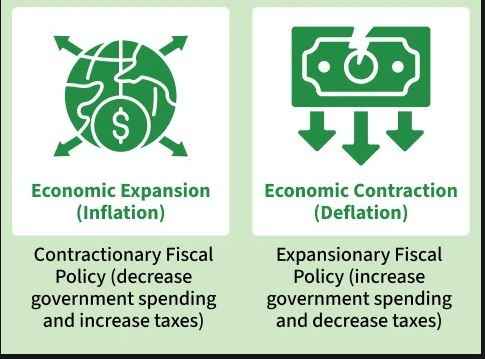
Fiscal policy is deployed in two main forms, depending on the state of the economy and the policy objective (i.e., whether the economy is facing a recession or inflation).
Expansionary Fiscal Policy
Expansionary fiscal policy is used during recession or deficient demand. Its main objective is to increase Aggregate Demand (AD) and create employment. Under this policy, the government increases public expenditure and reduces taxes. Higher government spending and lower taxes increase income, consumption, and investment, which help boost economic activity.
Contractionary Fiscal Policy
Contractionary fiscal policy is used during inflation or excess demand. Its main objective is to reduce Aggregate Demand (AD) and control rising prices. Under this policy, the government reduces public expenditure and increases taxes. This decreases disposable income and overall spending, helping to maintain economic stability.
Objectives of Fiscal Policy
1. Economic Growth: The government increases public expenditure on infrastructure, industries, education, and health to promote economic growth.
2. Price Stability: Fiscal policy helps control inflation and deflation by adjusting taxes and government spending.
3. Full Employment: The government creates job opportunities through public works and development projects.
4. Reduction of Income Inequality: Progressive taxation and welfare programs help reduce the gap between rich and poor.
5. Balanced Regional Development: The government provides special assistance to backward regions for balanced growth.
6. Economic Stability: Fiscal policy helps maintain stability during economic fluctuations .
Components of Fiscal Policy
Fiscal policy operates through the two main components of the government's budget: Government Revenue and Government Expenditure.
Government Revenue
This component includes all the funds the government collects, which influences the resources available for spending and the disposable income of the public.
Tax Revenue: This is the primary source, generated through taxes levied on income and wealth (Direct Taxes like Income Tax) and on goods and services (Indirect Taxes like GST). The level of taxation is a crucial policy tool used to manage Aggregate Demand.
Non-Tax Revenue: This includes income earned from sources other than taxes, such as fees, fines, profits from public sector undertakings, and interest receipts.
Government Expenditure
This refers to the government's total spending, which is a direct and powerful component of Aggregate Demand ($AD$). Expenditure is classified based on its impact on assets and liabilities:
Revenue Expenditure: This involves spending that does not create assets, such as salaries, pensions, subsidies, and interest payments. This spending primarily covers the government's day-to-day consumption needs.
Capital Expenditure: This includes spending that either creates physical or financial assets (e.g., investment in infrastructure like roads and hospitals) or reduces liabilities. This type of expenditure is vital for boosting the economy's long-term productive capacity.
Fiscal Policy to correct Excess Demand

When there is Excess Demand in an economy, a fiscal policy is formed with the aim of reducing the level of Aggregate Demand with the help of the following measures:
Expenditure Policy (Decrease in Government Spending): Government invests a significant amount of money in developing things like highways, flyovers, buildings, railway lines, etc. A change in such spending has a direct impact on the amount of aggregate demand in the economy and helps in the management of excess and deficient demand conditions. Government spending should be as low as possible in order to manage the condition of excessive demand. Greater attention should be placed on reducing defence and unproductive expenditures, as these rarely contribute to a country's growth. Reduced government spending serves to lessen inflationary pressures in the economy by lowering the level of aggregate demand.
Revenue Policy (Increase in Taxes): The government charges many types of direct and indirect taxes on the general public. Government Tax changes have a direct impact on the level of total demand and help in balancing excess and deficient demand in the economy. Government raises tax rates and even imposes some additional taxes during periods of excess demand. It results in a decline in total economic spending and helps in managing the condition of excessive demand.
Increase in Public Borrowings: The government borrows money in the form of public deposits from the public. It borrows money (public deposits) in order to withdraw the excess money held by the public during periods of excess demand. It helps in a reduction in the money supply of the economy, which as a result reduces the aggregate demand.
Decrease in Deficit Financing: Deficit Financing means printing currency. It increases the money supply in the economy. Therefore, during periods of excess demand, the government avoids deficit financing to prevent an increase in the money supply and hence, aggregate demand.
Fiscal Policy to correct Deficient Demand

When there is Deficient Demand in an economy, a fiscal policy is formed with the aim of increasing the level of Aggregate Demand with the help of the following measures:
Expenditure Policy (Increase in Government Spending): Government invests a significant amount of money in developing things like highways, flyovers, buildings, railway lines, etc. A change in such spending has a direct impact on the amount of aggregate demand in the economy and helps in the management of excess and deficient demand conditions. Government spending on public works should be increased as much as possible in order to manage the condition of deficient demand. This will enhance aggregate demand and help to correct the issue of deficient demand.
Revenue Policy (Decrease in Taxes): The government charges many types of direct and indirect taxes on the general public. Government tax changes have a direct impact on the level of total demand and help in balancing excess and deficient demand in the economy. In case of deficient demand, Government decreases tax rates and even eliminates some taxes. It increases the purchasing power of people, making them capable of spending more on consumption and investment because of an increase in their disposable income. It increases overall demand and helps in managing the condition of deficient demand.
Decrease in Public Borrowings: The government borrows money in the form of public deposits from the public. During the period of deficient demand, the government reduces public borrowings to increase the purchasing power of the people. It helps in increasing the money supply of the economy, which as a result increases the aggregate demand.
Increase in Deficit Financing: Deficit Financing means printing currency. It increases the money supply in the economy. Therefore, during periods of deficient demand, the government increases deficit financing to increase the expenditure level or money supply in the economy, which ultimately increases the aggregate demand.
Limitations of Fiscal Policy
Fiscal policy is an important tool for regulating aggregate demand, but it also has several limitations that reduce its effectiveness. These limitations arise due to administrative delays, political pressures, and structural issues in the economy. Because of these constraints, fiscal measures may not always produce immediate or accurate results in controlling excess or deficient demand.
Time Lags: Fiscal policy suffers from recognition lag, decision lag, and implementation lag. It takes time to identify the economic problem, get approval for changes in expenditure or taxation, and finally implement them. By the time the policy takes effect, the economic situation may already have changed.
Political Constraints: Government decisions on taxes and expenditure are influenced by political considerations. Cutting expenditure or increasing taxes may be unpopular, so timely corrective action is often delayed. This reduces the effectiveness of fiscal policy.
Inflexibility in Government Expenditure: A large part of government spending is committed to salaries, pensions, interest payments, and defence. These expenditures cannot be reduced easily in the short run, limiting the government’s ability to control aggregate demand.
Difficulty in Reducing Taxes: Once taxes are lowered during deficient demand, it becomes politically difficult to raise them again when needed. This restricts the use of taxation as a flexible tool of fiscal policy.
Crowding Out Effect: Excessive public borrowing may reduce the availability of funds for private investment. Higher government borrowing increases interest rates, discouraging private sector investment and reducing the effectiveness of expansionary fiscal policy.
Inflationary Impact of Deficit Financing: When the government uses deficit financing to increase spending, it raises the money supply. If used frequently, it can lead to inflationary pressures, defeating the objective of stabilizing the economy.
Problem of Accurate Measurement: It is difficult to measure the exact amount of excess or deficient demand in the economy. If the government estimates incorrectly, fiscal policy may worsen the situation instead of correcting it.
Fiscal Policy vs Monetary Policy
| Basis of Difference | Fiscal Policy | Monetary Policy |
|---|---|---|
| Meaning | Use of government expenditure, taxation, borrowing and deficit financing to influence Aggregate Demand. | Regulation of money supply, credit and interest rates by the RBI. |
| Implemented By | Government (Ministry of Finance). | Reserve Bank of India (RBI). |
| Main Instruments | Government spending, taxes, public borrowing, deficit financing. | Repo rate, reverse repo rate, bank rate, CRR, SLR, open market operations. |
| Objective | Increase or decrease Aggregate Demand, ensure growth, reduce unemployment, stabilize the economy. | Control inflation, maintain price stability, regulate credit and money supply. |
| Time Lag | Longer time lag due to political process and implementation delays. | Shorter time lag because RBI decisions are quick to enforce. |
| Flexibility | Less flexible because expenditure and tax structure cannot be changed frequently. | More flexible as RBI can change interest rates and liquidity any time. |
| Impact on Economy | Direct impact on level of output, income and employment. | Indirect impact through changes in interest rates and credit availability. |
| Focus Area | Focuses on government budget and public spending. | Focuses on money market and banking system. |