
Monetary Policy refers to the central bank’s conscious regulation of the money supply, credit availability, and interest rates in the economy. In India, this responsibility lies with the Reserve Bank of India, which uses monetary policy to influence the overall level of economic activity. Since changes in money supply affect borrowing costs, investment levels, consumption, and liquidity conditions, monetary policy becomes an important tool for achieving macroeconomic stability. The policy aims to balance economic growth with price stability and ensure a smooth functioning of the financial system. Through periodic policy reviews, the central bank signals its stance to the economy and adjusts credit and liquidity to maintain stable and sustainable growth.
Types of Monetary Policy
Monetary policy is used in two major forms, depending on whether the economy is facing inflationary pressures or recessionary conditions.
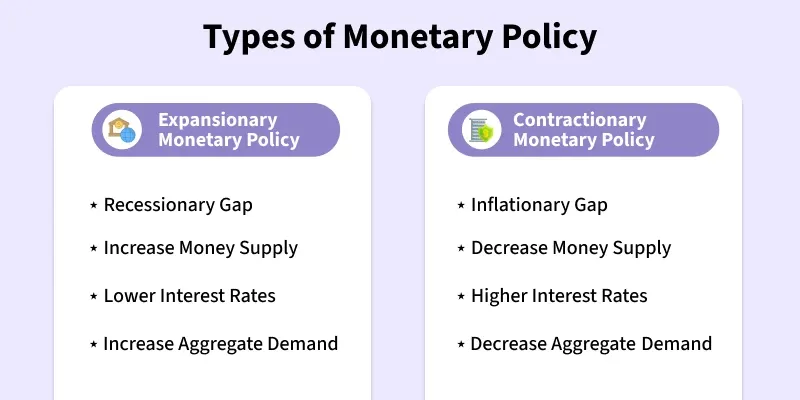
1. Expansionary Monetary Policy
Expansionary policy is adopted when the economy suffers from deficient demand or a recessionary gap. Its main objective is to increase the money supply and reduce interest rates so that households and firms can borrow more easily.
Action: The central bank increases liquidity and encourages credit flow. This is done by reducing policy rates like Repo Rate and Bank Rate, lowering CRR and SLR, and purchasing government securities in the open market. These measures make borrowing cheaper and increase investment and consumption spending, which raises Aggregate Demand.
2. Contractionary Monetary Policy
This policy is used when the economy faces excess demand or an inflationary gap. Its objective is to reduce the money supply and increase interest rates so that borrowing becomes costlier.
Action: The central bank reduces liquidity. It increases policy rates like Repo Rate, raises CRR and SLR, and sells government securities in the open market. These actions restrict credit creation, reduce borrowing and curb excessive consumption and investment. As a result, Aggregate Demand falls and inflationary pressures ease.
Objectives of Monetary Policy
The goals of monetary policy guide the central bank in maintaining economic stability and ensuring a balanced growth environment. These objectives are central to healthy macroeconomic functioning.
To Maintain Price Stability: Price stability is the most important objective. By controlling the money supply and interest rates, monetary policy helps prevent excessive inflation and major deflation. Stable prices create confidence among consumers and investors and ensure smoother economic functioning.
To Control Inflation: By raising interest rates or reducing liquidity, the RBI reduces excessive demand and brings down inflationary pressures. It also uses inflation targeting as a framework to keep price levels within a specified range.
To Promote Economic Growth: Monetary policy supports growth by ensuring adequate credit availability. When economic activity slows down, the central bank reduces interest rates and increases money supply to stimulate investment and production.
To Ensure Financial Stability: A stable financial system is necessary for the smooth functioning of markets. Through regulatory measures and supervision, the RBI ensures that banks and financial institutions remain sound and capable of meeting obligations.
To Regulate Credit: Monetary policy controls the quantity and direction of credit in the economy. It ensures that essential sectors like agriculture, small scale industries and exports receive adequate funds.
To Maintain External Stability: By influencing interest rates and foreign capital flows, monetary policy helps maintain stability in the external sector and supports a stable exchange rate environment.
Limitations of Monetary Policy
Monetary policy is an important instrument, but it suffers from certain practical limitations that reduce its effectiveness in controlling economic fluctuations.
Time Lag
The effects of monetary policy take time to spread through the economy. Even after the central bank changes the repo rate or CRR, banks take time to adjust lending rates and borrowers need even more time to change their investment and consumption decisions. This delay reduces the policy's effectiveness in tackling immediate problems like sudden inflation.
Weak Financial System
If the banking system is weak, burdened with bad loans, or unwilling to lend, monetary policy becomes less effective. Even if the central bank reduces interest rates, banks may not pass on the benefit to borrowers which leads to a poor transmission of policy.
Ineffective During Recession
During a recession, reducing interest rates may not boost demand. People avoid borrowing when they are uncertain about the future and firms postpone investment even if loans become cheaper. This situation is often referred to as the liquidity trap.
Dependence on Fiscal Discipline
Monetary policy cannot work effectively when the government is running large fiscal deficits. Excessive government borrowing can keep interest rates high and weaken the impact of the central bank's changes in policy rates.
Cannot Solve Supply Side Problems
Inflation caused by shortages of food, fuel, or raw materials cannot be controlled through interest rate changes. These problems require structural measures, not monetary tightening.
External Influences
Global economic conditions, foreign capital flows, and exchange rate movements can reduce the effectiveness of monetary policy. For example, rising US interest rates can force the domestic central bank to raise rates even if the internal economy is weak.
Monetary Policy vs Fiscal Policy
| Fiscal Policy | Monetary Policy |
|---|---|
| Use of government expenditure, taxation, borrowing and deficit financing to influence Aggregate Demand | Regulation of money supply, credit and interest rates by the RBI |
| Government (Ministry of Finance) | Reserve Bank of India |
| Government expenditure, taxes, public borrowing, deficit financing | Repo Rate, Reverse Repo Rate, Bank Rate, CRR, SLR, Open Market Operations |
| Adjust Aggregate Demand, promote growth, reduce unemployment, ensure stability | Control inflation, maintain price stability, regulate credit |
| Long recognition, decision and implementation lag | Shorter lag as RBI decisions are quickly enforced |
| Less flexible because expenditure and taxation cannot be changed frequently | More flexible because policy rates can be changed any time |
| Direct impact on income, output and employment | Indirect impact through interest rates and credit flow |
| Government budget and fiscal operations | Money market and banking system |