
Ontologies in Artificial Intelligence (AI) are used to represent knowledge in a structured way. They define concepts, properties, and relationships within a domain, helping AI systems understand how different pieces of information are connected. Ontologies also provide a shared understanding of data, improving communication and reasoning across systems.
- Organize domain knowledge in a structured form
- Help AI systems perform reasoning and decision-making
- Support knowledge sharing and interoperability between applications
Key Components
- Classes: They represent categories or groups of similar objects or concepts.
- Instances: These are specific examples of a class.
- Properties: It describes the characteristics or attributes of classes and instances.
- Relationships: Define how different classes or entities are connected.
- Constraints and Rules: Constraints define conditions or restrictions within the ontology.
Working
Ontologies work by organizing knowledge in a hierarchical structure, starting from general concepts and gradually moving to more specific ones. AI systems use this structure to understand relationships between entities and interpret information in a meaningful way.
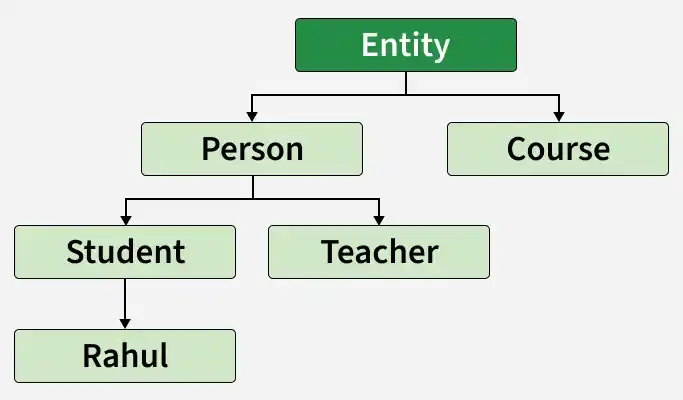
For example, in a university ontology:
- Ontologies start with a general concept called Entity
- This is divided into broader categories like Person and Course
- These categories are further broken into specific concepts like Student, Teacher, and AI Course
- Real-world examples like Rahul are stored as instances
- Relationships (such as “Student enrolls in Course”) connect different concepts
Applications
- Semantic Web: Help machines understand and connect web data meaningfully.
- Natural Language Processing (NLP): Improve language understanding and context interpretation.
- Search Engines: Enhance search accuracy by identifying relationships between concepts.
- Healthcare Systems: Represent medical knowledge such as diseases, symptoms, and treatments.
- Knowledge Graphs: Organize connected information for intelligent recommendations and reasoning.
Advantages
- Provide a structured representation of knowledge
- Improve data sharing between systems
- Support reusability of domain knowledge
- Help AI systems perform better reasoning
- Maintain consistency across applications
Limitations
- Developing ontologies can be time-consuming
- Large ontologies may become difficult to manage
- Updating knowledge regularly can be complex
- Scalability can become an issue in large systems