
Abstract classes and interfaces are used in Java to achieve abstraction and design flexible applications. They define a structure that other classes must follow, helping in code reusability and maintainability. While both serve similar purposes, they differ in implementation and usage.
- Abstract class can have both abstract and normal methods, while interface mainly contains abstract methods.
- A class can extend only one abstract class, but can implement multiple interfaces.
- Abstract class can have constructors and variables, whereas interface contains only constants and no constructors.
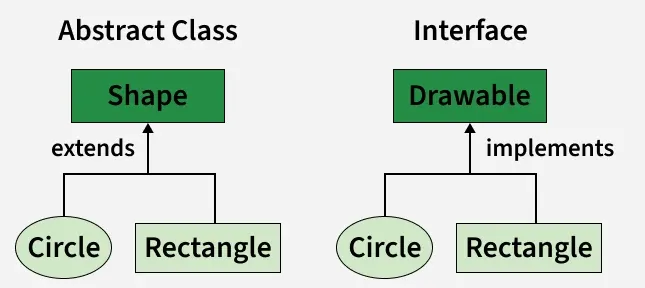
Abstract Class
An abstract class is a class that cannot be instantiated and is used as a base for other classes. It can contain both abstract (unimplemented) and concrete (implemented) methods.
- Supports both abstract and non-abstract methods.
- Allows constructors and instance variables.
abstract class Shape {

    // Abstract method
    abstract double area();

    // Concrete method
    void display() {
        System.out.println("This is a shape");
    }
}

class Circle extends Shape {

    int radius = 5;

    // Implementing abstract method
    @Override
    double area() {
        return 3.14 * radius * radius;
    }
}

public class Main {
    public static void main(String[] args) {

        Shape shape = new Circle();  // Upcasting
        shape.display();
        System.out.println("Area of Circle: " + shape.area());
    }
}
Output
This is a shape
Area of Circle: 78.5
Explanation: Shape is an abstract class with an abstract method area() and a concrete method display(). Circle extends it and implements area(). Using Shape shape = new Circle(); shows upcasting, and calling shape.area() demonstrates runtime polymorphism.
Interface
An interface is a blueprint that defines a set of methods a class must implement. It focuses on behavior rather than implementation.
- All methods are abstract by default (except default/static methods in Java 8+).
- Supports multiple inheritance.
// Interface
interface Drawable {
    void draw();
}

// Implementation class
class Rectangle implements Drawable {
    @Override
    public void draw() {
        System.out.println("Drawing Rectangle");
    }
}

// Main class
public class Main {
    public static void main(String[] args) {
        // Interface reference pointing to implementation object
        Drawable d = new Rectangle();
        d.draw();
    }
}
Output
Drawing Rectangle
Explanation: Drawable is an interface with method draw(). Rectangle implements it and defines the method. Drawable d = new Rectangle(); shows polymorphism, and d.draw() executes the Rectangle method at runtime.
Abstract Class vs Interface
| Feature | Abstract Class | Interface |
|---|---|---|
| Default Method Implementation | Can have any number of fully defined methods | Only default/static methods (Java 8+) |
| Method Access Level | Methods can be private, protected, or public | Methods are public by default (private allowed from Java 9) |
| Variable Initialization | Variables can be initialized or uninitialized | Variables must be initialized at declaration |
| Object Behavior | Can maintain state (instance variables) | Cannot maintain state (only constants) |
| Inheritance Type | Supports single inheritance | Supports multiple inheritance |
| Implementation Keyword | Extended using extends | Implemented using implements |
| Static Methods | Can have static methods | Can have static methods (Java 8+) |
| Final Methods | Can have final methods (cannot be overridden) | Cannot have final methods |
| Main Method | Can have main method | Can also have main method (Java 8+) |
| Design Purpose | For code reuse and base class design | For defining contracts/behaviors |
| Tight vs Loose Coupling | Leads to tighter coupling | Promotes loose coupling |
| When to Use | When classes are closely related | When classes are unrelated but share behavior |
| Method Overriding | Optional (only abstract methods must be overridden) | Mandatory to implement all abstract methods |
| Performance | Slightly better (less abstraction) | Slightly more overhead |
| Keywords Used | abstract, extends | interface, implements |