
Partial orders and lattices are important concepts in discrete mathematics and are widely used in computer science, especially in data structures, database theory, and the theory of computation. A partial order is a binary relation that describes a set of elements that are, in a sense, ordered, but not necessarily linear. A lattice is a particular kind of partially ordered set that has additional properties.
Partial Orders
A partial order is a binary relation ≤ over a set P that satisfies three properties: reflexivity, antisymmetry, and transitivity.
- Reflexivity : For all a ∈ P, a ≤ a.
- Antisymmetry : For all a b ∈ P if a ≤ b and b ≤ a, then a = b.
- Transitivity : For all a, b, c ∈ P, if a ≤ b and b ≤ c, then a ≤ c.
A set P together with a partial order ≤ is called a partially ordered set (poset).
Example of Partial Orders
Consider the set P={1,2,3} with the relation ≤ defined as the usual numerical order:
- Reflexivity: 1 ≤ 1, 2 ≤ 2, 3 ≤ 3.
- Antisymmetry: If a ≤ b and b ≤ a, then a = b.
- Transitivity: If 1 ≤ 2 and 2 ≤ 3, then 1 ≤ 3.
The set P with this order is a partially ordered set (poset).
Lattices
A lattice is a special type of poset in which every pair of elements has:
- A least upper bound (join) : The join of a and b, denoted by a ∨ b is the least element greater than or equal to both a and b.
- A greatest lower bound (meet): The meet of a and b, denoted by a ∧ b, is the greatest element less than or equal to both a and b.
This means you can always find a unique join and meet for any two elements in the set.
Example: The set of integers with the divisibility relation (where a ≤ b if a divides b) is a lattice.
Example of Lattices
Consider the set L = {1,2,3,6} with the divisibility relation:
- Join: The join of 2 and 3 is 6 since 6 is the smallest number that is divisible by both 2 and 3.
- Meet: The meet of 2 and 6 is 2 since 2 is the largest number that divides both 2 and 6.
The set L with this order is a lattice.
| Concept | Key Properties | Example |
|---|---|---|
| Partial Order | Reflexive, antisymmetric, transitive | Subset relation on sets |
| Lattice | Partial order + each pair has join and meet | Power set ordered by inclusion |
The concept of lattice and poset are explained in detail with the help of example below :
This is a Hasse diagram of a lattice, a type of partially ordered set (poset) where every pair of elements has a least upper bound (join) and a greatest lower bound (meet).
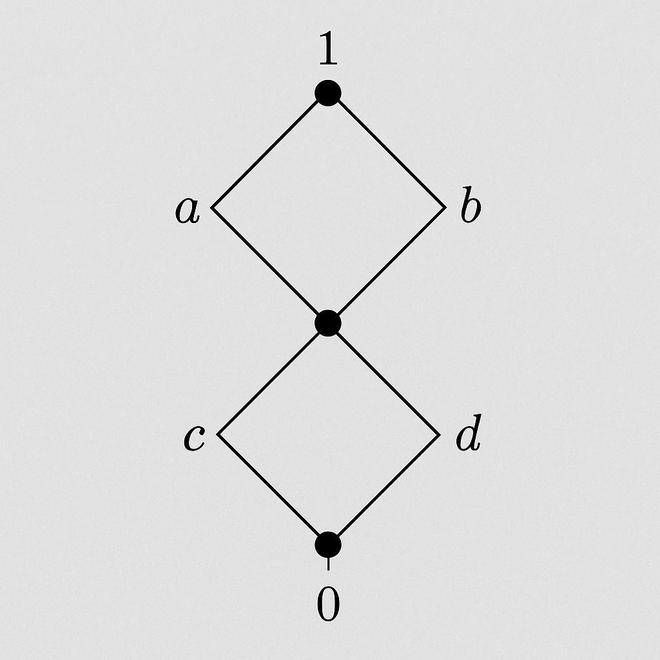
Elements
- The nodes labeled
0,c,d, middle point,a,b, and1represent elements in the poset. - The bottom element (
0) is the least element everything else is above it. - The top element (
1) is the greatest element it is above all others.
Explaination
- An upward path from one node to another means the lower one is less than or equal to the higher one (according to the partial order).
- For example:
canddare both above0, so0 ≤ cand0 ≤ d.- The middle node (unlabeled in the diagram but representing the join of
canddor meet ofaandb) is above bothcanddand below bothaandb. 1is aboveaandb, soa ≤ 1andb ≤ 1.
Meet and Join Examples
- Join (least upper bound) of
canddis the middle node. - Meet (greatest lower bound) of
aandbis the same middle node.
This structure shows how any two elements (e.g., c and d, or a and b) have both a meet and a join, which is what makes the set a lattice.
Applications in Engineering
Task Scheduling
- Partial orders are used to model dependencies among tasks.
- Tasks that must occur in a specific sequence are represented as partially ordered sets, enabling efficient scheduling and parallel execution.
Data Structures
- Lattices play a role in the design and optimization of data structures such as:
- They help maintain order and support efficient data retrieval and insertion.
Database Theory
- Partial orders and lattices are foundational in:
- Query optimization determining the most efficient way to execute a query.
- Schema design modeling hierarchies and constraints within relational databases.
Formal Verification
- Used in formal methods to ensure system correctness.
- Especially useful in concurrent systems, where events may not have a total order.
- Partial orders represent event causality and enable reasoning about different execution paths.
Network Design
- Communication networks benefit from partial order and lattice theory for:
- Routing optimization
- Dependency analysis
- Resource allocation
For more examples and understanding you can refer to the articles Partial Order Relation on a Set , Discrete Mathematics | Hasse Diagrams