
Predicates and Quantifiers are used in mathematical logic and are essential for expressing statements and reasoning about the properties of objects within a domain. These concepts are widely used in computer science, engineering, and mathematics to formulate precise and logical statements.
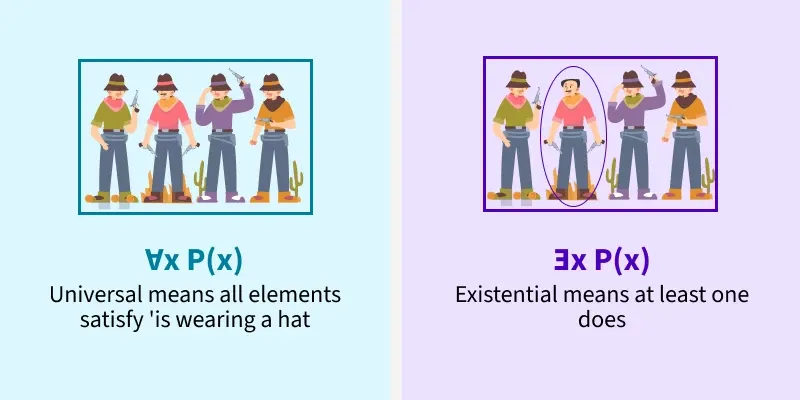
Predicates
A predicate is a statement that contains variables and becomes a proposition when specific values are substituted for those variables. Predicates express properties or relations among objects.
Example: P(x) = "x is an even number"
- When x = 2, P(2) is True.
- When x = 3, P(3) is False.
Quantifiers
Quantifiers are used in logic to show how much a statement is true for a set of things. They show whether something is true for all members of the group, or only for some of them.
The two main types are:
1. Universal Quantifier
The universal quantifier (∀) indicates that a predicate is true for all elements in a given domain.
Example: ∀ x ∈N, P(x)
Translation: "For all natural numbers xxx, xxx is even."
2. Existential Quantifier
The existential quantifier (∃) indicates that there exists at least one element in a given domain for which the predicate is true.
Example: ∃x∈N, P(x)
Translation: "There exists a natural number x such that x is even."
Common Quantifier Meanings
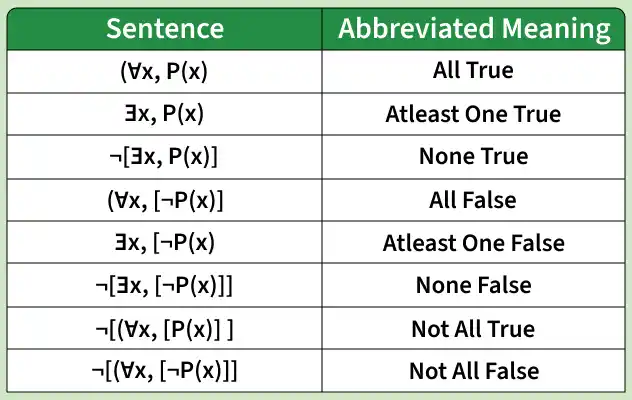
The table below shows common quantifier statements and their simplified meanings such as “all true,” “at least one true,” and “none true.” It helps in understanding how logical statements are interpreted in predicate logic.
Predicates vs Quantifiers
This table shows the key differences between predicates and quantifiers in logic.
| Predicate | Quantifier |
|---|---|
| A statement containing variables | A symbol indicating the scope of the predicate |
| Describes a property or relation | Specifies the extent to which the predicate is true |
| P(x): "x is an even number." | ∀: "For all" or ∃: "There exists" |
| No specific symbol | ∀ (Universal), ∃ (Existential) |
| Used to form logical statements | Used to quantify logical statements |
| Alone or with quantifiers | Always used with predicates |
| P(x), Q(x, y) | ∀x, ∃y |
| P(x): "x is an even number." | ∀ x ∈N ,P(x) : "For all x in natural numbers, x is even." |
| Describes properties of individual elements | Extends predicates over a range of elements |
Applications in Computer Science
Predicates and Quantifiers are used in Computer Science:
• Program Verification: Used to prove that a program works correctly for all possible inputs and satisfies its specifications.
• Databases & Query Languages: Predicates are used in conditions (WHERE clause), while quantifiers like EXISTS and ALL help filter and retrieve data logically.
• Artificial Intelligence (AI): Helps represent facts, rules, and relationships in knowledge-based systems for logical reasoning and decision-making.
• Algorithms and Data Structures: Used to define preconditions, postconditions, and constraints to ensure algorithm correctness and efficiency.
• Compiler Design and Static Analysis: Compilers use predicates to detect syntax errors, type mismatches, and rule violations before program execution.
Solved Questions
Question 1: Let P(x) be the predicate "x > 5" where x is a real number.
Solution:
P(7) is true because 7 > 5
P(3) is false because 3 is not > 5
Question 2: Let Q(x, y) be the predicate "x + y = 10" where x and y are integers.
Solution:
- Q(3, 7) is true because 3 + 7 = 10
- Q(4, 5) is false because 4 + 5 ≠ 10
Question 3: Let R(x) be the predicate "x² ≥ 0" where x is a real number.
Solution:
The statement ∀x R(x) is true because for all real numbers, their square is always non-negative.
Question 4: Let S(x) be the predicate "x² = 4" where x is a real number.
Solution:
The statement ∃x S(x) is true because there exist real numbers (2 and -2) whose square is 4.
Question 5: Let Q(x) be “x + 3 = 5x + 3 = 5x + 3 = 5” where x is an integer.
Write the truth value of:
a) ∀x∈
b) ∃x∈
Solution:
Q(x):x+3 = 5 , x∈
\mathbb{Z}
a) ∀x∈\mathbb{Z} Q(x) — False.
Reason: only x=2 satisfies it, not every integer.
b) ∃x∈\mathbb{Z} — True.
Reason: x = 2 is an integer solution
Question 6: Let Q(x) be the predicate "x is prime" where x is a positive integer.
Solution:
The statement ∀x Q(x) is false because not all positive integers are prime.
The statement ∃x Q(x) is true because there exist prime numbers (e.g., 2, 3, 5, 7, etc.).
Question 7: Let R(x,y) be the predicate "x < y" where x and y are real numbers.
Solution:
The statement ∀x ∀y R(x,y) is false because it's not true that every real number is less than every other real number.
The statement ∃x ∃y R(x,y) is true because we can find two real numbers where one is less than the other (e.g., 1 < 2).
Question 8: Let P(x) be the predicate "x is divisible by 3" where x is an integer. Determine the truth value of ∀x P(x) and ∃x P(x).
Solution:
∀x P(x) is false because not all integers are divisible by 3 (e.g., 4 is not divisible by 3).
∃x P(x) is true because there exist integers divisible by 3 (e.g., 0, 3, 6, 9, etc.).
Question 9: Let Q(x,y) be the predicate "x + y > 10" where x and y are real numbers. Determine the truth value of ∀x ∃y Q(x, y).
Solution:
∀x ∃y Q(x,y) is true.
For any real number x, we can always find a y such that x + y > 10.
We can choose y = 11 - x, which will always make x + y > 10 regardless of the value of x.
Question 10: Let R(x) be the predicate "x is a vowel" where x is a letter in the English alphabet. Write the following statement using predicate logic: "There is a vowel in the English alphabet."
Solution:
The statement can be written as: ∃x R(x)
This reads as "There exists an x such that x is a vowel."
Practice Questions
Question 1: Let P(x) be the predicate "x² - 1 = 0" where x is a real number. Determine the truth value of ∃x P(x).
Question 2: Let Q(x,y) be the predicate "x < y" where x and y are integers. What does ∀x ∃y Q(x,y) mean in words?
Question 3: Let R(x) be the predicate "x is even" where x is an integer. Write the statement "All integers are even" using predicate logic.
Question 4: Let S(x) be the predicate "x is a mammal" and T(x) be "x can fly" where x is an animal. How would you express "Some mammals can fly" using predicate logic?
Question 5: Let P(x,y) be the predicate "x is the parent of y" where x and y are people. Express "Everyone has a parent" using predicate logic.
Question 6: Let Q(x) be the predicate "x is prime" where x is a positive integer. What is the negation of ∀x Q(x)?
Question 7: Let R(x,y) be the predicate "x + y = 10" where x and y are integers. Is the statement ∀x ∀y R(x,y) true or false? Explain why.
Question 8: Let S(x) be the predicate "x is a multiple of 5" where x is an integer. Express the statement "There is no integer that is a multiple of 5" using predicate logic.
Question 9: Let T(x,y) be the predicate "x is taller than y" where x and y are people. Express the statement "Nobody is taller than themselves" using predicate logic.