
Dirichlet’s integral is a fundamental improper integral in mathematical analysis named after the mathematician Peter Gustav Lejeune Dirichlet. It typically refers to the improper integral of the sinc function over the positive real axis.
The classical form is :
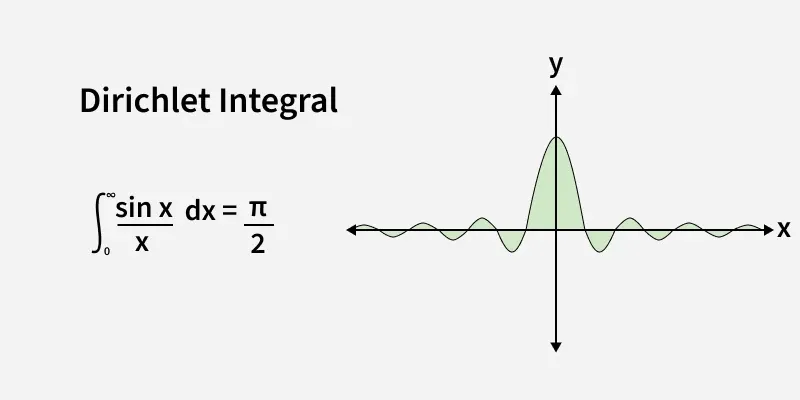
\int_{0}^{\infty} \frac{sin x}{x} \, dx = \frac{\pi}{2}
This integral cannot be expressed in terms of elementary functions and exemplifies a classic case of an improper integral converging conditionally. Dirichlet integrals also apply to multivariable integration in higher dimensions, which utilize Gamma functions.
Dirichlet’s Integral Formula
There are two forms of Dirichlet's formula:
One-Dimensional (Classical) Form:
\int_{0}^{\infty} \frac{sin x}{x} \, dx = \frac{\pi}{2}
Multidimensional Form:
I = \int_V x^{l-1} \, y^{m-1} \, z^{n-1} \, dx \, dy \, dz = \frac{\Gamma(l)*\, \Gamma(m) *\, \Gamma(n)} {\Gamma(l+m+n)}
with region V : x,y,z ≥ 0 ; x+y+z ≤1
where Γ(n) is the Gamma function.
Proof of Dirichlet Integral
The integral to be proved is:
Integration by Residue Theorem :
- Using the residue theorem from complex analysis, for a function f(z) with singularities in the upper half-plane,
\int_{-\infty}^{\infty} f(x) \, dx = 2\pi i \sum \text{Res}[f(z), z_k] + \pi i \sum \text{Res}[f(z), x_k] where zk and xk are singularities in the upper half-plane and real axis respectively.
- For the function eiz, the only singularity is at z = 0. Using residue theorem,
\int_{-\infty}^{\infty} e^{iz} \, dz = 2\pi i \cdot \text{Res}(e^{iz}, 0) = 2\pi i
- Therefore, comparing the imaginary part on both sides
\int_{0}^{\infty} \frac{\sin x}{x} \, dx = \text{Im} \left[ \int_{-\infty}^{+\infty} e^{iz} \, dz \right] = \frac{\pi}{2}
Real-World Applications
- Signal Processing: The sinc function (sinx)/x, integral to Dirichlet’s integral, plays a key role in Fourier transforms and ideal filter design.
- Physics: Problem-solving in wave mechanics and quantum physics where oscillatory integrals appear.
- Statistics & Machine Learning: The n-dimensional Dirichlet integrals form mathematical foundations for the Dirichlet distribution, widely used in Bayesian inference.
- Engineering: Calculation of volumes and distributions in constrained domains, e.g., tetrahedrons.
Properties of Dirichlet's Integral
- Linearity: The integral is linear with respect to the exponents inside the integrand. Scaling a variable’s exponent scales the integral according to the Gamma function’s properties.
- Symmetry: Since the integral is over the region defined by non-negative variables x,y,z whose sum is at most 1, it is symmetric in the variables x,y,z if the corresponding exponents are equal.
- Positivity and Convergence: The integral converges if and only if all exponents (parameters l,m,n) are positive. Negative or zero exponents may cause divergence.
- Scaling Property: If the integration region is scaled by positive constants on each axis, the integral scales by the product of those constants raised to the respective powers.
Solved Examples
Example 1 : Evaluate
Solution :
This is a scaled Dirichlet integral.
\int_{0}^{\infty} \frac{\sin(ax)}{x} \, dx = \frac{\pi}{2} for a = 1For general a:
\int_{0}^{\infty} \frac{\sin(ax)}{x} \, dx = \frac{\pi}{2} if a > 0
Example 2 : Find:
where V : x,y,z > 0 ; x+y+z ≤ 1
Solution:
Compare with standard formula, here l=3,m=2,n=4 :
I = \frac{\Gamma(3)\Gamma(2)\Gamma(4)}{\Gamma(3 + 2 + 4)} = 2! x 1! x 3! / 8!
= 2 x 1 x 6 / 40320
= 12 / 40320
= 1 / 3360
Practice Questions on Dirichlet's Integral
Q 1) Calculate :
Q 2) Solve :
Q 3) Calculate :