
A signed integer is a number that can be either positive or negative. Since computers store data in binary form, special methods are used to represent the sign of an integer.
- Signed integer representations allow computers to store and process both positive and negative numbers.
- The three main methods are Sign Bit, 1's Complement, and 2's Complement representation.
Example: For the decimal number +5, the binary representation is 00000101. For -5, the representation differs depending on whether Sign Bit, 1's Complement, or 2's Complement is used.
Signed Bit Representation
In the signed integer representation method, the following rules are followed:
1. The MSB (Most Significant Bit) represents the sign of the Integer.
2. Magnitude is represented by other bits other than MSB, i.e., (n-1) bits, where n is the number of bits.
3. If the number is positive, MSB is 0; else 1.
4. The range of signed integer representation of an n-bit number is given as –2n-1 - 1 to 2n-1 - 1.
Example:
Let n = 4
Range:
– (24-1 - 1) to 24-1 - 1
- (23- 1) to 23 - 1
- (7) to +7
For 4-bit representation, the minimum value = -7 and the maximum value=+7
Positive Numbers | ||||
|---|---|---|---|---|
| Sign | Magnitude | Decimal Representation | ||
| 0 | 0 | 0 | 0 | +0 |
| 0 | 0 | 0 | 1 | +1 |
| 0 | 0 | 1 | 0 | +2 |
| 0 | 0 | 1 | 1 | +3 |
| 0 | 1 | 0 | 0 | +4 |
| 0 | 1 | 0 | 1 | +5 |
| 0 | 1 | 1 | 0 | +6 |
| 0 | 1 | 1 | 1 | +7 |
Negative Numbers | ||||
| Sign | Magnitude | Decimal Representation | ||
| 1 | 0 | 0 | 0 | -0 |
| 1 | 0 | 0 | 1 | -1 |
| 1 | 0 | 1 | 0 | -2 |
| 1 | 0 | 1 | 1 | -3 |
| 1 | 1 | 0 | 0 | -4 |
| 1 | 1 | 0 | 1 | -5 |
| 1 | 1 | 1 | 0 | -6 |
| 1 | 1 | 1 | 1 | -7 |
Drawbacks
Despite its simplicity, the sign-bit representation has several limitations that make arithmetic operations and number representation less efficient.
- For 0, there are two representations: -0 and +0 which should not be the case as 0 is neither –ve nor +ve.
- Out of 2n bits for representation, we are able to utilize only 2n-1 bits.Out of 2n bits for representation, we are able to utilize only 2n-1 bits.
- Numbers are not in cyclic order i.e. After the largest number (in this, for example, +7) the next number is not the least number (in this, for example, +0).
- For negative numbers signed extension does not work.
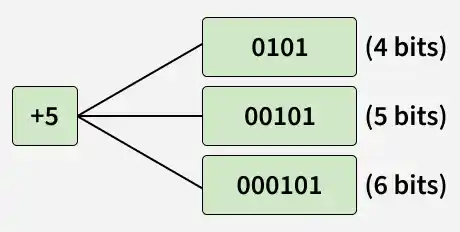
- As we can see above, for +ve representation, if 4 bits are extended to 5 bits there is a need to just append 0 in MSB.
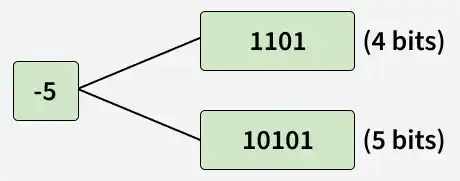
- But if the same is done in –ve representation we won’t get the same number. i.e. 10101 ≠ 11101.
Example:
Signed extension for +5
Signed extension for -5
1’s Complement representation of a signed integer
In 1’s complement representation the following rules are used:
1. For +ve numbers the representation rules are the same as signed integer representation.
2. For –ve numbers, we can follow any one of the two approaches:
- Write the +ve number in binary and take 1’s complement of it.
1’s complement of 0 = 1 and 1’s complement of 1 = 0
Example:
(-5) in 1’s complement:
+5 = 0101
-5 = 1010
- Write Unsigned representation of 2n - 1 - X for –X. Here n represent n-bit system.
Example:
X = -5
for n=4
24-1-5=10
10 in Binary System is written as: 1010(Unsigned)
3. The range of 1’s complement integer representation of n-bit number is given as –(2n-1 - 1) to 2n-1 - 1.
1’s Complement Representation
| Positive Numbers | ||
|---|---|---|
| Sign | Magnitude | Number |
| 0 | 0 0 0 | +0 |
| 0 | 0 0 1 | +1 |
| 0 | 0 1 0 | +2 |
| 0 | 0 1 1 | +3 |
| 0 | 1 0 0 | +4 |
| 0 | 1 0 1 | +5 |
| 0 | 1 1 0 | +6 |
| 0 | 1 1 1 | +7 |
| Negative Numbers | ||
| Sign | Magnitude | Number |
| 1 | 0 0 0 | -7 |
| 1 | 0 0 1 | -6 |
| 1 | 0 1 0 | -5 |
| 1 | 0 1 1 | -4 |
| 1 | 1 0 0 | -3 |
| 1 | 1 0 1 | -2 |
| 1 | 1 1 0 | -1 |
| 1 | 1 1 1 | -0 |
Drawbacks
- For 0, there are two representations: -0 and +0 which should not be the case as 0 is neither –ve nor +ve.
- Out of 2n bits for representation, we are able to utilize only 2n-1 bits.
Merits over Signed bit representation
1. Numbers are in cyclic order i.e. after the largest number (in this, for example, +7) the next number is the least number (in this, for example, -7).
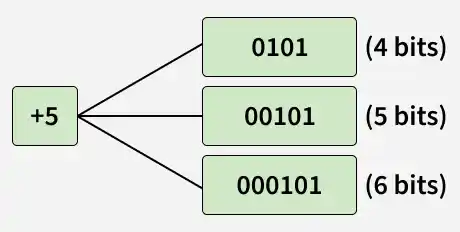
2. For negative number signed extension works.
Example: Signed extension for +5
Signed extension for -5
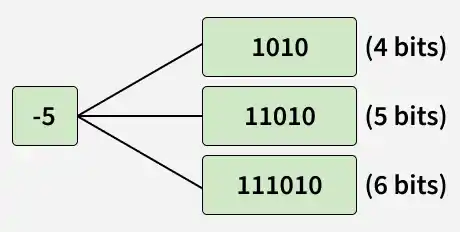
3. As it can be seen above, for +ve as well as -ve representation, if 4 bits are extended to 5 bits there is a need to just append 0/1 respectively in MSB.
2’s Complement representation
2’s Complement is the most commonly used method for representing signed integers in computers. It simplifies arithmetic operations and provides a unique representation for zero.
Rules:
- Positive numbers: Represented in the same way as unsigned binary numbers.
- Negative numbers: Can be represented using either of the following methods:
- Write the unsigned representation of 2ⁿ − X for −X in an n-bit system.
Example: (-5) in 4-bit representation
2⁴ − 5 = 16 − 5 = 11 → 1011
- Write the binary representation of +X, take its 1’s complement, and add 1.
Example: (-5) in 4-bit representation
(+5) = 0101
1’s complement = 1010
Add 1 → 1010 + 1 = 1011
Therefore, (-5) = 1011
3. Range: An n-bit 2’s complement number can represent values from −2ⁿ⁻¹ to 2ⁿ⁻¹ − 1.
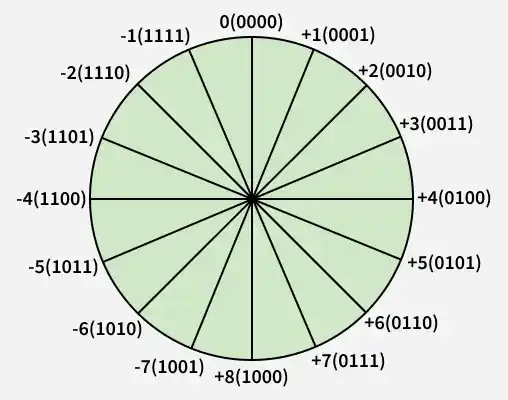
2’s Complement representation (4 bits)
Merits:
- No ambiguity in the representation of 0.
- Numbers are in cyclic order i.e. after +7 comes -8.
- Signed Extension works.
- The range of numbers that can be represented using 2’s complement is very high.
Due to all of the above merits of 2’s complement representation of a signed integer, binary numbers are represented using 2’s complement method instead of signed bit and 1’s complement.