
Analog-to-Digital Converters (ADC) are typically used in all modern-day systems. The main job of the ADC is to convert the analog signal to a digital binary signal. Why digital signal? The reason is that digital data is easy to process, store and transmit. With advancements in CMOS technology, it has been possible to fabricate thousands of logic circuits and gates on a 1mmx1mm chip. Digital binary data, represented by low and high voltage levels at the hardware level, can be used for all kinds of arithmetic operations, using combinatorial circuits, and storage, using sequential circuits. The transmission of digital data lowers the chances of communication errors. This necessitates the need for several types of ADCs, each having some pros and each being a right fit for a particular application.
There are many ADCs: slope-type, counter-type, tracking-type, and flash ADCs. Here we are going to discuss the counter-type ADC.
Counter-Type ADC
The counter-type Analog-to-Digital Converter (ADC) is also known as the digital ramp ADC. It is because the output of the counter is fed to a Digital-to-Analog Converter (DAC), and while the counter increments its count, the output of the DAC increases in ramp fashion or staircase fashion.
The counter-type ADC uses a counter for conversion from analog to digital.
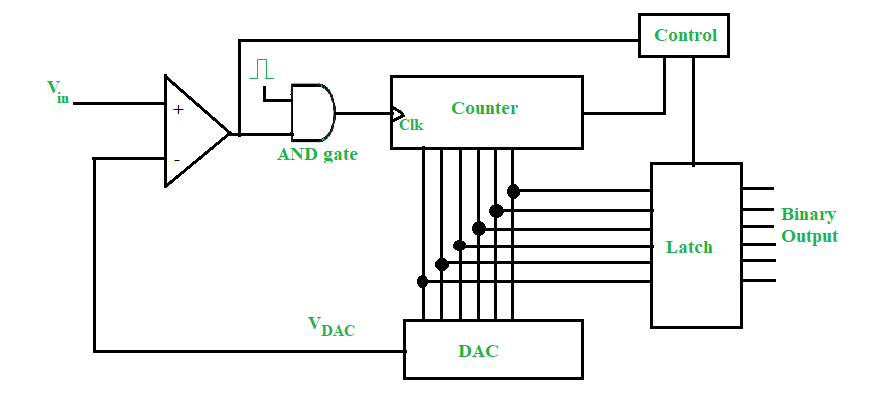
Counter-Type ADC Operation
During the start of the conversion, the output of DAC is zero. So, whatever input voltage Vin is applied at the positive terminal of the comparator, the output of the comparator is high. Since it is high, the AND gate is enabled and it allows the clock pulse to pass. The counter then starts counting the clock pulses. The output of the counter is fed to the DAC, which computes the decimal equivalent of its binary input. Now, the output of the DAC VDAC increases in a staircase fashion and it is continuously compared with the input Vin. As long as Vin > VDAC, the counter keeps counting.
The moment Vin < VDAC, the comparator output is low, and AND gate is disabled, therefore blocking the clock pulses. Also, the control block notices this transition and puts a low signal in the clear pin of the counter, thereby resetting it. Simultaneously, the last output of the counter is latched and this is the digital binary output of the given input voltage.
So, the basic principle of operation of the counter-type ADC is to keep counting the number of clock pulses till the input is greater than the DAC output and the moment DAC output is greater than the input, the counter is reset and the last count is latched and given as output.
Counter-type ADC Conversion Time
Conversion time for any ADC is defined as the time taken by it to convert a given analog input to a digital binary output. It is analogous to the propagation delay we study in digital logic gates.
If the counter has to count from the zeroth state (that is all 0s) and counts up to N, then the conversion time is (N-1)Tc, where Tc is the time period of the clock pulse. Maximum conversion time occurs when the input voltage is equal to the full-scale output range of the DAC. The DAC gives a full-scale output when all bits are one. To reach all ones from all zeroes, the counter takes 2n-1 clock pulses, where n is the number of bits. Hence, maximum conversion time = (2n-1)Tc.
Application of Counter-Type Analog-to-Digital Converter (ADC)
- Measurement and Evaluation of Instrumentation Systems: Utilized in logical and modern instrumentation for exact estimation of actual amounts like temperature, strain, and voltage.
- Calibration: used in calibration systems to make sure that measuring instruments are accurate.
- Systems for Data Acquisition and Signal Conversion: Basic to frameworks that catch and digitize signals from sensors and transducers, changing over them into advanced structure for additional handling.
- Digital Multimeters for Electronics: used to precisely measure electrical parameters like voltage, current, and resistance in digital multimeters.
- Data from Automotive Sensor Systems: used in automotive applications to transform analog signals from various sensors into digital data for onboard computer systems such as temperature and pressure
- Conversion of Telecommunications Signals: Applied in broadcast communications frameworks for changing over simple signs from correspondence channels into advanced design for handling and transmission.
- Modulation/Demodulation: used to accurately convert analog to digital and digital to analog in modems and other communication devices.
- Diagnostic Tools for Medical Equipment: utilized in medical diagnostic equipment for the precise conversion of biological signals into digital data, such as ECG and EEG machines.
- Automation of Control Systems: utilized in industrial automation and control systems where precise process control necessitates high-resolution analog signal measurement
- Accuracy Testing: used to accurately measure and analyze a variety of electrical and physical parameters in test and measurement equipment.
Advantages of Counter-Type ADCs
- High Resolution: The ADCs of the counter type are extremely high resolution, making them perfect for applications where digital representation is required at a high level of detail regarding an analog signal, this high resolution is particularly helpful in precision measuring systems.
- Accuracy: These ADCs help to make accurate analog-to-digital conversions, ensuring that the digital conversion is very close to the real input signal. This accuracy is important for applications such as further data processing or analysis.
- Simple Architecture: Compared to other types of ADCs, such as flash types, counter ADC architectures are relatively simple. This can result in easier design and implementation, especially for systems where top speed is not a serious concern.
- Good Linearity: Counter-type ADCs generally show good linearity properties, meaning the digital output is a linear function of its analog input, this linearity guarantees that the conversion is faithful to the original signal.
- Lower Quantization Error: The high resolution of counter-type ADCs reduces the quantization errors that occur when an analog signal is approximated to the closest digital value.
- Stability: Generally, they perform stably under different operating conditions, resulting in consistent and reliable digital conversion.
Disadvantages of Counter-Type ADCs
- Slow Conversion Speed: One typical drawback of counter-type ADCs is that the conversion speed is relatively slow, as the process has to measure each bit sequentially.
- Increased Complexity with Resolution: As the resolution of the ADC increases, the complexity of the counter circuitry also increases this can lead to longer conversion times and put more pressure on system performance.
- Power Consumption: Higher resolution and longer conversion times can result in higher power consumption, which can become a major issue in low-power or battery-operated systems where energy is a precious resource.
- Susceptibility to Noise: The slow conversion speed of counter-type ADCs can, in some cases, introduce susceptibility to noise and interference during the measurement process.
- Acquisition Times: Relatively slow conversion speeds can cause counter-type ADCs to require more time to acquire a full set of measurements, reducing the efficiency of the data acquisition process.
Conclusion
Counter-type Analog-to-Digital Converters (ADCs) are very critical for the correct conversion of analog signals into digital data. These are some areas where their use is critical: instrumentation, digital signal processing, data acquisition, automotive, and consumer applications. Disadvantages include speed, power, and an increasing necessity of resolution. Understanding such characteristics allows for ADC-type selection for appropriate applications, with good performance and effective behavior.