
Arithmetic circuits are fundamental blocks in digital systems and are used for arithmetic operations such as addition, subtraction, multiplication and division. These circuits constitute the major stream of computation in different applications such as processors, digital signal processing units, and calculators. Arithmetic circuits involve logic gates that deal with binary data which in turn enables it to perform calculations with great precision. In this article, the various categories of arithmetic circuits and how they operate will be discussed as well as their uses.
What is Arithmetic Circuit?
Arithmetic circuits are fundamental blocks in digital systems and are used for arithmetic operations such as addition, subtraction, multiplication and division. Arithmetic circuits can perform seven different arithmetic operations using a single composite circuit.
It uses a full adder (FA) to perform these operations. A multiplexer (MUX) is used to provide different inputs to the circuit in order to obtain different arithmetic operations as outputs.
4-Bit Arithmetic Circuit
Consider the following 4-bit Arithmetic circuit with inputs A and B. It can perform seven different arithmetic operations by varying the inputs of the multiplexer and the carry (C0).
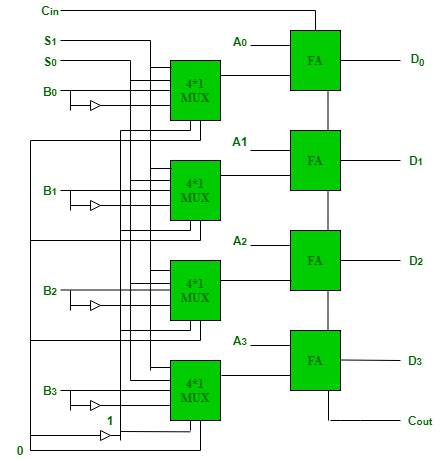
Truth Table for the above Arithmetic Circuit
| S0 | S1 | C0 | MUX Output | Full Adder Output |
|---|---|---|---|---|
0 | 0 | 0 | B | A + B |
0 | 0 | 1 | B | A + B + 1 |
0 | 1 | 0 | B' | A + B' |
0 | 1 | 1 | B' | A + B' + 1 = A - B |
1 | 0 | 0 | 0 | A |
1 | 0 | 1 | 0 | A + 1 |
1 | 1 | 0 | 1 | A - 1 |
1 | 1 | 1 | 1 | A - 1 + 1 = A |
Hence, the different operations for the inputs A and B are -
- A + B (adder)
- A + B + 1
- A + B'
- A - B (subtracter)
- A
- A + 1 (incrementor)
- A - 1 (decremental)
What is Adder Circuit?
Adder circuits are basic arithmetic circuits which are used for binary addition. They come in various types based on their complexity and function. They come in various types based on their complexity and function:
1. Half Adder
A Half adder is the basic type of the adder circuit, which is used in many digital designs. It performs addition of two one-bit binary numbers and generates an output in terms of sum and carry. The half adder consists of two logic gates: an XOR gate for the sum and an AND gate for the carry.
2. Full Adder
A Full adder is an improvement of the half adder since it performs addition of three binary numbers (two inputs and a carry from the previous addition). It produces a sum and a carry; it is made of two half adders and an OR gate for the carry.
3. Ripple Carry Adder
This kind of adder is made up of more than one full adder cascaded together in a serial manner. The carry output of each full adder is passed to the next; the circuit is simple but carries propagation delay makes it relatively slow.
4. Carry Look-Ahead Adder
Due to the delay issue in ripple carry adders, carry look-ahead adders are built in order to produce carry signals at a faster rate due to increased complexity. They enhance the speed of addition to a very large extent and thus are suitable where high speed processors are required.
What is Subtractor Circuit?
Subtractor circuits perform binary subtraction and come in two primary types: Subtractor circuits perform binary subtraction and come in two primary types
1. Half Subtractor
The half subtractor is used to carry out subtraction with two single bit binary numbers. It produces a difference and a borrow. As in the half adder, the difference is produced using an XOR gate while the borrow is produced using an AND gate with an inverted input.
2. Full Subtractor
A full subtractor extends the half subtractor to handle three inputs: Two binary numbers and borrow from the foregoing stage. And it produces both a difference and a borrow and the circuit diagram consists of two half subtractors and an OR gate for the borrow transfer.
What is Multiplier Circuit?
Arithmetic circuits include the multiplier circuits which are used to multiply binary numbers. They can be classified into various types based on complexity and speed. They can be classified into various types based on complexity and speed:
1. Array Multiplier
An array multiplier employs several adders in an array structure to multiply two binary numbers. They are obtained with the help of AND gates and added subsequent to by using adders.
2. Booth Multiplier
Booth’s algorithm is used in multiplication of binary numbers that are positive and also negative values. It minimizes the number of partial products and therefore the multiplication is faster than that of the array multiplier.
3. Wallace Tree Multiplier
It is a kind of multiplier that uses a tree like structure to minimize on the number of adders needed in the computation of the product of two binary numbers. The Wallace tree multiplier is faster than the other array multipliers because the number of carry propagate is minimized.
What is Divider Circuit?
Divider circuits perform binary division, and they come in two types Divider circuits perform binary division, and they come in two types:
1. Restoring Divider
The restoring division algorithm works by subtracting the divisor from the remainder and then taking the remainder and continuing the process until the division process is complete. It is less complex than non-restoring division but takes more time than the latter one.
2. Non-Restoring Divider
The new algorithm outperforms the restoring division method in that there is no need to restore the remainder at each iteration thus making division faster. Non-restoring dividers are suited best for high speed operation.
Arithmetic circuits are circuits that are used in performing arithmetic operations such as addition subtraction multiplication and division.
Advantages of Arithmetic Circuits
- Speed: Arithmetic circuits are capable of doing sophisticated arithmetic operations at very high rates, thus, they are well appropriate for real time use.
- Automation: They are involved in performing arithmetic operations whereby they minimize human error in computations.
- Scalability: Arithmetic circuits are highly expandable, meaning that it is possible to add more components to the existing ones in order to perform arithmetic operations on more significant numbers.
Disadvantages of Arithmetic Circuits
- Complexity: The use of high-performance arithmetic circuits often involves many problems such as carry propagation delay and the like.
- Power Consumption: Some of the advanced arithmetic circuits that operate at very high speeds are known to draw large currents hence large power in large-scale processors.
- Cost: In more complex circuits, it will require more gates and resources, and that will make the manufacturing to be expensive.
Applications of Arithmetic Circuits
- Microprocessors: Arithmetic circuits are very important for the microprocessors since they facilitate the computation in the circuits.
- Digital Signal Processing (DSP): Arithmetic circuits are employed in DSP units for operations such as image and audio processing.
- Calculators: The simplest operations of calculator involve the use of arithmetic circuits and these include addition, subtraction, multiplication as well as division.
- Computer Graphics: In rendering and manipulating of graphical data, arithmetic circuits are very essential.
Conclusion
Arithmetic circuits are essential to today’s computing as it deals with basic arithmetic operations that are essential in a range of digital systems. There are adder-subtractor circuits, multiplier divider circuits and many more; they provide a fast way of processing binary data in various applications.