
Cybersecurity policy has become one of the most critical concerns in today’s digital world. With the rapid rise in cybercrimes, Organizations must take proactive measures to protect their data, systems and networks from both external attacks and internal vulnerabilities.
- A well-defined cybersecurity policy helps ensure better security and risk management.
- Focuses on maintaining the confidentiality, integrity and availability of information.
Importance of Cybersecurity Policy
Cybersecurity policies play a crucial role in protecting organizational assets from evolving cyber threats. They help establish clear security practices and reduce risks associated with human and system vulnerabilities.
- Over 34% of organizations face insider threats annually
- Employees are often the weakest security link
- Remote work and BYOD increase vulnerabilities
- Protect organizational data and Improve incident response
- Ensure legal compliance and Reduce human error
- Common risks include: Clicking malicious links, Weak passwords, Data leaks
Types of Cybersecurity Policies
Cybersecurity policies can be categorized based on different areas of organizational security. Each policy addresses specific risks and defines guidelines to protect systems and data.
- Acceptable Use Policy : Defines how employees can safely use company systems, networks and internet resources. For example blocking access to unsafe or non work related websites.
- Password Policy : Ensures users create strong passwords and follow secure authentication practices.
It often includes rules for password length, complexity, expiration and reuse. For example use multi-factor authentication (MFA) along with strong passwords. - Email Security Policy : Protects organizations from phishing, spam and malware delivered via email.
It defines how to handle suspicious emails and attachments. For example Employees must not open unknown attachments or click suspicious links. - Network Security Policy : Covers the protection of internal networks through firewalls, VPNs and access controls. Includes: Firewall rules, Wi-Fi security and remote access guidelines.
- Incident Response Policy : Outlines how an organization detects, responds to and recovers from cyber incidents. Key Steps: Identify , Contain , Eradicate , Recover , Report
- Patch Management Policy : Ensures all systems and software are regularly updated to fix security vulnerabilities. For example automatic updates for operating systems and applications.
- Data Protection Policy : Focuses on safeguarding sensitive data using encryption, access control and secure storage. Includes: Data classification (public, internal, confidential)
- Remote Work Policy : Addresses cybersecurity risks when employees work from home or remote locations.
It ensures secure use of personal and company devices. For example mandatory VPN usage for remote access. - Cloud Security Policy : Defines how cloud services are securely used and managed. It ensures proper configuration and data protection in cloud environments. Focus Areas: Access control, encryption and cloud monitoring.
- Hardware Disposal Policy : Prevents data leaks when old devices are discarded or reused.
It ensures proper data wiping or destruction before disposal. For example securely erasing hard drives before recycling.
Stakeholders in Cybersecurity Policy Development
Effective cybersecurity policies require collaboration across different departments to ensure technical accuracy, legal compliance and alignment with organizational goals. Each stakeholder contributes a unique perspective to strengthen policy design and implementation.
- IT Teams: Provide technical expertise and implement security controls
- Legal Departments: Ensure compliance with laws and regulations
- HR Teams: Enforce policies through employee guidelines and training
- Management: Define strategy, allocate resources and ensure enforcement
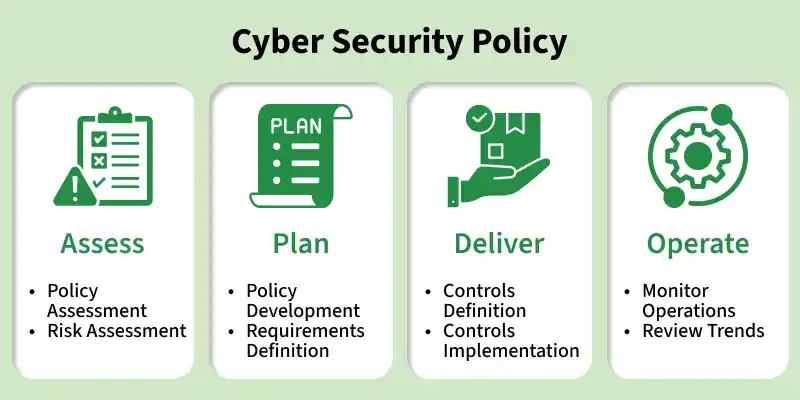
Steps to Create a Cybersecurity Policy
Developing a cybersecurity policy involves a structured approach to identifying risks, defining controls and ensuring compliance with standards.
Identify Threat Surface
- Devices, networks, cloud, users.
- Find weak points in your system.
Develop Policy Plan
- Business goals.
- Industry standards.
- Legal compliance (GDPR, HIPAA, PCI DSS)
Get Employee Feedback
- Ensure clarity.
- Improve usability.
- Increase adoption
Train Employees
- Security awareness training.
- Phishing detection.
- Safe data handling.
Update Regularly
- Review policies.
- Adapt to new threats.
- Continuous improvement.
Real-World Examples
Example 1: Employee Phishing Attack
A company employee clicked on a phishing email link, unknowingly giving attackers access to login credentials.
What went wrong:
- No email security awareness training.
- Weak cybersecurity policy.
Solution : A strong email security policy and employee training could have prevented the breach.
Example 2: Data Breach Due to Weak Passwords
An organization suffered a data breach because employees used weak passwords like “123456”.
What went wrong: No password policy enforcement
Solution:
- Strong password rules
- Multi-factor authentication
Top Cybersecurity Trends
- Agentic AI & "Shadow AI" Governance: As AI agents become autonomous, securing them against manipulation and preventing unmanaged "vibe coding" is critical.
- Rise of "Sovereign AI Clouds": The convergence of AI and cloud security is creating a demand for fully sovereign, regionally controlled AI stacks.
- Evolution of Ransomware: Ransomware has evolved into multi-stage, AI-driven extortion that uses deepfakes and manipulates recovery systems.
- Identity-First Security & Deepfakes: Identity is the primary battleground, with deepfake impersonation and machine identities (non-human accounts) requiring robust, AI-aware verification to prevent synthetic access breaches.
- Post-Quantum Cryptography (PQC) Readiness: Organizations are moving from planning to action, prioritizing cryptographic agility and migrating data to protect against "harvest now, decrypt later" threats.
- Zero Trust Architecture Overcomes VPNs: ZTNA is becoming the standard for remote access to reduce the blast radius of compromised credentials and mitigate lateral movement.