
The Abstract Digital Forensic Model is a widely used framework in digital forensic investigations (Computer Forensics). It provides a structured and systematic approach for handling digital evidence, ensuring that investigations are conducted efficiently and legally.
- This model consists of nine key phases, which guide investigators from identifying evidence to returning it after analysis.
- By following these phases, forensic experts can improve the chances of successfully solving and prosecuting cybercrimes.
Phases of the Abstract Digital Forensic Model
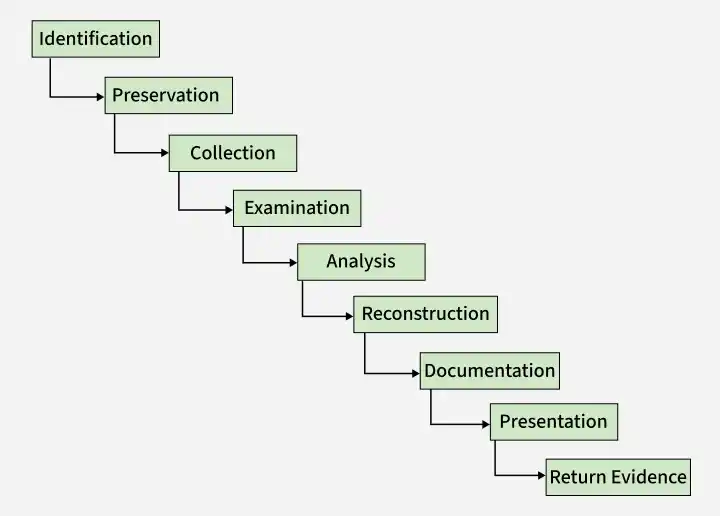
1. Identification
In this phase, potential digital evidence is identified. This may include Computers, Servers, Mobile devices, Cloud storage services. Proper identification ensures that no critical evidence is overlooked.
2. Preservation
The preservation phase focuses on maintaining the integrity and security of evidence. Investigators must ensure that the data remains unaltered and protected from unauthorized access.
3. Collection
During collection, evidence is carefully recorded and duplicated. A forensic copy (image) of the original data is created to prevent any damage to the original evidence.
4. Examination
In this stage, investigators examine the collected data to extract relevant information. They also look for hidden or related clues that may assist in the investigation.
5. Analysis
The analysis phase involves:
- Correlating data
- Recovering deleted or damaged files
- Identifying patterns or suspicious activities
This step helps in drawing meaningful conclusions from the evidence.
6. Reconstruction
Here, investigators reconstruct events based on the available evidence. This may include recreating timelines or simulating the situation in which the incident occurred.
7. Documentation
All findings from previous phases are documented in a structured format. Proper documentation is essential for:
- Legal proceedings
- Case reporting
- Future reference
8. Presentation
In this phase, the investigator presents the findings using Reports, Graphs, Visual aids. The goal is to make the evidence understandable for legal authorities or stakeholders.
9. Returning Evidence
After the investigation is complete, the evidence is returned to its rightful owner, ensuring proper legal procedures are followed.
Need of Abstract Digital Forensic Model
- Ensures a structured investigation process by dividing the procedure into clear phases.
- Helps maintain the integrity and authenticity of digital evidence.
- Provides a systematic approach, reducing errors and confusion during investigations.
- Ensures legal admissibility of evidence in court.
- Improves efficiency and accuracy in analyzing digital data.
- Assists in recovering deleted or hidden information effectively.
- Supports proper documentation and reporting for legal and official purposes.
- Helps investigators reconstruct events and timelines clearly.
- Reduces the risk of evidence contamination or loss.
- Provides a standard guideline for conducting digital forensic investigations.
Real World Examples
Mobile Forensics (Criminal Case)
In a criminal investigation, a suspect’s smartphone is seized to find evidence of communication.
- Identification: The suspect’s mobile phone is identified as key evidence.
- Preservation: The phone is placed in a Faraday bag to block signals.
- Collection: A forensic image of the phone data is created.
- Examination: Messages, call logs and media files are extracted.
- Analysis: Deleted messages and hidden chats are recovered.
- Reconstruction: Investigators recreate conversations and event timelines.
- Documentation: Findings are documented for legal use.
- Presentation: Chat records and timelines are presented in court.
- Returning Evidence: The phone is returned after the case is closed.
Outcome: Critical evidence links the suspect to the crime.
Limitations
- Lack of flexibility: Difficult to adapt to dynamic or complex scenarios.
- Complex results: Findings may be hard to interpret for non-experts.
- Limited scope: Not suitable for all types of digital investigations .
- Technology dependency: Failure of tools or systems can disrupt the process.
- Lack of standardization: Maintaining consistency across investigations can be challenging.