
Generating effective ideas is a critical skill in product design and innovation. Whether you are an entrepreneur, designer, or problem-solver, structured ideation techniques help transform complex challenges into actionable solutions.
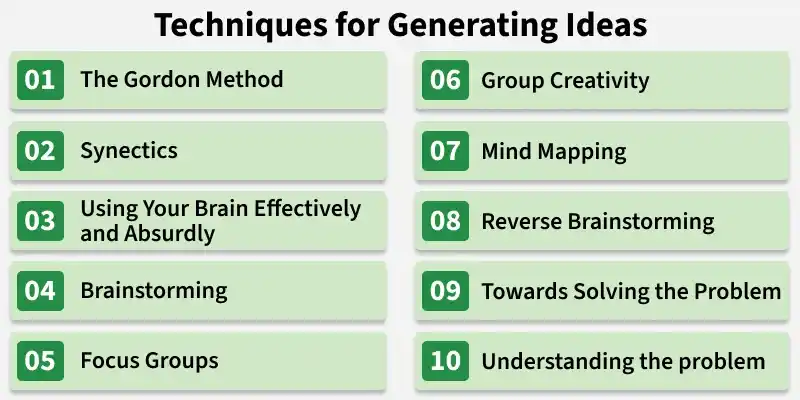
1. Understanding the Problem
It involves a systematic examination and comprehension of the problem the user is trying to solve. Some of the key characteristics of Understanding the problem are:
- Problem Definition: Before trying to solve the problem or even generate an idea, it is necessary to express the problem in the easiest way possible.
- Gathering Information: To understand the given problem, it is necessary to do some research and gather as much information as possible from other sources. This can include market research, data analysis, receiving feedback from customers, conducting surveys, etc.
- Identification of Stakeholders: It is also necessary to find out who will benefit from the solution of the problem, because they can provide some insights about the problem which will help in the idea generation process.
2. Towards Solving the Problem
Once a deep understanding of the problem has been gained, the solver can start to think about it and generate ideas to solve the problem and think about the potential solutions.
- SCAMPER: SCAMPER technique stands for Substitute, Combine, Adapt, Modify, Put to another use, Eliminate, and Reverse is a technique which allows users to view the problem from different angles and apply those aforementioned strategies to generate new ideas.
- Lateral Thinking: Lateral thinking is also another heavily used approach to generate ideas to solve problems. It seeks solution to the problem via indirect approaches.
3. Using Your Brain Effectively and Absurdly
This encourages both rational thinking and the deliberate use of the unconventional concepts to stimulate creativity. It uses the both sides of a human mind, one that thinks rationally and tries to find the solution in a more rational manner, and the other which solely lives in the imaginary world and thinks absurdly.
- Effective Thinking: This aspect of the using our brain effectively involves using the brain logically and efficiently. It solely depends upon the structured thinking and analysis of the problem thoroughly.
- Absurd Thinking: This might sound silly, but sometimes the absurd and imaginary thinking encourages the user to try some out of the box approaches to solve the problem.
- Thinking Visually and Conceptually: Using diagrams and Mind Maps is also helpful to effectively use our brain and generate new techniques to solve the problem.
4. Mind Mapping
Mind Mapping is a graphical and visualising approach used to represent the thoughts, ideas, concepts etc. and organise them in a hierarchical and interconnected manner. The main function is to recreate the process which happens inside human brain while trying to think about any solution of a particular problem. Below are the some of the most important components of a Mind Map:
- Central Idea: This occupies the center of the Mind Map, it represents the main concept or the main issue which is being solved.
- Branches: This are the thin lines that are used to join the key items and themes with the Central Idea in the middle.
- Keywords or Phrases: On each one of the branches (apart from the central idea), certain keywords or phrases are used to represent the main idea or issue of that sub-category or branch.
5. Group Creativity
Group Creativity is also known as collaborative creativity is a phase where a group of individual come together to share their ideas about solving a same problem. Some of the most important points about Group Creativity is mentioned below:
- Diversity of Perspectives: Each group consists of members whose thinking capabilities are different than the others, they can come from different backgrounds, hold different experiences. This diverse atmosphere leads to more creative solutions.
- Brainstorming: Brainstorming is special sessions carried out to encourage the group members to encourage them and boost their creativity to generate more ideas. During this sessions the members are encouraged to share any kind of idea without any judgement or criticism.
- Collaboration: Collaboration and effective communication between the group members are a necessity for nurturing creative thinking.
6. Focus Groups
Focus Groups is a Qualitative research method which mostly involves a small group, but a diverse kind of individuals who freely share their thought and opinions on a specific topic given to them. The discussions of a focus groups are generally mentored by a moderator or facilitator. Some key characteristics of Focus Groups are:
- Size of the Group: Generally the size of Focus Groups are small, it typically consists of only 6-10 individuals. It is kept like this because this is perfect number to get diverse ideas and keeping the encouragement and communication between them.
- Structured Discussion: As a certain moderator or Facilitator is in charge of a Focus Groups, he or she is in control of what should be discussed and what structure it would follow.
- Interactive Discussion: As the number of members are kept small, everyone gets the chance to participate in the discussion and interact with each other, this helps to discuss the ideas between them and rectify the mistakes if any.
7. Brainstorming
The main goal of a brainstorm session is to come up with a solution of the problem or challenge given to them. Some of the characteristics of Brainstorming are:
- Free Thinking: All the members of the group can share their thoughts and ideas freely without facing any criticism. The main goal is to get as many idea as possible.
- Divergent Thinking: It is also a form of Divergent Thinking, it allows the members to think about multiple possible ways to solve the problem.
- Done within a group: Brainstorming sessions are usually conducted in a group. So the idea and the discussion remains secret to that group members only.
8. Reverse Brainstorming
As the name itself suggests, Reverse Brainstorming is a well known problem solving technique which works in exactly opposite manner that of the traditional Brainstorming. Below are some of the key characteristics of Reverse Brainstorming:
- Define the Problem: It starts with defining the problem clearly and precisely, of whose solution we are trying to find.
- Reverse the Goal: Instead to directly finding the solution to the problem, encourage the participants to think how to create the problem or even make it worse. This approach will involve thinking about the actions, behaviour and different factors which will lead to the problem.
- Evaluate and Reverse: After collecting a pool of ideas which causes the problem or make it harder, the participants evaluate those ideas, then starts the actual brainstorming method to find the solution of those problems in the traditional way.
9. Synectics
Synectics is a creative problem-solving approach developed by William J.J Gordon and George M. Prince in 1950s. Synectics is used to establish connections between unrelated concepts/ideas generated during brainstorming sessions. Some of the key characteristics are:
- Use of Analogy and Metaphors: In Synectics, most of the times it relies on the use of different analogies and metaphors to establish connections between unrelated topics. By creating a connection between unrelated topics, new ideas can be generated easily.
- Relaxation and Playfulness: Creation of a Playful and Relax environment is necessary in case of Synectics. Relax environment is helpful to encourage people generate more ideas.
- No Judgement or Criticism: The participants are encouraged to not to judge others after listening to their ideas and not criticise them. This allows the other participants to think more freely without fearing of criticism.
10. The Gordon Method
The Gordon Method is a flexible group-based ideation technique focused on structured creativity aligned with business goals. Some of its key characteristics are:
- Clear Problem Statement: The Gordon Method starts with a clear and concise Problem Statement which needs to be solved.
- Emphasis on Organisational Goal: Gordon Method plays an important role of putting Emphasis on the Organisation's goal and objectives which aligns with Creative Thinking.
- Use of Triggers and Stimuli: The Gordon Method uses various types of Triggers and Stimuli like specific structured questions, scenarios, or various challenges which can provoke creative ideas.