
Authority and power are important concepts in management that help organisations function effectively. Authority is the formal right given by the organisation to make decisions, give instructions, and maintain order, while power is the ability to influence others through personal qualities, expertise, experience, or control over resources. Although related, authority comes from position whereas power may exist even without a formal role. Managers who combine formal authority with personal power are more successful in gaining cooperation, reducing resistance, maintaining discipline, and achieving organisational goals efficiently.
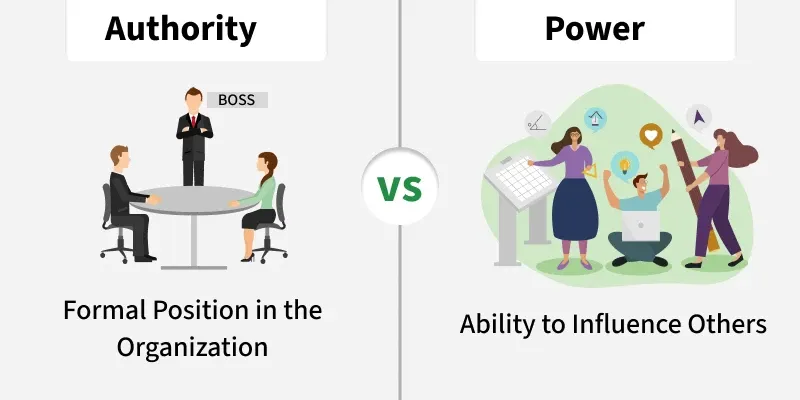
Authority
Authority refers to the legitimate right of a manager to give orders, take decisions, and direct the activities of subordinates in order to achieve organisational objectives. It is derived from the position held by an individual in the organisational hierarchy and is formally granted by the organisation. Authority provides the legal and organisational backing required for a manager to perform assigned duties effectively.
In an organisation, authority enables managers to allocate work, utilise resources, and take corrective action whenever required. It flows from higher levels of management to lower levels and helps in maintaining discipline, coordination, and control. Without authority, managers would be unable to guide employees or ensure that tasks are performed as planned.
Key Characteristics of Authority
- Authority is position based, not person based, and passes to the successor when the position changes.
- It flows downward from top management to lower levels through delegation.
- Authority is limited and defined by organisational rules, policies, and legal provisions.
- Authority must be commensurate with responsibility to ensure effective performance.
Thus, authority forms the foundation of effective management by providing managers with the power necessary to direct, supervise, and coordinate the efforts of employees toward organisational success.
Power
Power refers to the ability of an individual to influence the behaviour, actions, or decisions of others, irrespective of whether the person holds a formal position in the organisation. It represents the capacity to shape attitudes, guide actions, and secure cooperation from others to achieve desired outcomes.
Unlike authority, power is not always formally granted. It may arise from personal qualities such as leadership ability, confidence, or charisma, from specialised knowledge and expertise, or from control over valuable resources and information. An individual may possess power even without occupying a managerial position, and such power can continue even after formal authority ends.
Key Characteristics of Power
- Power may be formal or informal in nature, depending on its source.
- It can exist independently of authority and does not always require an official position.
- Power is dynamic and situational, changing with circumstances, relationships, and context.
- It is based on the ability to influence and gain acceptance rather than on formal rights.
In management, power plays a crucial role in leadership and organisational effectiveness. Managers who use power wisely, along with authority, can motivate employees, build cooperation, and achieve organisational goals more efficiently.
key differences between authority and power:
| Basis | Authority | Power |
|---|---|---|
| Meaning | Authority is the legitimate right to give orders and make decisions. | Power is the ability to influence the behaviour or actions of others. |
| Source | Derived from the organisational position or hierarchy. | Derived from personal qualities, expertise, experience, or control over resources. |
| Nature | Formal and official in nature. | Can be formal or informal. |
| Acceptance | Accepted because it is legally and organisationally sanctioned. | Accepted because of influence, dependence, or personal respect. |
| Permanence | Exists as long as the position is held. | May continue even without holding a formal position. |
Relationship between Authority and Power
Authority and power are closely related concepts that help managers influence employees and achieve organisational goals. Authority is the formal right given by the organisation to make decisions and issue orders, while power is the ability to influence others’ behaviour. Authority is one source of power, but power can also come from expertise, experience, or personal qualities. A manager may have authority without enough power, making it difficult to influence employees, while a person may have power without formal authority, such as an expert or informal leader. Power strengthens authority by increasing cooperation and acceptance. Therefore, effective management requires a balance of both authority and power to maintain discipline, motivate employees, and achieve organisational objectives successfully.
Conclusion
Authority and power are essential for effective organisational functioning. Authority is the formal right given to managers to make decisions, give orders, and direct employees, while power is the ability to influence others through expertise, personal qualities, or control over resources. Authority is based on position in the organisational hierarchy, whereas power may exist even without formal authority. Managers who combine authority with personal power can gain employee cooperation, maintain discipline, resolve conflicts, and achieve organisational goals more effectively and efficiently.