
Authority refers to the legitimate right of a manager to make decisions, give orders, and expect obedience from subordinates in order to achieve organisational objectives. It is derived from the position held by an individual in the organisational hierarchy and enables managers to direct and regulate the activities of employees.
Authority provides the power to allocate tasks, utilise resources, and take corrective action when required. It flows from higher levels of management to lower levels and helps in maintaining discipline and coordination within the organisation. Without authority, a manager cannot effectively perform managerial functions.
Authority is always linked with responsibility. When a manager is assigned a responsibility, adequate authority must be granted to fulfil that responsibility efficiently, while accountability ensures answerability for results. This relationship highlights the interdependence of authority, responsibility, and accountability in effective management.
Authority, Responsibility, and Accountability
Authority, responsibility, and accountability are closely related concepts that together form the foundation of effective management. These three elements are interdependent, and a proper balance among them ensures smooth functioning, coordination, and achievement of organisational goals.
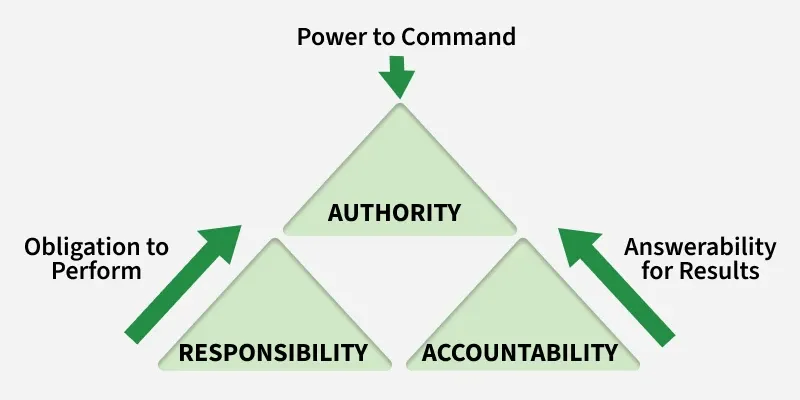
Authority: Authority is the legitimate right of a manager to give orders, take decisions, and direct the work of subordinates. It enables managers to allocate tasks, utilise organisational resources, and maintain discipline. Authority flows from higher levels of management to lower levels and provides the power necessary to carry out assigned duties effectively.
Responsibility: Responsibility refers to the obligation of an individual to perform assigned tasks and duties. It arises when authority is delegated and creates a duty to complete the work efficiently. Responsibility cannot be delegated, and even after delegating tasks, a manager remains responsible for the final outcome.
Accountability: Accountability means being answerable for the performance and results of assigned responsibilities. It ensures that individuals justify their actions and decisions to higher authorities. Accountability cannot be delegated and always flows upward in the organisational hierarchy.
Note:
"A proper balance among authority, responsibility, and accountability is essential for effective management. Authority should be commensurate with responsibility, and accountability should clearly follow responsibility. Maintaining this balance prevents misuse of power, reduces confusion, and ensures effective organisational control and performance."
Features of Authority
- Legitimate Right – Authority is the official right of a manager to give orders and make decisions.
- Position-Based – It arises from the position a person holds in the organisation, not from personal qualities.
- Flows Downward – Authority moves from higher levels of management to lower levels in the organisational hierarchy.
- Decision-Making Power – It enables managers to take decisions and direct the work of subordinates.
- Ensures Discipline and Coordination – Authority helps maintain order, coordination, and smooth functioning in the organisation.
- Linked with Responsibility – Responsibility and authority go together; managers need adequate authority to fulfil their responsibilities.
- Accountability Cannot Be Delegated – Even after delegating authority, the manager remains accountable for the final results
Sources of Authority
Authority can originate from various sources, depending on the context and domain these are some common sources of authority:
.webp)
Legal Authority: Legal authority arises from laws, rules, and regulations established by a governing system. Individuals or institutions derive this authority through official positions defined by the legal framework. Judges, police officers, and government officials exercise authority because the law empowers them to do so, and compliance is mandatory.
Traditional Authority: Traditional authority is based on long standing customs, beliefs, and cultural practices. It exists because people accept it as part of their social heritage. This form of authority is commonly seen in monarchies, tribal systems, and family hierarchies, where leadership is inherited or passed down through generations.
Charismatic Authority: Charismatic authority originates from the personal qualities of an individual such as charm, confidence, vision, or inspirational ability. Followers obey such leaders due to emotional attachment and admiration rather than formal rules. This authority may decline if the leader loses influence.
Expert Authority: Expert authority is derived from specialised knowledge, skills, or professional competence. People willingly follow experts like doctors, engineers, scientists, or teachers because of their recognised expertise and sound judgment.
Moral Authority: Moral authority is based on ethical values, integrity, and a strong sense of right and wrong. Individuals exercising moral authority influence others through principles and moral conduct rather than formal power.
Positional Authority: Positional authority comes from the formal position or rank held by an individual within an organisation. Managers and supervisors exercise authority because their job roles grant them the right to make decisions and issue instructions.
Collective Authority: Collective authority arises from group consensus and shared decision making. It is common in democratic systems and committees where authority is exercised jointly to ensure participation and balanced decisions.
Scope of Authority
The scope of authority refers to the limits within which a manager can exercise power and make decisions. Authority is not absolute and is restricted by several important factors that define its effective use.
Legal Constraints: Authority operates within the framework of laws and regulations. Managers must exercise authority in compliance with legal provisions. Any action taken beyond legal limits is invalid and can lead to penalties, thereby affecting the legitimacy of authority.
Organisational Limitations: Within an organisation, authority is defined by the organisational structure, job roles, and policies. Hierarchical relationships and formal procedures determine the extent of authority at each level. Managers must operate within these prescribed boundaries to maintain discipline and order.
Social Constraints: Authority is influenced by social norms, values, and ethical standards. For authority to be effective, it must be accepted by employees and society. Actions that violate social expectations may face resistance and reduce the effectiveness of authority.
Economic Constraints: Economic factors such as budgetary limits and availability of resources restrict the exercise of authority. Managers must consider financial feasibility before making decisions or initiating actions. Resource constraints often determine the scope of managerial authority.
Types of Authority
Authority in management can be divided into different types based on how power is used in an organisation.
1. Line Authority: These is the direct authority a manager has over subordinates. It allows managers to give orders and make decisions.
Example:
A production manager directing factory workers.
2. Staff Authority: The authority to advise and support line managers. Staff managers do not usually give direct orders to workers.
Example:
The HR department advising managers on employee matters.
3. Functional Authority: Functional authority is the right given to a specialist to control certain activities in other departments related to their expertise.
Example:
A safety officer enforcing safety rules in all departments.
4. Formal Authority: Formal authority comes from a person’s position in the organisation. It is officially granted by the organisation.
Example:
A school principal managing teachers and staff.
5. Informal Authority: Informal authority comes from a person’s knowledge, experience, personality, or leadership qualities rather than position.
Example:
An experienced employee whom others respect and follow.
Limitations of Authority
Authority is an important element of management, but it is not absolute. Its effectiveness is restricted by several factors that limit how far it can be exercised within an organisation.
Dependence on Acceptance: Authority becomes meaningful only when subordinates accept it. Even if a manager holds a formal position, authority will not be effective unless employees recognise and willingly follow instructions. Lack of acceptance leads to resistance and weakens managerial control.
Inability to Ensure Willingness and Commitment: Authority can enforce compliance but cannot create willingness, loyalty, or enthusiasm among employees. True commitment comes from motivation, leadership, and positive work relationships. Therefore, authority alone is insufficient for achieving high levels of performance.
Limitations Due to Human Behaviour: Human factors such as emotions, attitudes, beliefs, and personal values influence how authority is perceived and exercised. Employees may react differently to the same authority, which can result in misunderstanding or conflict. These behavioural factors restrict the effective use of authority.
Legal and Organisational Boundaries: Authority is constrained by legal provisions and organisational rules, policies, and procedures. Managers must act within these established limits and cannot exercise authority arbitrarily. Violating these boundaries can lead to legal action and loss of credibility.