
Respiration is an essential biological activity in which the exchange of gases between an organism and its surroundings occurs, producing the energy needed for cellular functions. Respiration is crucial for an organism's existence because it supplies the energy needed for various physiological activities, including cellular structure development, repair, and maintenance.
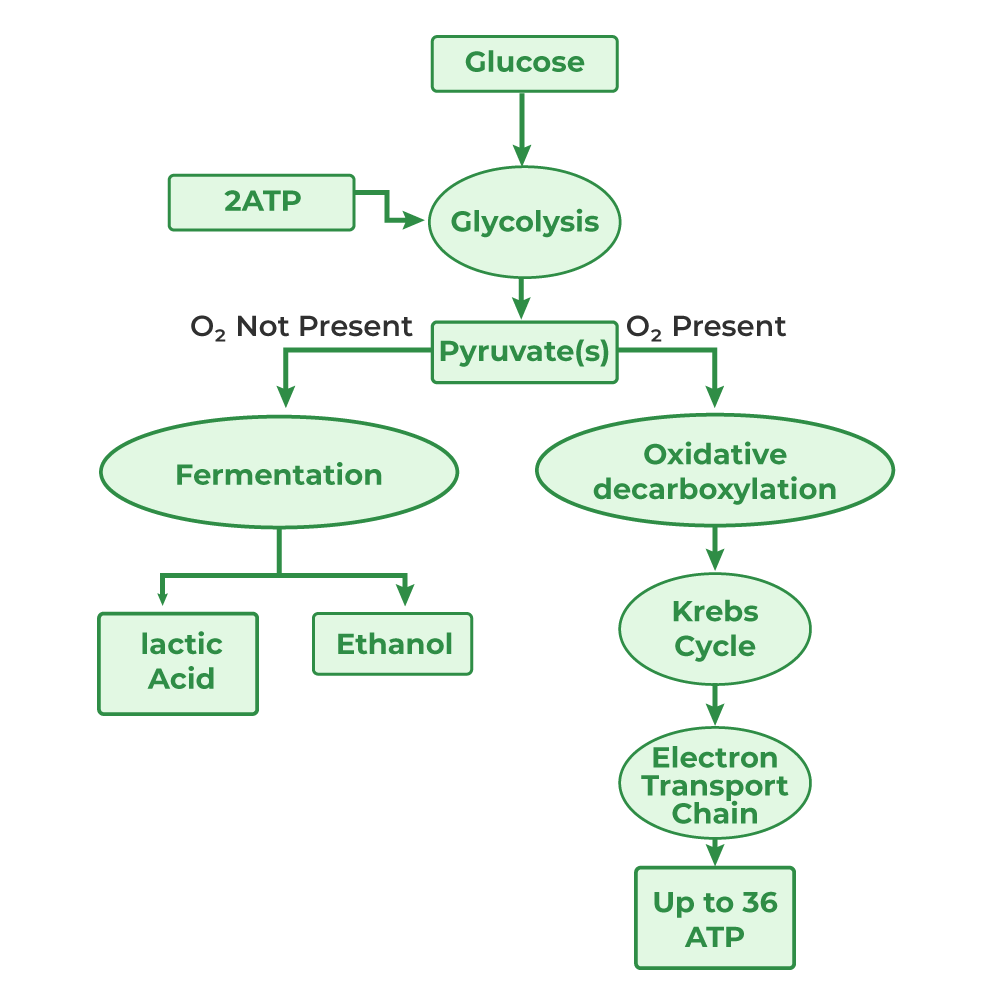
Respiration is the process by which organisms exchange gases between the air around them and the cells in their bodies. All living organisms, from plants and animals to prokaryotic bacteria, Archaea, eukaryotic protists, fungi, and animals respire.
Types of Respiration
There are 2 types of respiration:
1. Aerobic Respiration
- It is the process of producing energy from food through cellular respiration in the presence of oxygen.
- Aerobic respiration is the use of oxygen to break down glucose, amino acids, and fatty acids to produce ATP, and the byproducts of this process are water and carbon dioxide.
- For example, this type of respiration is found in the majority of plants and animals, including birds, humans, and other mammals.
Glucose (C6H12O6) + Oxygen (O2) ⇢ Carbon Dioxide(CO2) + Water (H2O) + Energy (ATP)
2. Anaerobic Respiration
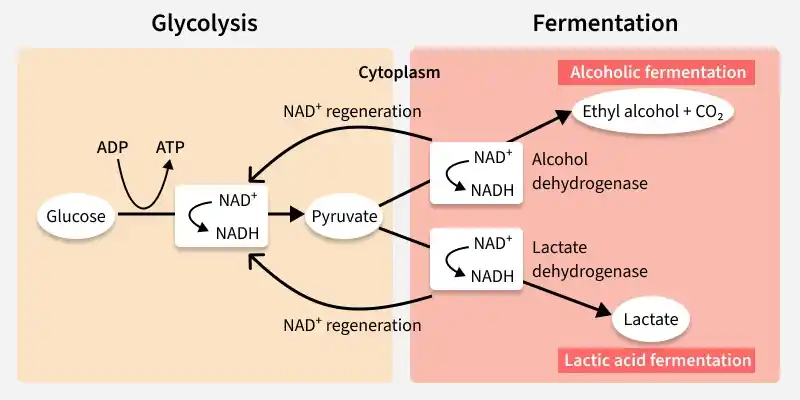
- Due to a lack of oxygen, they respire in the absence of oxygen to produce the energy they require, which is known as anaerobic respiration.
- Our bodies require a lot of energy when we do heavy or intense exercises like running, sprinting, cycling, or weight lifting. Because the supply of oxygen is limited, our body's muscle cells resort to anaerobic respiration to meet the energy demand.
- Anaerobic respiration, for example, is typically found in lower plants and microorganisms. The process occurs in a cell's cytoplasm. This process's chemical reaction is as follows:
C6H12O6 ⇢ 2C2H5OH + 2CO2 + 2ATP
Phases of Respiration in Organisms
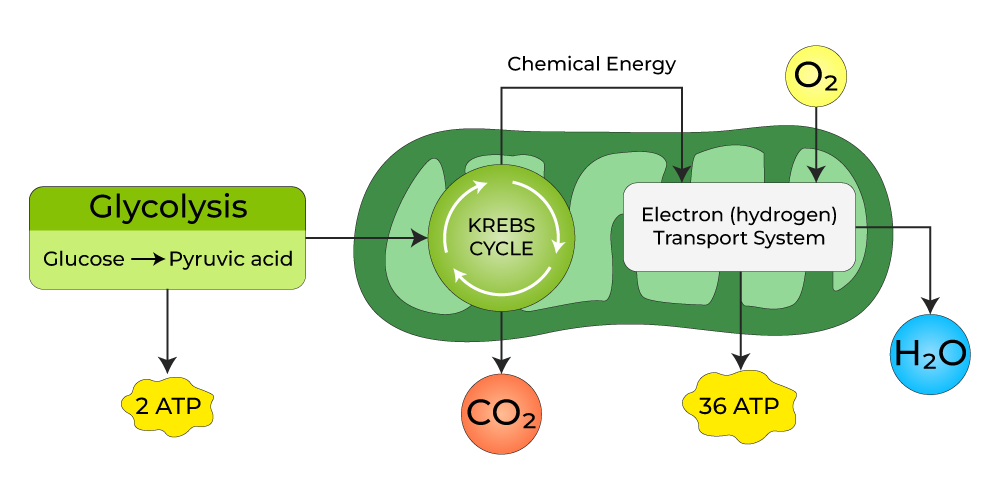
Cellular respiration occurs via a variety of metabolic pathways. In Prokaryotic cell respiration takes place in the cytoplasm, whereas in Eukaryotic cell, cell respiration starts in the cytoplasm and is completed in mitochondria. Glucose is degraded into water, carbon dioxide, and a small amount of ATP. More ATP is produced later in a process known as oxidative phosphorylation, which is powered by electron transport chain movement. The following is a summary of the various stages of cellular respiration:
1. Glycolysis
- The name “glycolysis” originates from the Greek words “glycose,” which means “sugar,” and “lysis,” which means “dissolution.”
- The glycolysis process is the first phase in the aerobic respiration process that takes place in the cytosol.
- Glycolysis is the metabolic pathway that converts glucose into pyruvate and produces ATP and NADH.
- Both end products are further used in different aerobic respiration steps.

Pyruvate Oxidation
- All aerobic organisms use it to release stored energy by oxidising acetyl-CoA derived from carbohydrates, fats, and proteins into carbon dioxide and chemical energy in the form of adenosine triphosphate (ATP).
- Each pyruvate molecule enters the mitochondrial matrix and is converted into a two-carbon molecule that is bound to Coenzyme A.
- Acetyl-CoA refers to the entire compound.
- Carbon dioxide and NADH are the byproducts of this reaction.
- Acetyl-CoA then enters the TCA cycle, whereas NADH is used by ETC.
2 Pyruvate + 2NAD+ + 2CoA⇢ 2 Acetyl-CoA+ 2NADH +2H+ +2CO2
2. Krebs Cycle
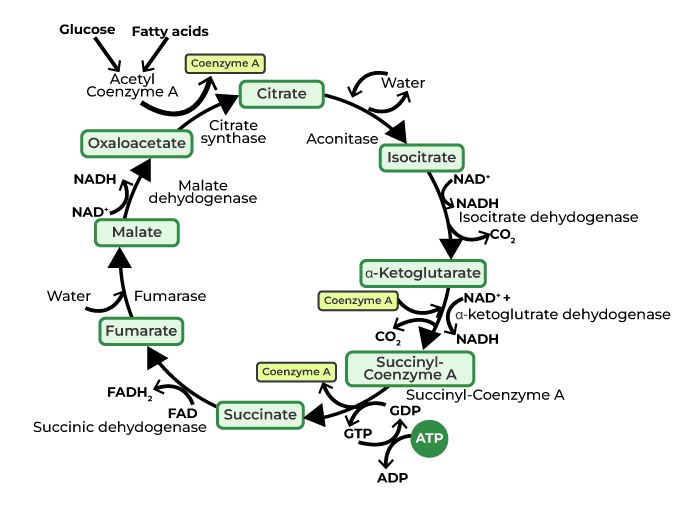
- The Krebs Cycle is also referred to as the Tricarboxylic Acid Cycle or the Citric Acid Cycle.
- It is the second stage of cellular respiration that takes place in the mitochondrial matrix.
- All the enzymes are water-soluble.
- It is an aerobic pathway because the electrons produced by NADH and FADH2 are transferred to the next pathway, which uses oxygen.
- No oxidation takes place if electrons are not transferred.
- During the process, 2 ATP are directly produced. The TCA cycle is a closed circuit. The pathway's final step regenerates the pathway's first molecule.
- The electrons generated in the Krebs cycle cross the mitochondrial matrix, creating an electrochemical gradient.
3. The Electron Transport System
- Electron Transport System (ETS) and Oxidative Phosphorylation are interconnected processes that occur in cellular respiration, particularly in the mitochondria of eukaryotic cells and the plasma membrane of prokaryotic cells.
- ETS and oxidative phosphorylation provide the energy needed for various cellular functions and are fundamental to aerobic metabolism.
- NADH2 is oxidised by NAD+dehydrogenase, and electrons are then moved to ubiquinone situated in the inner mitochondrial membrane.
- FADH2 is oxidised by succinate dehydrogenase and donates electrons to ubiquinone.
- The decreased ubiquinone is then oxidised with the movement of electrons by means of cytochromes bc 1 complex to cytochrome c.
- Cytochrome c is a small protein joined to the external surface of the internal membrane and moves electrons from complex III to complex IV.
- At the point when electrons moved to start with one transporter and then onto the next by means of mind-boggling I to complex IV, they are coupled to ATP amalgamation of ADP and Pi (inorganic phosphate).
- Oxygen assumes an essential part in eliminating electrons and hydrogen particles, lastly help in the development of H₂.

Oxidative Phosphorylation
- The process via which ATP formation occurs is known as oxidative phosphorylation.
- FADH2 and NADH generated in the Krebs cycle donate electrons to oxygen via various electron carriers via the electron transport chain.
- The reaction occurs in the mitochondrial matrix.
- As electrons move down the chain, energy is released, which is used to pump protons out of the matrix, forming a gradient.
- Oxidative phosphorylation serves as the final stage of cellular respiration.
- It is linked to an electron transport chain process. The electron transport system is housed within the inner mitochondrial membrane.
- Through a series of redox reactions, electrons are transferred from one member of the transport chain to another.
