
Egestion is the final step of digestion. It is a process of removing waste material from an organism. For simple species, egestion happens when cell vacuoles collect unwanted food and materials from the cells. After that, they fuse it with the cell membrane. The cell membrane then breaks down and the waste materials are released outside of the body.
In complex animals, the waste materials are transformed into poop and temporarily stored in the rectum, and then expelled through the anus. In this article, we are going to discuss Egestion in Simple and Complex Species in detail.
Table of Content
What is Egestion?
Egestion Definition: Egestion is the process of expelling waste or undigested substances from a cell or the digestive system of multicellular organisms.
In the complex species, egestion is a voluntary process that happens through the anus. In single celled organisms, egestion happens through cell vacuoles. Egestion marks the end of digestion process. Once nutrients are absorbed in the small and large intestines the undigested food exits through the anus.
Egestion in Simple Species
In simple species, egestion is direct and efficient. These organisms usually have one opening for eating and getting rid of waste. After digestion, whatever is not absorbed is pushed out through this opening, keeping the organism clean and healthy. An example of egestion in simple species is discussed below:
Egestion in Amoeba
In simple species, egestion occurs when cell vacuoles collect the unwanted materials from the cells and fuse with the cell membrane. After that, the cell membrane ruptures and the waste materials are released outside. The process involves:
Ingestion
- Simple organisms consume food particles or absorb nutrients directly from their surroundings.
- Breaking in can occur through processes such as engulfing particles or absorbing nutrients.
- It can also happen by directly taking in substances through the cell membrane.
Digestion
- Once food is ingested, it undergoes digestion.
- In simple organisms, digestion may happen inside cells or outside cells but within the body.
- Inside cells, digestion breaks down food in special compartments like vacuoles or lysosomes.
- Outside cells, digestion might involve releasing digestive enzymes into the surroundings.
Absorption
- Nutrients like sugars, amino acids, and fats are taken into cells.
- This happens through processes like simple movement, energy-requiring transport, or assisted movement.
- These nutrients are then used for making energy, growing, and carrying out body processes.
Waste Formation
- Waste materials, like leftover food bits and metabolic leftovers, build up as digestion and metabolism occur.
- These accumulated wastes need to be removed to keep the organism healthy.
Egestion
- The organism needs to get rid of the waste that has accumulated in its body.
- In simple organisms, this usually occurs through simple methods like releasing waste from cells or using specialized structures like anal pores or vacuoles.
- These processes help the organism keep its internal balance and avoid becoming too toxic.
Egestion in Complex Species
In more complex species, egestion involves a more intricate process. It ensures that the body efficiently removes waste and maintains internal balance. The example of egestion in complex species is discussed below:
Egestion in Human Beings
In complex animals, the waste materials are transformed into feces, stored temporarily in the rectum, and then expelled through the anus. The process involves:
Intake
- The process starts with food entering through the mouth.
- Food is broken down into smaller pieces by chewing and enzymes in the digestive system.
Processing and Uptake
- Food moves through organs like the stomach and small intestine, where it is further broken down by enzymes.
- The body absorbs nutrients and water through the walls of the small intestine, leaving behind what can not be digested.
Feces Formation
- Remaining undigested material, along with water, passes into the large intestine (colon).
- In the colon, water is absorbed, leaving behind the remaining material which forms feces.
Rectal Storage
- Feces are temporarily stored in the rectum, the final segment of the large intestine.
- The rectum acts as a reservoir for feces until they are ready to be expelled from the body.
Expulsion
- The intestines also play a role in excretion by removing undigested food and certain waste products through feces.
Disposal
- Faeces leave the body through the anus, completing the egestion process.
Difference Between Egestion Process of Simple and Complex Species
Here, the major difference between egestion process of simple and complex species as mentioned below.
| Aspect | Simple Species | Complex Species |
|---|---|---|
| Digestive System | Usually have one hole for eating and getting rid of waste, like flatworms. | Have separate holes for eating and pooping, like humans. |
| Digestive Complexity | Simple stomachs and guts, not many parts. | Have more complicated stomachs and guts with lots of parts. |
| Egestion Mechanism | May throw up or spit out waste. | Push waste out of their back end through the bum. |
| Fecal Composition | Poop may have food that was not digested and some spit. | Poop has leftover food, pee stuff, and things the body does not need. |
| Digestive Efficiency | Not so good at getting all the good stuff out of food. | Good at getting all the useful bits out of food. |
| Role of Microbes | Germs in their bellies might help with digestion. | Germs in their bellies might help, but not as much as in simple creatures. |
| Frequency of Egestion | Might poop less often because they eat less and digest slowly. | Poop more often because they eat a lot and digest quickly. |
| Regulation of Egestion | Not controlled so much by the body, maybe by what's around them. | Bodies control when they poop, keeping things steady inside. |
| Adaptations for Egestion | Might have special throats to throw up easier. | Have special places to hold and push poop out quickly. |
| Waste Products | Poop mostly has food and some stuff the body does not use. | Poop has food, pee stuff, and stuff that is bad for the body. |
| Relationship with Diet | What they eat can affect how often they poop. | How they eat and what they eat affects when and how they poop. |
| Evolutionary Advancements | Do not have many changes because they are simple creatures. | Have lots of changes to their bodies because they are complex and have to deal with lots of food and other things. |
Difference Between Egestion and Excretion
The egestion and excretion difference is given below:
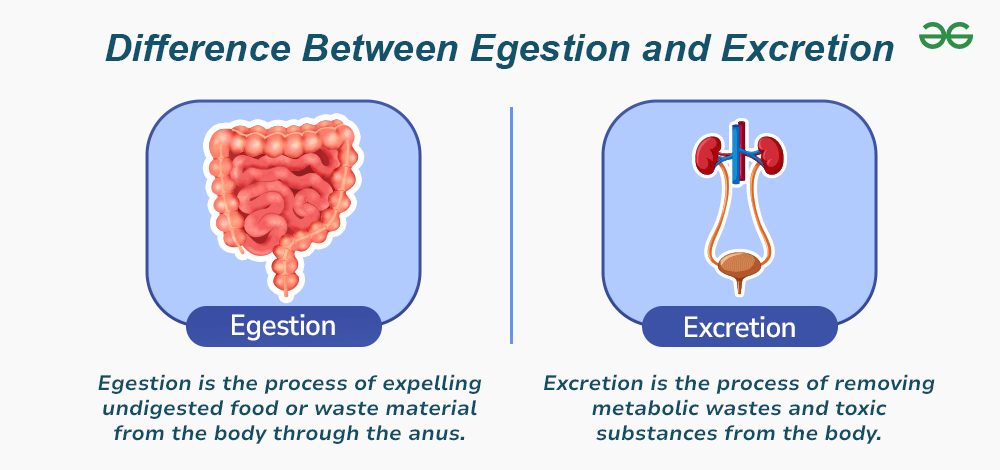
| Aspect | Egestion | Excretion |
|---|---|---|
| Definition | Getting rid of undigested food | Getting rid of body waste |
| Source | Mostly from the digestive system | Mostly from body's chemical processes |
| Type of Waste | Undigested food particles, like fiber | Metabolic waste products, like urea and salts |
| Pathway | Through the digestive tract (anus) | Through organs like kidneys and skin |
| Process Involved | Passing waste through the gut | Filtering, reabsorbing, and releasing by kidneys |
| Regulation | Mainly controlled by digestive system | Controlled by various organs, including kidneys |
| Frequency | After eating and digesting food | Continuous process in the body |
Also Read: Difference Between Egestion And Excretion
Conclusion
Egestion is the process of expelling waste or undigested substances from a cell or the digestive system of multicellular organisms. In this article, we are have discussed the egestion process in simple and complex species in detail. For simple species, egestion happens due to fusion it with the cell membrane and in complex animals, the waste materials are transformed into poop and temporarily stored in the rectum, and then expelled through the anus.
Also Read: