
Living organisms show a variety of characteristics that make them similar to their parents as well as different from others. These characteristics, or traits, can be broadly classified into inherited traits and acquired traits. Inherited traits are those that are passed from parents to offspring through genes and are present from birth.
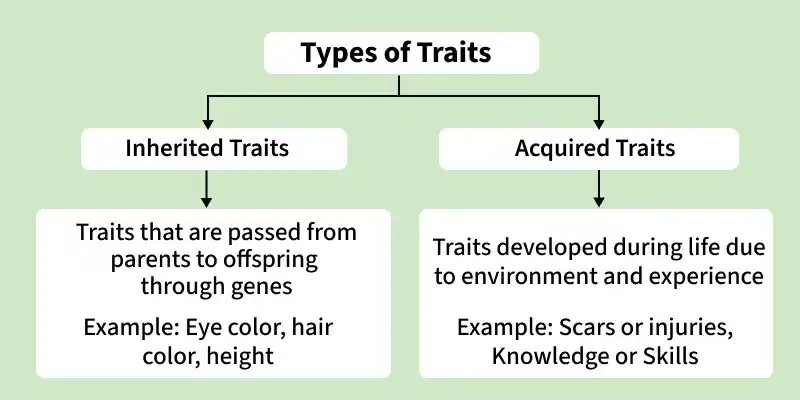
Understanding the difference between these two types of traits is important in the study of genetics and evolution, as only inherited traits are transmitted to future generations and contribute to long-term changes in species.
Acquired traits
Acquired traits are the characters which are acquired by an organism over the period of its lifetime. They do not get transferred to the next generation. e.g. loss of muscles, loss of weight, etc. An acquired trait is the character developed in an individual as a result of environmental influence. These traits are not coded by the DNA of a living organism and therefore cannot be passed on to future generations.
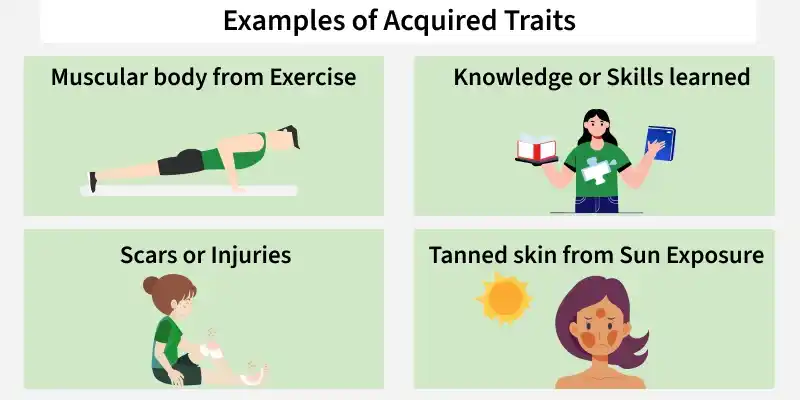
Examples of Acquired Traits
- Muscular body from exercise
- Knowledge or skills learned through education
- Scars or injuries
- Tanning of skin due to sun exposure
Inherited traits
Inherited traits are the traits that are transmitted by the parents to their offspring during the process of fertilisation. For if the parents have brown and black eyes, then the offspring may inherit brown, black or a combination of both. Inherited traits are controlled by genes, and the complete set of genes within an organism's genome is called its genotype.
The complete set of observable traits that make up the structure and behaviour of an organism is called its phenotype. Traits can be physical attributes, such as skin colour or height, or they can be intellectual or cognitive abilities, such as intelligence, empathy, or creativity.
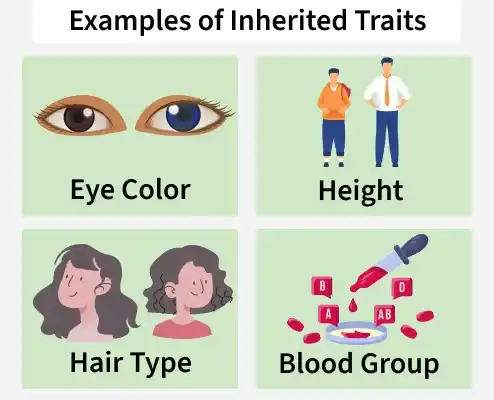
Examples of Inherited Traits
Some examples of inherited traits from parents are:
- Hair colour (Black/brown/blonde, etc.).
- Texture and type of hair (Rough/smooth or Straight/curly).
- Dimples
- Ability to roll the tongue
- Use of left hand/right hand
- In females, the onset of menopause.
- Sleep pattern
- Colour blindness
- The shape of the nose
- Skin colour and texture
- Blood group
Types of Inherited Traits
There are two types of inherited traits. This depends on the dominance or recessive nature of the trait. In case the copies are not identical to each other, the characteristics or the trait, which is expressed phenotypically, is referred to as a dominant trait, while the other is referred to as a recessive trait.
Dominant Trait | Recessive Trait |
|---|---|
Dominant traits are always expressed when the connected allele is dominant, even if only one copy exists. | On the other hand, recessive traits are expressed only if both the connected alleles are recessive. If one of the alleles is dominant, then the associated characteristic is less likely to manifest. |
Examples in humans: Almond-shaped eyes, right-handedness, Detached earlobes. | Round eyes, left-handedness, attached earlobes. |
Acquired VS Inherited traits
Acquired Traits | Inherited Traits |
|---|---|
These are the characters that are acquired by an organism in its lifespan between its birth and death as a response to the changes in the environment. | These are the characters that are inherited from the parental generation and will be passed to the next generation through DNA. The information is incorporated in genes. |
These traits are not controlled by genes. | These traits are controlled by genes. |
The changes that are occurring in somatic cells are called as acquired traits and are not going to be transferred. | The changes that are occurring in the germ cells are called as inherited traits and are going to be transferred to the next generation. |
This can be seen in a life period between birth and death. | This is present by birth. |
This type of variations are called as somatic variation. | These types of variations are called genetic variations. |
These traits are affected by environmental changes. | These traits are not affected by environmental changes. |
Educational knowledge, Technical skills, etc. | Hair colour, eye colour, etc. |