
Fertilisation and implantation are the two important events in human reproduction, which are the biological processes of producing new individuals from a fusion of male and female gametes. This complex process involves the fusion of gametes, the development of a zygote, and the growth and differentiation of the embryo, which ultimately leads to the formation of a fetus within the uterus.
Fertilisation in Humans
Human fertilisation is a complex natural life process that involves the fusion of male and female gametes to form a zygote, which develops into an embryo. It is a crucial step in human reproduction, and its success determines the genetic makeup of the offspring.
Steps of Fertilisation
The process of fertilisation takes place in a defined time frame since the viability of both gametes is very low. Inside the female reproductive tract, sperm can remain alive only for 24-72 hours, whereas after being released into the fallopian tube, a secondary oocyte can remain alive for 24 hours. The process of Fertilization can be broadly categorised into the following major processes.

1. Acrosomal Reaction
- After being released into the female reproductive tract, the sperm undergoes various modifications, one of which is capacitation (several modifications occur at the sperm plasma membrane, which enables it to fuse with the female gamete).
- Followed by the process of Capacitation, the Acrosomal reaction occurs when sperm binds to the zona pellucida, not directly the plasma membrane
- The head of the sperm contains enzymes that help it penetrate the outer layer of the egg cell, called the zona pellucida.
- Once the sperm has entered the egg cell, the zona pellucida undergoes a chemical change that prevents other sperm from entering and hence prevents the Polyspermy.
- Ca2+ ions helps in acrosomal reaction; other than this, pH, temperature, and Mg2+ also play a key role in the accomplishment of the process.
2. Cortical Reaction
- It is one of the preventive measures that oocyte takes to prevent polyspermy.
- Once the fusion of the plasma membranes of the egg and sperm occurs, the cortical reaction occurs on an immediate basis.
- Cortical granules are modified forms of the egg Golgi apparatus, which contain several proteases and are stored between the egg plasma membrane and zona pellucida.
- Once the fusion of the plasma membrane of the egg and sperm occurs, the cortical granules are released inside the space, which results in the hardening of the zona pellucida, which ultimately prevents the entry of other sperms.
3. Sperm Entry
The sperm enters the secondary oocyte through a projection known as the cone of reception, which is formed while the sperm contacts the secondary oocyte.
4. Karyogamy
- The entry of sperm results in the release of a second meiotic arrest of the secondary oocyte.
- This results in the formation of a haploid ovum and a secondary polar body (going to degenerate).
- Karyogamy is the fusion of both male and female pronuclei.
- The head of the sperm contains the male pronuclei, which is the only part of the sperm that enters the cytoplasm, and the rest of the parts are degraded. This fusion takes place inside the ovum cytoplasm.
5. Egg Activation
When sperm invade the ovum, then sperm activate the metabolism, i.e., Protein synthesis and other cellular respiration.
Implantation in Humans
Implantation is the process by which the blastocyst attaches to the endometrium (uterine lining). It occurs about 6–9 days after fertilisation and is essential for further development.
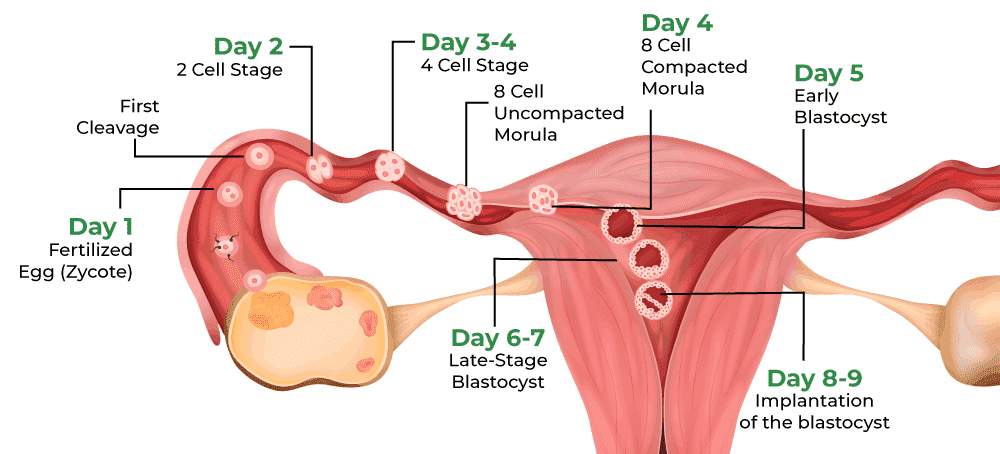
Day 1 – Fertilized egg (zygote) is formed after fertilisation in the fallopian tube.
Day 2 – First cleavage occurs and the embryo reaches the 2-cell stage.
Day 3–4 – Rapid cell divisions form the 4-cell stage, 8-cell stage, and then an uncompacted morula.
Day 4 – The 8-cell embryo becomes a compacted morula.
Day 5 – Morula develops into an early blastocyst and enters the uterus.
Day 6–7 – Late-stage blastocyst forms and prepares for implantation in the uterine wall.
Day 8–9 – Implantation of the blastocyst begins in the endometrium.
Features of the Implantation are given below:
- After the successful event of fertilisation, the zygote starts dividing mitotically and forms a 2-cell stage and proceeds to divide mitotically to finally form an 8-16-cell stage known as Morula. Furthermore, the morula grows to form a blastocyst.
- The blastomere in the blastocyst gets arranged to form an outer layer known as the trophoblast and an inner layer called the inner cell mass.
- The trophoblast layer then attaches to the endometrium. The endometrium, in response to the several hormonal changes that take place during the menstrual cycle, grows and provides a nourishing platform for the blastocyst to attach to the endometrium.
Factors affecting the process of Implantation
- Hormonal balance: Adequate progesterone is essential for successful implantation
- Uterine condition: Structural abnormalities may hinder implantation