
Accounting concepts are the fundamental rules and assumptions that serve as the foundation of financial reporting.
- They provide a uniform framework that guides how business transactions are recorded, classified, and presented in the financial statements.
- Ensuring consistency in accounting practices makes it easier to compare financial performance across organizations and time periods. Without them, accounting information would vary widely, leading to confusion and loss of credibility.
These concepts help accountants follow a standardized approach that enhances the reliability, transparency, and accuracy of financial data. They ensure that transactions are recorded objectively and reflect the true financial position of the business rather than personal judgment or bias.
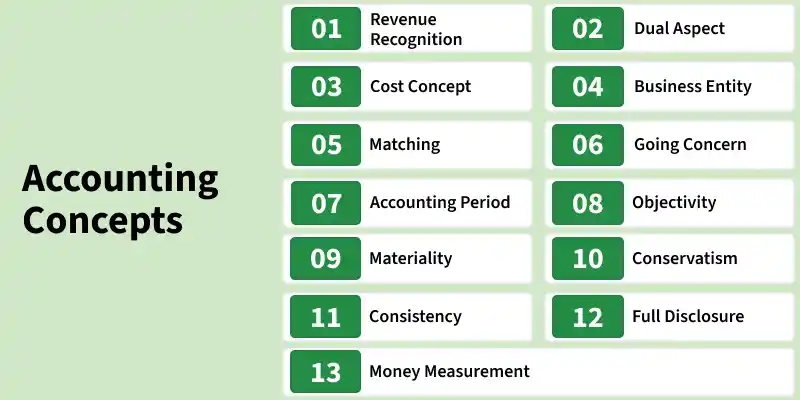
There are 13 important Accounting Concepts that are to be followed by companies to prepare true and fair financial statements.
1) Business Entity Concept
In business entity concept, business and its owner are treated as two separate identities. The business has its own set of accounts, and all its assets and liabilities belong to the business itself, not the owner. Every transaction is recorded from the business’s point of view.
Example:
Suppose the owner starts a business by investing ₹1,00,000 from personal savings. For the business, this amount is treated as capital or liability, as it owes the owner that money. If the owner later withdraws ₹10,000 for personal use, it is recorded as drawings and reduces both business cash and owner’s capital.
2) Money Measurement Concept
Money measurement concept says that only those transactions and events that can be expressed in monetary terms are recorded in the books of accounts. Non-financial factors such as employee skill, customer satisfaction, or brand reputation are not recorded. It helps in preparing financial statements that focus only on measurable financial information.
Example:
If a business pays ₹50,000 as salary to employees, it is recorded because it can be measured in money. But the employees’ honesty or teamwork, though important, cannot be recorded as it has no exact monetary value.
3) Going Concern Concept
The Going Concern Concept assumes that a business will continue to operate in the foreseeable future and will not be closed or liquidated soon. Because of this assumption, assets are recorded at cost and depreciated gradually instead of being shown at their selling or liquidation value. It helps in preparing financial statements .
Example:
A company buys a machine for ₹5,00,000 and expects to use it for 10 years. Under the going concern assumption, the cost is spread over its useful life through yearly depreciation instead of being recorded as a one-time expense.
4) Accounting Period Concept
Accounting Period Concept concept divides the life of a business into fixed time periods, usually one year, to measure profit or loss. It helps in preparing financial statements for a specific period and allows comparison of results over different periods. The accounting period may be a financial year or a calendar year.
Example:
If a company prepares its financial statements from April 1, 2024, to March 31, 2025, that period becomes its accounting year. At the end of this period, it calculates total income and expenses to find the profit or loss for the year.
5) Cost Concept
The Cost Concept states that all assets are recorded in the books at their original purchase price, which includes all expenses incurred to bring them to a usable condition. This cost remains the basis for valuation in future years, even if the market value of the asset changes. Although market prices may fluctuate, the cost concept ensures consistency in financial reporting and avoids subjective valuations.
Example:
If a company buys land for ₹10,00,000, it will be shown in the balance sheet at ₹10,00,000, even if its current market value rises to ₹15,00,000. The asset will continue to appear at historical cost unless revaluation is specifically done.
6) Dual Aspect or Duality Concept
The Dual Aspect Concept states that every transaction has two sides: a debit and a credit. In other words, every transaction affects two accounts in such a way that the total of debits always equals the total of credits. This is what keeps the accounting equation balanced:
Assets = Liabilities + Capital.
Example: If a business purchases furniture worth ₹20,000 in cash, the furniture account increases (debit) while cash decreases (credit) by the same amount. The total effect on assets remains the same, keeping the equation balanced.
7) Revenue Recognition Concept
The Revenue Recognition Concept states that revenue is recognized when it is earned and realizable, even if the actual cash is received later. This helps in matching revenue with the period in which the related goods or services are delivered, providing a true picture of financial performance. The concept ensures that income is not recorded too early or too late, maintaining accuracy and reliability in financial statements.
Example: If a company provides services worth ₹1,00,000 in March but receives payment in April, the revenue will still be recorded in March because the service has been completed and the income has been earned.
8) Matching Concept
Expenses should be matched with the revenues for the same accounting period. It emphasizes the direct relationship between income and the costs incurred to earn it. It show a more accurate measure of profit or loss for a particular period. Matching concept is a fundamental principle in accrual-based accounting and helps assess true business performance over time.
Example: If a company earns ₹5,00,000 from sales in March and pays ₹1,00,000 as sales commission in April, the commission expense should still be recorded in March since it relates to sales revenue of that month.
9) Full Disclosure Concept
The Full Disclosure Concept requires that all important and relevant information related to the financial statements clearly presented. The purpose of this concept is to ensure transparency and to help users of financial information—such as investors, creditors, and regulators—make informed decisions. Financial statements should also include necessary explanations, notes, and additional details that could affect a reader’s understanding.
Example: If a company is involved in a pending legal case that could result in a loss, it must mention this in the notes to accounts, even if the exact amount is not known. This keeps investors aware of potential financial risks.
10) Consistency Concept
The Consistency Concept states that a business should follow the same accounting methods and principles from one accounting period to another. This ensures that financial statements remain comparable over time. When the same methods are applied consistently, users such as investors, analysts, and management can study trends, evaluate performance, and make decisions more effectively.
Example: If a company uses the straight-line method for calculating depreciation, it should continue using the same method every year. If it switches to the written-down value method, the reason and financial impact of this change must be mentioned in the notes to accounts.
11) Conservatism Concept
The Conservatism Concept, also known as the Prudence Concept, advises that while preparing financial statements, accountants should act cautiously. Expected losses are recognized as soon as they are anticipated, but profits are recorded only when they are certain. This prevents the overstatement of income or assets and ensures that the financial position of the business is not shown in an overly optimistic manner.
Example: If a company expects a possible ₹1,00,000 loss due to a pending lawsuit, it should record this as an expense immediately. However, if it anticipates a profit from another case, that income should not be recorded until it is actually received.
12) Materiality Concept
The Materiality Concept states that only those items or events that have a significant impact on the financial statements should be recorded or disclosed. In accounting, not every small transaction needs to be treated with the same level of detail. What is considered “material” depends on the size, nature, and importance of the item. This concept helps make accounting records practical and efficient while keeping financial statements relevant and understandable.
Example: If a company buys a stapler for ₹200, it is treated as an expense instead of being recorded as an asset, since the amount is too small to affect financial decisions. However, the purchase of machinery worth ₹2,00,000 must be recorded as an asset because it is material in nature.
13) Objectivity Concept
The Objectivity Concept emphasizes that all accounting records and financial statements should be based on verifiable and reliable evidence rather than personal opinions or assumptions. It ensures that every transaction recorded in the books has supporting documents such as invoices, bills, or receipts that can be independently verified. By relying on objective evidence, this concept minimizes the chances of bias or manipulation in financial reporting.
Example: If a company purchases goods worth ₹50,000, it must record the transaction based on the supplier’s invoice. The invoice serves as objective proof of the purchase and ensures that the record is accurate and verifiable.