
The business entity concept states that a business and its owner are treated as separate entities for accounting purposes. This means the business maintains its own accounts, and personal transactions of the owner are not included in the business records.
If an owner invests money in the business, it will be treated as a liability for the business. However, if the owner takes out some money from the business for personal use, it will be considered drawings.

Key Takeaways:
- Businesses and owners are treated as separate entities.
- Assets, liabilities, income, expenses, etc. belong to the business and not the owner.
- Books of accounts are prepared from the viewpoint of the business and not the owner.
- The business entity concept applies to partnerships, companies, sole proprietorships, small enterprises, and large enterprises.
Need for Business Entity Concept
The business entity concept is needed to determine the separate financial position of a business. It helps in comparison between businesses, simplifies tax filing, assists in settlement during dissolution, and ensures accurate calculation of owner’s equity by keeping personal and business finances separate. Owner's equity also gets calculated easily when personal finances are not entangled with business finances.
Example
- Assume the owner needs to withdraw ₹50,000 for the construction of his/her own house. Such withdrawal acts will be known as drawings, and it is not the expense of the business but the owner's. The transaction must be written as Drawings.
- If the owner invests money in the business, the amount is considered a loan to the business and is the liability of the firm towards the owner.
Significance of Business Entity Concept
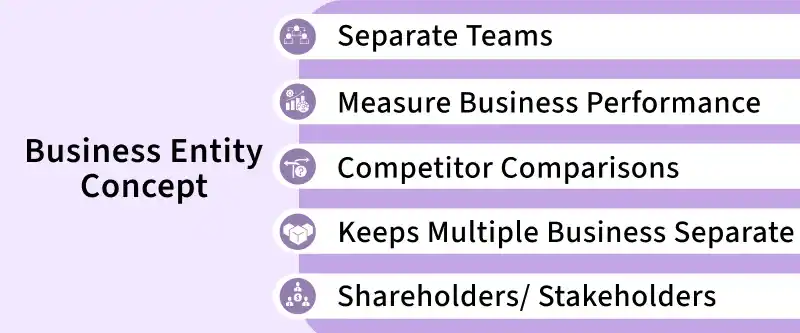
1. Separation of Personal and Business Finances: The Business Entity The concept prevents the mixing of personal and business finances, making accounting records clear and systematic.
2. Accountability: If the owner withdraws money for personal use (drawings), they remain accountable for such withdrawals and are responsible for any diversion of business funds.
3. Tax benefit: Keeping personal and business finances away from each other gives tax benefits to the owner. At the time of filing taxes.
4. Business Performance: Maintaining separate business records enables stakeholders to assess the financial position and performance of the business accurately.
5. Comparison: It helps the business in the comparison of financial performance with other business organizations.
Limitations of Business Entity Concept
1. Small businesses: In sole proprietorships and partnerships, the line between personal and business transactions is often mixed. It is difficult to apply this concept.
2. Limited Scope: The concept of a business entity might not fully account for intangible assets, such as brand value, human capital, and intellectual property, which can be crucial contributors to a company's value but are not always quantifiable.
3. Consolidation: While consolidation is often necessary for financial reporting, it can lead to challenges when attempting to present a clear financial picture of an individual business entity within a larger group.
4. Owner's Influence: When a single owner has significant control, financial statements may not fully reflect the true financial position, as some transactions could be influenced by the owner’s personal interests.