



Business Information Blog
Credit Management

Reports & Scores

Data & Analytics

The latest from our experts
Main Street Report Q2 2026: Experian’s small business credit analysis reveals a K-shaped economy, rising subprime debt, regional delinquency.

Experian takes a snapshot of the Construction Industry before the effects of the 21st Century ROAD to Housing Act take hold.
A path forward after SBA discontinued the use of the FICO Small Business Scoring Service (“SBSS”) for 7(a) Small Loan underwriting.
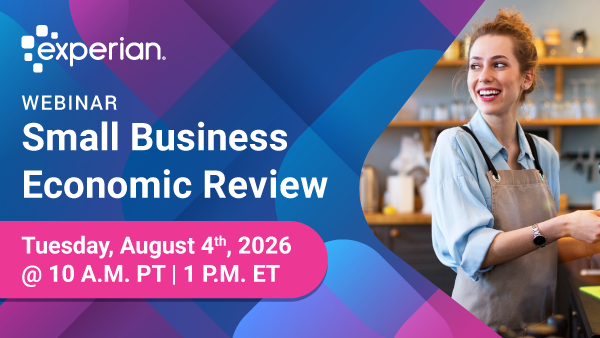
Experian experts present the small business economic review – a deep dive on small business credit health.
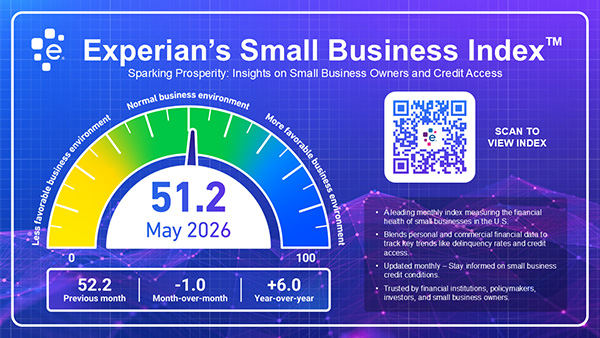
Small businesses navigated headwinds in May as uncertainty began to rise May 2026 Index Value (Mar): 51.2 Previous Month: 52.2 MoM: -1.0 YoY: +6.0 (May 2025 = 57.2) The Experian Small Business Index™ decreased slightly, falling 1 point to 51.2 in May, but remained 6 points higher than a year ago. Several credit risk factors supported the index in May. Past-due balances on business owners’ consumer accounts declined, as did later-stage delinquencies on their commercial accounts. However, several factors weighed on the index. Commercial credit utilization increased, and there was a sharp rise in consumer public records filings. While public records are typically a lagging indicator, this trend warrants monitoring in the coming months. In the broader economy, the unemployment rate declined to 4.2% from 4.3%, and GDP grew by 2.1%, exceeding expectations. Several measures of inflation also increased in May. Headline inflation rose from 3.8% in April to 4.2%, while core inflation, which excludes food and energy, increased from 2.8% to 2.9%. Energy prices were 23.5% higher than a year earlier and likely contributed to broader inflationary pressures. Food prices declined 0.1%, while rent increased 0.1%. Business formation remained strong, with 524,000 new business applications filed in May, up from 505,000 in April. This occurred despite the NFIB Uncertainty Index increasing to 91. The NFIB Small Business Optimism Index edged down to 95.3 in May from 95.9 in April. Explore Experian Small Business Index Related Posts

Small business lending is evolving. Experian uncovers who’s being left out and where the biggest commercial credit opportunities are hiding.

Discover key Leisure & Hospitality trends, including 181% growth in credit inquiries, record travel demand, and insights for risk leaders.
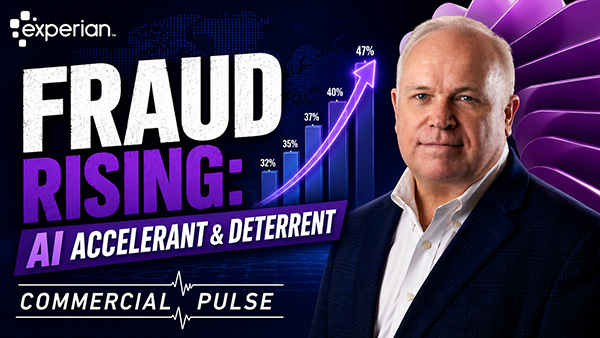
First-party fraud is rising across commercial lending. Learn how fraud trends, AI, and dark web activity are reshaping fraud risk management.
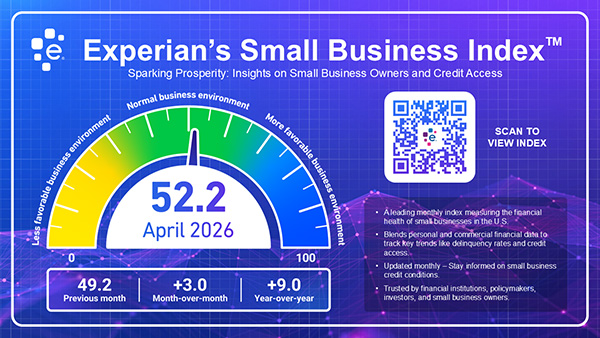
The Experian Small Business Index gained 3 points in April, driven by strong business formation, increased business credit demand.
How blended credit scores help SMB lenders improve risk assessment, expand automation, reduce false declines, and drive profitable growth.
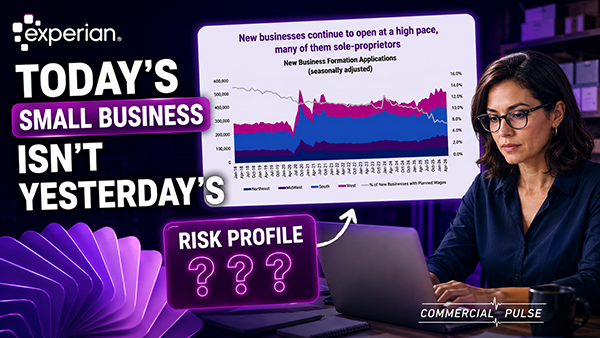
The U.S. small business landscape is undergoing a structural transformation — and commercial lenders may need to rethink what a “small business borrower” looks like. According to Experian’s May 26th, 2026 Commercial Pulse Report, new business formations remain at historically elevated levels, averaging approximately 450,000 per month since the pandemic. That pace represents a 54% increase compared to pre-pandemic averages from 2018 and 2019. Watch the Commercial Pulse Update According to Experian’s latest Commercial Pulse Report, new business formations remain at historically elevated levels, averaging approximately 450,000 per month since the pandemic. That pace represents a 54% increase compared to pre-pandemic averages from 2018 and 2019. But perhaps more importantly, the composition of those businesses has changed dramatically. In early 2026, approximately 93% of newly formed businesses were sole proprietorships, up from 85% in 2018. Many of these businesses have no employees, limited operating history, and different borrowing behaviors than the traditional small businesses lenders historically underwrote. That shift is creating a fundamentally different commercial credit environment. A Different Kind of Small Business Owner Historically, many small business lending models were designed around businesses with employees, established operations, recurring revenue streams, and longer credit histories. Today’s wave of new businesses often looks very different. Many newer firms are being launched by individuals pursuing consulting work, freelance opportunities, side businesses, creator-economy income streams, or post-retirement self-employment. These businesses may operate leaner, carry lower fixed costs, and rely more heavily on revolving credit products rather than traditional financing structures. In many cases, the business owner and the business itself are financially intertwined. That evolution matters because underwriting a sole proprietor is not the same as underwriting a mature operating company. The rise in sole proprietorships is being driven by several long-term labor force and demographic trends now reshaping the U.S. economy. Demographic Shifts Are Driving Entrepreneurship One of the most important forces behind the surge in sole proprietorships is the aging U.S. population. By 2050, individuals aged 55 and older are projected to represent nearly 40% of the total U.S. population. At the same time, Americans are increasingly working later in life. Labor force participation among older workers has steadily increased over the past two decades, while participation among younger workers has trended lower. Retirement itself is also evolving. Many retirees are no longer fully exiting the workforce. Instead, they are remaining economically active through part-time consulting, contract work, side businesses, and self-employment arrangements. According to research highlighted in Experian’s report, 59% of workers expect to continue working during retirement, while 61% of recent retirees express interest in continued employment. These trends are contributing to a growing segment of “microbusinesses” — businesses with few or no employees operating primarily around the skills, experience, or services of an individual owner. At the same time, broader workplace dynamics are also influencing entrepreneurial activity. Employee Engagement Is Falling According to Gallup, employee engagement in the U.S. and Canada declined to 31% in 2025, down from post-pandemic highs. Gallup estimates that low engagement costs the global economy nearly $10 trillion in lost productivity. Younger workers in particular appear increasingly affected by workplace stress, burnout, and changing expectations around flexibility and career mobility. As a result, more individuals may be pursuing alternative work arrangements, independent income streams, or self-employment opportunities. The side-hustle economy continues to expand as well. A recent PYMNTS study found that nearly 20% of workers engaged in regular side work during the previous six months. Collectively, these labor force dynamics are reshaping not only how Americans work, but also how small businesses are formed, financed, and evaluated from a credit perspective. Commercial Credit Usage Looks Different Experian data shows meaningful differences in how smaller and larger businesses use commercial credit. Smaller businesses and sole proprietors rely more heavily on commercial credit cards, while larger firms tend to utilize a broader mix of leases, lines of credit, and term loans. Businesses with four or fewer employees received average commercial card credit lines of roughly $8,900 in 2025. By comparison, businesses with more than 100 employees averaged approximately $29,500 in new commercial card credit lines. Even when loan origination rates appear similar across business sizes, loan amounts differ substantially. Businesses with fewer than four employees averaged approximately $119,000 in term loan originations, while larger businesses averaged closer to $268,000. Risk performance differs as well. Larger firms generally continue to demonstrate lower delinquency rates and stronger commercial credit scores, reflecting greater operational scale, more established financial histories, and broader access to capital. Why Risk Models May Need to Evolve For lenders, these shifts present both opportunity and complexity. The surge in new business formation creates potential growth opportunities across commercial credit markets. However, many of today’s borrowers may not fit historical underwriting assumptions. Traditional business risk models often relied heavily on factors associated with mature operating businesses — payroll size, years in business, trade depth, and established commercial borrowing history. Today’s newer firms may instead require a more blended view of risk that incorporates both commercial and consumer-level behaviors, cash flow dynamics, and alternative indicators of financial stability. As sole proprietors and microbusinesses continue to account for a growing share of the small business economy, lenders may need to remain agile in balancing portfolio growth with disciplined underwriting and risk management strategies. The definition of “small business” is evolving — and commercial risk models may need to evolve alongside it. Learn more ✔ Visit our Commercial Insights Hub for in-depth reports and expert analysis. ✔ Subscribe to our YouTube channel for regular updates on small business trends. ✔ Connect with your Experian account team to explore how data-driven insights can help your business grow. Download the Commercial Pulse Report Visit Commercial Insights Hub Related Posts

Watch the recording of the Small Business Economic Review webinar where Experian shared and discussed critical insights from the latest Main Street Report. This exclusive quarterly webinar delivers data-driven insights into small business credit performance, lending trends, and the forces shaping the U.S. economy. Whether you’re a lender, credit manager, or business strategist, this session will help you make informed, confident decisions heading into 2026. Why You Should Watch Leading Experts on Commercial and Macro-Economic Trends Credit insights and trends on 30+ Million active businesses Industry Hot Topics Covered (Inclusive of Business Owner and Small Business Data) Commercial Insights you cannot get anywhere else Peer Insights with Interactive Polls (Participate) Discover and understand small business trends to make informed decisions Actionable takeaways based on recent credit performance In an uncertain economic climate, information is your greatest advantage. The Experian Small Business Economic Review gives you the data, context, and expert perspective you need to navigate what’s next with confidence. 📅 Want to be alerted for our next webinar? Subscribe to our Commercial Insights Hub