

SUBSCRIBE TO OUR FREE NEWSLETTER
Daily news & progressive opinion—funded by the people, not the corporations—delivered straight to your inbox.
5
#000000
#FFFFFF
To donate by check, phone, or other method, see our More Ways to Give page.
Daily news & progressive opinion—funded by the people, not the corporations—delivered straight to your inbox.
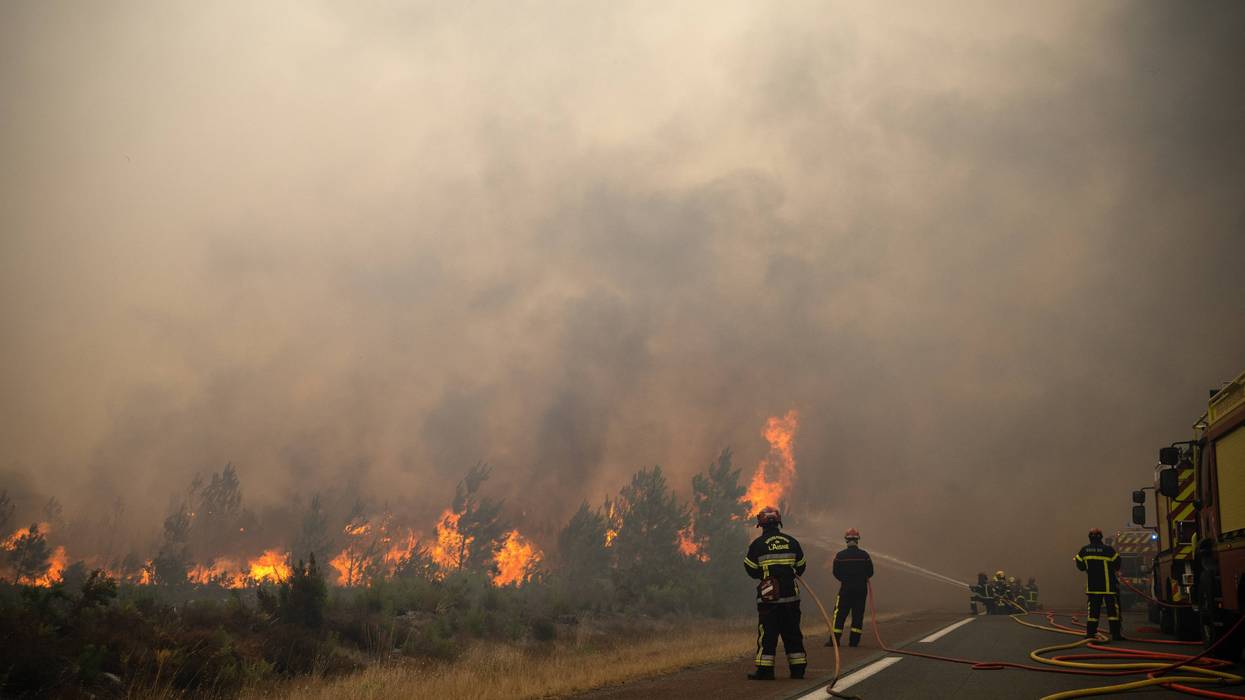
“It is the most painful manifestation of a climate emergency that is making… wildfires more voracious and heatwaves more frequent, and as a result our land more vulnerable," said Spanish Prime Minister Pedro Sánchez.
More than 300,000 people have been displaced as historic wildfires tear across France and Spain, presaging what some have called a climate-fueled "crisis of habitability" across Europe, which is heating faster than anywhere else on the globe.
Record heat and drought have fueled multiple record wildfires around the French wine-growing region of Bordeaux and in central Spain near Madrid. As the region expects to see temperatures above 95°F later this week, firefighters are racing to quell the blaze as it grows out of control.
Across the two countries, at least one person has been killed, and more than 100 have been sickened or injured. In France, 80 firefighters have been injured.
About 448 square miles of terrain have been scorched across France since the beginning of 2026, the highest annual total in modern history, even though it's only July.
The fires in France have grown so powerful and unwieldy that they've formed what the National Firefighters Federation of France described as a “pyrocumulonimbus”—an unprecedented fire-generated thunderstorm cloud that generates its own wind and lightning, which spreads the flames across the landscape.
In Spain, fires around Ávila burned about 193 square miles in five days—an area roughly five times the size of Barcelona—making it the largest wildfire in the nation's history. Civil protection chief Virginia Barcones said her country was facing a "monster."
Extreme wildfires are becoming more common around the world as global temperatures increase. Across Europe, where temperatures have soared twice as fast as the global average, the pattern has been even more intense.
Last year was the worst fire year on record in the European Union, with nearly 4,170 square miles of land burned—almost double the annual average from 2006-24.
Speaking at a climate conference, Spanish Prime Minister Pedro Sánchez emphasized that the fires should not be viewed as isolated incidents.
“It is the most painful manifestation of a climate emergency that is making… wildfires more voracious and heatwaves more frequent, and as a result our land more vulnerable,” Sánchez said. “It is no longer an exception. It is the rule.”
In an op-ed for Le Monde, philosopher Cynthia Fleury and the Socialist mayor of Saint-Médard-en-Jalles in southwestern France, Stéphane Delpeyrat-Vincent, wrote that where previous fires and heatwaves have posed threats to individuals, "the 2026 heatwave has been something else entirely."
"No longer are only individuals at risk, but entire regions," they wrote. "Extreme heat now goes hand in hand with megafires, the destruction of whole landscapes, the collapse of environments and the evacuation of entire towns. The health crisis has become a crisis of habitability."
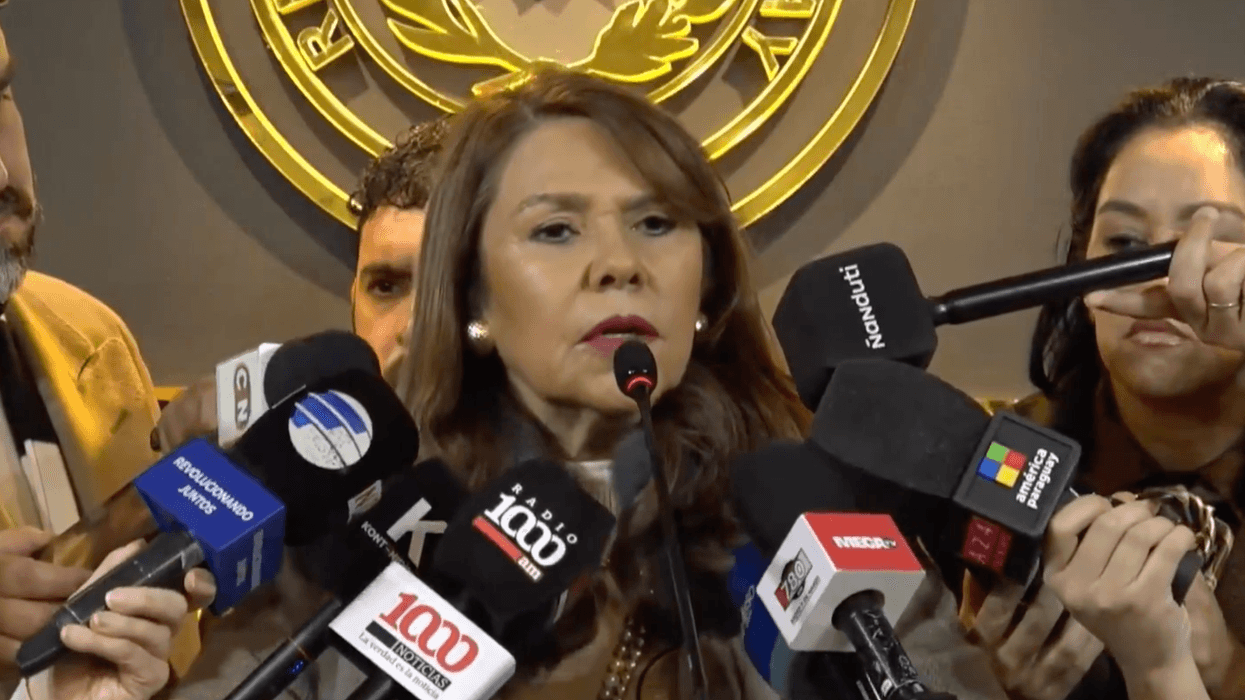
"I will not apologize," said 62-year-old Sen. Celeste Amarilla. "I come from a generation when gays were beaten up and calling someone a little Black shit was common."
A Paraguayan senator on Tuesday partially retracted her racist rant against French soccer superstar Kylian Mbappé but refused to apologize as French prosecutors weigh hate crime charges and officials in both countries condemned her remarks.
Prosecutors in Paris are considering charges of incitement to hatred or violence, or aggravated public insult, against right-wing Paraguayan opposition Sen. Celeste Amarilla, after the French Football Federation filed a complaint calling the "racist remarks" of the lawmaker "totally abject and unacceptable."
France eliminated Paraguay from the FIFA World Cup on Saturday, beating the South American side 1-0 in the Round of 16 match in Philadelphia, with Mbappé scoring a game-winning penalty kick in the 70th minute.
Following the unusually physical match—some observers accused Paraguay of being sore losers and playing dirty—Mbappé refused to shake Paraguayan goalkeeper Orlando Gill's hand.
An incensed Amarilla then took to X to call Mbappé a "colonized Cameroonian, pretending hard to be French, resentful, newly rich, arrogant, and ugly."
In a second post, the senator said Mbappé "didn't even learn to write; instead of mother's milk, he suckled on coconuts, and the most educated things he heard were the chimpanzees."
Mbappé was born in Paris and grew up just outside the French capital in Bondy.
Amarilla also cheered racist posts by other X users and asked "permission" to use one comment asking, "What kind of 'dark' thing can you ask someone who ran from lions so as not to be eaten?"
While many Paraguayans rushed to Amarilla's defense in the name of their national, sporting, and even racial honor, the country's Foreign Ministry released a statement saying the nation's government "deplores and rejects" her remarks, which it said are "contrary to the values and principles that inspire peaceful coexistence and respect for the human dignity that our country promotes."
Paraguayan Vice President Pedro Alliana also weighed in, asserting Monday that "football is an expression of fraternity" that "should unite people," and "there is no room for any type of discrimination" in the sport.
Mbappé responded directly to Amarilla on social media, saying, "You are a despicable woman and unworthy of your position."
"You do not represent Paraguay, that country which has sweated passion and honor throughout the competition," the French captain and Real Madrid superstar wrote. "Through your recklessness and your brazen racism, the entire world has already forgotten the journey and the historic effort that your players accomplished during this World Cup, making way for an incompetent woman who gives the worst possible image of her country."
French President Emmanuel Macron posted on social media: "Another goal for Kylian Mbappé. Against racism this time. All my support. When words defile, our values respond—dignity, respect, fraternity."
Amarilla subsequently posted a screed attacking what she called Mbappé's "arrogance" and "contempt."
"My posts were written in the heat of the moment," she claimed. "That mixed-race blood—a beautiful blend of Indigenous and Spanish blood flowing through my veins—was boiling while you mocked those great Paraguayan players who fought as equals until the very end of the match, and that's why I wrote those messages."
During Amarilla's youth, Paraguay committed genocide against the Aché, Ayoreo, Guaraní, and other Indigenous peoples under the US-backed dictatorship of Gen. Alfredo Stroessner.
"Soon afterward, however, I regretted responding with the same insults that I myself receive," Amarilla continued in a conciliatory twist. "I, too am looked down upon for being brown-skinned and Latina; they call us 'sudacas.' I regretted it and deleted the post. I realized I was repeating patterns that I hate. I understand that it may have hurt you, because it is humiliating."
"Now I demand that you also retract your words and apologize to me," she added.
Speaking at a Tuesday morning press conference, Amarilla again defended her actions, which she said were rooted in her Generation X upbringing, declaring, "I will not apologize."
🗣️ Celeste Amarilla: “I come from a generation where calling someone a “little Black sh*t” was common.
Watch out for Paraguayans. We put Dinho behind bars for corruption.
Don't underestimate me, I can file charges against you.”
She’s disgusting, bro. 🤮 pic.twitter.com/yAw55G0hSP
— 10 (@Kylian) July 7, 2026
"I'm nearly 62 years old and grew up in a society where gays were beaten and where calling someone a little Black shit was the most common thing," the senator said. "I come from that generation, so now I'm trying to build a different Celeste Amarilla, that's capable of co-existing with others."
"Have patience," she added. "I'm trying."
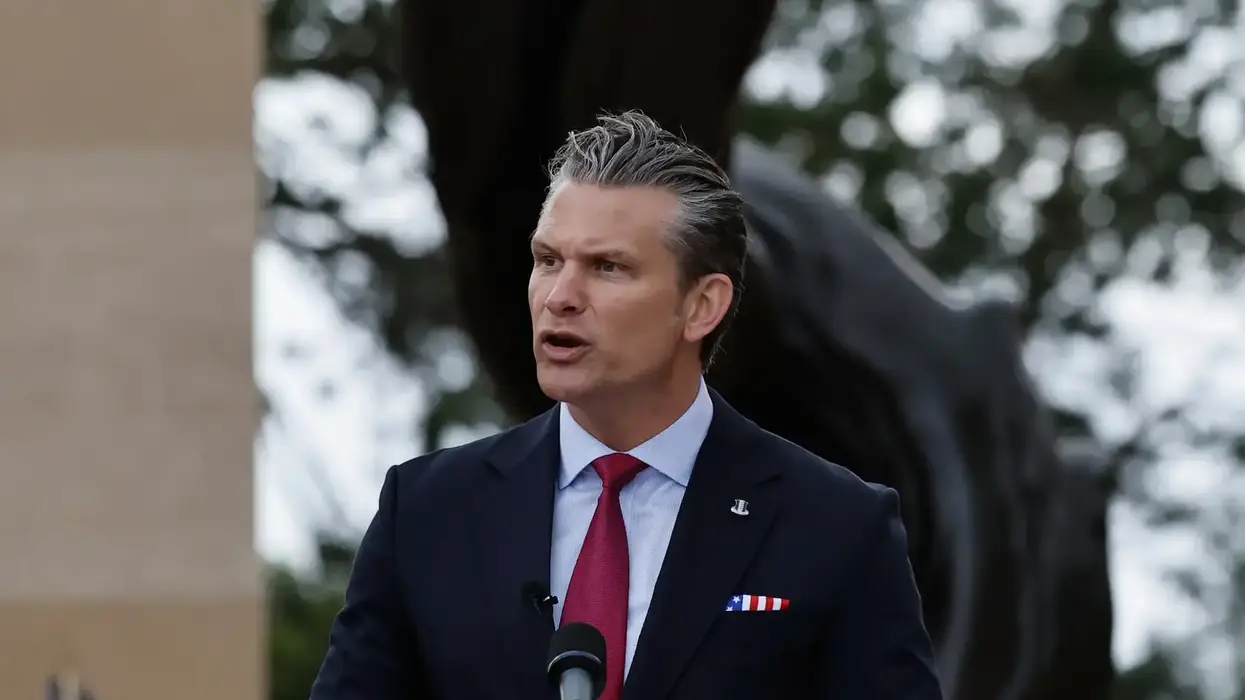
It is not surprising that Hegseth cannot identify with the men who fought on D-Day.
If you have ever had the opportunity to visit the Normandy American Cemetery in Colleville-sur-Mer, France it is something that stays with you. The rows of white gravestones silhouetted against green grass and blue sky bear silent and eloquent witness to what happened on June 6, 1944. The cemetery contains the graves of 9,389 of Americans, most of whom lost their lives in the D-Day landings and the battles in France in 1944.
From the cemetery, you can see down to Omaha Beach the bloodiest part of the D-Day battlefield. While estimates vary, 2,400 to 3,600 total American casualties (including killed, wounded, and missing) occurred on Omaha Beach on D-Day, June 6, 1944. For me, the most moving part of the Cemetery is the Walls of the Missing where inscribed 1,557 names of the soldiers and sailors who were missing in action and have never had their bodies recovered.
For decades, American politicians have been visiting the Normandy Beaches to pay tribute to all the Americans and Allies (primarily British and Canadian) who fought on June 6, 1944. Particularly well-known is the speech that President Ronald Reagan made in June of 1984:
The men of Normandy had faith that what they were doing was right, faith that they fought for all humanity, faith that a just God would grant them mercy on this beachhead or on the next. It was the deep knowledge—and pray God we have not lost it—that there is a profound, moral difference between the use of force for liberation and the use of force for conquest. You were here to liberate, not to conquer, and so you and those others did not doubt your cause. And you were right not to doubt. You all knew that some things are worth dying for.
For an American politician, remarks at the Normandy beaches ought to be simple and straightforward. All you have to do is pay tribute as best you can to the extraordinary sacrifice made on June 6, 1944. As hard as it is to believe, US Defense Secretary Pete Hegseth failed this simple task. Rather than just pay tribute to the efforts of those who “hit the beach” on June 6, 1944, Hegseth launched into an anti-immigrant and far-right rant. As the New York Times reported:
In his remarks, Mr. Hegseth said that “freedom is not free” and especially praised the role played by American troops, but said that over the past eight or so decades, some European countries had grown “comfortable.” “Today, different European beaches are stormed by different dangerous ideologies,” he said. “Boats and men arrive. When will European capitals do something about that invasion? Or is it too late?”
I am sure it escaped Hegseth the fact that many of the Americans he heralds for their sacrifice were the sons of immigrants to the United States. To compare refugees coming to Europe fleeing war and economic oppression with Nazi tyranny defies belief.
It is not surprising that Hegseth cannot identify with the men who fought on D-Day. They were not the much hyped “war fighters” ignoring politically correct rules of engagement that Hegseth celebrates. Instead, they were ordinary men doing extraordinary things to defeat the most terrible tyranny the world has ever seen. History will remember the deeds of those who defeated Nazi tyranny, while Hegseth's far-right rhetoric will be nothing more than a footnote to a sad chapter in American history.
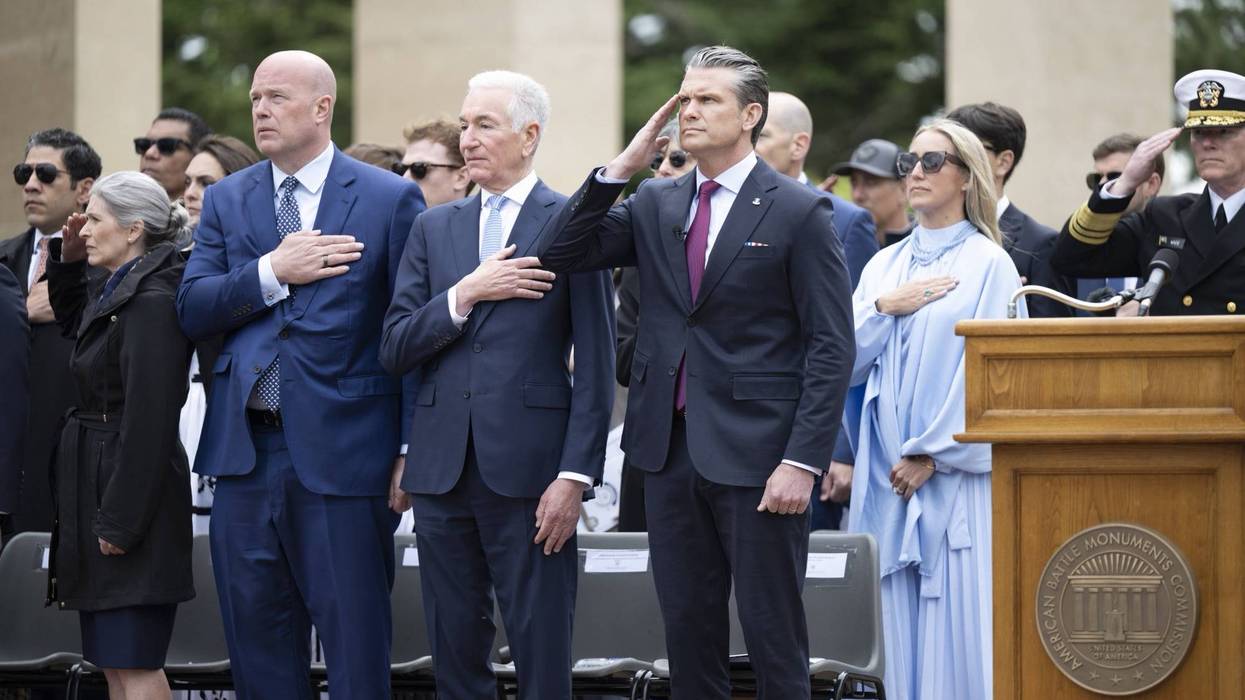
"Apparently our nitwit secretary of war(drobe) thinks a D-Day commemoration is an appropriate time to push his far-right ideology in Europe," said US Sen. Tim Kaine.
US Defense Secretary Pete Hegseth came under fire from critics around the world this weekend after he turned his speech at a Saturday event marking the D-Day anniversary into a "racist rant" against migrants.
On June 6, 1944, Allied forces stormed the beaches of Normandy in France, which was occupied by Nazi Germany's troops. Thousands were killed, but it is now widely seen as the beginning of the end of World War II. More than eight decades later, Hegseth traveled to the Normandy American Cemetery in Colleville-sur-Mer for the second straight year.
"Sadly, today, different European beaches are stormed by different dangerous ideologies," President Donald Trump's Pentagon chief said at the cemetery. "Beaches in Spain, in Italy, in Greece, and Bulgaria—boats and men arrive. When will European capitals do something about that invasion? Or is it too late? I pray not, and I believe not."
Critics quickly decried Hegseth's comments as "straight-up white nationalist talk," "utterly disgusting," "despicable," and "a disgrace to the memory of the men and women who gave their lives to win World War II."
US Army veteran and progressive advocate Mike Lavigne denounced Hegseth as "a disgrace to his office and to the nation."
Sharing a report about Hegseth's remarks on social media, Sen. Tim Kaine (D-Va.) wrote, "Apparently our nitwit secretary of war(drobe) thinks a D-Day commemoration is an appropriate time to push his far-right ideology in Europe."
House Minority Leader Hakeem Jeffries (D-NY) said: "Thousands of American heroes died on D-Day to defend freedom and defeat fascism. Pete Hegseth should honor and respect their memory. Not politicize their ultimate sacrifice. May God Bless the Greatest Generation on D-Day and every day."
After the speech, Hegseth "conspicuously skipped [the] afternoon's main international ceremony marking the anniversary of the Allied landings," France 24 reported. "His presence was not missed by some residents of the village hosting the ceremony, Langrune-sur-Mer, who said the US official was not welcome there."
As the news network detailed:
"He has very warlike views and it seems to us that this man does not share our democratic values," Sylvie Lamy Thepaut, a member of the municipal association Langrune en commun, told BFM TV.
A message on the association's website called for Hegseth's visit to be canceled on the grounds that the Pentagon chief "espouses values contrary to democracy, human rights and peace" and had made "numerous anti-European remarks," "warlike statements," and "American supremacist pronouncements."
"The honor of Langrune, that of France, and the memory of the young Allied soldiers—American, British, Canadian—who died on our beaches in the name of democracy would dictate canceling this individual’s visit," the statement concluded.
Hegseth's comments notably came a just day after US Vice President JD Vance claimed on social media that Henry Nowak—an 18-year-old student fatally stabbed in the United Kingdom last year by a fellow Brit who has since been sentenced to life in prison—would still be alive "if the last few generations of European elites had stood their ground against the politics of self-hatred and the mass invasion of migrants, many of whom despise the West and the people who love it."
"Each time a life like his is lost, the proper response—the only response—is righteous anger," Vance added. "One of the most important things the Trump administration has proven to the world is that stopping the flow of mass migration and defending national sovereignty is a matter of political will and leadership. Anything else is an excuse."
In response, a spokesperson for UK Prime Minister Keir Starmer said that "in recent days we have seen people trying to interfere in our democracy and seeking to stir up division on our streets. The Nowak family are grieving after Henry's horrific murder. They have said they don't want his death to be used to create further division, hatred, or tension. We should be respecting their wishes. Our politics should bring people together even in the most terrible of circumstances. That is who we are as a country."
The recent remarks from Vance and Hegseth align with the Trump administration's official National Security Strategy, which was released in December and is full of rhetoric often used by white nationalists. The document accuses the European Union of enacting "migration policies that are transforming the continent and creating strife," claims that "should present trends continue, the continent will be unrecognizable in 20 years or less," and stresses that US policy is to help "Europe to remain European, to regain its civilizational self-confidence, and to abandon its failed focus on regulatory suffocation."
Earlier this week, the 27-nation EU moved forward with an overhaul of its migration policy, which has led some human rights advocates to draw comparisons to Trump's use of US Immigration and Customs Enforcement (ICE) to crack down on people in the United States.
"Across the Atlantic, we see the violence and fear created by ICE's brutal immigration enforcement," Silvia Carter, a spokesperson for the Brussels-based Platform for International Cooperation on Undocumented Migrants, told The Associated Press. "Europe should be learning from the harms of that model, not building its own version of it."
Already, many migrants die while trying to reach Europe. The International Organization for Migration announced in February that at least 7,667 people died or went missing on migration routes worldwide last year—including at least 2,185 who died or went missing in the Mediterranean Sea, and another 1,214 on the Western Africa/Atlantic route toward the Canary Islands—but "the real toll is likely higher."
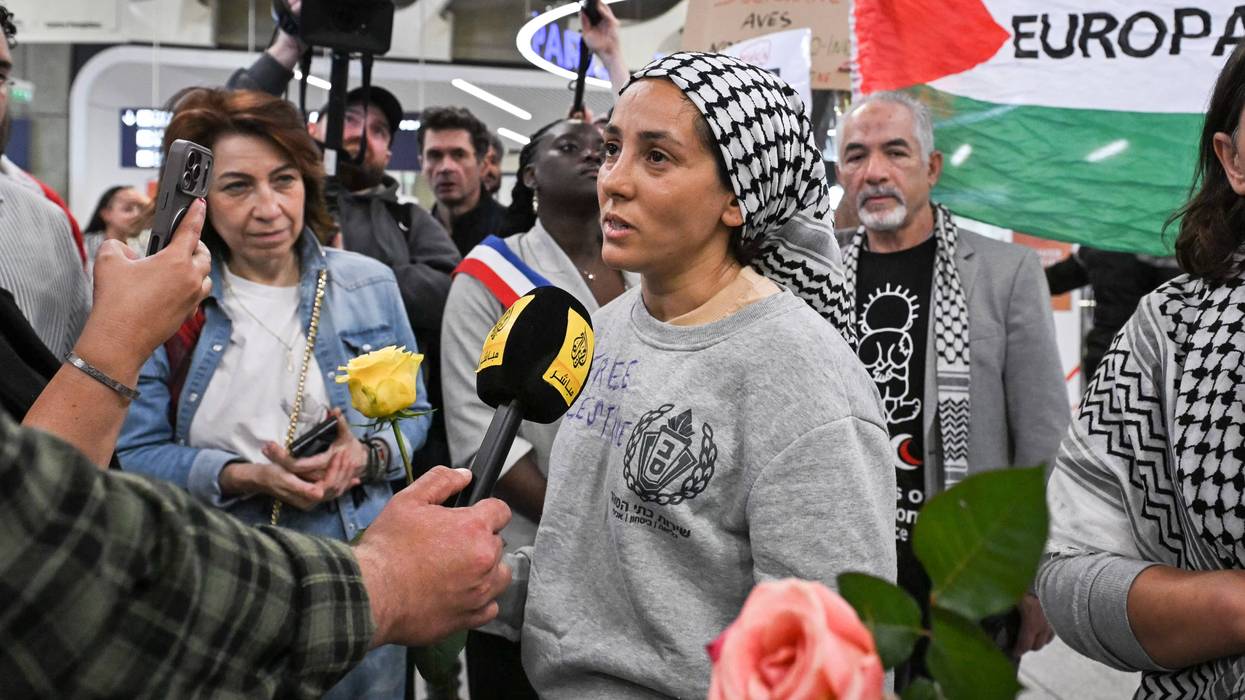
French nationals and people from dozens of countries who were abducted from the Global Sumud Flotilla say they were beaten, tortured, and sexually assaulted by their Israeli captors.
France's government on Friday asked prosecutors to investigate Israel's alleged mistreatment of French nationals aboard the last Global Sumud Flotilla, which was intercepted earlier this month in international waters while trying to break the illegal decadeslong Israeli blockade of Gaza.
“Based on a report I requested from our Consul General in Turkey—who informed me of sexual violence, exposure to the cold, beatings, and repeated humiliation of French nationals—all of these acts are likely to constitute criminal offenses," French Foreign Minister Jean-Noël Barrot said during an interview with France Inter, adding, "I decided yesterday to refer the matter to the public prosecutor."
The move follows France's indefinite ban from its territory of far-right Israeli National Security Minister Itamar Ben-Gvir, who posted a video on social media showing him joyfully humiliating detained activists, journalists, and others who were mostly kneeling with their hands tied behind their backs and their foreheads forced to the ground following the May 18 interception of flotilla vessels off the coast of Cyprus and the abduction of all aboard.
“We cannot tolerate that French nationals can be threatened, intimidated, or brutalized in this way—all the more so by a public official," Barrot said last week.
People from around 40 countries—including 37 French nationals—were seized from dozens of flotilla vessels and held in harsh conditions on what many of them called a "torture boat."
According to Global Sumud Flotilla (GSF): "Detained humanitarians, doctors, and journalists were processed one by one through a darkened shipping container. Inside, groups of three to five soldiers systematically brutalized each person who came through the door while those waiting outside listened to the screams.”
French medical professional Meriem Hadjal said she was "subjected to torture" in the container, where at least one Israeli soldier allegedly sexually assaulted her.
"We were treated like animals," Hadjal added, accusing her Israeli captors of "sadism."
GSF said Tuesday that "legal proceedings are now active in Turkey, Italy, and Spain, with Italian prosecutors opening an investigation into kidnapping and sexual assault" of flotilla members.
Numerous national governments condemned Israel's treatment of the flotilla abductees, including the United States. US Ambassador to Israel Mike Huckabee said that Ben-Gvir "betrayed the dignity" of his nation, which receives billions of dollars in annual armed aid and diplomatic cover from the United States to carry out what many experts say is a genocidal war on Gaza.
Malaysia is reportedly preparing to initiate proceedings against Israel at the International Court of Justice over the abduction and alleged torture of its citizens, 29 of whom were aboard the flotilla. The ICJ is currently weighing a genocide case against Israel filed by South Africa and formally supported by nearly 20 nations.
“We will not remain silent, we will not stop. While the legal team gathers all documentation on violations of international law; they were kidnapped more than once, they were tortured,” Amirudin Shari, chief minister of the Malaysian state of Selangor, said during a homecoming ceremony for the flotilla members at Kuala Lumpur International Airport.
Israeli troops have physically and psychologically tortured past flotilla abductees. Dozens of members of the previous Global Sumud mission required medical attention for broken ribs, noses, and other injuries inflicted by Israeli forces. In 2010, Israeli troops killed nine activists aboard one of the first-ever Gaza flotillas, including Turkish-American teenager Furkan Doğan.
As some countries pursue justice for flotilla members, others have declined to act. In the United Kingdom, Zarah Sultana, who represents Coventry South for the socialist Your Party in Parliament, is demanding "urgent action" in the wake of abuse allegations made by British flotilla abductees.
"France is acting. Spain is showing leadership. Where is the UK government?" Sultana said Friday on X. "Nothing but a simp for Israel, a genocidal apartheid state."
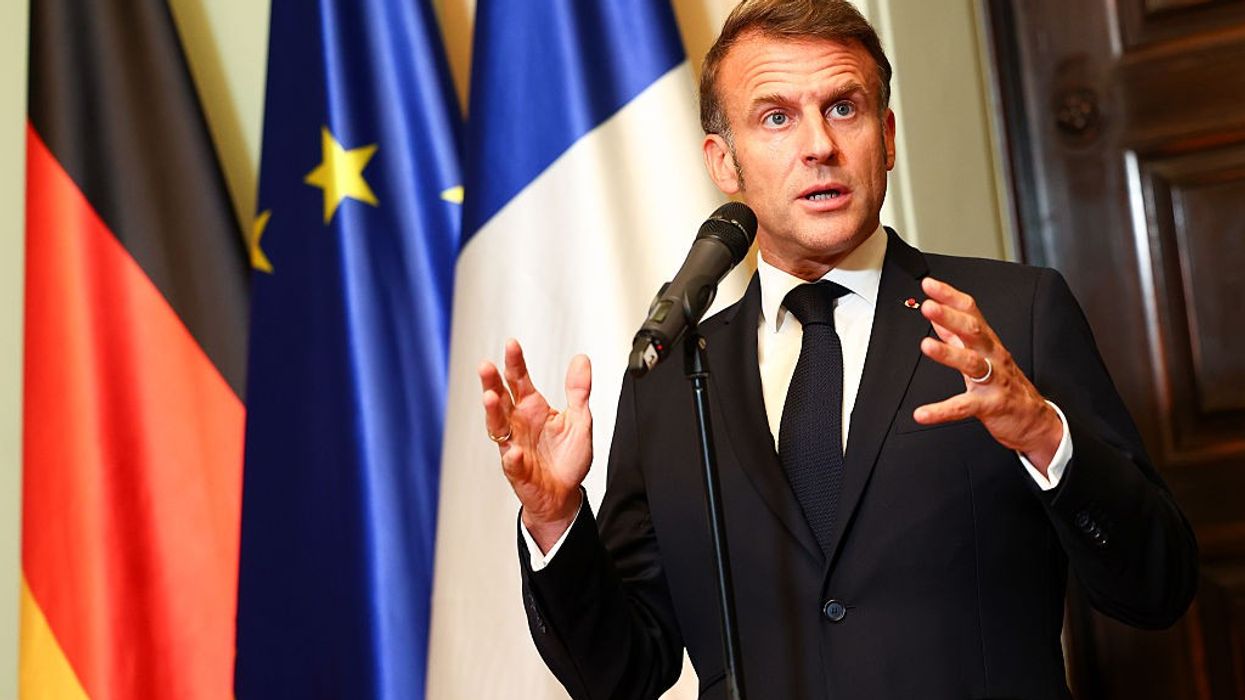
As Macron launches his "green" charm offensive in Nairobi, Africa must move beyond being a passive host.
In a maneuver dripping with historical irony and geopolitical desperation, French President Emmanuel Macron is set to land in Nairobi on May 11. He will be in Kenya to co-host the “Africa Forward Summit: Africa-France Partnership for Innovation and Growth.” To the uninitiated, the title suggests a progressive leap into a shared future.
However, to those who have watched the sun set on Françafrique in the West, the subtext is clear: Having been unceremoniously evicted from its traditional "stomping grounds" in the Sahel, Paris is pitching its tent in East Africa, hunting for new deals to cover the hemorrhaging fortunes of a dying empire. Ahead of his arrival—incidentally on the Ides of March—three French warships docked at the port of Mombasa, carrying with them over 800 military personnel. They were riding on the wave of newfound defense cooperation between the governments of Kenya and France.
The pact focused on maritime security, intelligence cooperation, peacekeeping, humanitarian assistance, disaster relief, and “any other defense or security-related areas of cooperation defined by mutual agreement between parties.” Through this pact, France now has a new hunting ground in East Africa, complete with boots on the ground, sea, and air. Kenya’s 142,400 square kilometers of Exclusive Economic Zone in the Indian Ocean, reputed for riches in fish, oil and gas, is in for a rude shock.
The irony is almost pathological. For over a century, France treated West Africa as a private warehouse. It did not merely colonize; it plundered, looted, and systematically attempted to dismantle the resilient African civilizations that predated its arrival. Its "assimilation" policy remains the most abhorrent, ignoble of colonial concepts; a cultural and political mis-philosophy designed to supplant African languages, customs, and identities with French surrogates.
Africa must stay circumspect. The convergence of military signalling and corporate presence must worry all countries participating in Nairobi. They must watch out for unequal relationships under new language.
When other colonial powers were loosening—however reluctantly—their grip, France was tightening its hold through a web of lopsided financial and military pacts.
With the rising tide of political "wokeness" across the continent, however, France now finds itself sorely ostracized, and endangered. Yet, rather than offering atonement, the French leadership has chosen to grandstand. The mask slipped definitively earlier this year when Macron, frustrated by the anti-French revolts sweeping through former colonies, dropped the pretense of diplomacy. “I think someone forgot to say thank you,” he remarked, with the chilling entitlement of a landlord demanding gratitude for a house he broke into.
Fast forward five months, and this same "savior" is now knocking on East Africa’s door, hat in hand, seeking a "new partnership built on equal ground."
The sudden pivot is driven by a cold reality: France’s "green" future is powered by African minerals. While the lights of Paris stayed bright on the back of Niger’s uranium, Africa remained in the dark.
But as the Nairobi summit approaches, Africa must move beyond being a passive host. If Macron and his European contemporaries truly seek a partnership of equals, they must meet a set of nonnegotiable demands that protect African interests, specifically within the environment and energy sectors.
First, a mandate for local beneficiation and value addition. Africa will no longer be a mere pit stop for raw material extraction. The Nairobi summit must establish a framework where no critical mineral—lithium, cobalt, or uranium—leaves the continent in its raw state.
Africans must demand that French and European companies invest in local processing plants and refineries. If the "Green Transition" requires African minerals, then the "Green Industrialization" must happen on African soil, creating African jobs and keeping the value chain within our borders.
Second, total reform of the financial architecture and the CFA Franc. For a nation that has enforced financial slavery through the CFA Franc since 1945, Macron’s talk of "financial reform" must be met with skepticism.
Africa must demand the total dismantling of the colonial financial umbilical cord. Africa requires a global financial system that does not penalize African nations with "sovereign risk" premiums that make green energy projects three times more expensive here than in Europe. It must demand the unconditional return of foreign reserves held in Paris and a shift toward independent, African-led monetary policies.
Third, energy sovereignty over "green exportation." France proposes to "decarbonize" Africa, yet many of our nations have barely "carbonized" to begin with. African “partners” must demand energy justice. This means the right to achieve universal electrification. Africa must reject a "Green Deal" that forces Africa to export its renewable energy (like green hydrogen) to Europe while her own hospitals and schools remain off the grid.
African energy needs must be met first; European exports come second.
Fourth, technology transfer, not just licensing. True innovation is not found in buying French software; it is found in owning the source code. The Nairobi summit must secure commitments for the unconditional transfer of green technologies. Africa should not be a "market" for European patents; it must be a co-owner of the intellectual property that will define the 21st century.
Fifth, climate reparations and debt cancellation. Already, France is active in "debt-for-development" swaps. Africa must demand that these are not treated as "gifts" but as partial down payments on a century of ecological and economic debt. Africa should also insist on total cancellation of debts that were accrued through colonial-era structures. Climate finance must be provided as grants, not loans that further burden Africa’s children for a climate crisis they did not create.
Sixth, accountability for multinational conglomerates. Total Energies, Orano, and Eramet—over 60 CEOs from French corporations will be attending—must answer tough questions at the summit. They ought to answer for their extractive interests that have historically disadvantaged the continent. Across Africa, communities have borne the environmental, social, and economic costs of such operations, with countries like Mozambique offering stark reminders of the consequences.
The companies must agree to be held to African environmental standards, not just French ones. Africa should pitch for a legal framework that allows communities to sue French corporations in both African and French courts for environmental degradation and human rights abuses.
There can be no "partnership" where companies operate with impunity in the Global South while preaching "environmental and social governance" values in the North.
Seventh, an end to paternalistic "security" pacts. Finally, Africa demands an end to the "policing" of the continent. True peace and security come from economic dignity, not from the over 60 military interventions France has conducted since 1960 to protect its interests. Africa must demand the closure of foreign military bases that serve extractive interests and a shift toward supporting African-led, autonomous security architectures. If partnership means equality, then reciprocity is simple—every French troop granted access and immunity in Africa should be matched by an African troop with the same rights in France
The "New Scramble" is couched in the language of "climate resilience" and "debt-for-development swaps." But beneath these green platitudes lie a hidden quest: to re-establish unfettered access to Africa’s critical minerals.
Africa must stay circumspect. The convergence of military signalling and corporate presence must worry all countries participating in Nairobi. They must watch out for unequal relationships under new language.
What France and its European partners fail to realize is that the "disinherited" continent has found its voice. Africa is no longer interested in being a marginal chapter in a European story, not even with a thousand summits. If President Macron wants a "thank you," he should start by returning what was stolen from Africa and respecting the sovereignty he so arrogantly claimed to have authored. The era of the "political orchestra" directed from Paris is over. The music has changed, and Africa is finally playing its own tune.
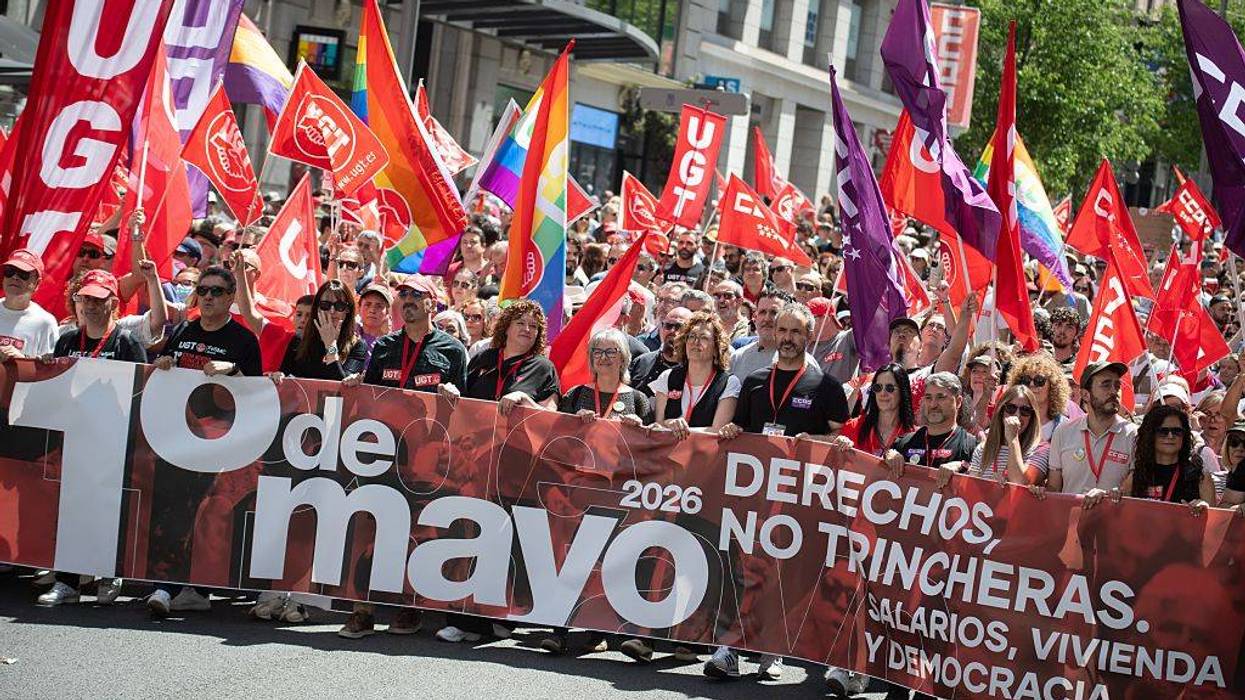
"Working people refuse to pay the price for Donald Trump’s war in the Middle East," said the European Trade Confederation.
May Day demonstrations across the world on Friday denounced the US-Israeli war against Iran, which has caused a global energy crisis that is disproportionately harming working-class people.
Among the earliest May Day demonstrations took place in the Philippines, and a video published by The Associated Press shows protesters clashing with police near the US Embassy in the capital city of Manila.
While many demonstrators held signs that referenced local issues, American foreign policy was also a major focus of the protesters, as marchers in Manila carried a large banner that read, "Down With US Imperialism."
Josua Mata, leader of the SENTRO umbrella group of labor federations, told The Associated Press that the war with Iran was a central focus of protests because of the impact it's had on energy costs.
"Every Filipino worker now is aware that the situation here is deeply connected to the global crisis," Mata explained.
Indonesian President Prabowo Subianto attended a May Day rally held in the capital of Jakarta, where Jakarta Globe reported that he announced a host of worker-friendly policies including plans "to build daycare facilities for workers’ children and accelerate the construction of at least 1 million homes."
France 24 reported that hundreds of demonstrators in Istanbul, Turkey were arrested after attempting to march to the city's iconic Taksim Square, which police had sealed off.
The Turkish Contemporary Lawyers’ Association (ÇHD) said on Friday afternoon that at least 350 demonstrators in Istanbul have been detained as a result of the protests, with hundreds more potentially in custody.
May Day demonstrations are also taking place across Europe, with many demonstrators blaming US President Donald Trump's war for the deterioration of workers' living standards.
The European Trade Union Confederation, which represents 93 trade union organizations in 41 European countries, released a statement declaring that "working people refuse to pay the price for Donald Trump’s war in the Middle East," adding that "today’s rallies show working people will not stand by and see their jobs and living standards destroyed."
Trump is also facing protests at home, with more than 4,000 "May Day Strong" events planned across the United States.
Daniel Bertossa, general secretary for Public Services International, said this year's May Day demonstrations are providing a desperately needed backlash to power grabs being made by the global billionaire class.
Bertossa pointed to the US-Israel attack on Iran, as well as Trump's repeated threats to invade Greenland, as key turning points that have pushed workers to organize and fight back.
"Rising living costs caused by the war are now driving anger among working-class people and producing a rare and powerful moment to connect and educate," said Bertossa. "Fascists don't have the answers to the economic pain they exploited to get elected—international affairs impact us all—and international working-class solidarity matters."
Bertossa added that "May Day is a vivid reminder that working-class politics is not a spectator sport," and "we have never won by watching, waiting, or relying on great power leaders to gift us our future."
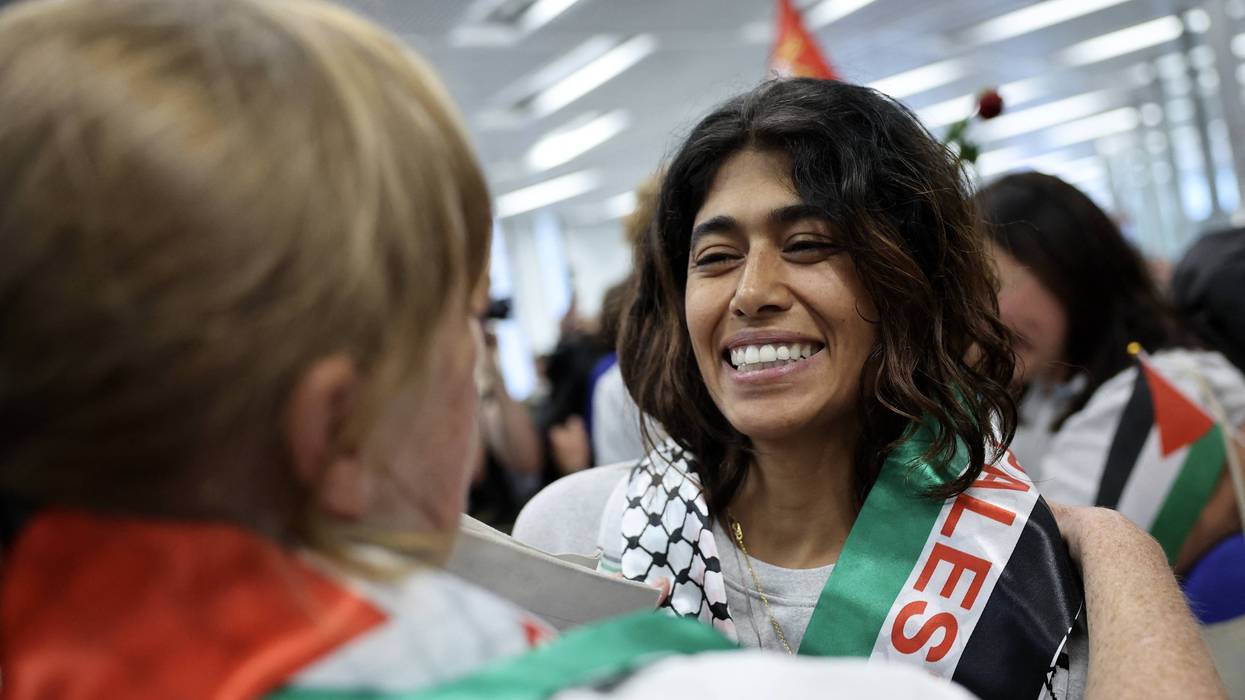
Police in Paris apprehended and briefly detained European Parliament Member Rima Hassan Thursday on suspicion of "apology for terrorism"—an allegation critics slammed as "judicial harassment" aimed at silencing her outspoken criticism of Israel's genocidal war on Gaza and the French government's support for it.
Hassan, who represents the leftist La France Insoumise (LFI, or France Unbowed in English) party in the European Parliament, was summoned as part of an investigation by the National Center for Combating Online Hate (PNLH), Le Parisiene first reported.
The newspaper also reported that "a few grams" of a synthetic drug—possibly 3-MMC—were found on Hassan, allegations that sparked skeptical reactions.
PNLH is probing a since-deleted March 26 post on the social media site X in which Hassan referred to Kōzō Okamoto, a member of the Japanese Red Army who, along with two others, killed 26 people and wounded 80 more in the name of Palestinian liberation during a 1972 massacre at Lod Airport in Israel.
Hassan, a descendant of Palestinians ethnically cleansed from their homeland during the foundation of the modern Israeli state, was born in a refugee camp in Syria and emigrated to France as a child.
The Sorbonne-educated jurist was one of the leaders of the June 2025 Gaza Freedom Flotilla Madleen mission, along with climate campaigner Greta Thunberg and others. Hassan and others aboard the Madleen were intercepted by Israeli forces and arrested in international waters as they attempted to deliver food, children’s prosthetics, and other desperately needed supplies to Gaza’s besieged and starving people. Hassan said that she was beaten in Israeli custody.
While far-right and pro-Israel French lawmakers celebrated Hassan's detention and called for her to be stripped of parliamentary immunity, Palestine defenders condemned the arrest.
"Once again, the offense of glorifying terrorism is being used to repress a Palestinian activist known worldwide for her fight against genocide," said leftist lawyer Elsa Marcel. "While Israel bombs Iran and Lebanon and colonization accelerates in the West Bank, the French state continues to repress the voices fighting for the liberation of Palestine. Immediate release!"
LFI French National Assembly Member Gabrielle Cathala voiced her "full support for Rima Hassan" in a post on X.
"In violation of her parliamentary immunity, she is currently being held in custody for a simple tweet that had nothing to do with 'apology for terrorism,'" she wrote. "This judicial harassment must stop."
"If this is already happening, just imagine what would occur in the event of a vote on the Yadan Law," Cathala added, referring to a highly controversial bill critics say would criminalize anti-Zionism by conflating opposition to Israel with animus toward Jewish people, aligning with the dubious International Holocaust Remembrance Alliance Working Definition of Antisemitism.
Soutien à ma camarade et collègue Rima Hassan, en garde à vue pour un tweet, alors que le génocide à Gaza se poursuit et que les palestinien•nes subissent désormais un apartheid par le gouvernement d’extrême droite israélien.
[image or embed]
— François Piquemal (@francoispiquemal.bsky.social) April 2, 2026 at 6:51 AM
Jean-Luc Mélenchon, the de facto LFI leader and a former European Parliament member, said on Bluesky: "The political police have once again summoned Rima Hassan for questioning regarding a retweet from March. Parliamentary immunity, then, no longer exists in France."
"It is intolerable," he added. "The Yadan Law was not passed—yet is it already being enforced?"
Hassan was previously summoned by authorities following a December 2024 complaint over social media posts, including one in which she asserted, “If Franco-Israelis are allowed to serve in the Israeli army while enjoying the gains of dual citizenship, every Franco-Palestinian must be able to join the Palestinian armed resistance, the legitimacy of which is recognized by [United Nations] resolutions on the right to self-determination of peoples."
Since she started speaking out against the Gaza genocide, Hasan has been subjected to online bullying, including death and rape threats and doxing.
Last week, Hassan was denied entry into Canada—where she was scheduled to speak at multiple conferences in Montréal and meet with left-wing pro-Palestine members of Québec's National Assembly—following concerns from the pro-Israel groups B’nai Brith Canada and the Center for Israel and Jewish Affairs. Hassan attended the conferences remotely.
“The revocation of [Hassan's] travel authorization is part of a worrying trend of restricting freedom of expression and movement of political representatives," LFI said in a statement, "as well as part of a broader pattern of censorship affecting democratic debate."
Other Palestine defenders have been targeted by the French government, including Olivia Zemor, president of the advocacy group Europalestine, who last week was hit with a 24-month suspended sentence for "apology for terrorism" due to her support for Palestinian rights.
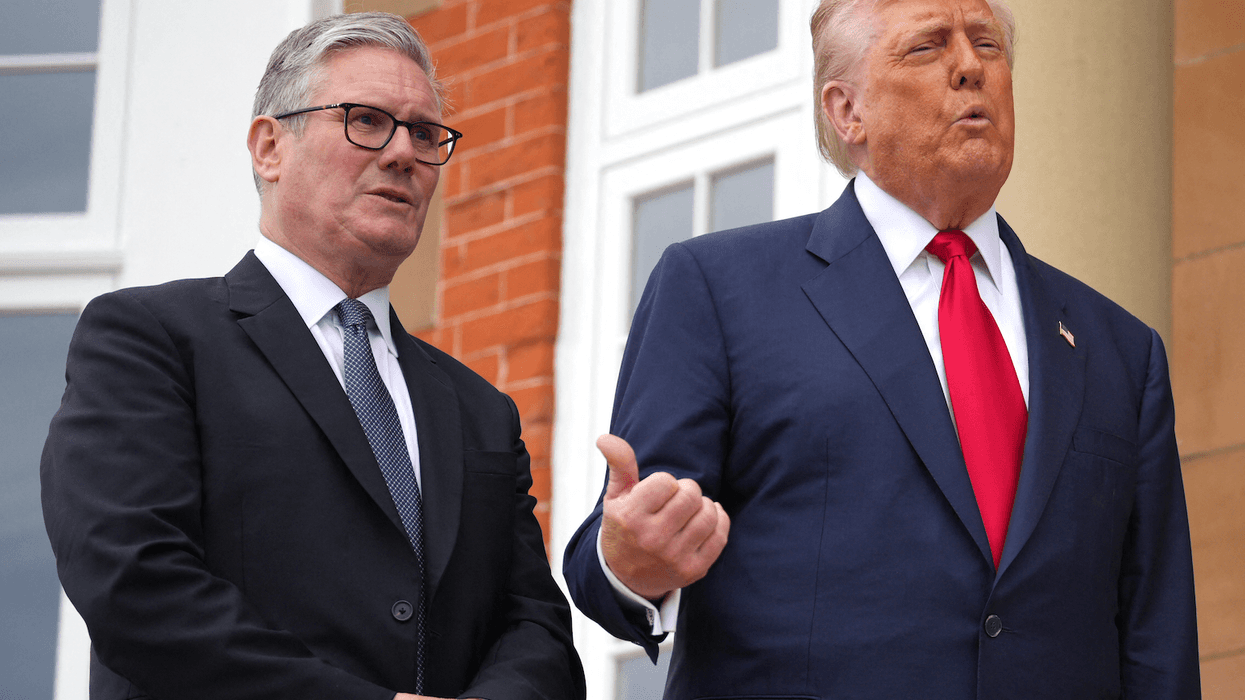
"The unspoken implication of the focus on diplomacy is that if Trump walks away without reopening the strait and without a deal with Iran, then Tehran holds the cards," said one observer.
As President Donald Trump lambasts European allies over their reluctance to be dragged into his illegal war of choice against Iran and reportedly mulls leaving the North Atlantic Treaty Organization, UK Prime Minister Keir Starmer announced Wednesday that Britain will host talks involving 35 nations—but not the US—on reopening the Strait of Hormuz via diplomacy.
Starmer said the talks, a continuation of UK-French efforts to secure safe passage for ships in the key waterway—through which around a quarter of the world's oil transits—would bring together nations to "assess all viable diplomatic and political measures we can take to restore freedom of navigation, guarantee the safety of trapped ships and seafarers, and to resume the movement of vital commodities."
Iran's Islamic Revolutionary Guards Corps said Wednesday that the Strait of Hormuz would remain closed to “enemies of this nation” and that the waterway is "firmly and dominantly" under its control, despite Trump's repeated claims that an end to the war is approaching.
Trump lashed out Tuesday at European leaders amid resistance tof the US-Israeli war on Iran, telling them to "go get your own oil" and calling them "cowards" who will "have to start learning how to fight" for themselves, because the US "won’t be there to help you anymore, just like you weren’t there for us."
Trump's tirade came amid reports that France, Italy, and Spain have either banned US warplanes from their airspace or from using bases in their countries. Spain announced Monday that its airspace is off limits to US aircraft involved in the Iran war, which socialist Spanish Prime Minister Pedro Sánchez and other officials in Madrid have condemned as illegal.
Italy also contends that the war on Iran is illegal and has denied US warplanes permission to land at the Sigonella air base in Sicily before heading to the Middle East, while France on Wednesday refuted claims by Trump that it is preventing US military planes from flying over its territory.
The Telegraph reported Wednesday that Trump is seriously considering withdrawing from the North Atlantic Treaty Organization, the alliance formed in 1949 to counter growing Soviet power in Europe, telling the British newspaper that NATO is "a paper tiger."
Secretary of State Marco Rubio also weighed in on the matter, telling Fox News host Sean Hannity Tuesday evening that "we’re going to have to reexamine the value of NATO."
“If now we have reached a point where the NATO alliance means that we can’t use those bases, that in fact we can no longer use those bases to defend America’s interests, then NATO is a one-way street,” he added.
It is unclear how Trump would attempt to quit the alliance, a move that would require the unlikely approval of Congress. In 2023, lawmakers passed legislation requiring their permission to leave NATO—a direct response to Trump's previous threats to do so.
Responding to Trump's NATO remarks, Starmer said during a Wednesday press conference that the UK remains "fully committed" to the pact.
“NATO is the single most effective military alliance the world has ever seen," the Labour leader asserted. “It has kept us safe for many decades."
"Whatever the pressure on me and others, whatever the noise, I'm going to act in the British national interest," Starmer continued. "And that's why I have been absolutely clear that this is not our war, and we're not going to get dragged into it. But I'm equally clear that when it comes to defense and security, and our economic future, we have to have closer ties with Europe."
Some critics have pushed back against Starmer's argument that it's not Britain's war, noting that his government is allowing US forces to use bases in the UK to launch attacks on Iran.
Leftist and anti-war critics have long argued that NATO—which was formed to counter a Soviet threat that ceased to exist 35 years ago—is unnecessary and helped provoke Russia's illegal invasion of Ukraine. Proponents of the alliance say it is key to the unprecedented peace and prosperity enjoyed by most Europeans during the post-World War II era.
Responding to Starmer's remarks, UK Green Party leader Zack Polanski urged the prime minister to "show leadership" by ending all involvement in the Iran War and stopping the upcoming state visit to the United States by King Charles III, whose family, like the British state in general, has enriched itself through centuries of imperialism, slavery, and war.
“Starmer must end this involvement in Iran and stop the King's visit to the USA.”@zackpolanski.bsky.social calls on Starmer to show leadership - stop UK involvement in illegal wars, refuse concessions to Trump, and oppose normalising fascism through inappropriate state visits.
[image or embed]
— The Green Party of England & Wales (@greenparty.org.uk) April 1, 2026 at 7:00 AM
The NATO alliance has been tested before. France, Italy, and Spain denied US warplanes overflight privileges during then-President Ronald Reagan's 1986 bombing of Libya, and in 2003 a much deeper rift emerged over then-President George W. Bush's unprovoked US regime change war in Iraq. Some US allies—including the UK, Italy, and Spain—took part in the invasion and occupation of Iraq, while others, led by France, vehemently opposed the illegal war of choice.
Starmer's signaling of closer ties to Europe comes a decade after Britons voted to leave the European Union. There is considerable regret over the so-called Brexit, with more than 6 in 10 respondents to a September 2025 Best for Britain survey saying it was a mistake to leave the EU and just 11% calling the move a success.
The transatlantic tensions come as Trump claimed Wednesday on his Truth Social network that Iran "has just asked the United States of America for a CEASEFIRE!"
Echoing Defense Secretary Pete Hegseth's repeated assertion that the US is "negotiating with bombs," Trump added: "We will consider [a ceasefire] when Hormuz Strait is open, free, and clear. Until then, we are blasting Iran into oblivion or, as they say, back to the Stone Ages!!!"
Nearly 2,000 Iranians have been killed over 33 days of US and Israeli bombing, according to officials there. On Friday, a coalition of human rights groups said that nearly 1,500 civilians, including 217 children, have been killed—many of them in the February 28 US cruise missile massacre at a girls' school in Minab that killed around 175 people.
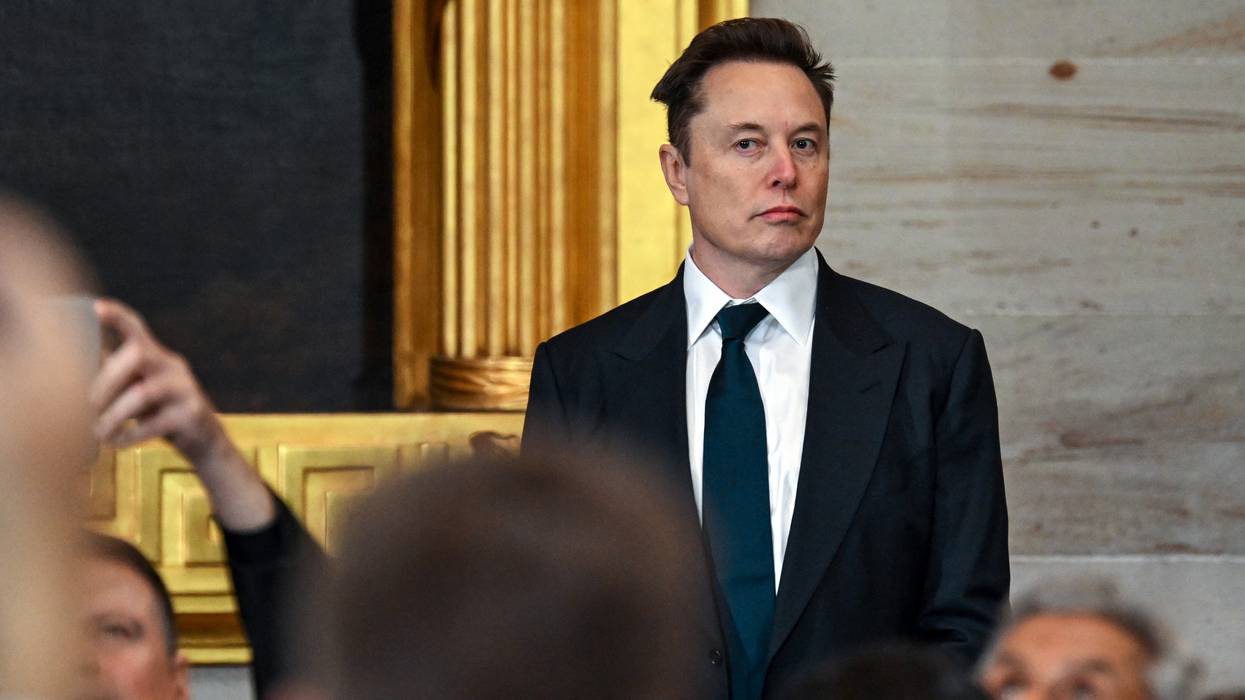
"Musk is not cloaked in some federal immunity just because he's off-again/on-again buddies with Trump."
Elon Musk is facing calls for legal ramifications after Grok, the AI chatbot used on his X social media platform, produced sexually suggestive images of children.
Politico reported on Friday that the Paris prosecutor's office in France is opening an investigation into X after Grok, following prompts from users, created deepfake photographs of both adult women and underage girls that removed their clothes and replaced them with bikinis.
Politico added that the investigation into X over the images will "bolster" an ongoing investigation launched by French prosecutors last year into Grok's dissemination of Holocaust denial propaganda.
France is not the only government putting pressure on Musk, as TechCrunch reported on Friday that India's information technology ministry has given X 72 hours to restrict users' ability to generate content deemed "obscene, pornographic, vulgar, indecent, sexually explicit, pedophilic, or otherwise prohibited under law."
Failure to comply with this order, the ministry warned, could lead to the government ending X's legal immunity from being sued over user-generated content.
In an interview with Indian cable news network CNBC TV18, cybersecurity expert Ritesh Bhatia argued that legal liability for the images generated by Grok should not just lie with the users whose prompts generated them, but with the creators of the chatbot itself.
"When a platform like Grok even allows such prompts to be executed, the responsibility squarely lies with the intermediary," said Bhatia. "Technology is not neutral when it follows harmful commands. If a system can be instructed to violate dignity, the failure is not human behavior alone—it is design, governance, and ethical neglect. Creators of Grok need to take immediate action."
Corey Rayburn Yung, a professor at the University of Kansas School of Law, argued on Bluesky that it was "unprecedented" for a digital platform to give "users a tool to actively create" child sexual abuse material (CSAM).
"There are no other instances of a major company affirmatively facilitating the production of child pornography," Yung emphasized. "Treating this as the inevitable result of generative AI and social media is a harrowing mistake."
Andy Craig, a fellow at the Institute for Humane Studies, said that US states should use their powers to investigate X over Grok's generation of CSAM, given that it is unlikely the federal government under President Donald Trump will do so.
"Every state has its equivalent laws about this stuff," Craig explained. "Musk is not cloaked in some federal immunity just because he's off-again/on-again buddies with Trump."
Grok first gained the ability to generate sexual content this past summer when Musk introduced a new "spicy mode" for the chatbot that was immediately used to generate deepfake nude photos of celebrities.
Weeks before this, Grok began calling itself "MechaHitler" after Musk ordered his team to make tweaks to the chatbot to make it more "politically incorrect."