`; document.body.appendChild(el); return el; } const bubble = ensureBubble(); const elH = bubble.querySelector("#tt-title"); const elB = bubble.querySelector("#tt-body"); const elClose = bubble.querySelector(".tt-close"); // ---------------- Parse [[term|heading|body]] anywhere ---------------- const TOKEN_RE = /\[\[([^|\]]+)\|([^|\]]+)\|([^\]]+)\]\]/g; const BLOCK_SKIP = new Set(["SCRIPT","STYLE","NOSCRIPT","TEXTAREA","INPUT","SELECT","CODE","PRE","TEMPLATE","IFRAME"]); function shouldSkipTextNode(n){ let el = n.parentElement; while (el){ if (BLOCK_SKIP.has(el.tagName) || el.isContentEditable) return true; el = el.parentElement; } return false; } const walker = document.createTreeWalker(document.body, NodeFilter.SHOW_TEXT); const textNodes = []; while (walker.nextNode()){ const n = walker.currentNode; if (!n.nodeValue || shouldSkipTextNode(n)) continue; if (TOKEN_RE.test(n.nodeValue)) textNodes.push(n); TOKEN_RE.lastIndex = 0; } textNodes.forEach(node => { const frag = document.createDocumentFragment(); const insideLink = !!node.parentElement.closest("a"); let text = node.nodeValue, last = 0; TOKEN_RE.lastIndex = 0; let m; while ((m = TOKEN_RE.exec(text))){ if (m.index > last) frag.appendChild(document.createTextNode(text.slice(last, m.index))); const term=m[1].trim(), heading=m[2].trim(), body=m[3].trim(); const t = insideLink ? document.createElement("span") : document.createElement("button"); if (insideLink){ t.setAttribute("role","button"); t.setAttribute("tabindex","0"); } else { t.type="button"; } t.className="tt-trigger"; t.textContent=term; t.setAttribute("data-tt-h", heading); t.setAttribute("data-tt-b", body); t.setAttribute("aria-haspopup","dialog"); t.setAttribute("aria-expanded","false"); frag.appendChild(t); last = TOKEN_RE.lastIndex; } if (last = 2) return el; el = el.parentElement; } // Fallback: nearest non-inline container el = trigger.parentElement || document.body; while (el && el !== document.body){ const d = getComputedStyle(el).display; if (d !== "inline" && d !== "contents") return el; el = el.parentElement; } return document.body; } // Utility: child of `ancestor` that contains `target` (direct child) function directChildContaining(ancestor, target){ for (const ch of ancestor.children){ if (ch === target || ch.contains(target)) return ch; } return null; } function getElementTarget(e) { // If target is already an Element, use it if (e.target instanceof Element) return e.target; // Otherwise, walk the composed/path for the first Element const path = (typeof e.composedPath === 'function') ? e.composedPath() : []; for (const n of path) if (n instanceof Element) return n; return null; } // ---------------- Dim everything except the trigger branch (sibling branches only) ---------------- function dimAllOtherBranches(container, trigger){ undim(); // clear previous const dimEls = []; const wrappedTexts = []; const pathEls = []; // Build ELEMENT-only path [container -> ... -> trigger] const path = []; for (let el = trigger; el && el !== container; el = el.parentElement) path.push(el); path.push(container); path.reverse(); // At each ancestor level, find the *direct* child that leads to the trigger for (let i = 0; i { if (node.nodeType !== 3) return; // text only if (!node.nodeValue || !node.nodeValue.trim()) return; // If this text node sits inside branchChild, skip if (branchChild && branchChild.contains && branchChild.contains(node)) return; const span = document.createElement("span"); span.style.transition = `opacity ${DIM_EASE_MS}ms ease`; span.style.opacity = String(DIM_OPACITY); span.textContent = node.nodeValue; node.parentNode.replaceChild(span, node); wrappedTexts.push(span); }); // Keep a reference to the path elements (so we can explicitly restore opacity if needed) if (anc && anc.nodeType === 1) pathEls.push(anc); } // Hard-guard: explicitly set opacity:1 on the entire path to neutralize any inherited fade pathEls.forEach(el => { el.style.opacity = "1"; }); dimCtx = { container, dimEls, wrappedTexts, pathEls }; } function undim(){ if (!dimCtx) return; const { dimEls, wrappedTexts, pathEls } = dimCtx; // Animate back dimEls.forEach(el => { el.style.transition = `opacity ${DIM_EASE_MS}ms ease`; el.style.opacity = "1"; // remove inline style after the animation so we don't override site CSS setTimeout(() => { if (el) el.style.opacity = ""; }, DIM_EASE_MS + 50); }); wrappedTexts.forEach(span => { span.style.transition = `opacity ${DIM_EASE_MS}ms ease`; span.style.opacity = "1"; span.addEventListener("transitionend", () => { if (!span.parentNode) return; span.parentNode.replaceChild(document.createTextNode(span.textContent || ""), span); }, { once:true }); }); // Clear hard-guard on path pathEls.forEach(el => { if (el) el.style.opacity = ""; }); dimCtx = null; } // ---------------- Positioning (centered, edge-aware, flip) ---------------- function clamp(v,min,max){ return Math.max(min,Math.min(max,v)); } function measureBubbleForPlacement(){ const wasOpen = bubble.classList.contains("is-open"); if (!wasOpen){ bubble.style.visibility="hidden"; bubble.classList.add("is-open"); } const rect = bubble.getBoundingClientRect(); if (!wasOpen){ bubble.classList.remove("is-open"); bubble.style.visibility=""; } return { w: rect.width, h: rect.height }; } function placeAnchored(trigger){ const vw=innerWidth, vh=innerHeight; const r = trigger.getBoundingClientRect(); const { w, h } = measureBubbleForPlacement(); let left = r.left + (r.width/2) - (w/2); left = clamp(left, EDGE_PADDING, Math.max(EDGE_PADDING, vw - EDGE_PADDING - w)); const topBelow = r.bottom + OFFSET_Y; const spaceBelow = vh - topBelow - EDGE_PADDING; const placeBelow = spaceBelow >= h; let top = placeBelow ? topBelow : (r.top - h - OFFSET_Y); top = clamp(top, EDGE_PADDING, Math.max(EDGE_PADDING, vh - EDGE_PADDING - h)); bubble.style.left = left + "px"; bubble.style.top = top + "px"; const br = bubble.getBoundingClientRect(); if (br.bottom > vh - EDGE_PADDING){ bubble.style.maxHeight = (vh - 2*EDGE_PADDING) + "px"; bubble.style.overflowY = "auto"; } else { bubble.style.maxHeight = "none"; bubble.style.overflowY = "visible"; } } // ---------------- Open / Close (place → fade/scale) ---------------- function animateIn(){ bubble.style.transition = "none"; bubble.style.opacity = "0"; bubble.style.transform = "scale(0.95)"; void bubble.offsetWidth; bubble.style.transition = "opacity .18s ease, transform .18s ease"; bubble.style.opacity = "1"; bubble.style.transform = "scale(1)"; } function animateOut(done){ bubble.style.transition = "opacity .16s ease, transform .16s ease"; bubble.style.opacity = "0"; bubble.style.transform = "scale(0.95)"; const end = () => { bubble.removeEventListener("transitionend", end); done && done(); }; bubble.addEventListener("transitionend", end); setTimeout(end, 260); } function openFromTrigger(trigger){ if (current && current !== trigger) forceClose(); current = trigger; trigger.setAttribute("aria-expanded","true"); elH.textContent = trigger.getAttribute("data-tt-h") || ""; elB.textContent = trigger.getAttribute("data-tt-b") || ""; bubble.classList.add("is-open"); bubble.setAttribute("aria-hidden","false"); placeAnchored(trigger); animateIn(); const container = findTextContainer(trigger); dimAllOtherBranches(container, trigger); hoverCount = 0; cancelCloseTimer(); } function forceClose(){ if (!current) return; bubble.classList.remove("is-open"); bubble.setAttribute("aria-hidden","true"); current.setAttribute("aria-expanded","false"); current = null; undim(); hoverCount = 0; cancelCloseTimer(); } function closeWithAnim(){ if (!current) return; const t = current; animateOut(() => { bubble.classList.remove("is-open"); bubble.setAttribute("aria-hidden","true"); t.setAttribute("aria-expanded","false"); current = null; undim(); }); } function scheduleClose(){ cancelCloseTimer(); closeTimer = setTimeout(() => { if (hoverCount { if (isCoarse()) return; const target = getElementTarget(e); if (!target) return; const t = target.closest(".tt-trigger"); if (!t) return; onZoneEnter(); if (!current || current !== t) openFromTrigger(t); }; const handleLeave = (e) => { if (isCoarse()) return; const target = getElementTarget(e); if (!target) return; const t = target.closest(".tt-trigger"); if (!t) return; onZoneLeave(); }; document.addEventListener("pointerenter", handleEnter, true); document.addEventListener("mouseenter", handleEnter, true); document.addEventListener("pointerleave", handleLeave, true); document.addEventListener("mouseleave", handleLeave, true); // ---------------- Keyboard ---------------- document.addEventListener("focusin", (e) => { if (!e.target) return; const t = e.target.closest(".tt-trigger"); if (t) openFromTrigger(t); }); document.addEventListener("focusout", (e) => { if (!e.target) return; const t = e.target.closest(".tt-trigger"); if (t && current === t) closeWithAnim(); }); // ---------------- Mobile / coarse ---------------- document.addEventListener("pointerdown", (e) => { if (!isCoarse()) return; const t = e.target.closest(".tt-trigger"); if (!t) return; e.preventDefault(); e.stopPropagation(); if (current === t && bubble.classList.contains("is-open")) { closeWithAnim(); return; } openFromTrigger(t); }, true); document.addEventListener("click", (e) => { if (!isCoarse()) return; if (!bubble.classList.contains("is-open")) return; const inBubble = !!e.target.closest(".tt-bubble"); const onTrigger = !!e.target.closest(".tt-trigger"); if (!inBubble && !onTrigger) closeWithAnim(); }, true); // Close button + ESC elClose.addEventListener("click", closeWithAnim); document.addEventListener("keydown", (e) => { if (e.key === "Escape") closeWithAnim(); }); // Reposition on resize/scroll while open const reposition = () => { if (!current) return; placeAnchored(current); }; addEventListener("resize", reposition, { passive: true }); addEventListener("scroll", reposition, { passive: true }); });
Beta
Next

Introducing @Claude

@Claude reacts in real time, where the work is happening. Available today for Claude Enterprise and Team in Slack. Tag it in, and it tags you back.

Read more
@Claude beta

Tag Claude in Slack

@Claude reads threads, understands the full context, and reacts in real time so your team moves forward together. Bring Claude into your channel.

Add to Slack
Read documentation

Available in beta for Claude Enterprise and Team in Slack.

Play video

“Claude Tag is our first responder for internal bugs. It reads incoming reports, looks at screenshots of failures, and uses access to Datadog, Linear, and GitHub to weed out user errors, trace root cause, and often draft a fix PR. Our engineers’ first reaction was ‘this is amazing.’”

Aabhas Sharma, CTO

“Claude Tag turned a summer of conference logistics — the follow-ups and chasing that always fell through the cracks — into an events program that runs itself while I stay on strategy.”

Matthew Scott, Product Marketing

“Claude Tag doesn’t just do the work — it challenges our thinking, provokes better questions, and elevates our judgement rather than replacing it. And we still feel very much in control throughout.”

Simon Mansfield, Director, Enterprise AI

“There were no skeptics on our team. Everyone leaned in from day one — it felt like Claude Tag in Slack was something they’d been waiting for.”

Darian Bailey, AI Engineer & Tag Admin

“Claude Tag meets our teams where they already work. Slack is the entry point for everything at Gusto, and the fact that Claude Tag is native there is huge for us. We see a lot of potential here.”

Chad Kunsman, AI Developer
Prev
0/5
Next

How it works

Tag Claude into any thread, no matter how long or messy. It reacts to context, decisions, or open questions to help busy teams get more done.

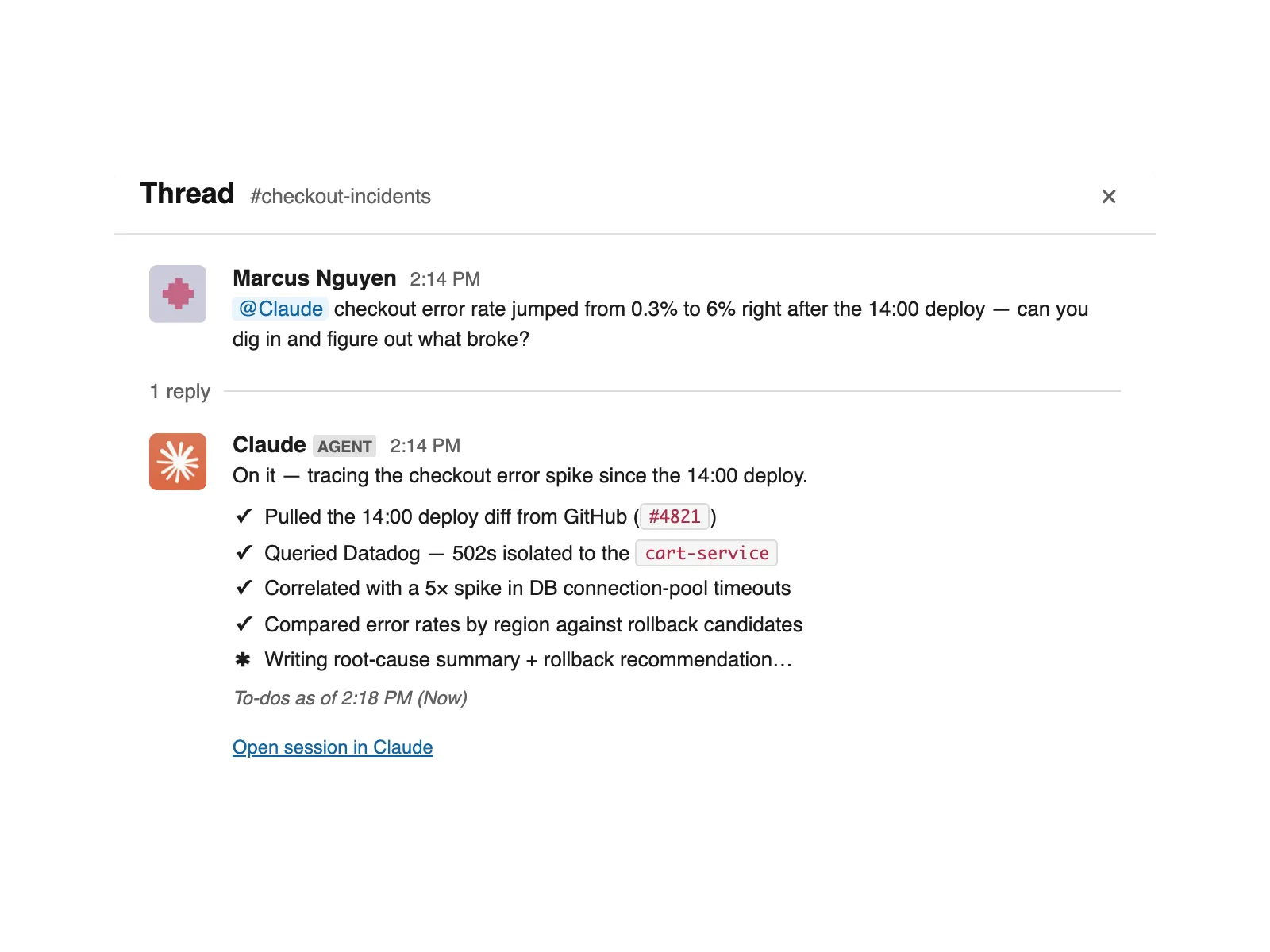
Tag it in

@Claude in any thread or channel and it picks up the context everyone already shares. Ask it to run the numbers, file a ticket, or organize a chaotic chat into action items. It reads the room and does the work.
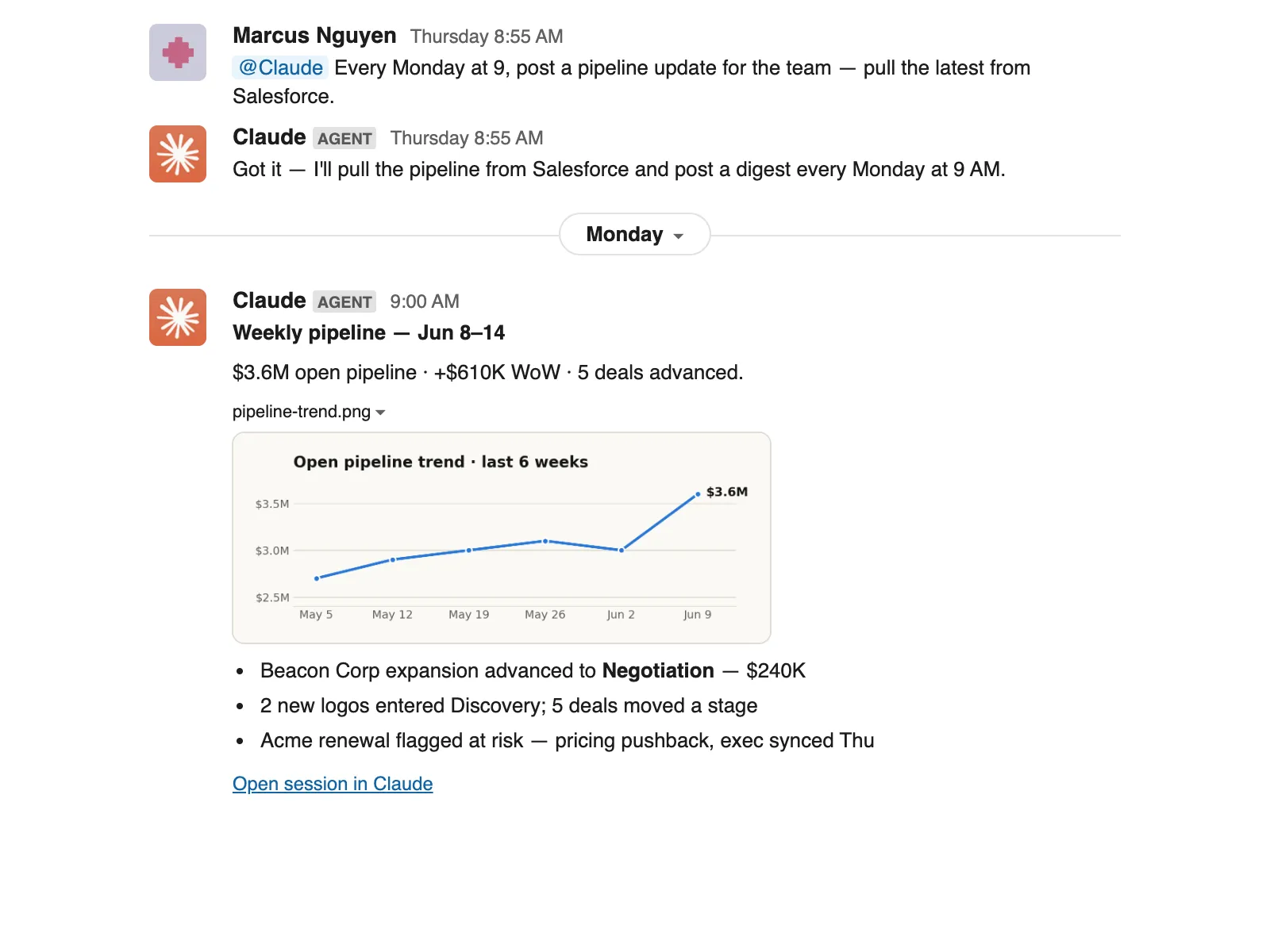
Set a schedule or let it run long tasks

Give @Claude standing instructions and it works without a mention now or in the future. Ask it to watch a channel, run a weekly digest, flag anything urgent, or page the right person.
It jumps in, and can tag you back

@Claude doesn't wait to be asked. It surfaces the thread that went quiet, posts when the deploy is live, and flags the decision that needs your call.
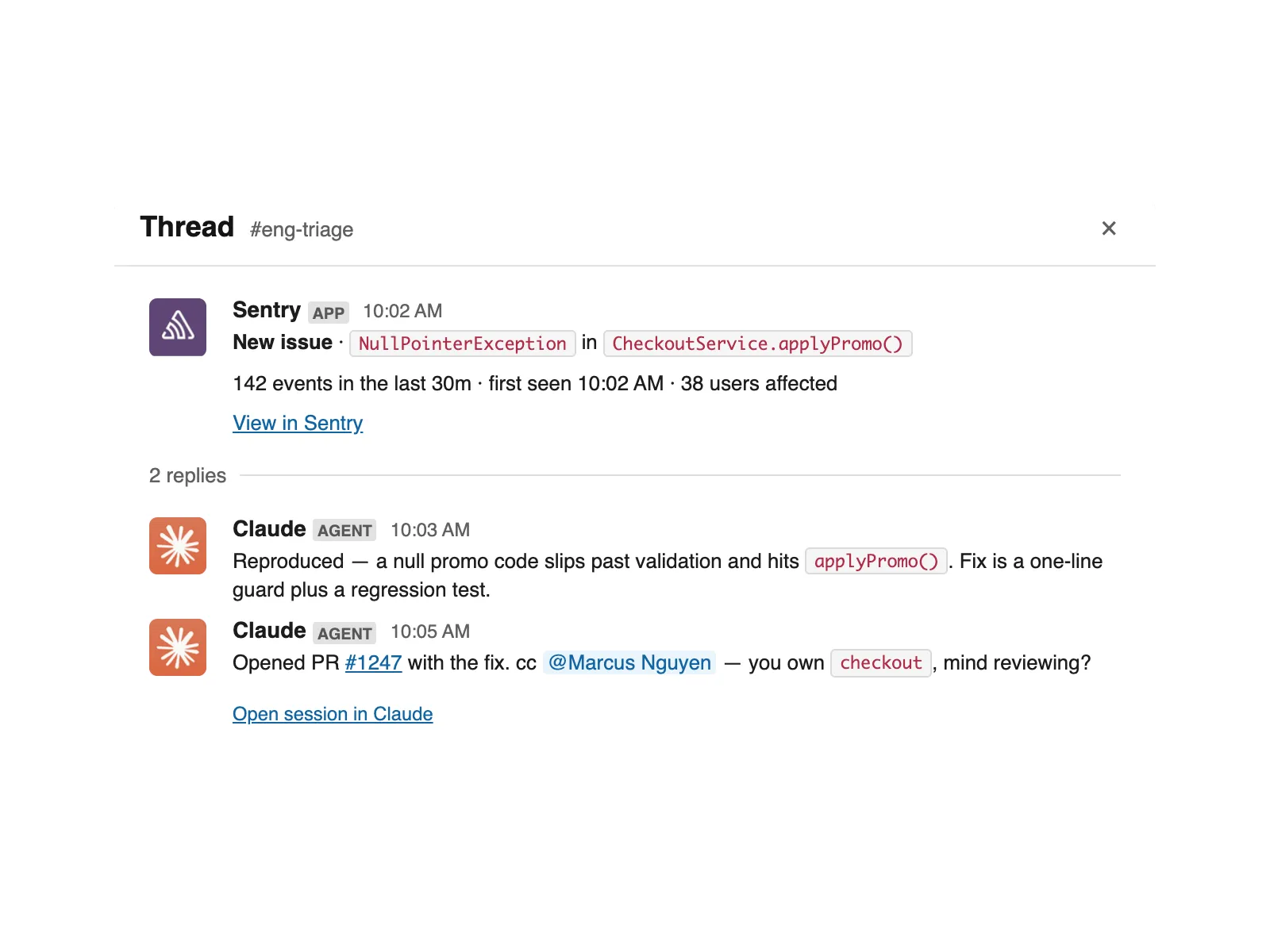
How teams use @Claude

Claude can share work in the format your team needs, right in the thread.

Catch up fast

Get everything you need from a long thread in seconds. @Claude can surface decisions, open questions, and stakeholders, and you see exactly what's waiting on you.
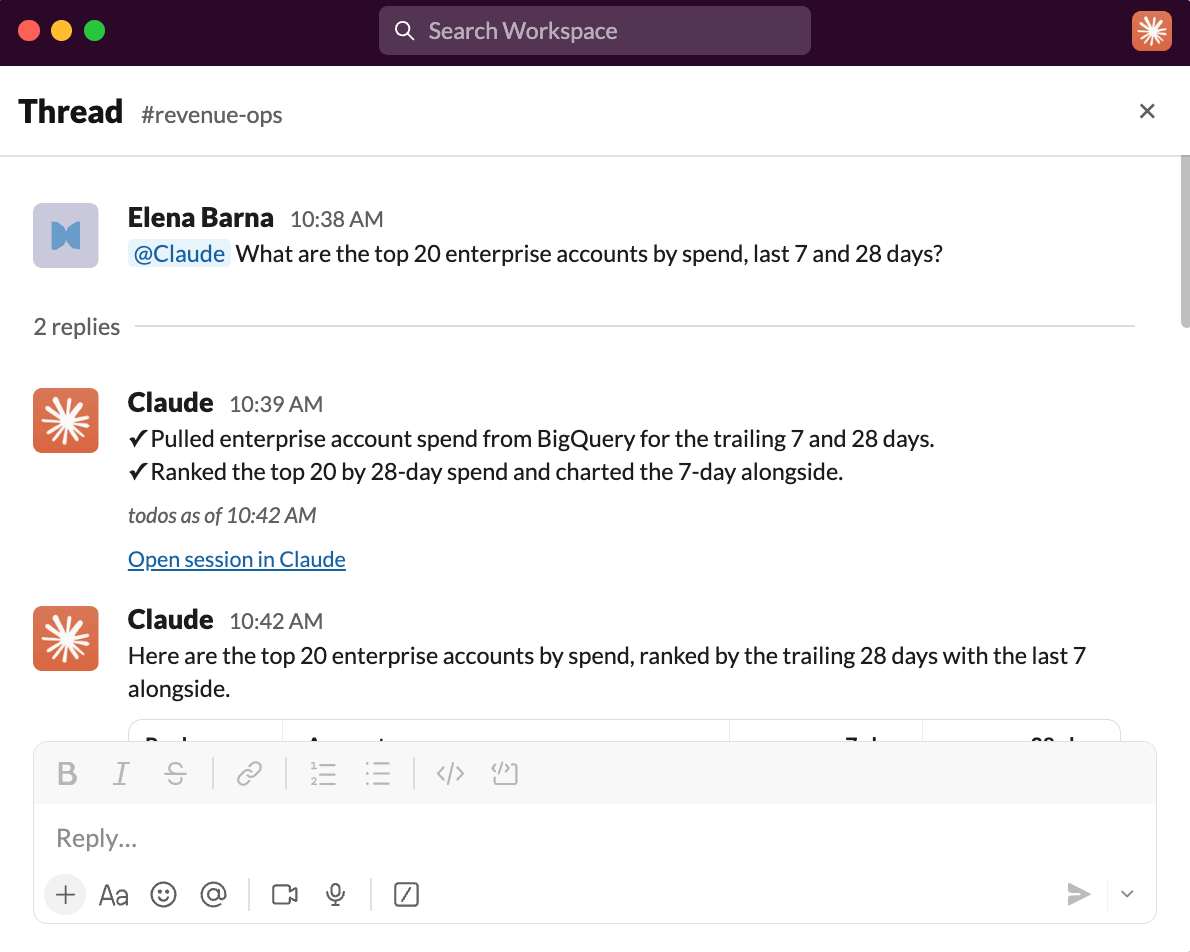
Pull the numbers

Ask @Claude to query your data and it posts results like metrics, benchmarks, and charts in the channel, so the whole team sees the answer and can keep asking questions right there.
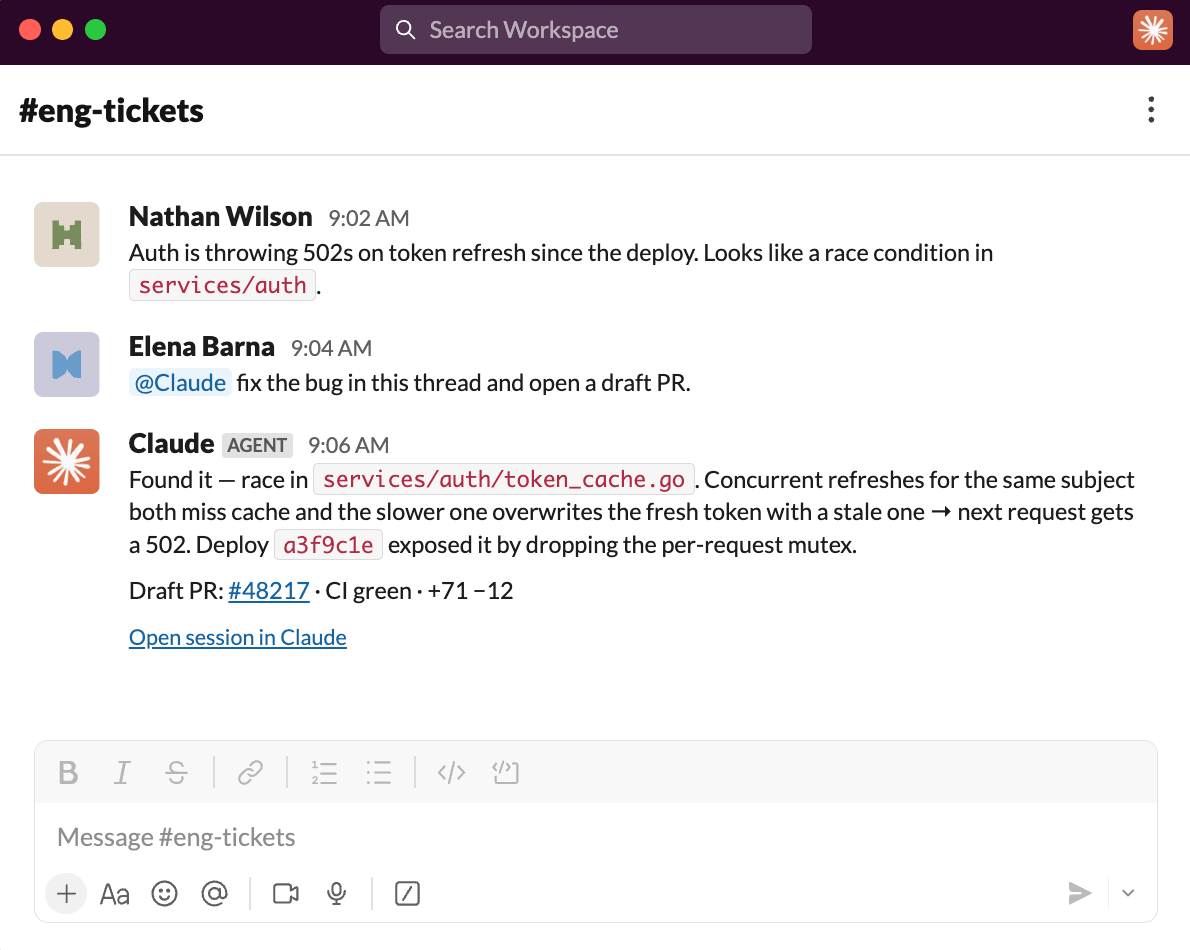
Build from the thread

Turn a bug report into a draft PR from the context is in the thread without ever leaving Slack. Get more done without switching tabs.

Prep before calls

Walk into every meeting with a full briefing. CRM notes, recent threads, and call history pulled together before you think to ask.

Watch what matters

@Claude can manage work in the channels your team never had bandwidth for: monitoring backlogs, triaging alerts, and surfacing what needs a human to review, so work that keeps getting pushed out can finally be completed.

Core capabilities

See what @Claude can do for your team.

Understands your org

The longer Claude works with your team, the more it understands how your organization thinks, how decisions get made, and who owns what.

Memory across threads and days

Context can draw on previous conversations and memory. What happened in Monday's standup is still there on Thursday, without anyone repeating it.

A shared resource in your channel

Claude surfaces what matters to the whole channel, not just the person who asked. Everyone sees the work, and anyone can build on it

Proactive action instead of asking

Set a standing instruction once. Claude watches the channel, runs routines, flags what's urgent, and tags you back when something needs a decision.

In the work and tools with you

Shape how Claude works in each channel with skills and instructions. Give it access to tools and data to take action on your behalf and post results.

Runs tasks that take days

Hand Claude a complex task and it works while you move on to other projects. It follows up, asks for input, or comes back when it's done.

logologo
logologo
logologo
logologo
logologo
logologo
logologo
logologo
logologo
logologo
logologo
logologo
logologo
logologo

@Claude connects to your tools

Configure any tool with an API using Agent Identity. Claude can query, act, and report back in the thread where the work is happening.

Read more

Admins stay in control

Claude acts under its own identity in your systems. Admins configure access once; everyone else just types @Claude.

Customizable  identities for granular governance

Claude has its own account in your systems, not a borrowed login. Every credential’s use is logged, so "what did Claude do, and who asked for it?" always has an answer.

Add it per channel

Decide which tools Claude can reach and read. Confine sensitive connectors to a single private channel or enable broader access for specific tools and resources. Adjust any time from the admin console.

What is Claude Tag?

Learn more about @Claude and what happens to the former Claude for Slack experience.

Read more
Agent identity: a new security model for autonomous, team-wide AI
Explore our new security model built for agents, not retrofitted from chatbots.

Read more
Tutorial: Working with @Claude in your workspace

Claude now works alongside your team, under its own account, in the places you already work together. You tag it in the way you'd tag anyone, or have it speak up on its own when there's something it can help with.

Read more
Prev
Next

Ready for a new way of working?

Add to Slack