ROBSTAR, our Experimental Robotics Platform
|
ROBSTAR is the experimental platform that allows the RAINBOW team members to easily deploy robotic systems to validate their research activities in visual servoing, visual tracking, active perception and shared control. From a software perspective, all hardware is integrated with with ViSP we develop in the team, an open-source software platform specialized in visual tracking and visual servoing, and telekyb3 open-source software framework developed originally at LAAS in Toulouse for the development of groups of multi-rotor Unmanned Aerial Vehicles (UAVs). ROBSTAR is also used to validate our software before any transfer to academic or industrial partners. Numerous demonstrations are also frequently presented to academics and the general public. This platform is fully accredited by the University of Rennes, and it is part of the French Research Infrastructure ROBOTEX 2.0 labeled by the French Ministry of Research. ROBSTAR is organized into 4 categories which are hereafter described. |
 |
1. Mobile Robots Platform
To validate our research in personally assisted living topic, we have five electric wheelchairs from Permobil, Sunrise and YouQ companies. The control of the wheelchair is performed using a plug-and-play system between the joystick and the low level control of the wheelchair. Such a system lets us acquire the user intention through the joystick position and control the wheelchair by applying corrections to its motion. The wheelchairs have been fitted with cameras, ultrasound and time-of-flight sensors to perform the required servoing for assisting people with disabilities. A wheelchair haptic simulator completes this platform aimed to develop new human interaction strategies in a virtual reality environment. Moreover, for fast prototyping of multi-robot control algorithms, since end of 2025 the platform provides about ten DJI RoboMaster S1 mobile ground robots.
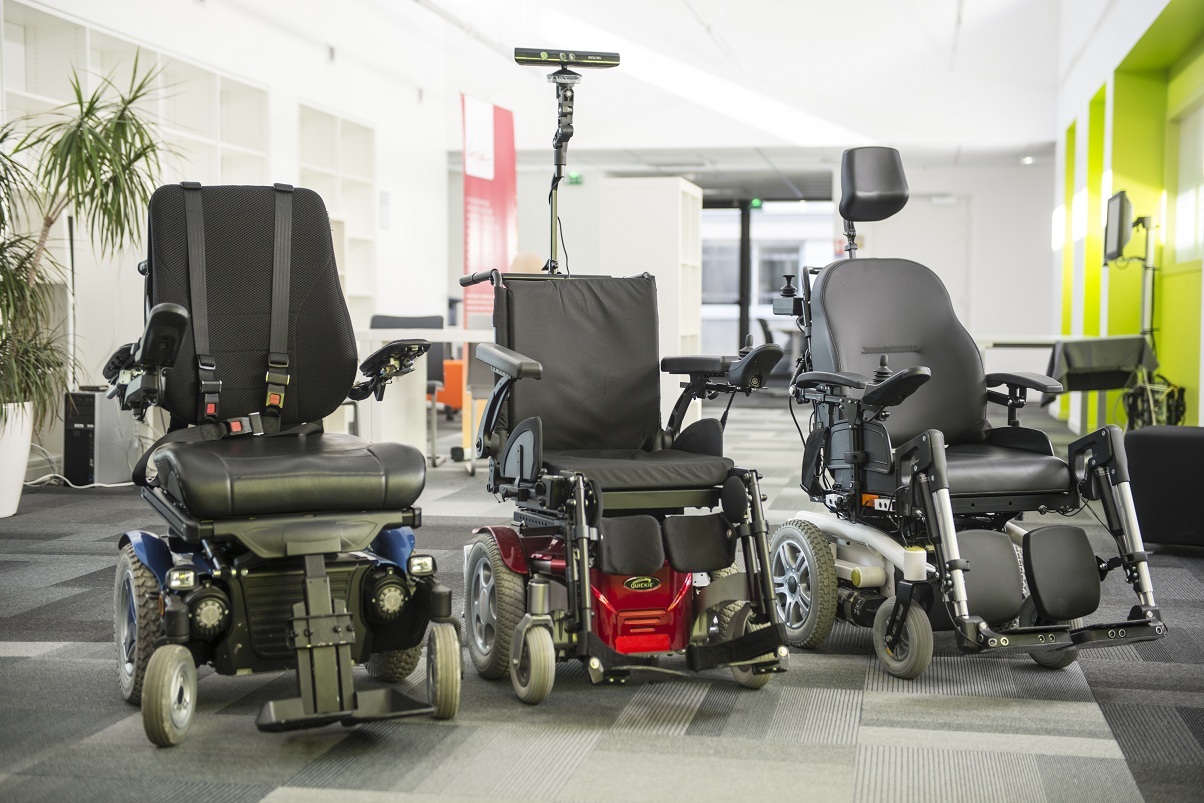
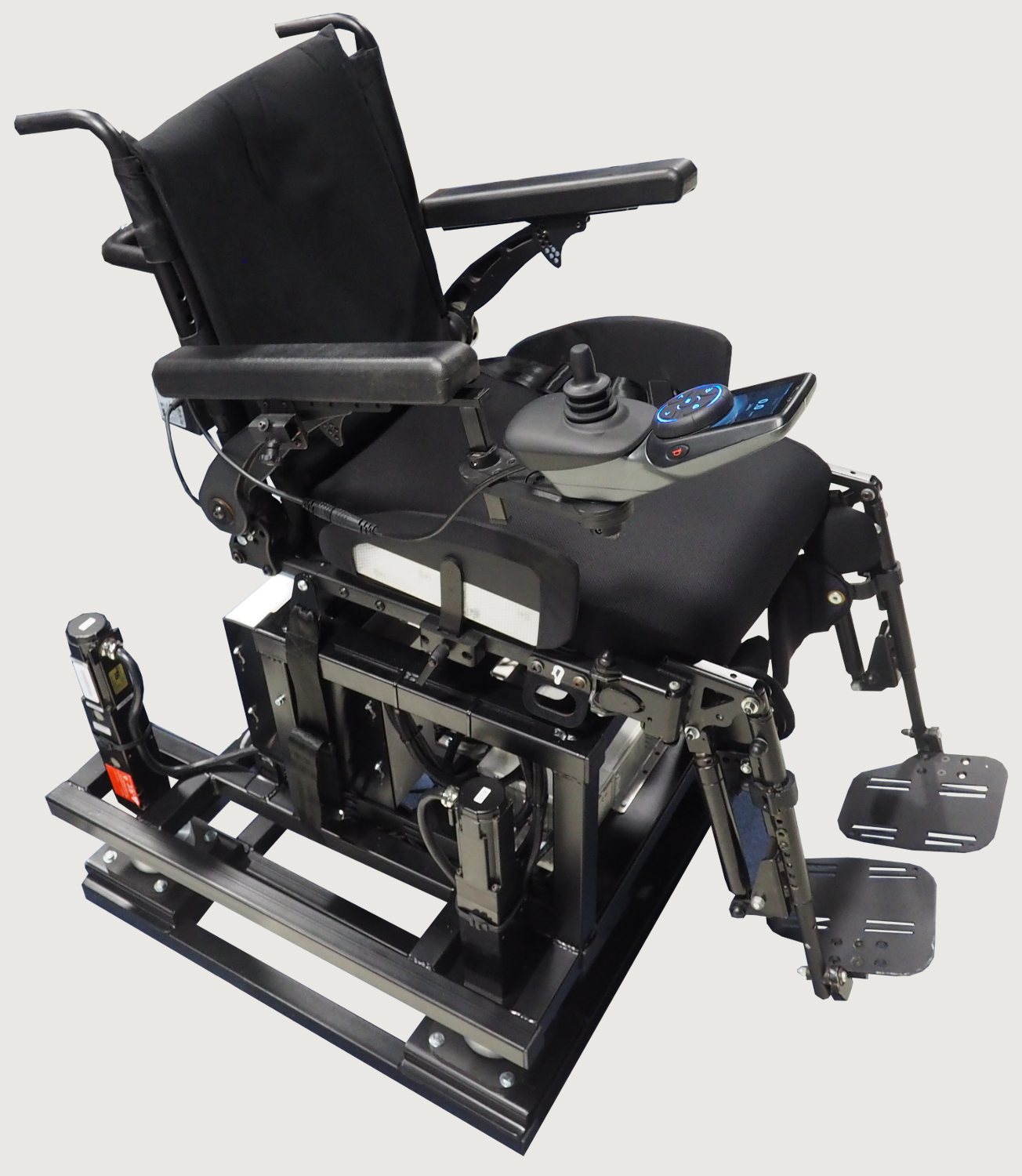
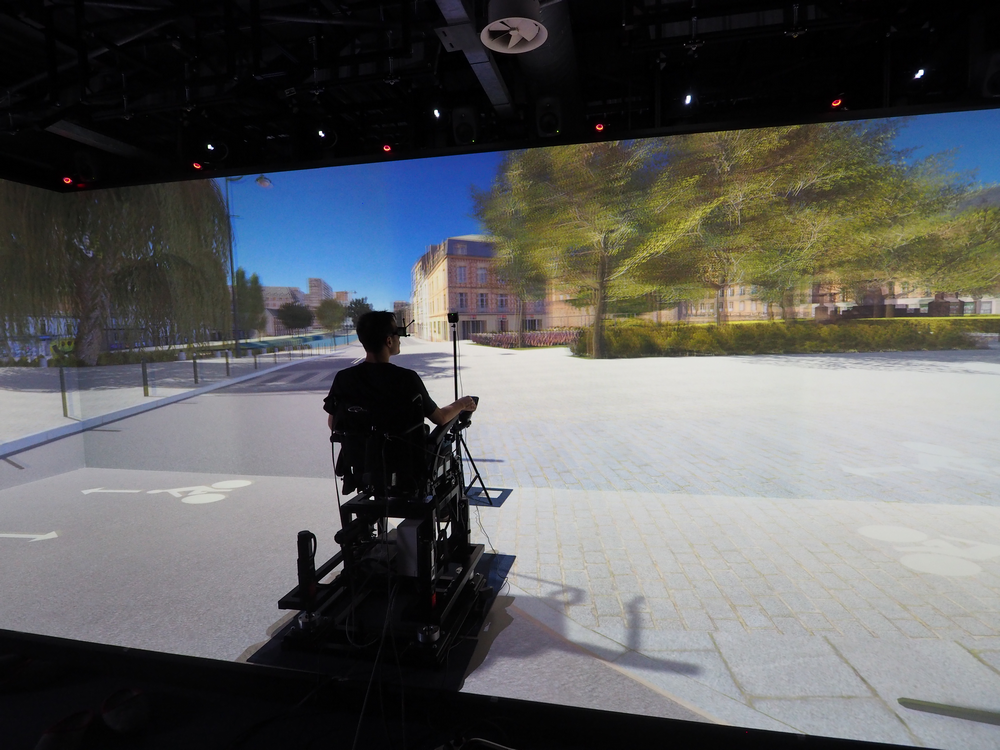
© Inria / H. Raguet, C. Morel
2. Advanced Manipulation Platform
This platform consists of 2 Panda lightweight 7 DoF arms from Franka Emika and 1 from Franka Robotics acquired end of 2025. They are equipped with torque sensors in all seven axes. The following end effectors can be mounted on the robot: an electric gripper, a camera, a soft hand from qbrobotics and a Reflex TakkTile 2 gripper from RightHand Labs. A force-torque sensor from Alberobotics is also attached to one of the robots end effector to provide greater accuracy in torque-controlled tasks.
Two Adept 6-DoFs arms (one Viper 650 robot and one Viper 850 robot) and a 6-DoFs Universal Robots UR5 complete this platform category.
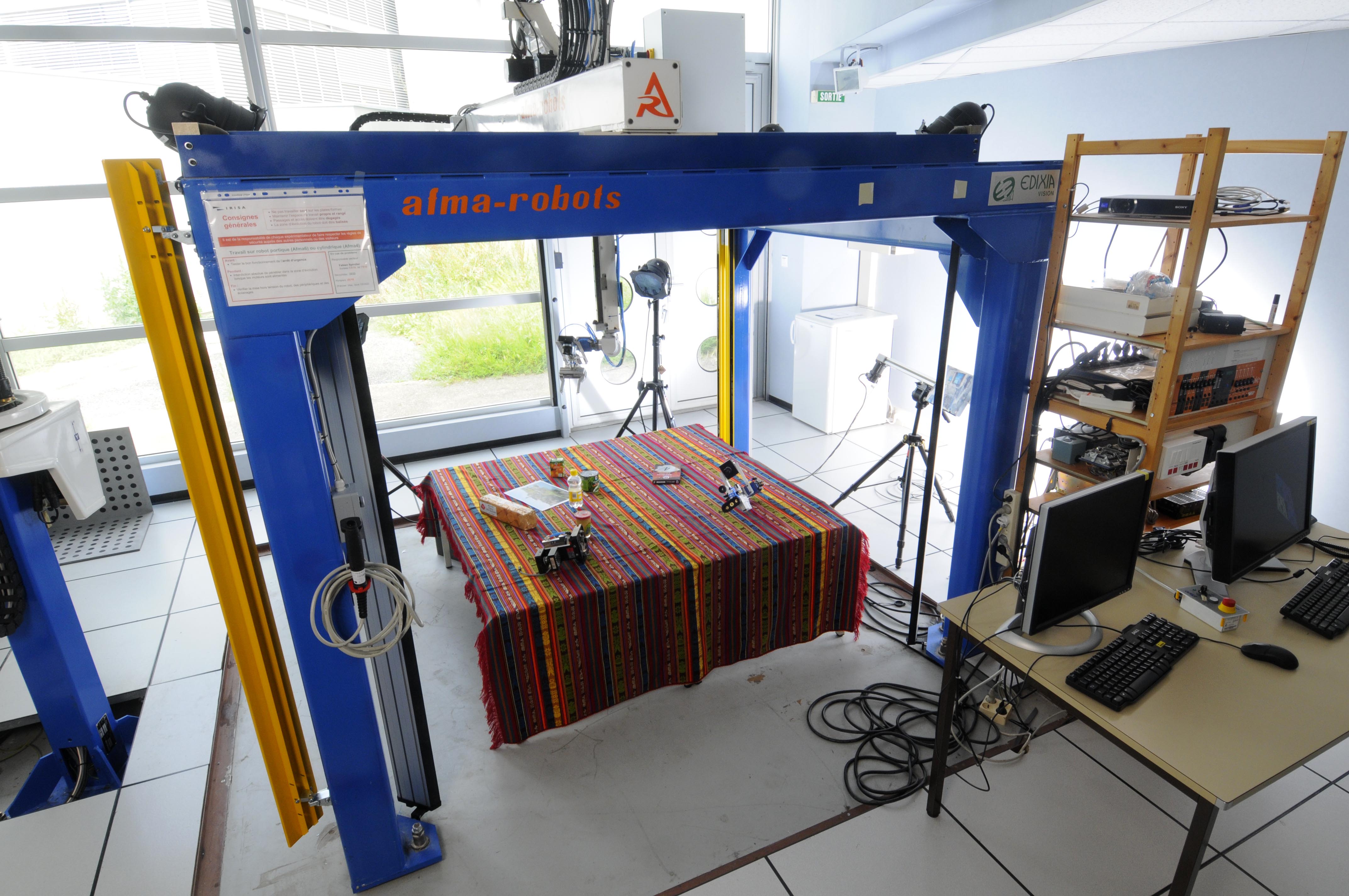
We operate an industrial robots to validate our research in visual servoing and active vision. This robot is a 6-DoFs gantry robot built by Afma Robots in the nineties equipped with a collection of various RGB and RGB-D cameras used to validate vision-based real-time tracking algorithm. A gripper can also be mounted on its end-effector. Unlike manipulator arms, this robot has a very large working space corresponding to a cube with sides measuring nearly 2 meters.
Moreover, since June 2025, the platform has been supplemented by the acquisition of a new TRIAGo robot from the company PAL Robotics. This robot is unique in the world. It was funded by the TIRREX Equipex and by Inria. It consists of a holonomic mobile base, on top of which sits a motorized torso, to which three 7-degree-of-freedom arms are attached. The end-effectors of these arms are modular and can be equipped with ATI force sensors and Allegro hands whose phalanges are fitted with Xela tactile sensors. This platform category is mainly used to validate our resarch in coupling force and vision control when attempting to manipulate deformable and soft objects. Other haptic devices can also be paired to any robot in this category.
This platform is mainly used to manipulate deformable objects and to validate our activities in coupling force and vision for controlling robot manipulators and in controlling the deformation of soft objects. Other haptic devices can also be coupled to this platform.
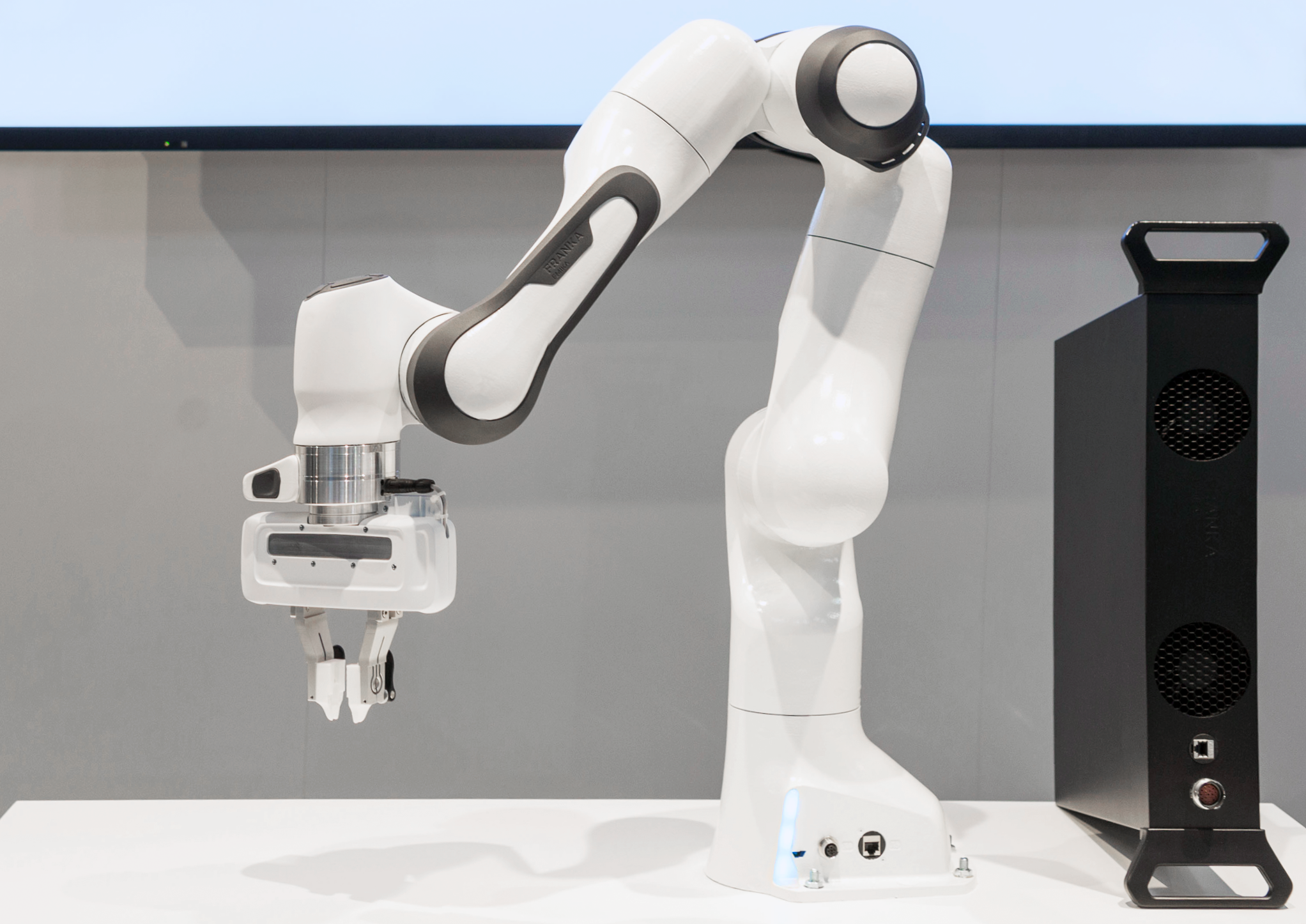
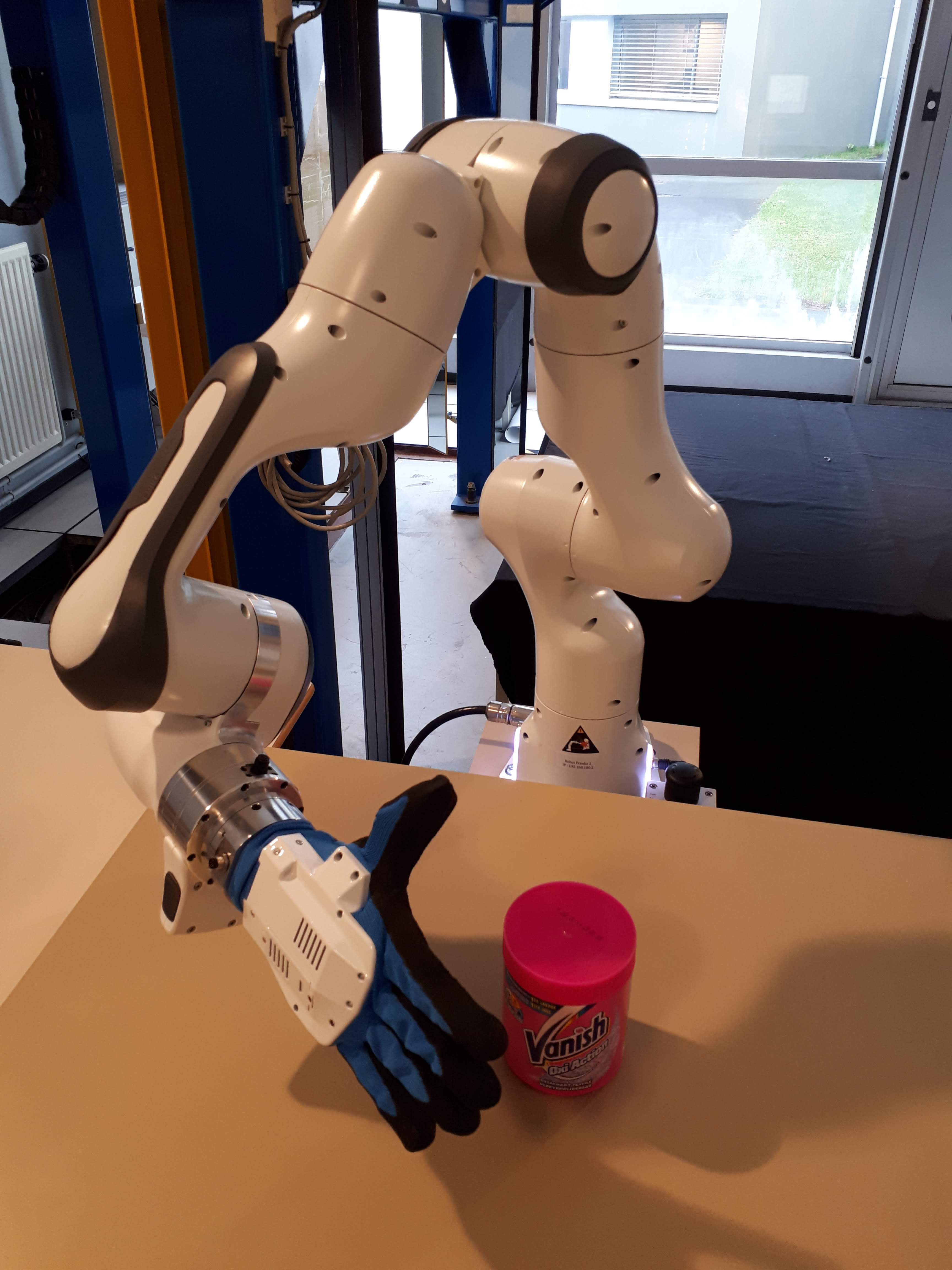
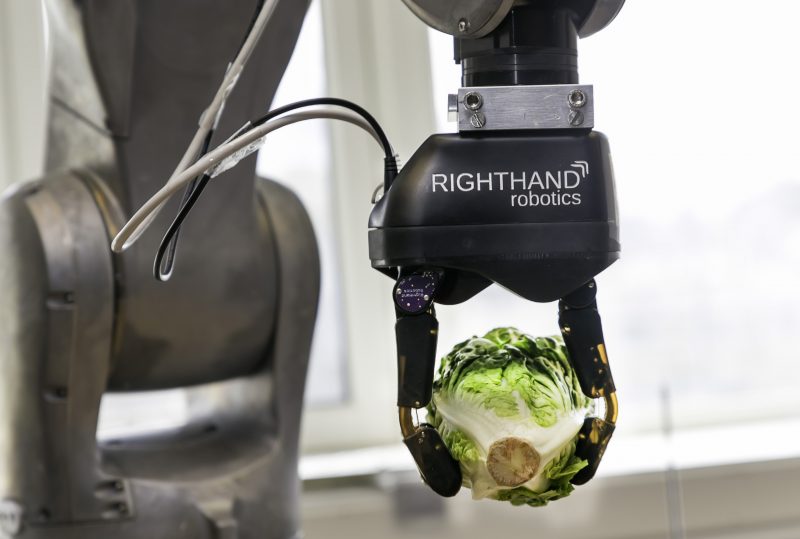
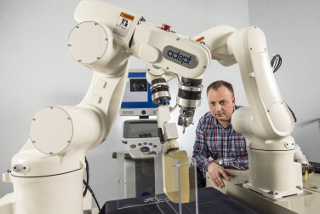
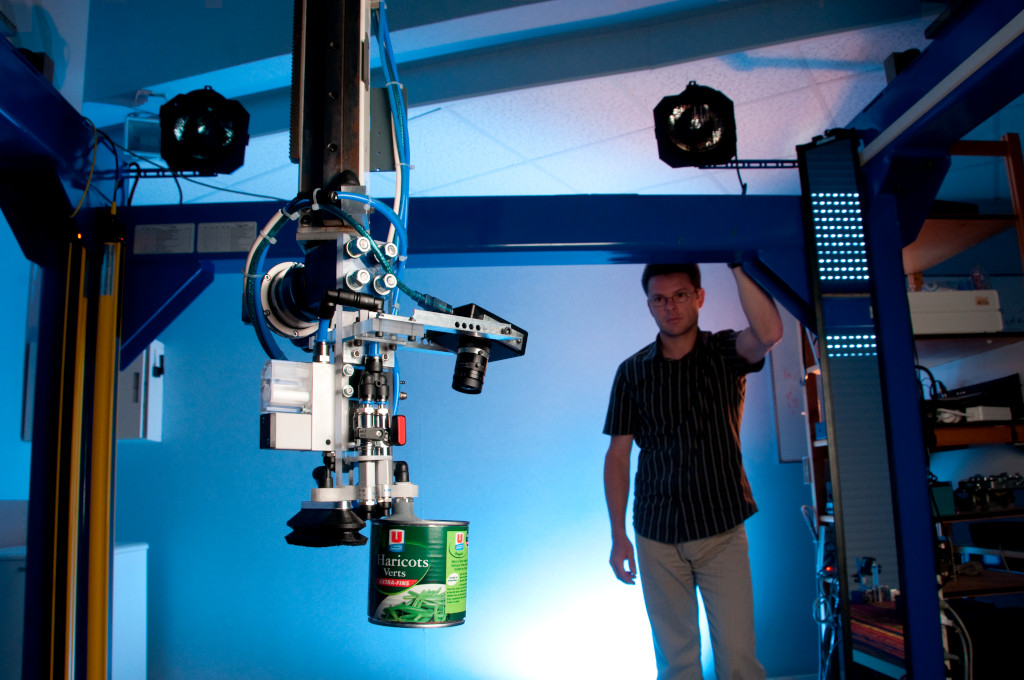

© Inria / H. Raguet
3. Unmanned Aerial Vehicles Platform
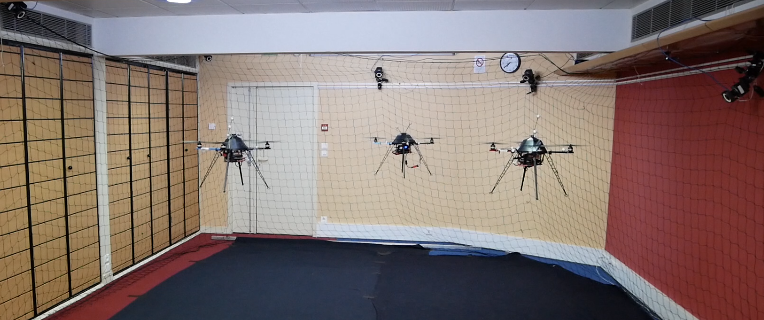
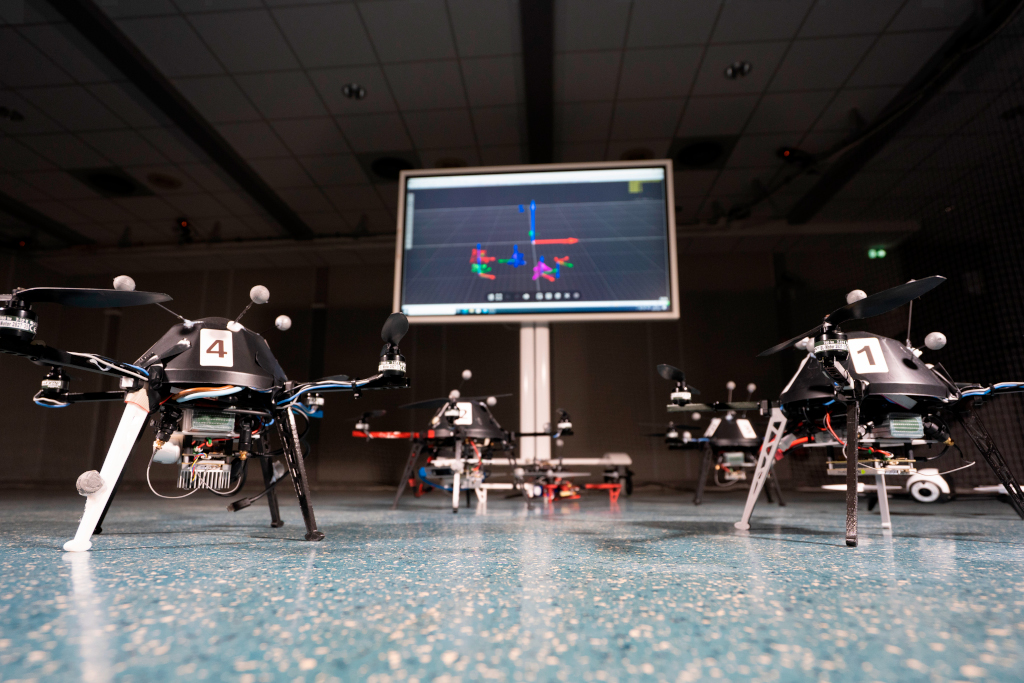
Rainbow is involved in several activities concerning conception, modelling, control and perception for single and multiple aerial robots (ARs). Two indoor flying arenas are used to carry out the related experimental activities. The first arena is relatively small (3m x 5m x H1.8m) and is equipped with 11 Vicon cameras for motion capture. The second one, spanning a larger volume (about 9m x 9m x H2.5m), is equipped with 14 Qualisys cameras. Compared to the former, the larger arena grants us with the possibility to fly multiple drones at the same time thanks to the larger volume and the great coverage offered by the larger number of cameras.
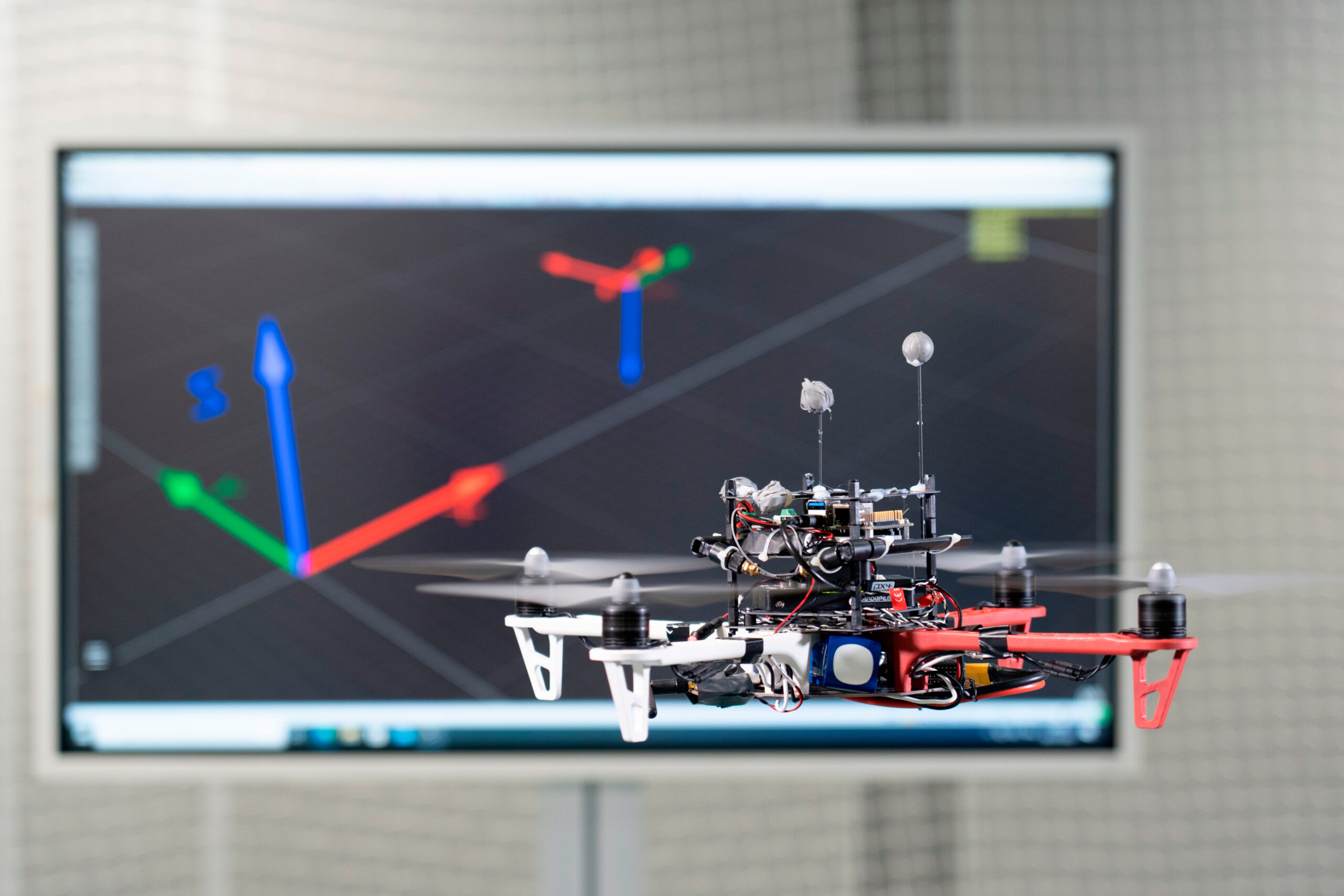
In these flying arenas, we operate several customized ARs which have been heavily customised by: reprogramming from scratch the low-level firmwares running on the onboard electronics (comprising flight and motor controllers), equipping each robot with an onboard computer (for instance a Jetson or a NUC board) running Linux Ubuntu and the telekyb3 software framework, and adding Realsense RGB-D cameras for onboard visual odometry and visual servoing.
The framework telekyb3 is an open-source architecture based on the Genom3 software tool which has been developed at LAAS in Toulouse. It features a modular and formal structure tailored to code reusability, high performance and middleware abstraction. It comprises a set of algorithms dedicated to localization, navigation and low-level control of aerial robots in maneuvering and physical-interaction-based tasks.
The aerial robotic platform of the team includes quadrotors and hexarotors which have been internally designed both at the mechanical and the electronic level. While the quadrotors have a standard (in jargon, collinear) propeller orientation, the hexarotors have the motors tilted w.r.t. the main body. This property grants them with manuvering capabilities that cannot be replicated by conventional and commercial drones with collinear rotors.
For most of the mechanical components, we rely on custom parts which are then realized by exploiting 3D printing technology and water-jet and milling processes of carbon-fiber material. From the electronic standpoint, our robots feature a Mikrokopter-based flight controller running custom firmware. However, due to the unavailibility and aging of the latter board, a newer flight controller named Paparazzi, has been adopted and consequently the firmware adapted to the new board. The Paparazzi flight controller is part of an open-source and open-hardware project started at ENAC in Toulouse. This board has been choosen as it fits well our needs: it comprises more precise onboard sensors and sufficient programmable peripherals used to communicate with the other electronic modules and sensors.
Smaller commercial drones, namely the BitCraze Crazyflie, have been added to this robotic platform. Thanks to the tiny dimensions of these drones and considering the limited available space for experiments, these robots are perfect candidates to carry out research related to the control and perception of a team of multiple robots.
4. Interactive interfaces and systems
Interactive technologies enables the communication between artificial systems and human users. Examples of such technologies are haptic interfaces and virtual reality headsets.
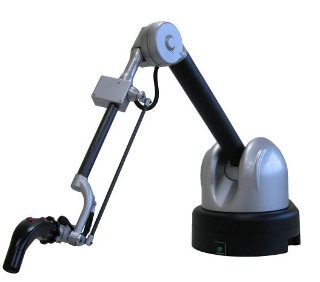
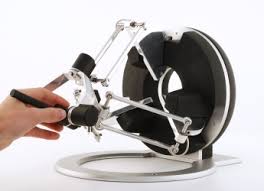
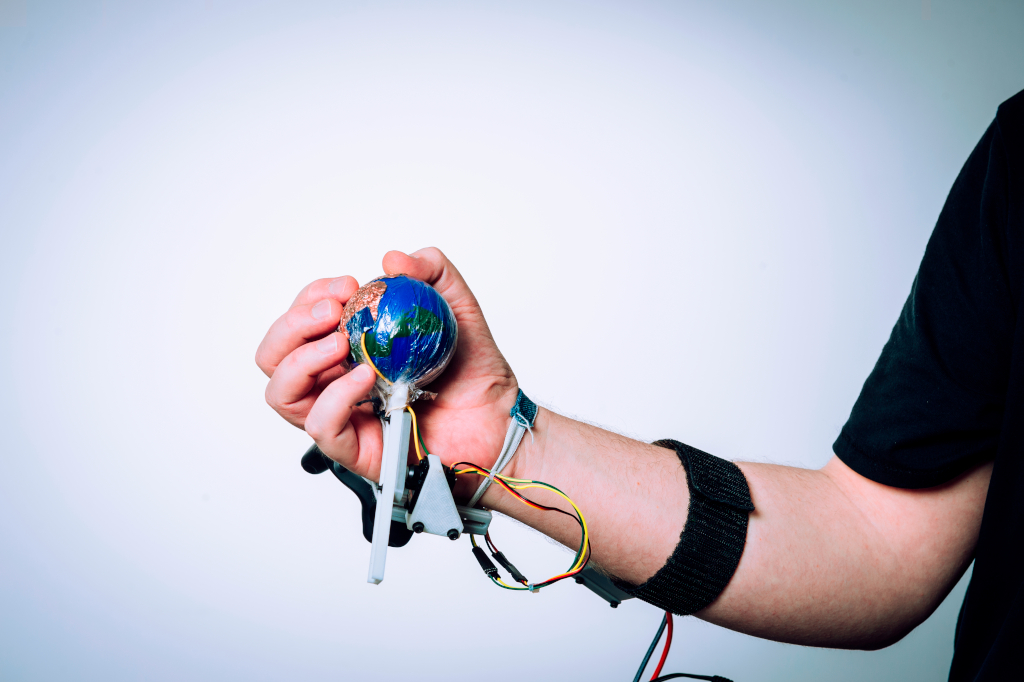
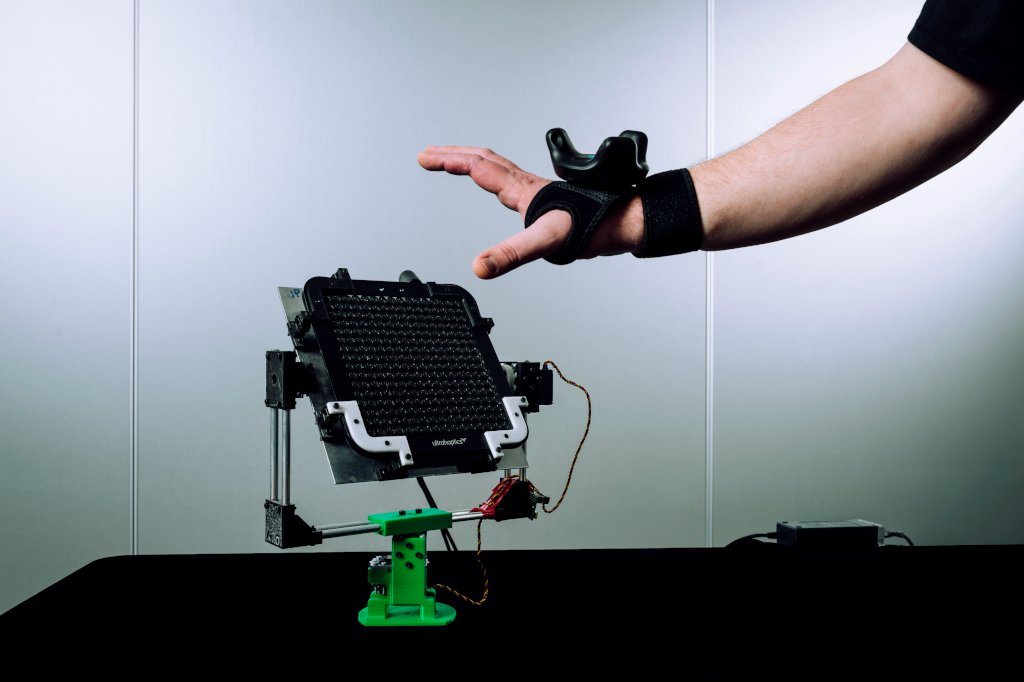
Various haptic devices are used to validate our research in, e.g., shared control and extended reality. We design some wearable haptics devices to enhance the user robotic interaction with sensorial feedback, while some other devices are bought from off-the-shelf products, such as a Virtuose 6D device and Desktop 6D device acquired fall 2025 from Haption. For instance, the latter equipment is used as the master device in many of our shared control activities. An Omega 6 from Force Dimension and devices from Ultrahaptics complete this platform that could be coupled to the other robotic systems.
Similarly, in order to augment the immersiveness of virtual scenarios, we make use of virtual and augmented reality headsets, namely HTC Vive headsets for VR tasks and Microsoft Hololens for Augmented Reality interactions.