 PieFed.ca
SpecialSetOfSieves, specialsetofsieves@lemmy.world
Instance: lemmy.world
Joined: 2 years ago
Posts: 81
Comments: 78
Posts and Comments by SpecialSetOfSieves, specialsetofsieves@lemmy.world






 curiosityrover








Comments by SpecialSetOfSieves, specialsetofsieves@lemmy.world
Some notes –
I have struggled to find earlier MastCam images of this difficult-to-reach part of Percy, but I will post updates if I find any. The science team doesn’t image this part of the rover deck very often - at least not of late:


This location at the base of the rover’s “neck” (mast) appears partly sheltered from the wind, which is interesting.
Image sources:
Abrasion patch #2
Abrasion patch #18
"Bizarre" purple coating (left)
"Bizarre" purple coating (right)
I’d be rather surprised if this is a meteorite, especially an iron meteorite. I’m not seeing enough in terms of regmaglypts or any of the usual telltales (e.g. Widmanstätten).
Could this be a stony meteorite? I can’t bring myself to see a fusion crust here in any wise. There are no flow lines that I can identify. The sharp, small protuberances at the bottom right would also be very unusual for a meteorite in my experience.
Of course, I could be wrong, but it doesn’t resemble any that I’ve seen. The science team doesn’t seem to be showing much interest in this one; and I would swear I’ve seen similar rocks on this mission, but none are coming to mind at the moment. I’ll see if I can scare up anything similar…
 Today I Learned
Thanks for this post. People don’t understand about geology and context, I find. I would love to see more of your commentary in the Perseverance rover and Curiosity rover communities, although I do remember seeing you there in the past. My mineralogy is still rather basic, all told, and with the exotic lithologies Perseverance is uncovering (well, by Martian standards - granite and serpentine, yet!), your participation would be most welcome.
 pics@lemmy.world
I don’t think the spacecraft are rotating in just the way you’d need to, but -
As the Voyagers speed away from the Sun at ~15 km/s, I sometimes visualize them as extending their booms upward each turn, like middle fingers, as they depart for greener blacker pastures.
Whether it’s checking for sandworms or the Epstein files, I applaud the science team for this new, aggressive search tactic.
 NASA's Perseverance Mars Rover@lemmy.world
Meteorology is a significant component of this mission, it’s just talked about much less than the geology. So we have a fixed camera on the rover that points up.
SkyCam is but one of the sensors used to study the weather and climate, but its specific tasks include tracking changes in cloudiness, dustiness, and the vertical structure of the atmosphere.
Some seasons are far cloudier than others (summertime and aphelion come to mind - the latter occurs when Mars is further from the Sun), so that’s easy to track with this instrument. The amount of dust in the atmosphere, and the layered structure (both of which change on a daily basis, as I understand it), are tracked through observations of the sky’s colour and brightness.
Pretty fascinating stuff, actually. From my perspective the Martian atmosphere is more… let’s say, revealing and honest, than the heavy, sodden blanket around Earth, or the colossal monstrosity around Venus. It’s responsive to temperature changes and solar influence in ways that the terrestrial atmosphere would mostly or entirely hide from you, which makes it fun to watch.
Hope this answers your question.
 Lemmy Shitpost@lemmy.world
my 250 million year old salt has expired
Yup, that’s Earth alright. Rookie numbers, as usual.
well‐preserved, clay and carbonate‐bearing sedimentary fan deposit located on the western edge of the crater
This fan is estimated to have formed approximately 3.2–3.8 billion years ago when ancient streams flowed into the Jezero crater lake
Post-drive notes for this sol:
There was a subsequent short drive on sol 1767 (I will update this comment as soon as I’ve compiled the information), as Percy maneuvers into position for using its contact instruments - the bedrock below Percy’s wheels looks mighty interesting, and we’ve been driving hard for weeks to reach this area. Stay tuned!
EDITED TO ADD: The rover drove a few metres west on 1767, then partly backtracked - I assume this means the science team knows what it wants to access. The image below, from 1767, offers another perspective on the interesting light-tan polygons that will likely be investigated closely in the next few sols:

Post-drive notes for this sol:
The publicly available data says that the drive took 4.5 hours, but the rover stopped after 13:00 hours for at least 10 minutes to capture some images, so I think we can safely discount the reported drive duration.
I should also note that the rover made three very short drives on sols 1758, 1760 and 1761, amounting to less than 4 m total. I’m not quite sure what the intent was - based on the images we have in hand, it doesn’t appear that the science team was trying to approach any particular target - so it may be that Percy experienced some drive errors. Nonetheless, we are well on the way to the big next science target, Lac de Charmes!
 Science Memes@mander.xyz
Nope. Further from the host star than Venus from Sol, and that star is far less luminous to begin with. (Source)
The amount of CO2 or any other plausible greenhouse gas you’d need to pump a place like that up to lead-melting temperatures means you’d need, what, two planets’ worth of available volatiles? You’d probably also need a seriously disturbed spin for that, like Venus does. I think we can safely start with the assumption that this place (if we can confirm it’s real) is pretty cold.
Science Memes@mander.xyz
Well. This is quite a pearl.
I don’t have time to read a 16-page paper in detail, but I did want to know how the host star compares to everyone’s favourite local solitary K-type dwarf, Epsilon Eridani. It’s slightly less massive (~0.7 solar mass versus 0.8 for ε Eri) and quite a bit less bright (difference of about 0.1 solar luminosity), but I especially wanted to know about the age of the star. ε Eri is quite young and frothy, but the investigators here infer from the star’s motion that it belongs to the thin disk, up to a whopping 10 billion years old.
So we are definitely not talking about an ε Eri-type system. So that should be mean no dust disks, no crazy activity from the star, and no newish planets still carving out their places through the system.
You’ve really got to wonder about such an old planet, however cold and quiescent it may be. The potential paths for climatic evolution on such a world boggle the mind, however cold it is. You could get an episodically or formerly active world like Mars, a beautifully unstable oscillatory world like Earth, or something completely different. Assuming any atmosphere, of course (safe assumption?). And that’s without considering whether there are any other planets in the system.
I really wouldn’t spend too much time thinking about this candidate detection, as we have literally seen just the one transit, and we will need to observe this fellow for a while to confirm the discovery, learn about other planets in the system, and so on. The investigators themselves note that the transit was shallow (meaning difficult to detect), but the good news is that the host star is fairly bright, well within reach of amateur equipment. I wonder if citizen scientists will be able to follow the transits.
Exciting times.
Excellent, very detailed episode by Steve Ruff (Mars Guy). I wish we had more access to the RP visualization tools (used by the rover drivers) that are shown off in this video.
I am however surprised that JPL allowed this use of the AI in the middle of a ripple field (you may wish to view a recent drive map to see what I mean - the AI drove on sols 1707 and 1709). The drive outcomes were good, and apparently the RPs are enthusiastic about the tool, but megaripples are a clear drive hazard for wheeled vehicles. I guess if they were going to run this experiment, they would do it when the rover was making moves purely for traversal to the next target-rich area, and not on science-oriented drives, like the last two.
… Of course this means that we’re now allowing AI to drive a state-of-the-art, nuclear-powered, laser-equipped planetary vehicle which is hunting for any and all signs of life in order to… identify them. I am of course terrified totally unconcerned.
photos of people getting arrested and harassed, possibly the worst moments of their life sold for profit
I was in full agreement with your entire comment until I read this.
Tell us - how is the photographer supposed to support himself in this work if not via his images? Do you suppose this person is making vast wealth from this? You yourself acknowledge the danger of documenting what is going on in Minneapolis. Shouldn’t we be encouraging people in this - or at the least, not work to discourage it? By this logic, filmmakers who make documentaries about the victims of war shouldn’t be able to make a wage from their work, either. How about whistleblowers who expose abuse from within, are they allowed to make money from writing books about their experience? If you can provide me with evidence that this kind of photojournalism is leading to vast and exploitative profit-making schemes, I’ll reconsider your argument, but short of that…
If you want to talk about the worst moments of a subject’s life, consider Phan Thi Kim Phúc. At the age of 9, her village was hit by freaking napalm, and she was severely burned - her clothes literally burned away, and she was photographed running naked from the smoking ruins of her village. This image won the Pulitzer Prize, which undoubtedly aided the photographer in his career… and the victim herself hated the photo at first. I strongly urge you to read the article, however, because it shows how her thinking on this subject evolved.
The important thing is that these images are being broadly disseminated. And you don’t even have to pay to see them, or form your own opinion on them. What more can we ask for?
Ingenuity is grounded, yes. The drone was still alive, however, when Percy was last in contact. It was still gathering onboard engineering data at that time, which would prove useful (even to the scientists) if we can retrieve it at a later date.
We won’t know for certain if “Ginny” has survived until we get proximity and line-of-sight communication between rover and ‘copter again. That won’t be possible until the rover returns to the interior of Jezero Crater, which won’t happen for a while.
Until then, I’m allowed to dream about Ingenuity bearing up down there in Neretva Vallis, where a muddy river once flowed.
As of this latest drive, Perseverance has left the area which was originally mapped in detail for this mission (I have highlighted the quadrangles visited by Percy in red below):

The rover is now south of “Forlandet”, one of the highlighted quadrangles at the far left of the map. (We landed in “Canyon de Chelly”, at right-centre, on the crater floor).
Obviously, there has been further geologic mapping of the terrain along Percy’s intended path - no surface mission has ever “roved blind”, even from the days of Apollo - but, to my knowledge, the mission has not shared any of the newer maps in a format accessible to a general audience (there have been a couple of publications in the last year or so, but these are strictly for geologists and not easily digestible). In particular, I cannot find any new information on the quadrangles that we are now roving or soon due to visit - not even their names.
How about it, NASA? JPL? We are aware of the savagery of the funding cuts under the current administration, and their effects on the actual people who make these missions happen. This comment is by no means intended as a complaint, but an acknowledgment of the importance of what you do - this whole community and the broadly positive attitude toward these missions that we readily see online is proof. Especially given that there are no new science missions, like sample return or future rovers, on the books…
That myth does not come from the planetary scientists. Lunar basalts, breccias and anorthosites do not have such tasty holes.
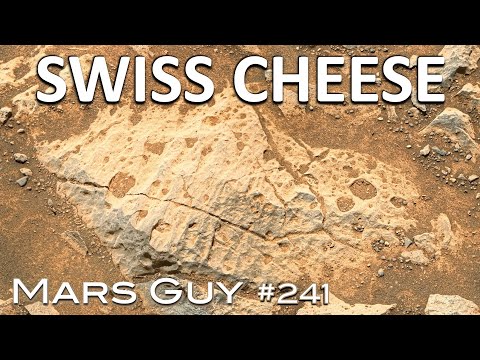
Maybe people can now understand why I’ve disdained this persistent, inappropriate demand for the use of bananas to judge scale in these images? On Mars we use cheese voids (the technical term is “eyes” for Swiss cheese - they’re a kind of biogenic vesicle) and sandworms (the HIpparchuS Crater Standard Sandworm, or HISSS) to measure lengths.
I wish people would learn.
I’d like to “make a hole” like that in the game’s development studio, not Lunae Planum…
Sorry, everyone! My mistake. Link fixed (the one Paul Hammond just posted is correct).
Taxation/fundraising idea:
Charge all social media users a nominal fee for every comment they make that includes speculations about aliens and critters, which inevitably follow posts like these. 90% of proceeds go to JPL for mission operations budgets.
That said, I look forward to the “odd comments” that always attend these “odd rocks”.
After half a kilometre of driving over the last few sols, Percy has finally reached a new investigation site. The Vernodden slope (see the map above), on the outer rim of Jezero Crater, was the rover’s home for over 70 sols, and proved interesting and rewarding from the standpoint of geology, though we were unsuccessful in acquiring a sample there.
The current area - flatter, but studded with small ridges - appears to have a rather different geology than Vernodden, and represents a step away from Jezero Crater proper. Considering the long missions of Spirit (2004-2010) and Curiosity (2012-present), which landed within immense craters and were never intended to exit them, four-and-a-half-year old Percy is getting a real tour of this region of Mars!

Some notes –
I have struggled to find earlier MastCam images of this difficult-to-reach part of Percy, but I will post updates if I find any. The science team doesn’t image this part of the rover deck very often - at least not of late:
This location at the base of the rover’s “neck” (mast) appears partly sheltered from the wind, which is interesting.
Image sources:
Abrasion patch #2
Abrasion patch #18
"Bizarre" purple coating (left)
"Bizarre" purple coating (right)
Is the "purple coating" forming on Percy today?
Since the earliest weeks of the mission, the science team has been documenting an interesting type of feature found on many of the rocks Perseverance has encountered, dubbed the “purple coating”. This has often been found on rocks that have been abraded by the rover (e.g. abrasion patches #2, left, and #18, right)…
I’d be rather surprised if this is a meteorite, especially an iron meteorite. I’m not seeing enough in terms of regmaglypts or any of the usual telltales (e.g. Widmanstätten).
Could this be a stony meteorite? I can’t bring myself to see a fusion crust here in any wise. There are no flow lines that I can identify. The sharp, small protuberances at the bottom right would also be very unusual for a meteorite in my experience.
Of course, I could be wrong, but it doesn’t resemble any that I’ve seen. The science team doesn’t seem to be showing much interest in this one; and I would swear I’ve seen similar rocks on this mission, but none are coming to mind at the moment. I’ll see if I can scare up anything similar…
Thanks for this post. People don’t understand about geology and context, I find. I would love to see more of your commentary in the Perseverance rover and Curiosity rover communities, although I do remember seeing you there in the past. My mineralogy is still rather basic, all told, and with the exotic lithologies Perseverance is uncovering (well, by Martian standards - granite and serpentine, yet!), your participation would be most welcome.
I don’t think the spacecraft are rotating in just the way you’d need to, but -
As the Voyagers speed away from the Sun at ~15 km/s, I sometimes visualize them as extending their booms upward each turn, like middle fingers, as they depart for
greenerblacker pastures.Whether it’s checking for sandworms or the Epstein files, I applaud the science team for this new, aggressive search tactic.
Meteorology is a significant component of this mission, it’s just talked about much less than the geology. So we have a fixed camera on the rover that points up.
SkyCam is but one of the sensors used to study the weather and climate, but its specific tasks include tracking changes in cloudiness, dustiness, and the vertical structure of the atmosphere.
Some seasons are far cloudier than others (summertime and aphelion come to mind - the latter occurs when Mars is further from the Sun), so that’s easy to track with this instrument. The amount of dust in the atmosphere, and the layered structure (both of which change on a daily basis, as I understand it), are tracked through observations of the sky’s colour and brightness.
Pretty fascinating stuff, actually. From my perspective the Martian atmosphere is more… let’s say, revealing and honest, than the heavy, sodden blanket around Earth, or the colossal monstrosity around Venus. It’s responsive to temperature changes and solar influence in ways that the terrestrial atmosphere would mostly or entirely hide from you, which makes it fun to watch.
Hope this answers your question.
laughing in Martian
Yup, that’s Earth alright. Rookie numbers, as usual.
Post-drive notes for this sol:
There was a subsequent short drive on sol 1767 (I will update this comment as soon as I’ve compiled the information), as Percy maneuvers into position for using its contact instruments - the bedrock below Percy’s wheels looks mighty interesting, and we’ve been driving hard for weeks to reach this area. Stay tuned!
EDITED TO ADD: The rover drove a few metres west on 1767, then partly backtracked - I assume this means the science team knows what it wants to access. The image below, from 1767, offers another perspective on the interesting light-tan polygons that will likely be investigated closely in the next few sols:
Drive report (sol 1765) - 2 h, 200 m
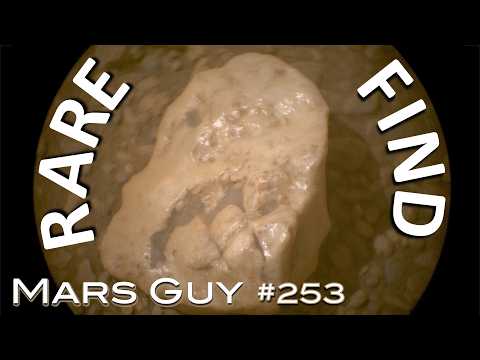
Mars Guy Ep. 253 - Stumbling across more "white rocks"
Quartz-rich rock? (sol 1764)
For context:
Post-drive notes for this sol:
The publicly available data says that the drive took 4.5 hours, but the rover stopped after 13:00 hours for at least 10 minutes to capture some images, so I think we can safely discount the reported drive duration.
I should also note that the rover made three very short drives on sols 1758, 1760 and 1761, amounting to less than 4 m total. I’m not quite sure what the intent was - based on the images we have in hand, it doesn’t appear that the science team was trying to approach any particular target - so it may be that Percy experienced some drive errors. Nonetheless, we are well on the way to the big next science target, Lac de Charmes!
Latest drive (sol 1762) - 150 m
Nope. Further from the host star than Venus from Sol, and that star is far less luminous to begin with. (Source)
The amount of CO2 or any other plausible greenhouse gas you’d need to pump a place like that up to lead-melting temperatures means you’d need, what, two planets’ worth of available volatiles? You’d probably also need a seriously disturbed spin for that, like Venus does. I think we can safely start with the assumption that this place (if we can confirm it’s real) is pretty cold.
Well. This is quite a pearl.
I don’t have time to read a 16-page paper in detail, but I did want to know how the host star compares to everyone’s favourite local solitary K-type dwarf, Epsilon Eridani. It’s slightly less massive (~0.7 solar mass versus 0.8 for ε Eri) and quite a bit less bright (difference of about 0.1 solar luminosity), but I especially wanted to know about the age of the star. ε Eri is quite young and frothy, but the investigators here infer from the star’s motion that it belongs to the thin disk, up to a whopping 10 billion years old.
So we are definitely not talking about an ε Eri-type system. So that should be mean no dust disks, no crazy activity from the star, and no newish planets still carving out their places through the system.
You’ve really got to wonder about such an old planet, however cold and quiescent it may be. The potential paths for climatic evolution on such a world boggle the mind, however cold it is. You could get an episodically or formerly active world like Mars, a beautifully unstable oscillatory world like Earth, or something completely different. Assuming any atmosphere, of course (safe assumption?). And that’s without considering whether there are any other planets in the system.
I really wouldn’t spend too much time thinking about this candidate detection, as we have literally seen just the one transit, and we will need to observe this fellow for a while to confirm the discovery, learn about other planets in the system, and so on. The investigators themselves note that the transit was shallow (meaning difficult to detect), but the good news is that the host star is fairly bright, well within reach of amateur equipment. I wonder if citizen scientists will be able to follow the transits.
Exciting times.
Excellent, very detailed episode by Steve Ruff (Mars Guy). I wish we had more access to the RP visualization tools (used by the rover drivers) that are shown off in this video.
I am however surprised that JPL allowed this use of the AI in the middle of a ripple field (you may wish to view a recent drive map to see what I mean - the AI drove on sols 1707 and 1709). The drive outcomes were good, and apparently the RPs are enthusiastic about the tool, but megaripples are a clear drive hazard for wheeled vehicles. I guess if they were going to run this experiment, they would do it when the rover was making moves purely for traversal to the next target-rich area, and not on science-oriented drives, like the last two.
… Of course this means that we’re now allowing AI to drive a state-of-the-art, nuclear-powered, laser-equipped planetary vehicle which is hunting for any and all signs of life in order to… identify them. I am of course
terrifiedtotally unconcerned.Mars Guy Ep. 252 - "Claude" AI drives Percy twice
Drive report (sol 1756) - 2 h 30 m, 200 m
I was in full agreement with your entire comment until I read this.
Tell us - how is the photographer supposed to support himself in this work if not via his images? Do you suppose this person is making vast wealth from this? You yourself acknowledge the danger of documenting what is going on in Minneapolis. Shouldn’t we be encouraging people in this - or at the least, not work to discourage it? By this logic, filmmakers who make documentaries about the victims of war shouldn’t be able to make a wage from their work, either. How about whistleblowers who expose abuse from within, are they allowed to make money from writing books about their experience? If you can provide me with evidence that this kind of photojournalism is leading to vast and exploitative profit-making schemes, I’ll reconsider your argument, but short of that…
If you want to talk about the worst moments of a subject’s life, consider Phan Thi Kim Phúc. At the age of 9, her village was hit by freaking napalm, and she was severely burned - her clothes literally burned away, and she was photographed running naked from the smoking ruins of her village. This image won the Pulitzer Prize, which undoubtedly aided the photographer in his career… and the victim herself hated the photo at first. I strongly urge you to read the article, however, because it shows how her thinking on this subject evolved.
The important thing is that these images are being broadly disseminated. And you don’t even have to pay to see them, or form your own opinion on them. What more can we ask for?