

Abstract
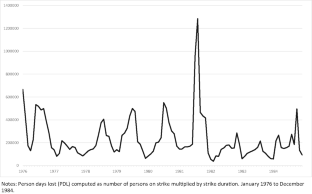
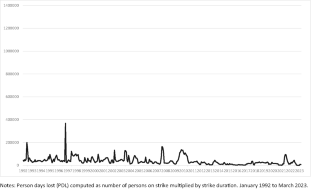
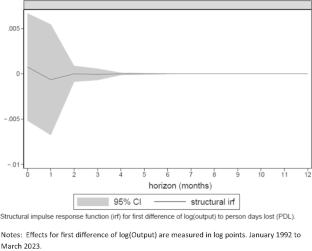
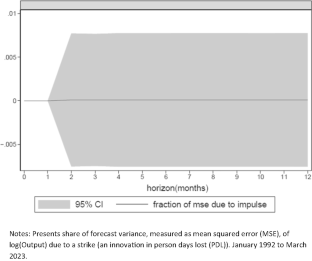
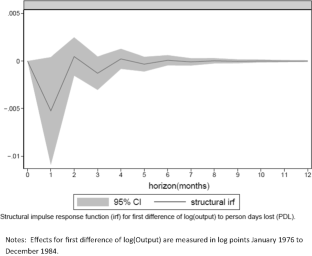
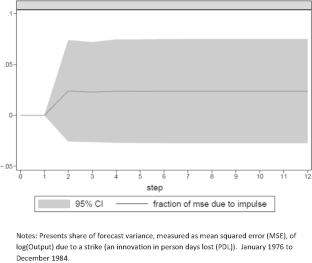
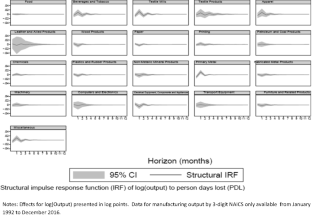
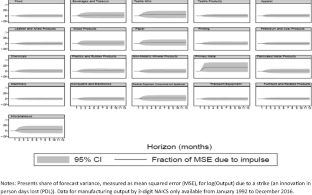
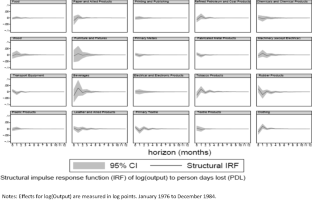
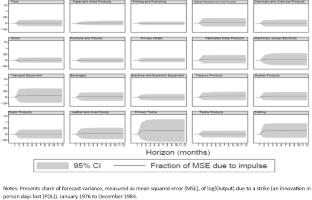
I examine the effects of strikes on Canadian manufacturing output using monthly data from 1992 to 2023. I estimate a structural vector autoregression, which places identifying restrictions on the parameters, and use the parameter estimates to create impulse response functions and forecast variance decompositions to determine the effects of strikes on manufacturing output for a 12-month horizon after the start of a strike. I also use this methodology to study data from 1976 to 1984 to see how the effects of strikes on manufacturing output have evolved over time and how they compare with estimates from the earlier literature. In both of the periods I consider, I find that strikes have little effect on manufacturing output and these effects are not statistically different from zero. I obtain similar findings when I conduct an analysis by subsector in manufacturing for both periods I consider.
Data Availability
The data used in this analysis are available upon request.
Notes
Campolieti (2023) discusses the post-war experience with strikes in Canada.
Hameed and Lomas (1975) include iron and steel mills, smelting and refining, other primary metal production, structural metal, metal stamping, other metal products, rubber industries, aircraft and parts, motor vehicles, motor vehicle parts, other transport equipment, pulp and paper mills, other paper products and construction in their analysis.
References
Bernstein I, Lowell HG (1953) Are coal strikes national emergencies. Ind Labor Relat Rev 6:352–367
Campolieti M (2023) An event study analysis of the effects of collective bargaining legislation on strike outcomes. Labour 37:242–279
Canova F (2007) Methods for applied macroeconomic research. Princeton University Press
Christenson C (1953) The theory of the offset factor: the impact of labor disputes on coal production. Am Econ Rev 43(September):513–547
Christenson C (1955) The impact of labor disputes upon coal consumption. Am Econ Rev 45(March):79–112
Cullen DE (1953) The Taft-Hartley Act in national emergency disputes. Ind Labor Relat Rev 7:15–30
Gunderson M, Melino A (1987) Estimating strike effects in a general model of prices and quantities. J Labor Econ 5:1–19
Hameed SMA, Lomas T (1975) Measurement of production losses due to strikes in Canada: an input-output analysis. Br J Ind Relat 13:86–93
Hamilton JD (1994) Time Series Analysis. Princeton University Press, Princeton
Lüktepohl H (1993) Introduction to Multiple Time Series Analysis, 2nd edn. Springer-Verlag, Berlin
Lüktepohl H (2005) New Introduction to Multiple Time Series Analysis. Springer-Verlag, Berlin
Maki D (1983) A note on the output effects of Canadian postal strikes. Can J Econ 16:149–154
Maki D (1985) Output losses due to strikes: the case of sawmills in British Columbia. Empir Econ 10:121–124
Maki D (1986) The effect of the cost of strikes on the volume of strike activity. Ind Labor Relat Rev 39:552–563
Neumann GR, Reder MW (1984) Output and strike activity in U.S. manufacturing: how large are the losses? Ind Labor Relat Rev 37:197–211
Paarsch HJ (1990) Work stoppages and the theory of the offset factor: evidence from the British Columbia lumber industry. J Labor Econ 8:387–417
Riddell C, Riddell C (2004) Changing patterns of unionization: the North American experience. In: Verma A, Kochan TA (eds) Unions in the 21st Century. Palgrave Macmillan
Funding
This research did not receive any specific grant/financial support from funding agencies in the public, commercial, or not-for-profit sectors.
Author information
Authors and Affiliations
Contributions
I wrote the paper, curated the data and conducted all analyses.
Corresponding author
Ethics declarations
Ethics Approval
N/A.
Informed Consent
N/A.
Conflict of Interests
The author has no conflicts of interest to report.
Additional information
Publisher's Note
Springer Nature remains neutral with regard to jurisdictional claims in published maps and institutional affiliations.
Rights and permissions
Springer Nature or its licensor (e.g. a society or other partner) holds exclusive rights to this article under a publishing agreement with the author(s) or other rightsholder(s); author self-archiving of the accepted manuscript version of this article is solely governed by the terms of such publishing agreement and applicable law.
About this article

Cite this article
Campolieti, M. The Effects of Strikes on Manufacturing Output. J Labor Res 47, 6 (2026). https://doi.org/10.1007/s12122-026-09385-8
Received:
Accepted:
Published:
Version of record:
DOI: https://doi.org/10.1007/s12122-026-09385-8
Keywords
- Strikes
- Manufacturing output
- Structural vector autoregression
- Impulse response function
- Variance decomposition