

Abstract
The functioning of rural markets and the impact of modernization on them in modern China has long been controversial. This study revisits this issue drawing on micro-survey data collected by the Manchuria Railway Survey Department of Japan in modern Northeast China during the 1930s. Specifically, we systematically test whether rural markets were complete exploiting newly developed methods in agriculture economics and investigate how the progress of modernization affected these markets. The results show that even in the Northeast, where land is relatively abundant, rural markets did not conform to the assumption of complete markets, and excess labor was still prevalent among farm households. We also find that cash crop cultivation significantly contributed to factor allocation efficiency, but modern industrial and commercial development did not have this effect due to its failure to absorb labors sufficiently. Finally, an intertemporal comparison using data from contemporary rural households reveals that the remarkable success of non-farm labor transfers has brought contemporary rural markets closer to complete markets. This study not only provides new evidence concerning the controversy of rural markets’ function in modern times, but also provides insights to promote structural transformation and factor allocation in developing countries.
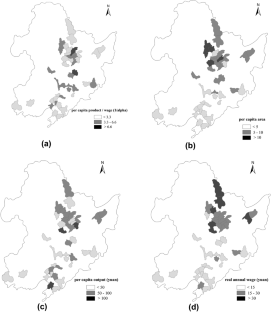
Source: the 1934–1936 Manchurian rural survey reports
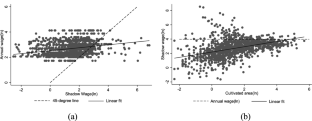
Notes
Notably, not all scholars have expressed clear support or opposition to these perspectives, and many compromise views have emerged. For example, Xia (2005) asserted that the rural market in modern Northern China was highly competitive, but remains an “over-dense market.” Regarding the controversy of modern rural economic concerns, please refer to the reviews such as Myers (1991) and Wiens (1993) for details.
Note that even though some markets, particularly financial markets, are absent, agents can sign interlinking contracts that can partially compensate for the absence of these markets and formal institutions. For example, ex-ante payment in a labor-hiring contract may function as a credit device. For more discussions, one can refer to Brandt and Hosios (1996).
If separability is not satisfied, it can be verified that the markets are incomplete. Therefore, in this study, the concepts of market completeness, the separability of production and preference, market clearing, and optimal factor allocation efficiency have the same meaning. For a more detailed theoretical discussion, see, for example, Dillon et al. (2019).
Using the same set of rural micro-survey data, existing studies have conducted relevant research on the rural market in Northeast China at that time. For example, Benjamin and Brandt (1997) found that factor markets were not complete but were functioning well, and active factor markets could reduce farmers’ income inequality. Huang et al. (2022) also found that although the land market was active at that time, it was not in a clear state. The findings of this paper further confirm these conclusions. In addition, Kung and Li (2011) and Huang and Li (2023) both found that the impact of modern international soybean trade had a positive impact on farmers’ wealth.
6 The characteristic of the rural economy in Northeast China during the modern era is its active factor market, particularly the lack of obvious institutional obstacles in land transfer in the market. A notable contemporary feature is that the market-oriented reform of factor flows has generated a significant amount of non-agricultural labor transfer; therefore, we emphasize the importance of non-agricultural employment opportunities in our conclusion. Of course, many factors affect the functioning of the rural economy, such as the dual oppression of feudalism and imperialism that farmers faced in modern times. The essential differences in social and economic systems may render the modern and contemporary contexts not directly comparable, so this study takes only a long-term economic perspective. Similar intertemporal comparisons have been made, e.g., in Benjamin and Brandt (1999).
7 Research group of Northeast Resource Regulation Committee: “Northeast Economy Series: Agriculture” (Production Part), Jinghua Printing House, 1948, pp.4–5.
8 Yao Yongchao, Vol. 9 Economic Geography of Modern China: Modern Economic Geography of Northeast China, East China Normal University Press, 2014, p. 303.
According to the micro-survey data of Manchuria Railway used in this article, the proportion of farmers who obtain loans from large institutions such as the Manchuria Central Bank by mortgaging their land is only 10%.
10 Considering the safety of investigators, the surveyed villages were mainly located near county towns. Although this fact will lower the generality of our findings since remote villages were excluded from the sample, it also brings one merit, i.e., it helps to investigate the impact of modernization better since remote villages might not be affected.
Note that in the data of Buck (1937), the values of the board expense that the employers provided are available (also in unit of yuan). By substituting these figures for the per capita consumption, the real wages remain almost unchanged.
Family preference can involve various factors such as total consumption of agricultural products, preference for specific agricultural products, balance between labor and leisure, and other concerns that are generally related to factors such as households’ demographics.
13 We can also introduce restrictions on land and capital markets, which are omitted for the sake of simplicity because the results are consistent with those of labor markets, as in Dillon et al. (2019).
Note that if the markets were complete, the labor market would be clear, which means the optimal \({L}_{f}^{*}\) only depends on exogenous prices, such as \(p\) and \(w\).
The problem with Benjamin’s test method mentioned above can be addressed by combining it with panel data to determine whether there is a surplus or shortage of the labor force through the asymmetry of household members increase or decrease in population (Dillon et al. 2019). However, the historical data used in this paper are cross-sectional data from a single survey, so the method based on panel data cannot be applied.
In practice, the test methods of Benjamin (1992) and Jacoby (1993) may lead to opposite conclusions, so the method of Le (2010) can cross-check the two methods and only need the information of the total output value without the detailed information of the quantity and price of each input and output. It does not need to estimate the output elasticity accurately, so it has the characteristics of simplicity and flexibility.
The literature on rural market completeness tests (\(\overline{{L }_{i}}\)) is generally composed of the number of labor endowments in a household (size effect) and the proportion of age groups (composition effect). If the combination of these variables is insignificant, the hypothesis of market completeness cannot be rejected (LaFave and Thomas,2016).
According to the survey reports, most of the villagers carried their agricultural products to the nearest town for transactions. To avoid outliers in deal prices, we calculate the average price at the village level.
In the sample used in this study, 1,911 rural households are included. Since we primarily investigate the relationship between households’ agricultural production decisions and variables such as family factor endowment and market environment, we obtained a total of 1,198 observed values after excluding the sample of households in which families did not engage in farming.
In related literature, the wages obtained by rural households in wage labor are generally used as market wages; however, in the data used in this study, only about 11% of rural households received annual wages. Therefore, we use the average annual wage at the village level as a proxy variable for market wage. In addition, although farmers received most of their wages as seasonal day laborers, they were not employed as day laborers during most of the year. Thus, we compare the value of agricultural output, which is an annual variable, with the wage of annual workers.
Under the market-clear assumption of neoclassical economics, the two should always remain equal.
As the data from this survey are cross-sectional data from a single survey, we do not have exact demographic information from three or five years ago. In this regard, we can only use the age of each member in the current demographic information minus the number of years lagged and recalculate the household labor equivalent of several years ago as an IV.
Notably, in all the regression analyses in this study, the construction of the main variable does not involve labor output elasticity; therefore, its value does not affect our regression results, but only the calculation of shadow wages.
Soybeans were the main cash crop in Northeast China in modern times. We derive the potential crop output data from the United Nations Food and Agriculture Organization Global Agro-Ecological Zones database, version 4. The database calculates the theoretical maximum yield for each crop in each grid based on local natural conditions such as soil and climate.
Among crops, wheat is another important cash crop in North Manchuria, and its volume for sale accounted for 50.7% of total production. In addition, the major crops (and unit prices in dan/yuan) were soybeans (4.02), wheat (5.62), sorghum (3.12), millet (3.30), and corn (2.92). The unit prices of cash crops (soybeans and wheat) were higher than other three major food crops.
According to Huang and Li (2023), cultivation for cash crops was more labor-intensive than food crops that means the expansion of cash crops can absorb more agricultural labor.
According to Huang et al. (2022), major cities in Manchuria include Qiqihaer, Harbin, Changchun, Jilin, Shenyang, Dalian, and Yingkou, which were mainly built as early Russian or Japanese dependent territory of railways.
In this survey data, the non-agricultural income of farmers mainly includes the income from engaging in industry and commerce and the wages of migrant workers.
Since the survey data of micro-farmers in Northeast China in modern times only contained the data of household cash income (including agricultural and non-agricultural), and some agricultural products were not sold in the market, their value was not included in the cash income. As a result, the proportion of non-agricultural income in modern times (34%) in Table 11 is actually overestimated.
References
Acemoglu D, Guerrieri V (2008) Capital deepening and nonbalanced economic growth. J Polit Econ 116(3):467–498
Allen RC (2001) The great divergence in European wages and prices from the middle ages to the first world war. Explor Econ Hist 38(4):411–447
Allen RC, Bassino JP, Ma D, Moll-Murata C, Van Zanden JL (2011) Wages, prices, and living standards in China, 1738–1925: in comparison with Europe, Japan, and India. Econ Hist Rev 64(s1):8–38
Benjamin D (1992) Household composition, labor markets, and labor demand: Testing for separation in agricultural household models. Econometrica 60(2):287–322
Benjamin D, Brandt L (1997) Land, factor markets, and inequality in rural China: historical evidence. Explor Econ Hist 34(4):460–494
Benjamin D, Brandt L (1999) Markets and inequality in rural China: parallels with the past. Am Econ Rev 89(2):292–295
Brandt L (1987) Farm household behavior, factor markets, and the distributive consequences of commercialization in early twentieth-century China. J Econ Hist 47(3):711–737
Brandt L (1989) Commercialization and Agricultural Development in East-Central China, 1870–1937. Cambridge University Press, Cambridge
Brandt L (1997) Reflections on China’s late 19th and early 20th-century economy. China Q 150:282–308
Brandt L, Hosios AJ (1996) Credit, incentives, and reputation: a hedonic analysis of contractual wage profiles. J Polit Econ 104(6):1172–1226
Brandt L, Sands B (1990) Beyond Malthus and Ricardo: economic growth, land concentration, and income distribution in early twentieth-century rural China. J Econ Hist 50(4):807–827
Buck JL (1937) Land utilization in China: statistics. Commercial Press Co, Shanghai
Bureau of Statistics, Nanjing National Government (1942) Statistical Analysis of China's Tenancy System (Zhongguo zudian zhidu zhi tongji fenxi). Zhengzhong Press
Ci H (1998) The rural commodity market and capital market in North China in the Early 20th Century. Soc Sci China 01:90–105
Clark G (2007) The long march of history: Farm wages, population, and economic growth, England 1209–1869. Econ Hist Rev 60(1):97–135
Dillon B, Barrett CB (2017) Agricultural factor markets in Sub-Saharan Africa: an updated view with formal tests for market failure. Food Policy 67:64–77
Dillon B, Brummund P, Mwabu G (2019) Asymmetric non-separation and rural labor markets. J Dev Econ 139:78–96
Eckstein A, Chao K, Chang J (1974) The Economic development of Manchuria: the rise of a frontier economy. J Econ Hist 34(1):239–264
Erten B, Leight J (2021) Exporting out of agriculture: the impact of WTO accession on structural transformation in China. Rev Econ Stat 103(2): 364–380
Huang PCC (1985) The peasant economy and social change in North China. Stanford University Press, Stanford
Huang PCC (1990) The peasant family and rural development in the Yangzi Delta, 1350–1988. Stanford University Press, Stanford
Huang T, Li N (2023) Efficiency or equity? The effect of an exogenous agricultural commercial shock: Evidence from Manchuria in the 1930s. China Econ Rev 80:102003
Huang T, Li N, Se Y (2022) Development of modern non-agricultural industries, population pressure and rent rate—Investigation from modern rural surveys. China Econ Quterly 22(04):1343–1360 (in Chinese)
Humphries J, Weisdorf J (2019) Unreal wages? Real income and economic growth in England, 1260–1850. Econ J 129(623):2867–2887
Jacoby HG (1993) Shadow wages and peasant family labour supply: an econometric application to the Peruvian Sierra. Rev Econ Stud 60(4):903–921
Kebede HA (2022) Market integration and separability of production and consumption decisions in farm households. J Dev Econ 158:102939
Kong J (1986) Dongbei Jingjishi (economic history of Manchuria). Sichuan Renmin Press, Chengdu (in Chinese)
Kumon Y (2022) The Labor-Intensive Path: Wages, Incomes, and the Work Year in Japan, 1610–1890. J Econ Hist 82(2):368–402
Kung JK, Li N (2011) Commercialization as exogenous shocks: the effect of the soybean trade and migration in Manchurian villages, 1895–1934. Explor Econ Hist 48(4):568–589
Kung J-S, Bai N, Lee Y-F (2011) Human capital, migration, and a ‘vent’ for surplus rural labour in 1930s China: the case of the Lower Yangzi. Econ Hist Rev 64(s1):117–141
LaFave D, Thomas D (2016) Farms, families, and markets: new evidence on completeness of markets in agricultural settings. Econometrica 84(5):1917–1960
Le KT (2010) Separation hypothesis tests in the agricultural household model. Am J Agr Econ 92(5):1420–1431
Lewis WA (1954) Economic development with unlimited supplies of labour. Manchester School 22(2):139–191
Li J (2012) Ten controversies in the study of modern rural economic history in China. Hist Res 01:171–189 (in Chinese)
Li N (2016) Social network, linkage contract and risk reduction: the investigation on interest-free loan contract in the 1930s Northeast China. Res Chin Econ Hist 01:65–80 (in Chinese)
Lin Z, Peng K (2022) Risk sharing, transaction cost and agrarian contract choice: based on the SMR survey. Res Chin Econ Hist 06:54–66 (in Chinese)
Liu Z (2024) Wages, labour markets, and living standards in China, 1530–1840. Explor Econ Hist 92:101569
Ma D (2008) Economic growth in the lower yangzi region of China in 1911–1937: a quantitative and historical analysis. J Econ Hist 68(2):355–392
Ma D (2021) ‘Involution’ or seasonality: a new perspective on the 19–20th Century Chinese Agricultural Development. https://papers.ssrn.com/abstract=3960195
Merfeld JD (2023) Labor elasticities, market failures, and misallocation: Evidence from Indian agriculture. Agric Econ 54(5):623–637
Myers R (1970) The Chinese Peasant Economy: Agricultural Development in Hopei and Shantung 1890–1949. Harvard University Press, Cambridge
Myers R (1976) Socioeconomic change in villages of Manchuria during the Ch’ing and Republican periods: some preliminary findings. Mod Asian Stud 10(4):591–620
Myers R (1991) How did the modern Chinese economy develop?—a review article. J Asian Stud 50(3):604–628
National Agricultural Research Bureau, Ministry of Industry (1936) Crop Reporting in China 1934. Issued by the National Agricultural Research Bureau, Nanking, China
Perkins D (1969) Agricultural development in China, 1368–1968. Aldine Publishing Co, Chicago
Pomeranz K (2000) The great divergence: China, Europe, and the making of the modern world economy. Princeton University Press
Rawski TG (1989) Economic growth in prewar China. University of California Press, Berkeley
Schultz T (1964) Transforming traditional agriculture. Yale University Press, New Haven
Singh I, Squire L, Strauss J (1986) Agricultural household models: extensions, applications, and policy (69)
Wang Y (1934) Dongsansheng Zudian Zhidu (Institution of tenancy in Northeast China) Zhengzhi Jingji Xuebao (J Polit Econ) 3(1) (in Chinese)
Wiens TB (1993) Trends in the late qing and Republican rural economy: reality or illusion? Republican China 18(1):63–76
Wright T (2007) The Manchurian economy and the 1930s world depression. Mod Asian Stud 41(5):1073–1112
Xia M (2005) A new exploration of the development nature of rural markets in modern North China—comparison with Jiangnan. Chin Rural Stud 2005(00):38–99 (in Chinese)
Xu D (1983) Zhongguo Jindai Nongye Shengchan yu Maoyi Tongji Ziliao (Statistics on Agricultural Production and Trade in Modern China). Shanghai Renmin Press, Shanghai (in Chinese)
Yao Y (2014) Dongbei Jindai Jingji Dili (Northeast Modern Economic Geography). East China Normal University Press, Shanghai (in Chinese)
Zhang Y (1957) Zhongguo Jindai Nongyeshi Ziliao Vol.2 (Materials on the History of Modern Chinese Agriculture, Vol.2). SDX Joint Publishing Company, Beijing (in Chinese)
Acknowledgements
This work was supported by the National Natural Science Foundation of China (Grant No. 72363003).
Author information
Authors and Affiliations
Corresponding author
Ethics declarations
Conflict of interest
The authors have no competing interests to declare that are relevant to the content of this article.
Additional information
Publisher's Note
Springer Nature remains neutral with regard to jurisdictional claims in published maps and institutional affiliations.
Appendix
Appendix
See Fig. 3 and Tables 12, 13, 14, 15, 16 and 17.
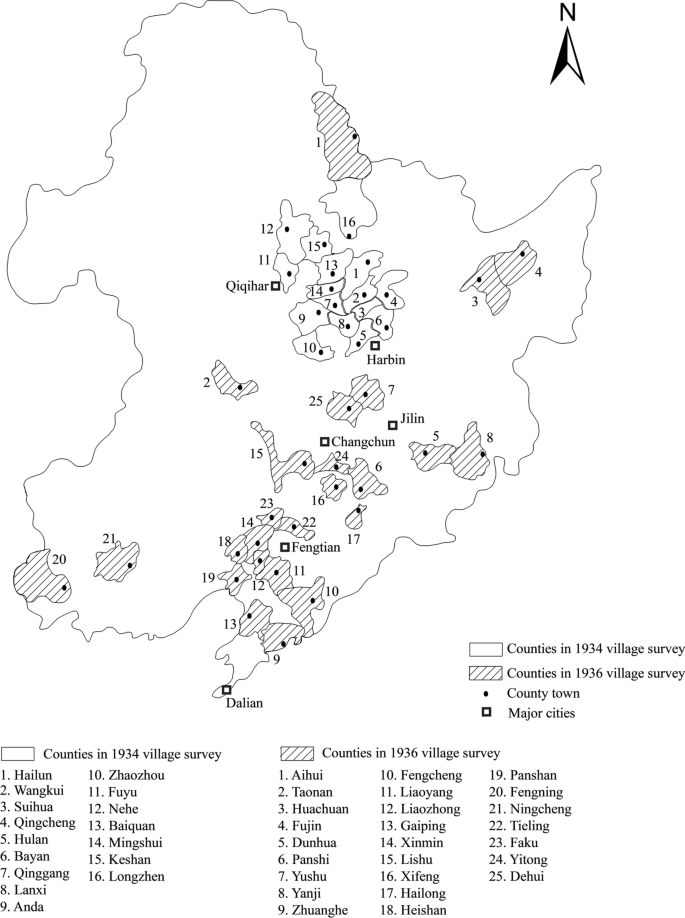
Source: Location of observation is from Manchuria Village Surveys in the 1930s
Location of villages in the 1934–1936 Manchurian village survey.
Rights and permissions
Springer Nature or its licensor (e.g. a society or other partner) holds exclusive rights to this article under a publishing agreement with the author(s) or other rightsholder(s); author self-archiving of the accepted manuscript version of this article is solely governed by the terms of such publishing agreement and applicable law.
About this article

Cite this article
Huang, T., Quan, Y., Li, N. et al. Revisiting the functioning of rural markets: a long-term investigation based on micro-surveys in Northeast China. Cliometrica 20, 221–263 (2026). https://doi.org/10.1007/s11698-025-00314-w
Received:
Accepted:
Published:
Version of record:
Issue date:
DOI: https://doi.org/10.1007/s11698-025-00314-w