
Overview
This embedded content is from a site (www.youtube.com, flickr.com, etc) that does not comply with the Do Not Track (DNT) setting now enabled on your browser.
Clicking through to the embedded content will allow you to be tracked by the embed provider.

What do you do if you want the convenience of MIDI but the warm tones of analog synths? Build a MIDI to CV converter, of course! In this project, you'll use a QT Py RP2040 running CircuitPython with an MCP4725 DAC to convert MIDI messages to a gate output and 1V/oct output.

The build is housed in a snazzy 3D printed skull adorned enclosure. The output jacks are located in the skull's eyes.

The CircuitPython code converts MIDI NoteOn and NoteOff messages to gate out and 1V/oct signals that are sent through the two mono audio jacks. This lets you play your CV controlled synths with a MIDI keyboard or a MIDI song file from your DAW.
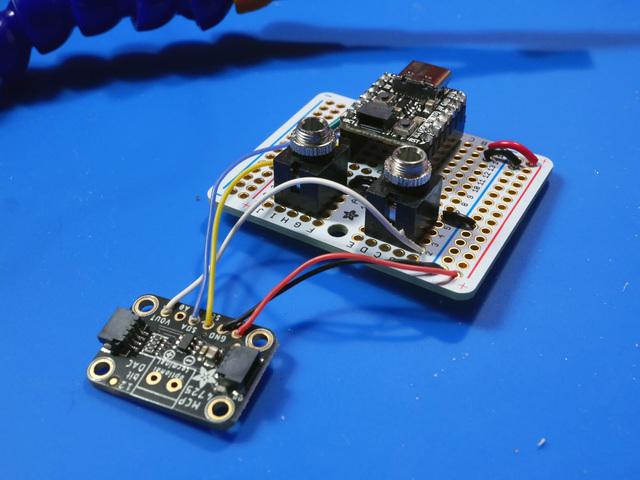
The MCP4725 DAC is a digital to analog converter and outputs the voltages to correspond with the expected 1V/oct value.
What is 1V/oct?
1V/oct is a standard for controlling pitch in modular synthesis. A volt is divided to correspond with the twelve pitches in western music. For example, 0.333V is pitch E-2 and 0.917V is pitch B-2. When the voltage is increased by 1V, the octave increases by 1. For example, 1.333V is pitch E-3 (an increase of 1V and 1 octave) and 2.917V is pitch B-4 (an increase of 2V and 2 octaves).
However, these pitches are approximate and depend on a variety of factors, such as your oscillator's tuning and any electrical interference. But that's half the fun of synthesis!


Page last edited March 08, 2024
Text editor powered by tinymce.


