My first 1911 was a
Springfield Armory pistol.

Back then, I had not yet experienced the allure of the Colt product, but I wrote about the Springfield Mil-Spec as a review online somewhere. Fortunately, I still have that review in my files, as well as a subsequent review on the pistol that would become the Springfield GI45.
I still heartily recommend the Springfield 1911 to people who want to explore the 1911 and all it's potential. the Springfield has a forged frame and slide. Less expensive 1911s lack this quality. I believe forgings to be important on an old design that fires a substantial cartridge if the firearm is to remain durable in the long term.
I still own these Springfield pistols, and they still shoot beautifully. I would not hesitate to purchase another one at the right price. I paid $499 for my NIB Mil-Spec years ago, and $400 for my GI version. Not surprisingly, the prices have since gone up. Last week I saw a new Mil-Spec in a gun store priced at $663. They had a GI45 for $499. I present the rather dated reviews, with current photos, here for your enjoyment.
The Springfield Mil-Spec
I became interested in handguns during the height of the Wondernine Revolution. I was in the military when we transitioned from the venerable old 1911 to the M9 Beretta 92FS. Sidearms in particular are a personal thing to a man in the military. I heard all the arguments from the old salts who wanted to keep the 1911. Like most changes, the troops did not like the change to an unproven sidearm. When I got out of Uncle Sugar's Yacht Club in late 1991, the first major purchase I made was a Beretta 92FS. It took me years to see the wisdom of the old salts I had fought with.
A decade later, my son acquired a Colt 1991 Officer's Model, and I was amazed at it's accuracy. I was also intrigued by it's utilitarian business like design. Then one afternoon at my local gunstore, I noticed a Springfield Mil-Spec in the case. It was a rather uninspiring looking pistol, with black plastic grips and a dull black parkerized finish. I listened while the counter guy gave me the standard internet rumor that the NM serial number meant this pistol had a leftover National Match frame. I looked at the $499 price tag, and decided that perhaps it was the day to buy a 1911. The NM rumor ended up being horse hockey, the pistol ended up being a diamond in the rough. The pistol came with two magazines, a coupon for a bunch of goodies, but best of all, a lifetime warranty.
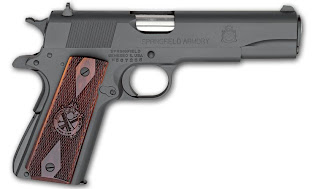
The Springfield Mil-Spec is a Series 70 type pistol, meaning it has no firing pin safety. Instead, Springfield uses a lighter titanium firing pin. This is the only proprietary part. All other parts can be replaced with Colt Series 70 parts. The Regular Mil-Spec (as opposed to the WWII model) has a lowered and flared ejection port. It has generous three dot sights that are quick to acquire. It also has a slightly extended tang on the grip safety that effectively eliminates hammerbite. At the time of this writing, the Springfield Mil-spec is available in Government length as well as Commander (Champion), and Ultra Compact (3.5 inch). There have been reliability problems reported with the Mil-Specs in Ultra Compact length, but nothing that the factory could not iron out. The Mil-Spec now comes in several finishes....parkerized, stainless steel, two toned (parkerized slide, stainless frame), olive drab Armor Kote, Springfield's teflon based coating.
The frames and slides of the Springfield Mil-Spec are forged.  The barrel is a two piece barrel, a reservation for some, but a non-issue for others. Some have a Chamber Indicator Slot cut into the barrel hood to allow a shooter to see brass in the chamber. All have the Integral Locking System built into the mainspring housing. The ILS is a rather ingenious locking device that only takes a turn of a discrete keyway to lock the weapon's hammer in place, thus disabling it. What's ingenious about that you ask? Well you can get rid of it by changing out the mainspring housing, mainspring, and the mainspring cap. The housing is routinely swapped out by 1911 shooters anyway. The cap is a three dollar part. Thus you have a choice of whether you want the device. Springfield has preserved the original format of the 1911 while still incorporating a drop safety as well as an integral safety. Both Kimber Series II and Colt Series 80 pistols have extra mechanical mechanisms for a firing pin safety. Springfield's solution is simple, elegant and smart.
My Springfield Mil-Spec was a decently accurate gun out of the box. It would shoot average two inch groups with an occasional flyer at 25 feet. An experienced 1911 shooter could have done better, as I was new to the caliber and platform. One of the first things I did was change out the stainless steel bushing my Mil-Spec came with. I just did not like the silver bushing on a parkerized gun. I ordered a King's bushing and slowly went about fitting it. Over 3000 rounds later, it still requires a wrench to remove. The King's bushing had the Midas effect on this gun. It went from scattered groups to single holes. The change was so immediate that I have to credit the bushing and not my growing experience with the gun. To date I have well over 3000 rounds through this pistol with only one stovepipe in the first fifty rounds. That was likely my fault, from limpwristing. I use Wilson Combat magazines in the pistol, but it functioned fine with the stock Springfield magazines as well.
Out of the box trigger pull was a crisp 5-6 pounds. To lighten the trigger pull, I installed a Colt trigger from my Commander, an 18 pound mainspring (along with a 20 LPI checkered mainspring housing to get rid of the ILS) and a bit of Brownell's Action Magic grease on the sear nose. I installed a King's wide spur hammer, simply because I like the looks of it. After a night of dry firing the pistol at liberals on the television, the action polished up to a crisp three pound trigger with a light take up and no creep. After I lightened the mainspring to 18 pounds, I received the occasional lightstrike. I rectified this by cutting two coils off the firing pin spring, thus lightening it as well. The lightstrikes were eliminated.
I really like the teardrop shaped thumb safety on a concealed carry 1911, but this 1911 was not to be a CCW gun. Thus I installed an Ed Brown extended ambi-safety. I went through several sets of grips before I finally settled on Kim Ahrends cocobolo checkered grips. They will stay on the pistol. I rarely change grips again once I find a set that I like for a given pistol. I also installed a Chip McCormick drop in rear sight.
I would recommend the Springfield Mil-Spec right alongside the NRM Colt as the perfect choice for the 1911 novice. It is affordable, reliable, durable, and incredibly addictive. Even if you never loosen a grip screw, you will find this pistol to be an incredible value. People have taken it straight from the counter to IDPA matches, with little more than a squirt of CLP on the rails, and found it to be 100% reliable. In the past, Springfields have taken a hit compared to Colts and Kimbers at the trade-in counter. I expect this to stabilize in the future. To take the hit, an owner must trade in the pistol. I don't ever expect to trade mine in, so it's a non-issue for me. For the person who wants to venture into the world of John Moses Browning's 1911 brainchild and see if they will enjoy a gun of infinite possibilities, undisputed effectiveness, and incredible value, the Springfield Mil-Spec is a $500 ticket to never seeing any handgun in the same way again. The 1911 raises the bar for all handguns. The Springfield Mil-Spec raises the bar for affordable 1911s. Get one. You will not regret it.
The Pistol That Became The Springfield GI45

In 2003, Springfield decided to release their own version of a military style 1911A1. Rumors of this had circulated the 1911 forums for a couple of months, and some buyers, like myself were chomping at the bit for this pistol. We all wanted a GI style 1911 as a shooter, and the Auto Ordnance version just did not measure up. The Colt reproduction was just to expensive, and many thought to pretty. Sistemas seemed to be a crapshoot and hard to find. Norincos were even tougher to find. Forget about Remington Rands and Switch & Signals and other real GI guns, they are just to valuable to be shooters. The market was ready for a durable, decently fitted and inexpensive GI styled 1911 that could shoot out of the box. I ordered mine the day after Springfield released them. I had no idea what to expect. The ads showed a gun with brown plastic grips and a stainless barrel. The initial MSRP was $489. My cost was $400, and it seems as if you can now find several Springfield WWII Mil-Specs at any gunshow for $399.
When my WWII Mil-Spec arrived, it had Springfield's ILS system, a teardrop thumb safety, standard trigger, and black plastic checkered grips.  It also had a parkerized barrel with a loaded chamber indicator, and the older blocky Springfield front strap. I found it to be acceptable for $400 though.
I have listed the differences between the two Mil-specs below, as this often confuses people. My WWII Mil-Spec had "IMBEL BRAZIL" buzzpenned under the dustcover, indicating it was finished in Brazil. The good thing is that it had a GI style ejection port, straight slide serrations, and a parkerized barrel and bushing. The slide and frame are forged.
The first thing on mine to be changed were the grips. I went with walnut double diamonds. Basically what I wanted to do was not to reproduce a certain pistol, but to make my pistol have the feel of a military 1911. I located a GI trigger, a GI abbreviated thumb safety and installed them. Next, I installed a checkered magazine release and slide release. The ILS system had to go, so I bought a lanyard loop mainspring housing off ebay and installed it. I also picked up a couple of GI magazines. I like a wide spur hammer, so I installed one of those as well, and polished up the action.
This pistol is a surprisingly good shooter once you adapt to the military sights. It is as accurate as the regular Mil-Spec. Make no mistake though, military sights are not Novaks. This pistol looks even better with finish wear (imagine that!). After approximately 600 rounds, I began to have feeding difficulty on the last round of a magazine. I swapped magazines to no avail.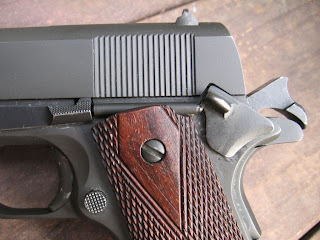 I finally resorted to putting an 18.5 pound recoil spring in the pistol, and it has been chugging along ever since. I'm not positive of my round count, but I know it is between 1500 and two thousand, mostly Winchester White Box with a smattering of reloads. This pistol does ding the brass a bit on ejection, but not badly according to a reloader friend. It will eject a live round. I had no stovepipes. It will shoot JHP, although I only ran one magazine of HydraShoks through it just to see if it would. Others report no problems with JHP as well.
The Springfield WWII Mil-Spec is a great buy if you want a military style 1911 that is a shooter and can be beat around. It won't fool a WWII buff, but if you swap in a checkered slide stop, checkered mag release, a GI thumb safety, put on brown plastic or walnut grips and get rid of the ILS mainspring housing it is pretty darned authentic. I would rate it as a best buy for a novice 1911 buyer. Many experienced 1911 shooters are buying this pistol and having a heck of a lot of fun with it. Most are trying to figure out how Springfield is turning a profit. This is certainly one 1911 that gives you more than you pay for.
A semi-accurate compilation of the differences between these two 1911s is listed below. Some changes have occured since, such as the improved rounding of the frontstrap and the dustcover to bring the pistols closer to the classic 1911 profile. I have not kept up with all the changes.
Springfield Mil-SpecPB9108LP (parkerized 5 inch)
N or NM serial number
Around $650 now
Lowered and flared ejection port
Slanted slide serrations
Stainless barrel with chamber indicator
Three dot sights
Stainless bushing (some are parkerized)
Rounded front strap
Less machining marks under slide
Has crossed cannons logo on slide
No lanyard loop
Serrated slide stop and mag release
Civilian teardrop safety
Short serrated trigger
Sear and hammer pins are flat on right side
Black checkered plastic grips (later changed to crossed cannon logo wooden grips)
Comes in parkerized or stainless
Blue plastic box
Springfield WWII Mil-Spec (GI45)PW9108LP (parkerized 5 inch)
WW serial number
Around $500 now
GI style high ejection port
Straight slide serrations
Parkerized barrel with chamber indicator (chamber indicator omitted on later models)
Military sights
Parkerized bushing
Blockier front strap (later models have the rounded frontstrap)
More machining marks under slide
No ".45 Cal" or crossed cannon logo on slide
Lanyard loop
Serrated slide stop and mag release
Sear and hammer pins are domed on right side
Civilian teardrop safety
Short serrated trigger
Black checkered plastic grips (later changed to US logo wooden grips)
Comes in parkerized, stainless olive drab, various sizes and even high capacity
Cardboard box (Later changed to green plastic)
Over the past few years, some of my preferences have changed, and Springfield's packaging and pricing of these pistols has changed, but I never felt the need to upgrade among Springfield Armory's products. Springfield makes some excellent high end pistols, and I understand their Custom Shop is second to no other manufacturers. I also understand their service is second to none. I have never had to use either.
I have purchased a used
stainless GI45 at an
excellent price. It, too, has been an excellent pistol. So, in the end, if you are a person wanting to try the 1911 platform, here's your meat. In my opinion, the Springfield 1911 is the best product available for the 1911 newbie who wants a durable, accurate and inexpensive entry gun into the 1911 arena.
How to remove the ILS.Labels: 1911 Basics, 1911's, Springfield
 I don't have my first handgun any more, but I will never sell my first 1911.
  I don't have my first handgun any more, but I will never sell my first 1911.