Showing posts with label Museums. Show all posts

Saturday, February 27, 2016

Mort Kunstler Long Island Artist Telling the American Historical Story

The amazingly precise art of Mort Kunstler, Oyster Bay Artist, is being presented at the Long Island Museum in Stonybrook, featuring American History, Art, and Carriages.
 This exhibit fits in beautifully with the mission that I have come to know regarding their emphasis on teaching and  displaying Long Island Art and artifacts.

 Carriages.

Mort Kunsler is a Brooklyn born artist that lives in Oyster Bay.  His work is outstandingly faithful and accurate due to his artistic excellence, and to his pursuit of actual objects and places that he renders in each of his compositions.
 His work had been on display at the Norman Rockwell Museum in Stockbridge , Massachusetts.  But a collection of his art, incredibly varied, is on display at the Long Island Museum in Stonybrook. until May 30, 2016.   Mort Kunstler has the ability to portray historical events and themes with super real drawing and rendering.  The works are researched for authenticity.  He graciously smiled for me and was so charming and kind.
 The Art Museum housed in a separate building on the property, is up on a hill.  It has a majestic entrance.
 Inside the Mort Kunstler exhibit was presented.  It included illustrations, paintings for Movie poster art assignments, commercial art, historical oil paintings on canvas, gouache paintings ( an opaque form of watercolor,) a sculpture of a horse, preparatory drawings in pencil and charcoal, covers for magazines, and toy model kits, and  patriotic renderings of American History, and so much more.
 This is a composition of his 1942 Brooklyn Dodger team with their actual autographs.
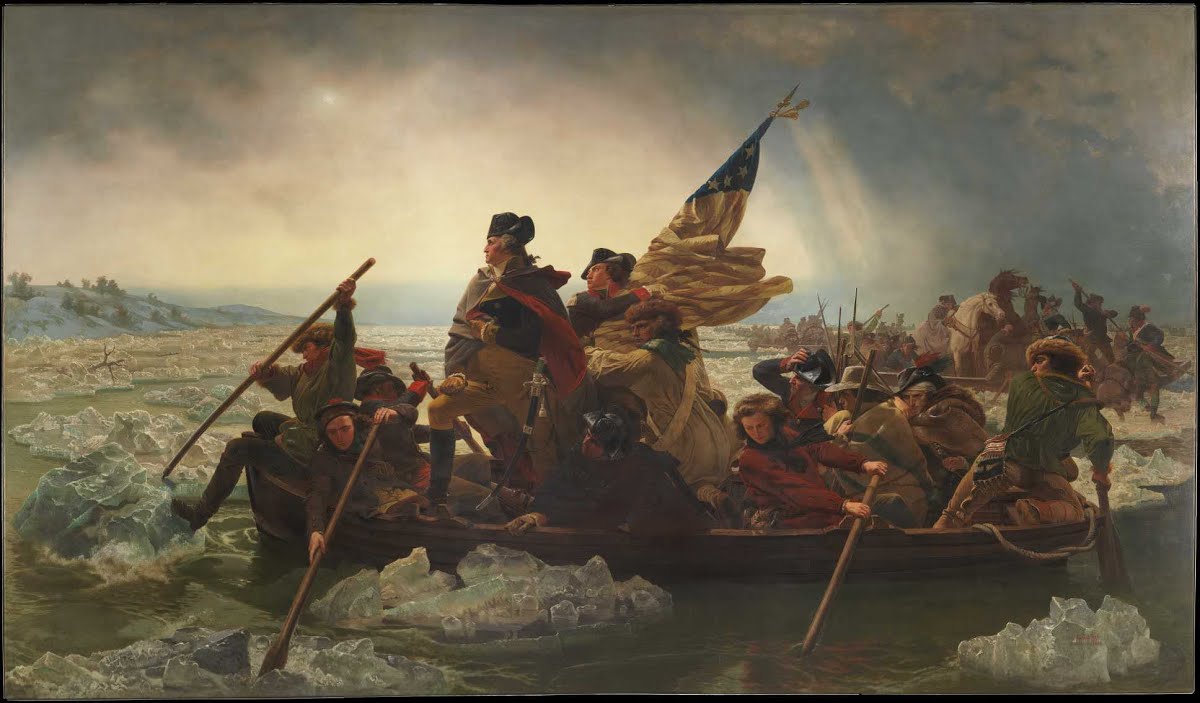
 In this series of three paintings, Kunstler parodies a famous painting, Washington Crossing the Delaware 1851, Metropolitan Museum of Art,  by Emanuel Gottlieb Leutze.   The assignment was commissioned by the Yellow Pages Directory.  
My favorite painting in the exhibit was The Culper Spy.   It depicts Robert Townsend of Oyster Bay sitting in a room in Raynam Hall.  Abraham Woodhull, the first spy, signed his letters to Washington as Samuel Culper Sr., and Townsend  signed as Samuel Culper Jr.  This had special meaning to me because a few hundred feet from the Jarvis House stood the Widow Platt's Tavern.  Washington stopped there for lunch on his 1790 tour of Long Island.  He made that tour to inspect the topography, the soil conditions, the crops that could be grown here on Long Island,  but the subtext of his trip was to thank the Culper Spys that helped him win the Revolutionary War.  His lunch at the Tavern is noted by him in the journals that he wrote on this tour.    Kunstler went to Raynam Hall to authentically recreate the image of Townsend and Long Island history.
Anyone interested in a remarkable Long Island Artist should visit the Long Island Museum in Stonybrook.  People at this show were lovingly standing up close to the detailed paintings, in wonder that this artist could capture history in such a thorough and exquisite manner.

Sunday, December 6, 2015

Sagamore Hill Long Island Home of Theodore Roosevelt Christmas with the Roosevelts 2015

Sagamore Hill, the  newly restored Oyster Bay, Long Island home of the twenty-sixth president of the United States, Theodore Roosevelt, was the site of a special event, "Christmas with the Roosevelts."
 The National Parks Service spent three years carefully repairing and restoring the structure, the  interior, and the artifacts of this treasure on the North Shore of Long Island.
 They provided new pathways around the Roosevelt's family home for the public to enjoy the natural beauty of the property.
 A very impressive wooden windmill.  In the day, Sagamore Hill was a working farm.

 One can just imagine the president roaming across the family fields and playing with his children, pointing out the different plants and animals.  He was a very involved father and encouraged physical activities out doors.
 The beauty of the weathered split rail fencing and the mature plantings and trees give the visitors to this National Park a true view of what Long Island looked like during the days of the "Summer White House. "   President Roosevelt lived at Sagamore Hill from 1885 until his death in 1919.
Sagamore Hill is named for the Algonquin word "Sagamore" which means chieftain or head of the tribe.
 This is an enormous Copper Beech tree that stands proudly just outside the front entrance to Roosevelt's home. 

Sagamore Hill was truly a family residence for the Roosevelts and their six children. Edith Kermit Carow Roosevelt, Theodor's second wife, died there in 1948. Her working desk is prominently shown by the guides because she was in charge of the daily comings and goings and the finances at Sagamore Hill. Although Teddy Roosevelt was a prolific writer and author, naturalist, soldier, explorer and statesman, he left the handling of money to Edith. Good thing too, because he couldn't account for the spending money she would give him each day, according to the guides.
 Front door
 A historian giving a few anecdotes about the family.
 I noticed a mill stone near the curb.
 After the tour  of the interior first floor of Sagamore Hill, we were making our way to the parking field, and spotted James Foote, the twenty-sixth president re-enactor.
He as telling stories about the president, and was very
 gracious, so how could we leave without a photo with Teddy Roosevelt!
 Just before we got into our car, we noticed these beautiful cherry-like  fruit on a tree in the parking lot.
These are the leaves from that tree.  If anyone knows what type of tree this is please let me know.  Any plants that fruit or bloom this late in the season are interesting to me because I am sure that the fruit would be consumed by winter birds.  Natural berries or fruiting trees are essential to help encourage winter birds.
James Foote as the president.

Sunday, January 11, 2015

Theodore Roosevelt Sculpture at the American Museum of Natural History, NYC

On my bucket list for last year was a trip into NYC to the American Museum of Natural History to see and sit next to the very realistic bronze sculpture of Long Island's own past United States President, Theodore Roosevelt.
The trip involved a ride on the Long Island railroad, then on to a NYC subway to the museum's underground stop at 81st street.
There were amazing mosaics of animals on the subway walls.


Looking down, this was one of the floor tiles at the subway s top.
 Outside the front entrance to the museum, an equestrian sculpture of Roosevelt stands.
 It maybe because the design of this portrayal of Roosevelt is a bit too idealistic, that the museum decided to use a more human, trail blazing, adventurer styled bronze of the President.  His hat, binoculars, neckerchief, and explorer's clothing appear in the new bronze. 
 
 Quotations from Roosevelt are engraved into the building's facade.  The museum is a tribute to his life long interest in the environment and natural history.  There are exhibits inside from his youth, and lists of the National parks and expanses of land in the United States that Roosevelt set aside for  future generations.  Sometimes he had to go against big businesses and the houses of government to get this done.


 For the holidays, the Museum decorated the front steps with topiaries of dinosaurs.
 There is a magnificent display of the universe with huge models of the planets and the solar system, explaining the relative sizes of the heavenly bodies and the distances between them.

 As a child, I remembered the many beautifully designed, painted, and sculpted dioramas of animals and geography.  As an adult, I am taken by the efforts to replicate all of that by the many artists that worked on these creations.
 When I look at indigenous and primitive artifacts on display, I cannot help but connect these with modern artists that used them for inspiration.
 Fossils and
 recreations of ancient animals,
 dinosaurs full size on display,

 and the bones of past creatures reconstructed, so that visitors, adults and children can marvel at their size and ferociousness. 
 When I got to the museum, I looked for this particular diorama of a cross section of garden soil with its leaves and bugs.  It was still there, and still giant!
 Some of the exhibits are large and hanging,
 some are cast and small.
 One of the areas that I most enjoy is the portrayal of human development.
 Then, there is a area dedicated to minerals and gem stones.
 Huge crystals are displayed in the walls.

 Geodes and
 gem stones are on display.
 But the thing that made this trip to the American Museum of Natural History was the new realistic sculpture of President Theodore Roosevelt.  Visit the museum soon,and discover all of the things that you remember from your childhood visits, and see the new exhibits that make us appreciate anew, the contributions of Roosevelt. Located at Central Park West at 79th Street, NY, New York 10024.