Showing posts with label pulitzer. Show all posts

Wednesday, 28 September 2022

Apex Hides the Hurt

'Apex Hides the Hurt' by Colson Whitehead (my goodness he has won a shitload of awards) was picked up as a charity shop find, his name recognisable because he had been on the Booker long-list. It concerns a (I suddenly realised, presumably ironically) nameless hero, who's job it is to come up with new names for things, or names for new things; a really unpromising scenario for a novel, but I have so enjoyed it. When not much happens a book has to be character driven and what a wonderful collection of vivid people Colson has created here. 

So, he arrives in the town of Winthrop because the local council is having debate about the town's name; whether to retain the name Winthrop, return to the town's original name of Freedom, or to change it to New Prospera. Each of the three members of the town council is championing one of the options, and they each take turns making their case to him, while he spends time to get to know the town and its people. Here he has just arrived at the Hotel Winthrop (he's limping because he has just had a toe removed, this is relevant to the back story), I love this whole description, a good example of his writing:
"He limped around the room. He was on the top floor of the hotel and had a nice view of the emptied square. He pressed his palms to the sill. People had umbrellas now, not the compact-click found in major metropolitan areas but favourite umbrellas they never lost, and they made a break out of doorways for their cars or homes, confident now that this was not a brief sudden shower but a rain that was going to hang around for a while. It was a bad cough that had turned into something that showed up on X-rays. The leaves fled one way, then another. From the window, the river along the square was a brown worm without head or tail. The wind changed, and he was startled by a gust that threw spray against the panes for a few vicious seconds. The bed was safe, well-pillowed, and he made his retreat." (P.13)

He goes in search of some local history (he takes his job seriously, he's not just here to pick a name out of the hat), and I also loved this description of libraries (the local one is unfortunately being replaced with an 'Outfit Outlet'):
"On the rare occasions that he entered libraries, he always felt assured of his virtue. If they figured out how to distill essence of library into a convenient delivery system - a piece of gum or a gelcap, for example - he would consume it eagerly, relieved to be finished with more taxing methods of virtue gratification. Helping old ladies across the street. Giving tourists directions. Libraries. Alas there would be no warm feeling of satisfaction today. The place was a husk. The books were gone. Where he would usually be intimidated by an army of daunting spines, there were only dust-ball rinds and Dewey decimal grave markers. as if by consensus, all the educational posters and maps had cast out their top right-hand corner tacks, so the their undersides bowed over like blades of grass. Nothing would be referenced this afternoon, save indomitable market forces." (p.91-2)

I loved the picture of small town life, it's politics and history, that although they disagreed they all liked and respected each other. Here is another little snippet that I noted, where he just goes for a walk in the woods, something, I get the impression, he had never down before:
"At first it was quiet. Such was his frame of reference that he likened it to the deep silence that follows when a refrigerator stops humming. Only him and the apartment, alone, the end of the fridge's hum the departure of a guest he hadn't even known was present. He continued down the path, which terminated at the lip of a gloomy, mottled marsh. He heard the words of the woods. Animals, insects, small branches disturbed by unseen creatures. The more he listened, the deeper he tumbled into the noise. For a few minutes he allowed himself to be swayed by the sales pitch of nature." (p.152)

Regina, Lucky and Albie vie for his attention, each in their own unique way, though it was his relationship with the surly barkeeper and the overly pugnacious housekeeper at the hotel that I found most entertaining. The whole book was just a delight, and had a suitably delightful denouement. Our hero's personal existential crisis seems to have been helped by his stay too. (By the way, Apex is the name he gave to a brand of plasters.) Names in all their complexity play an important role, in life, in society, in consumerism, and maybe you do have to live with a name for a while for it to come into its own.

Stay safe. Be kind. Would a rose by any other name smell as sweet.

Wednesday, 5 January 2022

Bewildered

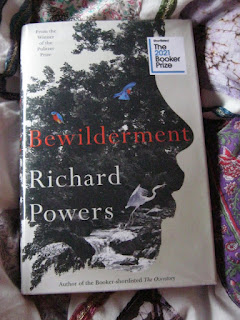
'Bewilderment' by Richard Powers is definitely a book worthy of inclusion on the Booker shortlist. In it Theo and Robin struggle with life without Aly, but that is not their only struggle. As Robin decides to continue his mother's fight to save the planet's wildlife Theo must battle the authorities for the soul of his son; Robin's increasingly erratic behaviour is causing concern that may lead to 'medication'. Theo's job involves the search for life on other planets, and he creates a game with his son where they imagine that they are exploring alternate realities, possible lifeforms across the galaxy that manage to exist in the most unlikely of circumstances. Robin continues to have problems controlling his anger and frustration so Theo turns to Martin Currier, a former colleague (and lover) of Aly who does brain research, and the boy takes part in a study involving mapping brain patterns of emotional states. The technique helps him enormously, and he in return contributes to the research. In attempting to balance protecting Robin from the pressures of a system that does not wish to accommodate him with the need to be a professor they discover the joys of home schooling; they jump through the curriculum hoops that the state requires and leave Robin free to pursue his passion for endangered animals.  When Martin asks to use Robin's experience in his research to help with his funding Theo reluctantly agrees, and that's when things get a bit out of control, with consequences that might have been anticipated. 

A beautiful book, intense and emotionally fraught. Lots of obscure science stuff, that may or may not have any basis in reality, but you can imagine that it does. It feels like the fate of the planet is in the hands of this boy, he takes the weight of the world on himself, and it squashes him. I liked that he was bright and precocious, but also a child, with the way that children can experience things so intensely, and feel so intensely their smallness and weakness in the face of the powers that control. And his father supported him in what he was trying to do, in spite of his smallness and weakness, he made him believe it was worth trying. And then hopes are crushed all round and the reality of the world come crashing in and I cried.

The trials of being a parent loom large in the book, and that is what really sucked me in:
"But it turns out children have a tolerance for mistakes that I never imagined. Who's have believed a four-year-old could pull a grill full of hot charcoal down onto himself and walk away with no lasting harm beyond a brand like a shiny pink oyster on his lower back.
On the other hand, the ways of going wrong never fail to stun me. I once read my six-year-old The Velveteen Rabbit and only learned from my eight-year-old about the months of nightmares it had given him. Two years of night terrors he's been too ashamed to tell me about: that was Robin. God only knows what the eleven-year-old might confess to me about the things I was right now doing wrong. But he'd survived his mother's death. I figured he'd survive my best intentions.
I lay in our tent that night, thinking how Robbie had spent two days worrying over the silence of the galaxy that ought to be crawling with civilizations. How could anyone protect a boy like that from his own imagination, let alone from a few carnivorous third-graders flinging shit at him? Alyssa would've propelled the three of us forward on her own bottomless forgiveness and bulldozer will. Without her, I was flailing.
I twitched in my sleeping bag, trying not to wake Robin. A chorus of invertebrates swelled and ebbed. Two barred owls traded their call-and-response: Who cooks for you? Who cooks for you-all? Who would ever cook for this boy, aside from me? I couldn't imagine Robin toughening up enough to survive this Ponzi scheme of a planet. Maybe I didn't want him to. I liked him otherworldly. I liked having a son so ingenuous that it rattled his smug classmates. I enjoyed being the father of a kid whose favourite animal for three straight years had been a nudibranch. Nudibranchs are deeply underappreciated.
Late-night anxieties of an astrobiologist. I smelled the trees respiring and heard the river where Alyssa and I first swam together, polishing its boulders even in darkness. A noise came from the bag next to me. Robin was pleading in his sleep. Stop! Please stop! Please!" (p29-30)

Stay safe. Be kind. Get tested. (We finally had covid here last week, it can strike even the fully vaccinated.)

Friday, 3 December 2021

Threads of Ruin

I (very) briefly mentioned Anthony Doerr back in 2019 when I finally got around to reading 'All The Light We Cannot See' and I have been promising myself for several days that I would try and do justice to 'Cloud Cuckoo Land'. I will fail to. I keep trying, and reading, and planning to sit and reflect, but then remind myself that I am not supposed to beat myself up about it. I want writers out there to know that their efforts are appreciated. That their stories are making life better. 

In many ways Cloud Cuckoo Land is similar in structure to All The Light, although it revolves around a story written by  Antonius Diogenes and the impact that it has over the centuries. The two young people in this story drift inexorably towards each other during the downfall of Constantinople in 1453; Omeir having been forced to join the invading Ottoman army and Anna inside the city, working as a bad embroiderer and trying to learn Greek. In other parts of the story Zeno is a soldier in the Korean war and then an old man, also learning Greek and sharing his love of Diogenes' story with some local schoolchildren. Konstance (I just realised, appropriately named) lives in the future, on a centuries long space journey to a new world, who's connection to the story saves her life. Again what I loved most about the book was the characters and how I became involved in their various fates. It is essentially what I want from my reading, to care about the people and their story, to feel invested in what becomes of them, to feel their joys and share their sorrow. 

Soldiers arrive at Omeir's home, and take his oxen, and himself as their teamster:
"Little whorls of sawdust rise through the lamplight and melt back into the shadows. 'When they saw your oxen,' he says, 'their heads nearly fell off their necks,' but he does not laugh and does not look up from his work.
Omeir sits against the wall. A particular combination of dung and smoke and straw and wood shavings make a familiar warm tang in the back of his throat and he bites back tears. Each morning comes along and you assume it will be similar enough to the previous one - that you will be safe, that your family will be alive, that you will be together, that life will remain mostly as it was. Then a moment arrives and everything changes." (p.64)

Zeno, after he returns from a year as a prisoner of war:
"In the dresser drawer the Plywood Plastic soldiers slumber in their tin box. Soldier 401 marches uphill with his rifle. Soldier 410 kneels behind his anti-tank gun. He gets into the same brass bed he slept in as a boy but the mattress is too soft and the day keeps getting brighter. Eventually he hears Mrs Boydstun go out and he creeps down the stairs and unlatches every door in the house. He needs them unlocked at the least, open at best. Then he tiptoes into the kitchen, finds a loaf of bread, tears it in half, puts one half beneath his pillow and divides the other between his pockets. Just in case.
He sleeps on the floor beside his bed. He is not quite twenty years old." (p.340)

In the prisoner of war camp Zeno meets and falls in love with Rex. After years of yearning and searching he finds him again, but when he travels to London to visit he is unable to tell him, and leaves without speaking of it:
"Horns honk and Rex glances behind them. 'Don't be so quick to dismiss yourself,' he says. 'Sometimes the things we think are lost are only hidden, waiting to to rediscovered.'
Zeno gets out of the car, suitcase in his right hand, books under his left arm, something inside him (regret) thrusting to and fro like a spearman, pulverizing bone, destroying vital tissue. Rex leans over and puts out his right hand and Zeno squeezes it with his left, as awkward a handshake as there's ever been. Then the little car is swallowed by the traffic." (p.408)

Stay safe. Be kind. Read this book.

Saturday, 30 January 2021

Good news, sad poetry

In good news yesterday scientists have discovered why wombats have cubed poo, activists who protested deportations in 2017 and were convicted under anti-terrorism laws have had their convictions quashed, and in France the village of Le Chambon-sur-Lignon was left a large bequest by a man who's family had been sheltered there fleeing the Nazis. The article points out this is nothing new for the local community;  "Over the centuries the village has taken in a wide range of people fleeing religious or political persecution, from priests driven into hiding during the French Revolution to Spanish republicans during the civil war of the 1930s, and more recently migrants and refugees from the Middle East and Africa." What a proud history for a village to have; it makes me feel better about the human race.

In poetry news there was this little piece about poets writing lockdown poems and linking to this one from Brian Bilston which is somewhat more of a political commentary on the current situation:


Stay safe. Be kind. See you tomorrow.

p.s. Just browsing Brian Bilston's website and found this wonderful take on Lovesong (that I shared the other day)


Tuesday, 1 September 2020

100 Days - 62nd : summer reading


Some members of the clan have been having an exciting time buying new houses in Devon with panoramic sea views and going on dappled sunlit bike rides with the oldies ...
some of us have just been going to work and coming home and not writing any book reviews.

This is a bad pile. I have had backlogs before but this is bad. From the top:
'The New York Trilogy' by Paul Auster. I read, and loved, 4321 back in 2017 but after I read the first two novellas, that were too alike in theme and character, I crawled to a halt on the third.
'Purple Hibiscus' by Chimamanda Ngozi Adichie was quite a hard read. I found I hated the controlling and violent parenting so much that I was just angry at the situation while I read; angry at the mother for not protecting her children, angry at the respect for religious people that allows such behaviour to go unchallenged. Have read several others by her that I enjoyed more, here, here and here.
'The Bluest Eye' by Toni Morrison is another one that made me angry, but for the grinding and inescapable poverty of their situation as much as for the people's behaviour. 
"The Discomfort of Evening' by Marieke Lucas Rijneveld has just won the International Booker Prize but I bought and read it some time ago. I don't want to say it was another book that made me angry but it was. What is it with people writing about stifling religiosity, anybody would think that all religion is controlling and stifling ... oh wait, it mostly is. It is a story of loss and people crumbing under it. When Matthies dies the parents just kind of fade away, leaving their remaining children to emotionally fend for themselves. I cared about them and wanted to wrap them up and reassure them, to reassure Jas that it was not her fault. I loved the relationship between Jas and Hanna, her younger sister was the saving grace of the story, which made the ending all the more traumatic. I got to the last page, the last line, and cried out in horror, but of course I should have seen it coming. The naive, optimistic part of me wanted to believe the love of her sister would pull her through, but it didn't. 
'The Stories of Eva Luna' by Isabel Allende was just a lovely collection of stories, some funny, some a little dark, all about the characters and their intriguing lives.
'Arboreal' edited by Adrian Cooper, subtitled, a collection of new woodland writing, was a lovely collection of people just writing about woods that they know and love. Some were very lyrical or childhood remembrances, others much more scientific or expounding on the ecological significance. The sheer variety kept it interesting throughout. Having experienced much tree joy this year what's not to love in a book all about the joy of trees.

'The Terrorist at my Table' by Imtiaz Dharker. I came across one of her poems in the Guardian back in April and very much enjoyed the rest of her collection (you can read several on her website). Unusually for a poetry book it was punctuated by her atmospheric line drawings. I lost the paper on which I listed my favourites. They managed to combine the personal and the political with just lovely evocative images and use of language. I have to pick this one, just because ... tea (I also love the one entitle Tissue). Maybe the literature festival will invite her some time.

The right way

You call this
tea?
Black brew, no sugar, raw milk?
Let me tell you how it should be.
Put the water in the pan. 
Add sugar, more than that,
more. Then boil it
till it becomes quite syrupy.
Now add the tea-leaves,
let them boil, to get
your money's worth from them.
This is when
my wife would put in
ginger, cinnamon, or seeds of cardamom.
You have none of those?
No matter, let me show you.
Put milk now. Boil again,
yes, boil. Let it rise,
turn down the heat.
Turn it up, let it rise again,
sizzling. Blow on it to keep it
bubbling just inside the rim.
This takes skill, and shows respect 
to both tea and guest.

Then take the cup
and strain it in. No,
don't drink yet,
I am showing you the way
we drink tea in my village.

Pour it in
to the saucer, blow.
Now drink. Don't shake, don't spill.
Don't laugh.
Good, no?

'Why I'm no longer talking to white people about race' by Reni Eddo-Lodge is a highly recommended and thought provoking look at the race situation in Britain. So much is being said in the news about race in America at the moment that you sometimes find British people being a bit smug, but you know what, we are as fucked up as they are. Our history is as fucked up, our economy and education systems are as fucked up, our criminal justice system is as fucked up. There is no area of life where people of colour do not get the short end of the stick. If that's not systemic I don't know what is. People complained the other day about an Argos advert with a black family in it, and you want to smack your head off a brick wall. You know what, don't be sorry, don't be defensive, don't say 'yes, but', just accept that this is the reality of our society and see what you can do to challenge it. Reading books is a good first step because it's important to know what you're up against. 

I borrowed the Gardening with Containers from Julie and have enjoyed browsing ideas and learning about plants and compost and all that jazz. I also found 'How to Garden' by Alan Titchmarsh in the charity shop which has been great for all sorts of basic stuff about growing plants. I am getting much joy from seeing things grow and want to do more
I know I have gone back to living inside my own life recently, well, since I bought the house really. It feels selfish. Going to the gym and caring about being fit feels selfish. I could have gone and joined with with some XR stuff in Manchester but I didn't want to. I feel like I am hiding, but you know what, I am not beating myself up about it, it's just what I need to do right now.
Stay safe. See you tomorrow.


Tuesday, 17 September 2019

I have been reading, honest

Life has been weird. We had a couple of months of hectic activity on the house and then I ran out of both money and energy. The bathroom is still in process, looking fab, but delayed somewhat by cutting the top off my thumb with the Stanley knife, and now waiting for a suitable day to redo the bath sealant.

The list of books unreviewed has been growing and I just wanted to make a record of them for posterity, or whatever:

Gingerbread by Helen Oyeyemi - a magical realist story of Perdita and Harriet and their strange provenance and the gingerbread with peculiar properties. (Realised looking at her website that I read Mr Fox too some time ago but did not like it.)

The House on Mango Street by Sandra Cisneros: vignettes from the life of a young girl Esperanza, considered a coming-of-age classic.

The Passenger by Lisa Lutz: thriller about a woman who changes her identity to escape her past; rather implausible much of the time and a predictable ending.

The Siege by Helen Dunmore: I love Helen Dunmore, many other of her books read and reviewed here. This one follows a family as they live through the siege of Leningrad during the Second World War, despite the extreme cold it is warm and life-affirming.

Fever Dream by Samata Schweblin: I read a list of recommendations of translated novels and requested a few from the library. Fever Dream is a scary and surreal story, it is about a mother's bond with her child, and the extremes they go to in the face of threat. Hard to describe and it left me disturbed.

All the Light We Cannot See by Anthony Doerr: Winner of the Pulitzer in 2015 this has been on the shelf for some time. I loved it as much as I anticipated. It is the story of Marie Laure, a blind french girl, and Werner, a young german boy, and the war that uproots their entire existence and leads them to a place where their lives brush gently up against each other. It is the kind of story that you can allow yourself to sink in and live it with the characters, beautifully drawn characters and meticulously historical, I wish there were more books like this in my life (and that I had the energy to do it justice).

Birds of America by Lorrie Moore: Have done a lot of late night insomnia reading of this short story collection. Have struggled with the stories being long enough to get thoroughly engaged and then feeling dropped as they end, and also the sense that they are about the same people in slightly different situations and times in their lives. She is so highly thought of but I feel a bit underwhelmed.

So quite a bit of variety, despite feeling like I have lost my mojo. The readathon is coming up in a few weeks so will try and recapture it.

Wednesday, 25 July 2018

Mushrooms and Idiots

I managed almost exactly 7 hours of reading on Saturday for the 24 in 48 readathon. Sunday Dunk and I went for our annual day out to New Mills in Derbyshire, a mere half an hour on the train, to take a little stroll along the Goyt Way. The girls went to the coast with some friends and played on the beach, so a good time was had by all. This morning I checked on the avocado tree and found the pot now has its own little ecosystem.


'The Idiot' by Elif Batuman is my number four from the Women's Prize for Fiction shortlist (though I have not read the winner yet) and also a finalist for the 2018 Pulitzer Fiction prize. 'Sprawling' is what Miranda July called it on the front cover, and I think that would be my reaction too. It follows the freshman college experience of Selin as she struggles to make friends and find out what she thinks about life, the universe and everything. There is a wonderful cast of characters who all seem to have themselves much more 'together' making Selin feel that she must be doing something wrong. She drifts between classes, seeking something that will tell her the true direction her life should take. Although written in past tense it has a very immediate feel to it, as if she is relating stuff that only just happened, with lots of extraneous and trifling details about what people (and Selin herself) wore and ate and said, but this has the effect of making you feel intimately involved in their lives. All of the characters are either learning languages, or not native english speakers, and much of the discussion revolves around national and linguistic identity, and also interesting conversations about language use and how it differs and how words are shared between cultures. Selin is rather sweet and naive and often takes things too much at face value:

"In philosophy class, we talked about the problems we would have on Mars - the language problems. Supposing we went to Mars and the Martians said 'gavagai' every time a rabbit ran by; we would have no way of knowing whether 'gavagai' referred to rabbits, to running, or to a kind of fly that lived in rabbit's ears. I found this incredibly depressing - both the obstacles to understanding and the rabbits with flies in their ears." (p.125-6)

"At some point in our conversation, Ivan mentioned that strawberries grew on trees. I said I thought they grew on little plants close to the ground. No, he said - trees.
'Okay,' I said. I knew that in my life I had seen strawberries growing, on plants, but this didn't seem like irrefutable proof that they didn't grow on trees.
'You're easy to convince,' he said.
We walked for three hours. On the way back we got lost and had to climb down a steep hill. I really didn't want to climb down the hill. I actually walked into a tree and then stayed there for a minute.
'What are you doing?' Ivan asked.
'I don't know,' I said.
He nodded. He said that there were lots of possible ways down the hill, but probably the best way was one where you didn't have to go through a tree. Then he started talking about the execution of Ceausescu and his wife." (p.161)

At the same time she can also be quite astute. She sums up nicely a conversation Monkey and I have had on several occasions about the consumption of alcohol. I find this does not just apply to college students but in my own experience with work colleagues, people thinking that if you don't drink on a regular basis it is for some kind of principle like being a vegetarian:

"This obsession with drinking was one of the things that had most surprised me abut college. I had always looked down on alcohol, both my parents liked to drink at dinner and it always made them more annoying. I had known that alcohol was supposed to be a big part of college life and that some people would really care about it, but I hadn't realised it would be basically everyone, except the most humourless or childish people, and also some people who were religious. There didn't seem to be any way of not drinking without it being a statement." (p.174)

Somewhat in pursuant of Ivan, her elusive, email love interest, she takes herself off to teach English in Hungary for the summer, an experience that seems to serve to leave her more confused about the whole life and universe thing. I liked Selin immensely and the book is very witty and perceptive; that while it sometimes tries to argue that language and culture dictate identity equally people's experience of their struggle with identity is universal and something we share across national boundaries.

"I read a book of fables and read two fables about harts. They both ended badly. In 'The Hart in the Ox-Stall', the hart hid from the hunter in an ox-stall. The hunter noticed its antlers sticking out of the straw and killed it, proving that 'nothing escapes the master's eye.' In 'The Hart and the Hunter', the hart deplored its legs for being less handsome than its antlers. Later, when it was running from a hunter on its legs, its antlers got tangled in a tree and it got killed. The moral was: 'We often despise that which is most useful to us.' In general, the hart's biggest problem was antlers. Or no, it wasn't antlers at all, it was hunters." (p.189)

Saturday, 14 November 2015

Oscar Wao

This is going to be the very brief mention of 'The Brief Wondrous Life of Oscar Wao' by Junot Diaz because it is now quite some time since I finished reading it. 

It was quite a demanding book, and one that made me eternally grateful for a life that has been utterly devoid of random violence, since it seems to be an everyday feature of Oscar's. Although he is supposedly the central character the book revolves much more around the lives of La Inca (his great-grandmother), Beli, (his mother) and his sister Lola, and seems to be narrated in part by the long term, on-again-off-again boyfriend of Lola. The story skates back and forth from some run down corner of America to a run down corner of the Dominican Republic, relating the history of the three women and how they manage to keep a grip on life, when it is trying very hard to push them under. ( I learned a heck of a lot about the history of the Dominican Republic too; there are copious footnotes in the early parts of the book giving all sorts of interesting cultural and political background.) And Oscar sits there somewhat oblivious, in his own nerdy world of fantasy writing, hoping vainly that some day a woman will come into his life and make it worthwhile. It is written almost entirely in what we middle class people politely call 'vernacular' (and a copious scattering of Spanish too), which meant that some of it went right over my head and I occasionally had to guess what they were talking about, and I spent much of the time wondering if people really talk like that. It was almost like reading science fiction, they could have been on another planet for all their lives, attitudes and experiences had in common with mine. But then that's why they invented novels, and if they don't kick you out of your comfort zone occasionally then you're probably doing it wrong.

This is where the boyfriend (who's name I can't remember) has offered to room with Oscar at college to 'keep an eye on him':

"Point is when her brother lapsed into that killer depression at the end of sophomore year - drank two bottles of 151 because some girl dissed him - almost fucking killed himself, and his sick mother in the process, who do you think stepped up?
Me.
Surprised the shit out of Lola when I said I'd live with him the next year. Keep an eye on the fucking dork for you. After the suicide drama nobody in Demarest wanted to room with homeboy, was going to have to spend junior year by himself; no Lola, either, because she was slotted to go abroad to Spain for that year, her big fucking dream finally come true and she was worried shitless about him. Knocked Lola for a loop when I said I'd do it, but it almost killed her dead when I actually did it. Move in with him. In fucking Demarest. Home of all the weirdos and losers and freaks and fem-bots. Me, a guy who could bench 340 pounds, who used to call Demarest Homo Hall like it was nothing. Who never met a little white artist freak he didn't want to smack around. Put in my application for the writing section and by the beginning of September, there we were, me and Oscar. Together." (p169-170)

So, culture shock, most definitely, but I rooted for Oscar right to the bitter end.

Tuesday, 30 June 2015

Visit from the Goon Squad

A review that has been in the draft folder for weeks so I just need to write something and move on ... not that I didn't love this book, just that I have been lacking the energy to put fingers to keyboard.
I picked up 'A Visit From the Goon Squad' by Jennifer Egan when I was visiting Monkey in London. It is a collection of interlocking stories that covers the lifetime of the central group of young people who gather in the first chapter. Each time you have to make a small mental adjustment to see who is involved and where in time the events are taking place; often years have flashed past in the turn of the page and they are all but unrecognisable. I liked it because of the different voices and the immediate way she manages to involve you on each new chapter; despite the ups and downs  that life throws at them the characters are identifiable and I enjoyed the unfolding of the separate paths. She jumps around from tense to tense; sometimes things are described very immediate as they happen, then other times it is reminiscences, and then others she lurches wildly into the future describing in a short paragraph the long term outcomes of a particular event. I really love the chapter written by a teenage daughter in the form of charts and diagrams, it gave her a very distinctive voice. I didn't note down any quotes, which is unusual, and mostly signifies that I was engaged with the story more than the intricacies of the prose.
I pulled this one out almost at random, it gives a picture of their teenage days:

"On warm days Scotty plays his guitar. Not the electric he uses for Flaming Dildos gigs, but a lap steel guitar that you hold a different way. Scotty actually built this instrument: bent the wood, glued it, painted on the shellac. Everyone gathers around; there's no way not to when Scotty plays. One time the entire J.V. soccer team climbed up from the athletic field to listen, looking around in their jerseys and long red socks like they didn't know how they got there. Scotty is magnetic. And I say that as someone who does not love him.
The Flaming Dildos have had a lot of names: the Crabs, the Croks, the Crimps, the Crunch, the Scrunch, the Gawks, the Gobs, the Flaming Spiders, the Black Widows. Every time Scotty and Bennie changed the name, Scotty sprays black over his guitar case and Bennie's bass case, and then he makes a stencil of the new name and sprays it on. We don't know how they decide if they should keep a name, because Bennie and Scotty don't actually talk. But they agree on everything, maybe through ESP. Jocelyn and I write all the lyrics and wok out the tunes with Bennie and Scotty. We sing with them in rehearsal, but we don't like being onstage. Alice doesn't either - the only thing we have in common with her." (p.43-44)

There is something faintly nostalgic about the story, or you feel that way by the time you reach the end, a wistful sense of what might have been, and a trying to hold on to the romantic notions of adolescence. 

Friday, 17 April 2015

O is for Oliver

I reviewed 'Twelve Moons' by Mary Oliver only a few weeks ago but wanted to include Wild Geese in my A to Z, so here it is, twice. As I have commented before poetry is an oral medium, hearing it read is such a different experience, and so enhances the meaning.

Wild Geese

You do not have to be good.
You do not have to walk on your knees
for a hundred miles through the desert, repenting.
You only have to let the soft animal of your body
      love what it loves.
Tell me about your despair, yours, and I will tell you mine.
Meanwhile the world goes on.
Meanwhile the sun and the clear pebbles of the rain
are moving across the landscapes,
over the prairies and the deep trees,
the mountains and the rivers.
Meanwhile the wild geese, high in the clean blue air,
are heading home again.
Whoever you are, no matter how lonely,
the world offers itself to your imagination,
calls to you like the wild geese, harsh and exciting - 
over and over announcing your place
in the family of things.


(Linking back to the A to Z Challenge)

Tuesday, 24 February 2015

Twelve moons

I put Mary Oliver's 'Wild Geese' on my 101 books list, but 'Twelve Moons' was the one that the library had so I requested it anyway. It has loitered in the living room for a couple of weeks being read intermittently. 

At first glance they are quite nature-y poems, but paying closer attention on subsequent perambulations through the collection revealed a wider variety of themes; bears, snakes, wolves, bats and raccoons populate her woods, both threatening and familiar, and a selection of mysterious characters punctuate the list of titles, but all with strong links to the wilder side of life, and based around the twelve poems with moon references. She manages to encapsulate an intriguing tiny story into each poem, they are never mere descriptions.
The snake appears repeatedly, alive:"A black snake, / Coiled in the sun, flutters / Its forked tongue and lied/ Like a stroke of oil over / The path." (Looking for Mushrooms), dead: "Now he lies looped and useless / as an old bicycle tyre" (The Black Snake), and asleep: "they sleep in their cold cauldron: a flickering broth / six months below simmer." (Snakes in Winter). In Strawberry Moon a great aunt is seduced and hides (or is hidden) in shame: "At sixty-one, she took in boarders, / washed their dishes, / made their beds, / spoke whatever had to be spoken, / and no more." A staid piano teacher with a house full of "knick-knacks" becomes something else as she plays: "her eyes luminous and wilful, / her pinned hair falling down - / forgetting, the house, the neat green yard, / she fled in that lick of flame all tedious bond" (Music Lessons).  In Lil a child takes bread to an elderly hermit neighbour: "She thanked me, in a voice / sweet as a bell, while behind her / oh the clutter, the dirt! the smell of her lonely meditations!" And an invented relative, Aunt Leaf, a flight of fancy: "While she,  / old twist of feathers and birch bark, / would walk in circles wide as rain and then / float back / scattering the rags of twilight / on fluttering moth wings". 
The moons do not appear cyclical, just ever present with a kind of watchfulness, observing and, at times, apparently governing what goes on below. So many ways to see the moon: "round and full and milk-white / as a woman's breast" (Flower Moon), "The moon steps lower, / quietly changing / her luminous mask, brushing / everything as she passes / with her slow hands / and soft lips" (Harvest Moon), "you turn in your bed / to watch the moon rise, and once more / see what a small coin it is / against the darkness" (Beaver Moon), "The moon / sinks like the dime that buys nothing anymore." (Neutralities)
The cold, winter, and darkness predominate, nighttime envelops the reader with its dreams and ghosts, but we encounter death as a natural part of life: Here in 'For Eleanor' who is dying of cancer: "Probably, sooner or later, it will snow. / The white flakes will fly over the hillsides / Smoothing out everything, settling / Calm as a sheet over a tired body" but also tragically, one poem beginning "When somewhere life / breaks like a pane of glass" and ending "and somewhere, for someone, life / is becoming moment by moment / unbearable." (Beaver Moon - the Suicide of a Friend). The poems are lyrical without being florid and the descriptions are more quiet and understated. Often the woods become a character in themselves, with intentions and desires. I sent a letter to Monkey containing the poem 'Sleeping in the Woods', it seemed apposite to their current rehearsals for Midsummer Night's Dream: "I thought the earth / remembered me, she / took me back so tenderly, arranging / her dark skirts, her pockets / full of lichens and seeds."

I enjoyed last week listening to this lovely interview over on Brainpickings (probably where I first heard of her), and the more I have flicked back and forth through this little volume of poems the more I like her. It is always a mistake to borrow poetry from the library, for I just get attached to it and then have to return it. I loved the idea of 'an inscrutable presence' so I leave you with this one:

The Lamps

Eight o'clock, no later,
You light the lamps,

The big one by the large window,
The small one on your desk.

They are not to see by - 
It is still twilight out over the sand,

The scrub oaks and cranberries, 
Even the small birds have not settled

For sleep yet, out of reach
Of prowling foxes. No,

You light the lamps because
You are alone in your small house

And the wicks spluttering gold
Are like two visitors with good stories

They will tell slowly, in soft voices,
While the air outside turns quietly

A grainy and luminous blue.
You wish it would never change - 

But of course the darkness keeps
Its appointment. Each evening,

An inscrutable presence, it has the final word
Outside every door.

Monday, 22 September 2014

existence is catastrophe


'The Goldfinch' by Donna Tartt has been the subject of a great deal of attention, including this article in Vanity Fair  on whether it is really the great novel that everyone is claiming. I have admitted before to being a bit of a literature snob, to not reading much 'popular' fiction and to not really being in the 'any kind of reading is good reading' camp: life is too short to read bad books in my opinion. This was a very good book. There is something different about a good short book, and a good long book; when a book is, say, less than 200 pages, it has to manage the story and the characters differently from one, like this, that is well in excess of 800. Not, however, that it felt (unlike the last four Harry Potter books) like it needed a bit of radical editing, the sometimes meandering and often boring detail all added to your sense of following someone real, because life often is meandering and boring. I felt that it was a good book because by the end I cared about everyone in it, I cared about what happened to all of them, and boy did I care about the painting. It was lovely to discover that it is a real painting and not something of the author's invention.

The Goldfinch
(Possible spoilers but it's a bit unavoidable I'm afraid) The story is told first-hand by Theo and relates the years of his life following the death of his mother in a terrorist bomb attack on a museum. As a bewildered young boy he is taken in for a few months by a friend's family but then his estranged father and his girlfriend turn up and he is shipped off to Vegas. Here he is left pretty much to fend for himself and he survives due mainly to the friendship of Boris, with whom he consumes vast amounts of alcohol and recreational drugs and they appear to live almost entirely on snack food. A subsequent tragedy necessitates a hasty return to New York, where he finds a foster home with Hobie, a furniture dealer and restorer. In the years that follow old friends reappear in his life bringing with them a variety of unforseen consequences.

But what about the painting, I hear you cry. Well, Theo steals the painting in the aftermath of the bomb, to save it for his mother, he convinces himself. But once it is in his possession it becomes a tangible link to her, something she loved, and the longer he has it the more he finds himself unable to let go of it. Though most the book does not revolve around what happens to the painting it remains this vital part of the story, a reminder for Theo of what has gone before but also something strangely permanent in the often unpredictable world. 

The book is a weird contradiction. Lengthy passages detailing the dissolute and chaotic life of neglected teenage boys manage to make you think very hard about the nature of adolescence and how they make sense of life. The endless drug taking would have depressed me except it seemed to depress him more. His determination not to create any expectations for either himself or others about his life paints a vivid picture of a person adrift in his own life; he doesn't know how to ask for help because he has no notion of what is missing. He is so isolated that he cannot trust even Hobie with knowledge of the painting. He shares with Pippa that fate of being haunted by the bombing, something that, in his favourite moments, bonds them together, but they are both too lost to be able to help each other. I wished she had been more significant to the story, but she becomes another shadow figure who cannot help him. Summed up in this lovely quote:

"Worse: my love for Pippa was muddied-up below the waterline with my mother, with my mother's death, with losing my mother and not being able to get her back. All that blind, infantile hunger to save and be saved, to repeat the past and make it different, had somehow attached itself, ravenously, to her. There was an instability in it, a sickness. I was seeing things that weren't there. I was only one step away from some trailer park loner stalking a girl he'd spotted at the mall. For the truth of it was: Pippa and I saw each other maybe twice a year; we e-mailed and texted, though with no great regularity; when she was in town we loaned each other books and went to the movies; we were friends; nothing more. My hopes for a relationship with her were wholly unreal, whereas my ongoing misery, and frustration, were an all-too-horrible reality. Was groundless, hopeless, unrequited obsession any way to waste the rest of my life?" (p.570)

Despite being 864 pages it seems to race along, though I did read a large chunk of it very fast yesterday because it was overdue at the library. I'm not sure I appreciated everything about it. Quotes I found and like, capturing certain aspects of the story and what it is trying to say. This one when he is sitting with Welty in the wreckage of the museum; it's as if part of him has realised instantaneously how his life has changed, while the rest of his mind pretends he has to go and meet his mother:

"But his hand in mine was limp. I sat there and looked at him, not knowing what to do. It was time to go, well past time - my mother had made that perfectly clear - and yet I could see no path out of the space where I was and in fact in some ways it was hard to imagine being anywhere else in the world - that there was another world, outside that one. It was like I'd never had another life at all." (p.45)

This one just amused me, and there were not many laughs in the book:

"Christ, I thought, turning from the mirror to sneeze. I hadn't been around a mirror in a while and I barely recognised myself: bruised jaw, spattering of chin acne, face blotched and swollen from my cold - eyes swollen too, lidded and sleepy, giving me a sort of dumb, shifty, homeschooled look. I looked like some cult-raised kid just rescued by local law enforcement, brought blinking from some basement stocked with firearms and powdered milk." (p.421)

I tried very hard not to be irritated by the affluent people (books about rich people are so irritating and literary fiction abounds with them), and the claim that his mother was having 'financial problems' but she still manages to leave him all this money and he goes to school with people who are incredibly wealthy. However I liked this. At one point he is horrified to find his old building has been gutted for renovation, the need to have things stay the same becomes very important. Here he is reassured by the permanence of the doorman at the Barbour's building and this is his imagining:

"Even in some smoky post-catastrophe Manhattan you could imagine him swaying genially at the door in the rags of his uniform, the Barbours up in the apartment burning old National Geographic for warmth, living off gin and tinned crabmeat." (P.527)

These two, touching on the same idea really, the last one comes from the final pages. What is life really all about, and why do we bother with it? 

"Most people seemed satisfied with the thin decorative gaze and the artful stage lighting that, sometimes, made the bedrock atrocity of the human predicament look somewhat more mysterious and less abhorrent. People gambled and gloved and planted gardens and traded stocks and had sex and bought new cars and practiced yoga and worked and prayed and redecorated their homes and got worked up over the news and fussed over their children and gossiped about their neighbours and poured over restaurant reviews and founded charitable organisations and supported political candidates and attended the U.S. Open and dined and travelled and distracted themselves with all kinds of gadgets and devices, flooding themselves incessantly with information and texts and communication and entertainment from every direction to try and make themselves forget it: where we were, what we were. But in strong light there was no good spin you could put on it. It was rotten top to bottom." (p.535)

"Is Kitsey right? If your deepest self is singing and coaxing you straight towards the bonfire, is it better to turn away? Stop you ears with wax? Ignore all the perverse glory your heart is screaming at you? Set yourself on the course that will lead you dutifully towards the norm, reasonable hours and regular medical check-ups, stable relationships and steady career advancement, the New York Times and brunch on Sunday, all with the promise of being somehow a better person? Or - like Boris - is it better to throw yourself head first and laughing into the holy rage calling your name?" (p.853)

Such a cast of characters: the wild and reckless Boris; wonderful intuitive, reliable Hobie; Mrs Barbour, reserved and in control of everything, but then so crushed and vulnerable when Theo comes back; the enigmatic Pippa; Kitsey and Platt each coping with their family trauma in their own ways; the unpleasant and insidious Lucius Reeve. And then, having had bouts of relative stability punctuated by sudden trauma, and then pottered along harmlessly for several hundred pages, it turns into something of a tense thriller that had me racing through the pages saying aloud 'but where's the bloody painting!' All in all a wonderful book.

Wednesday, 19 June 2013

the noiseless subsidence of opening pages

I think this may be my longest blogging lull since I started ... sorry. I have started two new Coursera courses and they are taking up rather too much of my free time and the reading has taken a bit of a back seat. 'The Touchstone' by Edith Wharton has been a slow starter at the breakfast table but it is a very brief novella and once I got used to the style it was very engaging.

I actually bothered to read the foreword by Salley Vickers and was glad I did because it gave much food for thought. Knowing what happens in the story is not really that important because it's all about the reactions and emotions of the characters. It reminded me a little of Howards End and the notion of propriety that I wrote about when I reviewed it; they were written during the same period so the social attitudes were very similar even though Wharton is american. What was acceptable behaviour in polite society, and the relationship between husband and wife are scrutinised and unpicked.

The story is of a young man, Glennard, and the unrequited love of a woman called Margaret Aubyn. This unrequited love caused her to continue to correspond with Glennard even after her rise to fame as an author takes her from America to London, where she quietly dies. The book begins some years later when Glennard sees an advertisement by a publisher seeking any unknown writing by Mrs Aubyn. He is currently living in somewhat reduced circumstances (not poverty, just that when he is at 'the club' he scouts around for dinner invitations so he doesn't have to pay for himself) and he is unable to marry the woman of his affections because of this financial situation. After discovering by a roundabout conversation the potential value of the letters he has in his possession he decides to sell them to improve his own fortunes. The ladies of his social circle are both scandalised and unable to resist, they censure the man who offered them for publication but read them voraciously (Mrs Touchett: "I'm positively sick of the book and I can't put it down."); we know nothing of the content of the letters but it is obvious they are emotionally intense and revealing. What follows is a very circuitous process by which he deals with the guilt he feels, and eventually becomes a better person. 

Pretentious is the only suitable word for describing Wharton's writing style; why use a nice simple word if there is a more ostentatious one available. To begin with it enchanted me, it felt clever and intelligent, but towards the end the use of long words became almost predictable, not to mention annoying when I didn't know what they meant. I think maybe it is a sign of the times and the kind of writing that was looked up to a hundred years ago. Having said that it was all part of what gave the book it's particular atmosphere and it adds an intensity that is necessary to the emotional impact that is packed in to less than 100 pages.
I loved firstly this description of Mrs Aubyn:

"Her dress never seemed a part of her; all her clothes had an impersonal air, as though they had belonged to someone else and been borrowed in an emergency that had somehow become chronic. She was conscious enough of her deficiencies to try to amend them by rash imitation of the most approved models; but no woman who does not dress well intuitively will ever do so by the light of reason, and Mrs Aubyn's plagiarisms, to borrow a metaphor of her trade, somehow never seemed to be incorporated with the text." (p.13)

And then how he comes to view her (and her continuing correspondence) after she has left for England and become famous:

"The door was never to reopen; but through its narrow crack Glennard, as the years went on, became more and more conscious of an inextinguishable light directing its small ray towards the past which consumed so little of his own commemorative oil. The reproach was taken from this thought by Mrs Aubyn's gradual translation into terms of universality. In becoming a personage she so naturally ceased to be a person that Glennard could almost look back to his explorations of her spirit as on a visit to some famous shrine, immortalised, but in a sense desecrated, by popular veneration." (p.16)

I am not sure where she stood on the subject of women, and on the whole she is a little dismissive of them (not that she is admiring of the men, in fact the whole book has a feeling of a social dissection) but there was this lovely little snip, from a social gathering on Flamel's yacht:

"As for the other ladies of the party, they were simply the wives of some of the men - the kind of women who expect to be talked to collectively and to have their questions left unanswered." (p.39)

and then this, rather scathing comment:

"Alexa was a woman of few requirements; but her wishes, even in trifles, had a definiteness that distinguished them from the fluid impulses of her kind." (p.45)

Having agonised over whether his wife knows the truth (the above mentioned Alexa), if she knows why hasn't she reacted, and whether he should confess all, Glennard then takes himself off to Mrs Aubyn's grave, as if seeking some kind of forgiveness, but it seems he is not going to find a solution that easily; lovely atmosphere in this description (having gone empty handed he goes to the greenhouses to find some flowers):

"The hot air was choked with the scent of white azaleas, while lilies, white lilacs; all the flowers were white; they were like a prolongation, a mystical efflorescence, of the long rows of marble tombstones, and their perfume seemed to cover an odour of decay. The rich atmosphere made Glennard dizzy. As he leaned in the doorway, waiting for the flowers, he had a penetrating sense of Margaret Aubyn's nearness - not the imponderable presence of his inner vision, but a life that beat warm in his arms...
The sharp air caught him as he stepped out into it again. He walked back and scattered the flowers over the grave. the edges of the white petals shrivelled like burnt paper in the cold; and as he watched them, the illusion of her nearness faded, shrank back, frozen." (p.72)

A lovely book, even if stylistically a little old fashioned, it will definitely improve your vocabulary. I was left not sure what he felt or what he wanted, nor what his wife Alexa felt. For some pages they skirt around the issue, talk in vague terms without saying much. It is a game of cat and mouse as he accuses her of having an affair and she tries to explain that she only tried to like Flamel because she thought he wanted her to, it is all very convoluted. It is as if he wanted her to know by osmosis, by reading his mind, and wanted to understand what she thought by reading her mind, there was not a great deal of real communication between them. The final quote kind of sums up the whole of the human condition:

" 'I've imagined that you had reasons for still wishing me to be civil to him, as you call it.'
'Ah,' said Glennard, with an effort at lightness; but his irony dropped, for something in her voice made him feel that he and she stood at last in that naked desert of apprehension where meaning skulks vainly behind speech."

Saturday, 4 May 2013

The Hours

'The Hours' by Michael Cunningham
I read Mrs Dalloway back in 2009 and it was a hard read, but you can't help but be drawn to Virginia Woolf's story and this book is a very intriguing take on both her history and the story of Mrs Dalloway. It is also interesting to see a book with three central, strong women characters being written by a man; having also read 'A Room of One's Own' I found the voice of Virginia Woolf very authentic. So the story has three strands: a woman called Clarissa, who is nicknamed Mrs Dalloway by a friend; Laura Brown, a young mother in 1949, who escapes her tedium by reading Mrs Dalloway; and finally Virginia Woolf herself, in the period when she is writing Mrs Dalloway.

It is a very cleverly constructed book, not imitating but somehow mirroring Mrs Dalloway. Clarissa is hosting a party for her friend Richard, a poet who has been awarded a prestigious prize, and she goes out to buy flowers, with various distracting things happening to her along the way. Laura is struggling with being a parent and wife, the mundanity of her life, afraid of being swamped by it. She runs away from it and hides in a hotel room with her book. Virginia is intimidated by the servants, by her sister, but manages to conceal her feelings of inadequacy. She too wants to run away to her beloved London, but resigns herself to the safety and stability that Leonard has tried to provide for her. The three stories are separate and yet linked by a subtle atmosphere. All the three women have this vague sense that there is something not quite right. It is hard to pin down quite how he achieves this, maybe a closer familiarity with 'Mrs Dalloway' would be helpful.

So much good writing. It is always the writing that hooks me. This is Laura coming down to breakfast:

"She brushes her teeth, brushes her hair, and starts downstairs. She pauses several treads from the bottom, listening, waiting; she is again possessed (it seems to be getting worse) by a dream-like feeling, as if she is standing in the wings, about to go onstage and perform in a play for which she is not appropriately dressed, and for which she has not adequately rehearsed. What, she wonders, is wrong with her. This is her husband in the kitchen; this is her little boy. All the man and boy require of her is her presence and, of course, her love. She conquers the desire to go quietly back upstairs, to her bed and book. She conquers her irritation at the sound of her husband's voice, saying something to Richie about napkins (why does his voice remind her sometimes of a potato being grated?) She descends the last three stairs, crosses the narrow foyer, enters the kitchen." (p.43)

Laura's reference to a performance is then reflected in the thoughts of Virginia:

"On the steps of Hogarth House, she pauses to remember herself. She has learned over the years that sanity involves a certain measure of impersonation, not simply for the benefit of husband and servants but for the sake, first and foremost, of one's own convictions. She is the author; Leonard, Nelly, Ralph and the others are the readers. This particular novel concerns a serene, intelligent woman of painful susceptible sensibilities who once was ill but has now recovered; who is preparing for the season in London, where she will give and attend parties, write in the mornings and read in the afternoons, lunch with friends, dress perfectly. There is true art in it, this command of tea and dinner tables; this animating correctness." (p.83)

And then again, with Clarissa in her kitchen (returning with the flowers):

"Clarissa is filled, suddenly, with a sense of dislocation. This is not her kitchen at all. This is the kitchen of an acquaintance, pretty enough but not her taste, full of foreign smells. She lives elsewhere. She lives in a room where a tree gently taps against the glass as someone touches a needle to a phonograph record. Here in this kitchen white dishes are stacked pristinely, like holy implements behind glassed cupboard doors. A row of old terra-cotts pots, glazed in various shades of crackled yellow, stand on the granite countertop. Clarissa recognises these things but stands apart from them. She feels the presence of her own ghost; the part of her at once most indestructibly alive and least distinct; the part that owns nothing; that observes with wonder and detachment, like a tourist in a museum, a row of glazed yellow pots and a countertop with a single crumb on it, a chrome spigot from which a single droplet trembles, gathers weight, and falls." (p.91-2)

So for each of them the day unfurls, then unravels and then is somehow drawn back together again. It reminds me of the idea that there are in fact only about six stories in the world, all stories are just variations on these, but that what makes the difference is the way they are told and the details within them. They are three women with the same story.The story is about the strength of women, how despite the unravelling there is still strength to hold it all together, of deciding to rather than being obliged. These are three wonderful characters in three very different settings, the atmosphere of each eras exquisitely drawn. If you like Virginia Woolf you will love this book. It both pays homage and creates something unique in itself.