Showing posts with label personal. Show all posts

1/03/2026

the 2025 roll of nickels year in review

2025 was a very quiet year here at Roll of Nickels, as life and work demands derailed my grand ambitions. I only managed to post five quotes on writing, and archive three of my favourite pieces of critical prose that I've written in recent years: an essay on poetry and companionship; my companion piece to my book Weather, "Some Notes on Writing Haiku"; and my recent interview with Ben Robinson for the Hamilton Review of Books (which, in the months that followed, shut its doors - more motivation to archive old material!).

The aforementioned Weather had a very nice year, being named a finalist for both the Raymond Souster Award and the Fred Cogswell Award. A new poem of mine, "Harrison River, November" was also a finalist for the Arc Magazine Poem of the Year competition. In addition, I published nine interviews with authors, which appeared in Read Local BC, The New Quarterly, and EVENT. I will (god willing) post those here over the coming year.

2025 was also exciting for me as, for part of an upper level Creative Writing course I was teaching at the University of the Fraser Valley, my students each conducted an interview with a Canadian author. Look for those interviews (25 in total!) in lit mags and reviews in 2026. (Here's the first student interview - Xavier Ibraheem interviewing John Terpstra for The Woodlot - to give you a sense of what's to come.)

I will be publishing seven or eight of my own interviews this year, too. I'm very happy to help get more of what I think of as the supreme form of both poetics and literary criticism out into the world! 

As I posted so little this year, I won't be listing the "highlights" of the year at the end of this post, but I will share this article I gathered of writing in praise of Sandy Shreve and this photo of some of my favourite books I read in the past two years:


The books:

the berry takes the shape of the bloom, andrea bennett 

Entre Rive and Shore, Dominique Bernier-Cormier

After That, Lorna Crozier

Midway, Kayla Czaga

Hello, Horse, Richard Kelly Kemick

Devotional Forensics, Joseph Kidney

Shadow Blight, Annick MacAskill

We, the Kindling, Otoniya J Okot Bitek (read my little essay on it here)

Fine, Matt Rader

People You Know, Places You've Been, Hana Shafi

The Work, Bren Simmers

Wellwater, Karen Solie

Existing Music, Nick Thran

I highly recommend giving them all a read, at least while you wait for me to get my act together and post more content here!

7/28/2025

Towards the Unsaid of the Blank Page: An Interview with Rob Taylor

The following interview was originally published in the Hamilton Review of Books in August 2024. I am archiving it here, along with a number of my other essays and interviews which have yet to be included on this site.

---

Ben Robinson: I’m curious about the origins of this book in relation to your earlier work. You have a haiku in your first collection that begins:

I can’t help but hate
haiku. They end abruptly
just as they’re getting

How did you go from publishing that poem in 2011 to 2024’s Weather, comprised almost entirely of haiku?

Rob Taylor: Ha! Yes, it’s been a journey. A long one in some ways, and a short one in others. Back in my first book, I was reacting against the syllable counting that dominates how haiku is taught in North America. Poems that follow that one rule alone are often treated as haiku — any old set of words could count. A favourite recent “haiku” discovery of mine, for instance, is the beauty pageant “Community Chest” card in Monopoly:


“you have won second / prize in a beauty contest / collect ten dollars.” It can get silly quickly, eh?

When I wrote my poem I didn’t really have issues with actual Japanese or English-language haiku — I was largely ignorant of them. But my favourite poem at the time was William Carlos Williams’s “The Red Wheelbarrow,” which I’ve come to see as a haiku prefaced by an invocation to readers to pay haiku-like attention to what follows: “so much depends / upon.” So in some ways I was already on my way to the form.

I’ve kept an interest in minimalist writing and, increasingly, haiku over the intervening years: I quote two haiku, one by Matsuo Bashō and the other by Kobayashi Issa, in The News, and I included haiku about my father’s books as section breaks in Strangers.

I was already researching haiku prior to the COVID outbreak (Robert Hass’s translations in The Essential Haiku were a revelation, and opened many doors for me, as did Hiroaki Sato’s essay collections 100 Frogs and On Haiku), but our time in quarantine, in which I worked mostly in the park near our apartment, was a period of intensive study and experimentation for me. That was where the haiku in Weather came into being.

BR: In thinking about your use of time constraints across your last three books — the 40 weeks of pregnancy in The News, your life from age three until your son’s third year in Strangers, and the first three years of your daughter’s life here in Weather — to what extent are the different characters and forms of these books a result of the time spans they encompass in your and your family’s lives?

RT: A great question! In both The News and Weather, I set their poem-a-week time constraint in order to capture a fleeting moment in my family’s life. I don’t think I would have written time-constrained books otherwise. The constraint proved vital to the creation of the forms and “voice” of each. I normally write quite slowly (Strangers took me a decade), so to produce poems at that rate required me to devise a structure I could more consistently place my observations in.

For The News, the form I struck on was more of a formula, the mixing together of three types of “news”: political, poetic/philosophical, and personal. The poems became these sort of condensed glosas, with quotes from poems and philosophical texts snaking through the other content. For Weather, obviously, I adopted/adapted an existing form, but I also used the pressure a haiku poet puts on language (“If even one syllable is stale in your mouth, give it all your attention.” - Bashō) to write minimalist free verse poems. So the formula this time around was to communicate small, discrete subject matter while using no unnecessary syllables.

Strangers was quite different, written slowly over a longer time span, each poem its own “formula.” The work I did on the other two books is visible in some of the poems in Strangers, but I also do things in there that bear little resemblance to either. Strangers is more the type of book I thought I would write when I started out as a poet, believing I was a writer of individual poems, not books. The other two coming along has been a welcome surprise.

BR: You mentioned above that the haiku form allowed you to communicate small, discrete subject matter. In keeping with thinking about constraint, to what extent does haiku, along with form, constrain or suggest content? To what extent were you writing haiku because you were “venturing outside to work in peace” versus writing about nature because you had decided to write haiku?

RT: I sometimes think of myself as an uncreative writer (not in the Kenneth Goldsmith way, though). Other than a few poems in my first book, everything I write is autobiographical and, more often than not, born out of an event or observation I experienced that day. Poems are often a way for me to process my life or unpack why I am drawn to a particular image or scene. The language takes over and a poem can move away from that starting point, of course, becoming less autobiographical along the way. But I’m not someone who writes in response to prompts, or assembles poems from assorted lines in a notebook, or prints the internet in an art gallery in Mexico City. I live a thing and I write it down.

In an essay in her tremendous collection, alfabet/alphabet, Sadiqa de Meijer talks about the Punjabi concept of jugaad, or “mak[ing] do with what is at hand.” That struck me as speaking directly to my poetics. Yes, sure, a poem can be about anything, but I’d rather work with what’s at hand, hopeful that I might discover something surprising in the process. And if I’m surprised in writing the poem, it increases the chances that you might be, too, in reading it.

Which is all a long way to say that my first instinct in answering your question is: no, the form doesn’t dictate the content. I wrote about birds and trees and a crying baby because that was what I was surrounded by at the time. But really that’s too simplistic. The “formula” I talked about earlier in writing my haiku wasn’t just “no unnecessary syllables,” it was also “look up and attend to this world before it passes you by, you fool.” And some of that — that “so much depends upon” level of haiku attention — is definitely connected to the form, and a major element of my attraction to it.

BR: I can certainly see that attention to what is at hand in your work, and in Weather in particular. While we have many excellent mother-poets in this country and increasingly collections from gender-diverse parents, there aren’t many other Canadian poets I can think of who have engaged with fatherhood the way you have across your last three books. What does a poetics of fatherhood mean to you? And do you have any models?

RT: You’re right that there aren’t too many role models out there for me, which is bleak. Male writers have inherited a long legacy of men who shunted parenting responsibilities off to their wives and partners, and whose children hardly made appearances in their lives, let alone their poems. There’s no question that being an attentive parent reduces the time available to you to write, but I also reject the idea that a writer is here exclusively to write. We’re here to live full lives, and as a result we can hopefully write fully-lived poems. Fewer poems in total, perhaps, but that seems like a fine tradeoff. I wrote about this in a poem in Strangers called “Cemetery”:


My son pulls my pen to his mouth
and chews it awhile.

I watch, contented, as some magnificent
stretch of my poem disappears.

That said, I don’t think I write about fatherhood as some great statement, some middle finger to the canon. I just write what I live, and becoming a parent has been the single most transformative event of my life — how could I avoid it, and why would I want to? I’m aware, though, that my interest in writing about fatherhood is tied in some way to my loss of my own father at age eleven. A “presentiment of loss” — a term Stephanie Bolster used to describe Don Coles’s poetry — infuses many of my parenting poems, as it did in Don’s, such as “Flying,” a poem from his final collection which I was lucky enough to publish while poetry editor at PRISM international. You can read that issue here, which also includes a wonderful fatherhood poem by Russell Thornton (“Picking Blackberries with My Daughter”). I suppose I had some role models after all! Other contemporary writers whose fatherhood poems have shaped my own include Todd Boss, Raoul Fernandes and Matsuki Masutani.

As I suggest, my twinned interest with fatherhood poems is dead-dad poems. My role models for these are far more plentiful — Kayla Czaga writes such damn fine ones in her new book, Midway, for instance. My biggest dead-dad poem influence is Larry Levis, whose collection Winter Stars, especially its title poem, gets me every time.

And motherhood-poets! Mothers writing about pregnancy and raising young kids have had a great impact on me as well: Adrienne Gruber, Elizabeth Ross, Fiona Tinwei Lam, Sadiqa de Meijer, Jennica Harper...that one, too, is a very long list.

BR: Yes, many of my own favourites are in that list as well. Staying with fathers for another moment, both in your own experience as well as your experience as a son, I’m wondering if you have any thoughts on this question from another rob — that of rob mclennan from an Open Book Ontario editorial he wrote a while back on Writing Fatherhood:

What are the perspectives that fatherhood can bring that aren’t already inherently there from the perspective of motherhood? Perhaps little, perhaps nothing at all; perhaps something that I can’t quite articulate or shape. Perhaps something that requires far more study than I have space and time for here.

RT: Lower-case rob! What a force. There’s no one I’d rather be constantly confused with in the writing world. (I also once had the strangest conversation with a poet over dinner. Only at the end did we figure out she’d thought I was Rob Winger the whole time. But I digress...)

I think the distinction between motherhood and fatherhood (or child-bearing and non-child-bearing parent) is most obvious during pregnancy — the perspective of the happening-to and the happening-beside. I would have loved to have been a mother, but I also quite like the “happening-beside” perspective. I often encourage my short fiction students to rewrite their stories from the perspective of a peripheral character, or an animal or inanimate object, that is involved in the action only peripherally. What do they see that the central characters cannot? It can transform a writer’s sense of a story. Writing on pregnancy as a father feels like that — you are unable to access so much of what’s happening, but that’s what makes it interesting. It’s a creative restraint, not unlike many of the others I’ve mentioned already.

Some amount of that “happening-beside” continues after the baby is born — breastfeeding, for instance — but it diminishes with time. Or, really, all parenting becomes a happening-beside as the child gains independence. So maybe the non-child-bearing parents just get an earlier taste of what’s to come. That shapes the whole relationship for some fathers — they remain buffered from the intimate lives of their children, nearby but never a part of — but thankfully not all. One of the joys of fatherhood, I think, is your ability to draw closer to your children over time. Lacking an umbilical bond spurs the need to forge some sort of emotional equivalent. And it can be physical too: my son was a restless baby, and would only fall still in his mother’s arms, usually when breastfeeding. When he was nine months old we moved into the Al Purdy A-frame. Shortly after, he caught a cold — a mild fever, nothing too serious, but it calmed him. I lay on Al’s old couch for a whole afternoon, Harvest revolving on the record player and dust drifting slowly through the spring light, my son resting in the crook of my arm. It was a euphoric feeling (I’m welling up even now, as I type this), one I’d waited for for months, years, in some ways my whole life. It wasn’t superior to a mother’s experiences, just adjacent. Alive in its own light.

BR: Lovely. I’m reminded of your lines in The News, “Our journeys / are not the same.” Many different ways of parenting and connecting with children, each with its own character.

I’d like to ask about your thinking around the layout and pacing of the book. There are times when a single haiku appears on the recto between two blank versos; at other times there are three haiku on both page and page-facing. Weather largely forgoes individual titles, at least for the haiku, and so sections of it also read something like a long poem or a sequence, as almost one poem. When did you begin to think about how the poems would appear in book form and what were your considerations around how to lay it out? How were you thinking about the tension between a collection of individual poems and something more like a sequence where those haiku start to blur into tercets?

RT: Robyn Sarah, who edited my first book, once told me in an interview that “sequencing a collection is like writing one last poem,” but I’ve always thought that was an understatement, especially with a book like this — 156 poems! When I was nearing the end of the three years of writing, I went away for a weekend to a friend’s family cabin to try to figure out how to bring everything together. I had maybe 300 haiku and 30 short poems. I knew I wanted to hew as close to the chronology of their composition as possible, one-per-week as in The News. I also wanted to emphasise seasons and seasonal change, which play such an important role in haiku. So I culled what I had down to 156 poems and divided them into twelve thirteen-poem groupings. That part was largely just math, but it brought with it another math problem: how do you arrange thirteen poems evenly? I drove myself a bit crazy trying to figure it all out. (Did I mention I developed shingles that weekend?) I like the quietude of a single haiku on a page, but a book that exceeded 200 pages felt ridiculous and potentially monotonous. I eventually struck upon a balance: in each section two haiku get their own page, one to start the season and one to close it, while the others are gathered in groups of three and paired with a couple longer poems. I fully expected Andrew Steeves at Gaspereau to suggest compressing the book further (even this more condensed version reached 120 pages), but he liked it as it was and was willing to give it that space. Yet another way in which Gaspereau is generous to its authors and our words.

Beyond maintaining the chronology, I wasn’t overly concerned with how the poems would come together as a book. I trusted they would, as I had with The News, the narrative in each being the narrative of my life, the arc of my witnessing a child’s slow becoming. You’re right to say that in many ways it’s a long poem (we chose to emphasise this by not including a table of contents). But the micro-sequencing — gathering together the best possible groups of three haiku, picking the poems to open and close each section, etc. — took me forever. I’m obsessed with the way one image, or thought, or colour, or sound, might carry forward and flow into the next poem — the generative space between two poems, in which the reader creates a ghostly third poem. Robyn gets a lot of the credit (blame?) for this obsession, having gotten me to think deeply about it with my first book. I couldn’t move the poems too widely in the manuscript — poems written in the fall of my daughter’s first year, for instance, always stayed in that cluster — but within a given group I would rearrange the sequence endlessly. The process wasn’t wildly different from the process of writing some of the individual poems, swapping out poem for poem (word for word) until something clicked. I love that search, that kind of being lost, perhaps as much as the eventual finding.

BR: I love that idea, that the sequencing is its own kind of creative act. I think you achieved that here, the variety keeps monotony at bay.

Staying with the idea of searching and lostness, throughout the collection there’s this sense that many of these poems are just barely wrested from the void, from the blank page — “no notebook—/ running home past the dog park/ a poem in my mouth” or “the explainable poem/ evaporates” or “too cold to write down/ the poem about clouds.” I’m thinking of David McFadden’s late haiku as he contended with Alzheimer’s — is the haiku the closest poetic form to silence?

RT: I didn’t know of McFadden’s haiku. I’ve ordered the book! I love his poems–his “Country Hotel in the Niagara Peninsula” is an all-time favourite of mine.

I’m pulled in conflicting directions when thinking about haiku and silence. On the one hand, yes, for sure, for me haiku has felt part of a long winnowing of my poems, shifting the balance away from the said of the ink towards the unsaid of the blank page. A form of sweeping up as I back out of the room. (I wrote an essay on this for EVENT and The Tyee.) But at the same time, there is something quite loud, even boisterous, about a haiku. There are fewer words, but the ink is thicker, you know? Concentrated with thought and image. The gulf between even a handful of words and silence is so much greater than that between a haiku and an epic poem.

This divide plays out in debates within the haiku community: is haiku connected to Zen? Can all that talking in haiku really be a path to enlightenment? (13th-century Zen Master Yueh-lin: “Ninety percent accuracy is not as good as silence.”) I know little about Zen, but my own attitude on haiku’s potential role on the path to inner peace is: yes and no. It is close to silence, it is miles from silence. If I wish to achieve true silence I will have to one day leave it behind.

BR: After “almost whispering” for more than a hundred pages, is there something of this tension between silence and speech in your decision to turn to prose in the afterword?

RT: Ha — yes, I’m lousy at this silence stuff! In the original manuscript the four page afterword was accompanied by six pages of notes on the haiku form. Collectively, those two paratexts contained half of the words in the book! Every early reader who looked at the manuscript said that I should take out the notes, but I clung to them until my editor very gently suggested the same. I’m a stubborn man, but even I will come to my senses eventually. I pulled out the notes, expanded on them a bit, and published them as an essay on The Woodlot in May.

The two essays were byproducts of all the new learning I was doing around the haiku form. They were also inquiries into my restlessness: Why take on this new form and write it so feverishly? Why, still, was I choosing poetry instead of silence? (The EVENT/Tyee essay is really the third in this little navel-gazing triptych.) The notes were a form of self-defence, my “showing my work” as I ventured into a new form, one originating in a different language and culture. “I’m not just messing around! I did my homework!” That was the anxious element that needed to go.

The afterword you see in the book earned its place, I think, because it wasn’t really trying to do that. It frames the book a bit, but mostly it’s a love note to my late father, and to poetry. And to how poetry might (might!) bring me closer to mental peace and reconciliation with my past. In many ways I think of the afterword as approaching the same big questions the haiku tackle, but from the other side of language, letting words flow freely after having concentrated them down for so long. Hopefully it creates a pleasing balance for readers.

BR: Yes, I think there’s a kind of balance there — both in form and also the way it brings in the past so explicitly.

Lastly, I’d like to ask you, what is Rob Taylor’s radish?

RT: Ha! I’ve wondered about that myself. I open the book with a Kobayashi Issa haiku, translated by Robert Hass: “The man pulling radishes / pointed my way / with a radish.” I tell myself I included it as a nod to that jugaad-ian sense of making do — we make the world legible with the tools we have at hand. For me that meant my family and the natural (and occasionally man-made) world around me. But also, hell, I don't know. Why does anyone do anything? I loved it and it felt right, even if certain elements of the poem will always exist beyond my reach. The radish could be anything. The man could be pointing it anywhere. Where is Issa even trying to go? But I like the thought of a man with more knowledge than Issa showing him the way, then Issa unknowingly doing the same for me, and now me here, 200 years later, attempting my own version in guiding my kids. Radishes in all our hands, whatever radishes are. Maybe even the same damn radish this whole time.

---

Ben Robinson is a poet, musician and librarian. His first book, The Book of Benjamin, an essay on naming, birth, and grief was published by Palimpsest Press in 2023. His poetry collection, As Is, was published by ARP Books in September 2024. He has only ever lived in Hamilton, Ontario on the traditional territories of the Erie, Neutral, Huron-Wendat, Haudenosaunee, and Mississaugas. 

1/01/2025

the 2024 roll of nickels year in review

2024 saw the publication of nine interviews here on the blog - seven originally published over at Read Local BC and one each from Arc Poetry Magazine (with Matt Rader) and The Antigonish Review (with Gillian Sze). I'll have at least as many new interviews coming your way in 2025, as I release my sixth-annual Read Local BC interview series, along with a couple other interviews elsewhere: Rhea Tregebov, Ali Blythe, Cecily Nicholson, Anita Lahey, and more. It's going to be a good year!

Weather, with its "Best
of 2024" sticker!
This year I also added nine quotes on writing, a meagre offering by my usual standard, but I blame the new booknew job, literary festival, and juror duty for that. (The latter also explains why I haven't posted a list of my favourite books of the year... more to come!)
It was a ton of fun launching Weather this year and touring it around southern BC with Kevin Spenst (if you haven't already done so, check out Kevin's new book, A Bouquet Brought Back from Space). Some highlights of releasing the book have included a wonderful "hometown" launch in Port Moody; my essay on the book, "Some Notes on Writing Haiku," reaching many readers in both North America and further afield (it was reprinted in New Zealand!); a couple lovely reviews; and, recently, its being named a Miramichi Reader Book of the Year!

Enough preamble! On to my review of my favourite posts of the year:

October 2024: The Sponsoring Condition: An Interview with Matt Rader
"Pain is very difficult to speak about except in symbols, metaphors, and analogies. It reminds me of poetry: the best poems can’t be paraphrased because how they say what they say is, to be tautological, what they say." - Matt Rader


October 2024: Halting, Slowing, Quickening: An Interview with Gillian Sze
"I love the poetic spaces that the reader can drop into. I remember my first encounter with Anne Carson’s translations of Sappho. I still like falling into those gaps. Reading poetry is like that, I think. The reader enters the poem, ultimately filling those spaces in their own way." - Gillian Sze


October 2024: Becoming More Visible: An Interview with Meghan Fandrich
"I was surprised that the words emerged as poetry. I’m not a poet. I’d never written poems (other than the rhyming poems of Grade 6, of course). For the past decade, I hadn’t written at all, not even in my journal; I had only recently begun to journal again when I met the friend, the love, six months after the fire. There was no reason that the memories would come out as poetry. But they did." - Meghan Fandrich


November 2024: The Silence of the Woods: An Interview with Rodney DeCroo
"Poetry gave my life purpose— I was part of something fine— and that made me feel like I mattered in some way. I was a poet, goddamn it! By my late teens when I dropped out of school I was already a drunk and a drug addict. I lived on and off the streets and worked horrible, humiliating jobs and got fired regularly. I got into fights and often got my ass kicked. I spent many nights in the Vancouver drunk tank. So while my poems were awful they kept me going. I was betting everything on them. Now, I think differently about those poems. Sure, they weren’t much but learning to write poetry is a long, unbroken process that is never finished. The poems I write now contain the DNA of those early poems no matter how awful they were. So yeah, my wonderful, worthless poems. Without them I wouldn’t be here." - Rodney DeCroo
 
November 2024: A Freely Given Gift: An Interview with Jess Housty
"I get teased sometimes for how often I talk about prayer. I’m not a religious person. For me, prayer is the word I use to describe moments of meditation and communion that ground me in myself and the world around me. In that sense, absolutely—each poem is a prayer, regardless of the title! Because each poem depends on beings and places and ideas outside of myself, and so each poem is relational and connective. I hope that, taken together, they feel like a ceremony or practice grounded in communal blessing, curiosity, and thanksgiving." - Jess Housty


November 2024: A Beautiful Constellation: An Interview with Samantha Nock
"It has been a very strange and absolutely beautiful experience seeing how strangers and people close to me relate and react to my book! I’ve always looked at my poems having a very specific audience: other Indigenous people, specifically northern Cree Métis kin, my family, and the BC Peace Region. But just because that is who I was writing too doesn’t mean that I think my work is not “for,” or inaccessible to, people who are outside of that audience. I absolutely love hearing how people have found themselves in my work and the ways they relate to it or feel called to it. There is a teacher who I am in contact with who teaches some of my poems in their class and they will share their students’ reflections with me. It honestly has made this entire ten-year process of writing this book worth it." - Samantha Nock


November 2024: The Hinge Where the Mysteries Lie: An Interview with Donna Kane
"I am... obsessed with the liminal space between one moment and the next. I feel like that hinge, that transition point, is where the real mysteries lie. I hadn’t actually thought about the silence of the blank space or pages between poems as reflecting this same sort of liminal space, but it’s a great observation. Because my poems have always focused more or less on the same subjects—the material world, phenomenology, consciousness—I feel they have always been in conversation with each other. I think any poem we read is in conversation with all the other poems we’ve read or written. " - Donna Kane

December 2024: You Are Your Own Landscape: An Interview with Onjana Yawnghwe
"It was important [for me] to get at an emotional truth that was authentic to my own experiences. I think that’s sort of the freedom in poetry—there is little expectation to get things “right,” only to get things to feel true... Writing about my parents was a way to get out of my own head, an exercise in empathy and creation, a sort of “negative capability,” as Keats would say. I’m writing about myself, but not really—I’m putting on the page ideas that branch out and become larger than myself, a self that, after all, is an insignificant thing given the scope and nature of life itself." - Onjana Yawnghwe

December 2024: Amphibious Poetics: An Interview with Leanne Dunic
"When it comes to making art, I like to think of the idea of cross-training. Cross-training refers to using various modes of exercises outside of a central activity so that other muscles in the body are engaged and balanced in strength. For me, cross-training is key to my practice and involves me working in one discipline in order to keep my senses sharp in another." - Leanne Dunic

Happy New Year, all!

10/09/2024

"Weather" updates

I had a wonderful time launching my new book, Weather, across BC in May, culminating in a hometown launch in Port Moody, hosted by Raoul Fernandes and featuring a reading by Kayla Czaga from her new book, Midway.

Raoul Fernandes' hosting was so entertaining that
hardly anyone was playing Monopoly when he spoke.
Thank you to everyone who came out to any of my events or picked up a copy of the book. It really means the world to me.

A highlight of the summer was being interviewed by Margaret Gallagher for CBC's North by Northwest in August. You can listen to the interview here.

Another highlight has been the reception to my essay "Some Notes on Writing Haiku," which was published at TheWoodlot.ca (Chris Banks' new poetry review site!) in May. I've received really positive responses from both folks who were new to haiku and haiku devotees (I worried a bit about the latter). The essay was even picked up by the New Zealand Poetry Society, who reposted it on their blog in September. What a thrill!

If you haven't read the essay, and are curious about haiku (either in general, or my take on the form), I encourage you to give the essay a read. And, of course, if it piques your interest at all, I encourage you to pick up a copy of the book from Gaspereau Press or your local bookstore!

5/03/2024

"Weather" Book Launch and Tour


My new book, Weather, is almost here! If you're in the Lower Mainland, I will be launching the book in Port Moody on May 24th. The event will take place at the Old Mill Boathouse, next to Rocky Point Park, where I wrote much of the book!

I will be joined by dear friends and brilliant poets, Kayla Czaga (whose new book, Midway, was just published) and Raoul Fernandes. The event is free and open to all, and will be kid-friendly (read: snacks!).

The details:

Weather - Book Launch and Reading
Featuring: Rob Taylor, with special guest Kayla Czaga
Hosted by Raoul Fernandes

Friday, May 24, 2024, 7 PM
Old Mill Boathouse
2715 Esplanade Ave.
Port Moody, BC

Poster time:


In advance of the launch, I will be embarking on a quick four-city tour of the Southern Interior of BC with fellow new-release poet, and friend of the blog, Kevin Spenst. We'll be in Enderby on May 11th, Nelson on May 14th, Rossland on May 15th and Kelowna (with Dallas Hunt, Matt Rader and Cole Mash) on May 16th

You can learn more at those individual links, or in these news articles, or by reading this poster:


If you're in the neighbourhood for any of these events, know that I'd love to see you there!

1/02/2024

the 2023 roll of nickels year in review

2023 saw the addition of more of my favourite things here on the blog: eight new interviews and thirteen new quotes on writing. Those eight interviews put me over one hundred total! And more will be coming your way soon, including interviews with Gillian Sze and Sue Sinclair in the next issues of The Antigonish Review and ARC Poetry Magazine, respectively. And my Read Local BC Poetry Month series will be back for its fifth year. 

Far more important than any of that, in 2023 the Malahat Review Listserv experienced a second "unsubscribe" meltdown down (you can read my summary of the 2014 meltdown here). This time round, I opened up the opportunity to publish found poems drawn from the dozens of "unsubscribe" requests to all Listserv members, and poems poured in from Rhonda Ganz, Patrick Grace, Penn Kemp and more (you can read them all here).

Some of my favourite reads of 2023
On a personal level, 2023 was a very busy year, which largely explains the sparse posting! In addition to writing and teaching, I served as Writer-in-Residence at the University of the Fraser Valley in the winter, and then returned to campus to coordinate the Fraser Valley Writers Festival in the Fall. I also wrapped up edits on my next book, Weather, a companion piece to my 2016 collection The News, which will be published this Spring from Gaspereau Press.

Enough preamble! On to my review of my favourite posts of the year:

July 2023: On Display in My Mind: An Interview with Nick Thran
"I don’t see the engagement with other art forms in my poems as an interest, really. It’s just my life. Maybe it has to do with trying to rid oneself of the ego, of the preciousness that can sometimes accompany one’s identity as it relates to a singular art form. I think it’s important to think about the metaphor of an artistic diversity, like a biodiversity, as something that has the potential to save and sustain life. It never has made sense to me why anyone would impose a hierarchy of value upon, or a border between, an episode of Succession, an album by Frank Ocean, a quilt by Anna Torma, and a poem by Sarah Holland-Batt. And it has never made sense to me why I wouldn’t write about the ways any other person or group’s work has burrowed itself into my own consciousness, into my own point of view and practice. " - Nick Thran


November 2023: Listening For My Breath: An Interview with Délani Valin
"I’ve long had the sense that being Métis isn’t a checkbox we tick off, nor does it end with the knowledge of Métis ancestry. Being Métis is an ongoing process: a way of seeing, being, knowing and connecting. Being in relation with other Métis people helped me see this, and made me realize the validity of my own experience. It echoed the experiences of others, and was in some places distinct." - Délani Valin 


November 2023: The Poem's Hum: An Interview with Roger Farr
"At times I imagined what I was doing as a kind of psychoanalysis—deciphering exquisitely complicated “defense mechanisms” designed to throw me off the case. But the realization that I would never “get it right” was very liberating. I let go of any desire to “master” poetic language a long time ago, and instead learned to enjoy the free play and signification of words. It’s something I notice a lot of my writing students struggle with. For me, difficulty and complexity are an invitation into collaboration and creative problem solving. As a writer I thrive there." - Roger Farr


November 2023: Uncooperative with the Expected: An Interview with Dale Tracy
"Outside of poetry, I worry a lot about misunderstandings and about misrepresenting myself. But communicating with poetry circumvents those worries. There’s always more meaning in art than any one person can arrive at, so I have no impulse for readers that would get in their minds exactly what I have in mine. " - Dale Tracy
 
December 2023: Choosing Not To Cry: An Interview with Jane Munro
"There is a draining of the body when a lover goes and will not be replaced. I am hugely grateful for the fullness of life I have been given. But now solitude is to my soul what food is to my body. I feel a profound need, and gratitude, for the solitude that has come lately into my life, giving me time and space to write." - Jane Munro


December 2023: Close to the Barbed Wire: An Interview with Tāriq Malik
"It was a struggle pinning the words to the pages. Often, all I wanted to do was violently break open the language to express my own rage." - Tāriq Malik


December 2023: A Little Clearer and Cleaner: An Interview with David Zieroth
"write to find what the initial idea or inspiration wants me to find, and I feel this process not only creates action on the page but also is the most exhilarating and exciting in my life, and also the healthiest. " - David Zieroth

December 2023: Learning a Second Language When It Should Be My First: An Interview with Wanda John-Kehewin
"I wanted to use poetic elements like tone, diction, syntax, meter, form, etc. to weave my way through discovery and what it felt like to write in another language which wasn’t my own, but which was the only language I spoke. It felt foreign and still feels foreign to try to sound out Cree words, like I am trying to learn a second language when it should be my first. " - Wanda John-Kehewin

Happy New Year, all!

12/28/2022

the 2022 roll of nickels year in review

2022 was a year of two halves here at Roll of Nickels. The first half of the year was largely devoted to quotes on writing. I added 50 more in total this year, largely gathered from three of my favourite reads of 2022: Resonance: Essays on the Craft and Life of Writing50 Years of EVENT Magazine: Collected Notes on Writing and Poetry in Person: Twenty-five Years of Conversations with America's Poets (I'm still waiting for the writing-craft anthology on writing succinct titles to writing-craft anthologies...). You can read all 700+ (!) of my quotes on writing here

We're throwing out the old
year here at Roll of Nickels!
The second half of the year was devoted to my interviews: another ten this year, two of which were holdovers from 2021 (print publications which finally appeared online). I've included all of those in the year's highlights, below! 

I had two other interviews published this year, one with Steven Heighton in January for The Walrus (you can read that one here), and one with Matt Rader for in November for Arc. Both of those were excerpts from longer interviews, and I hope to publish them in full here on the blog at some point in 2023.

I also managed to squeeze in posts on new books by David Ly, Frances Boyle, and Otoniya J Okot Bitek, and tributes to Kate Braid and Matsuki Masutani

2022 was a welcome quiet year for me, my family life largely keeping me from writing - no new books, and few poetry publications outside of haiku magazines. I was able to set time aside to write a number of essays on writing, though. It was something new for me, which I found I quite enjoyed. Essays appeared in the aforementioned Resonance anthology, EVENT, Canadian Notes + Queries, the League of Canadian Poets poetry month blog, The Tyee, The Tyee again, and Brick.

That last essay, in Brick, is the most personal for me - a reflection on what Steven Heighton taught me about life and writing. Steve's sudden death in April shocked me, as it did so many, and even now hardly seems real. I was so glad I was able to talk with him in-depth about his writing for our Walrus interview, something I'd considered putting off for one more year until my time freed up (needless to say, it didn't). The issue only just came out, and if you get a chance to pick up a copy, I very much encourage you to do so. (It also features a tribute to Steve from Karen Solie, which Brick has posted online - it can be read here. And a heck of a poem about swans from 2022 interviewee Sadiqa de Meijer.)

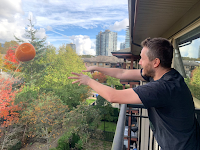
On a lighter note, last year I wrote that 2021 was "the year my internet silliness spilled over into the real world." That continued in 2022, when my faux outrage over being excluded from The Plum Review, a UK "This is Just to Say" parody anthology, resulted in my last minute inclusion, Silliness levels went off the charts when my "This Is Actually More Of A Comment" jack-o-lantern inexplicably garnered over 3 million views on Twitter (shared between me and a UK author who stole the image and then pretended everyone was doing it). After JK Rowling retweeted my image, I got to have a little fun hurling the pumpkin off my balcony, to boot.

Ok, enough preamble. Here are my favourite posts from the year:

January 2022: To Show Up For Others: Writers on Kate Braid's Mentorship
"I was terrified of the creative writing classroom. Kate's warmth and rigor as a mentor taught me to be an engaged peer. She taught not just to respond to poetry, but to show up for other writers. To let the collective knowledge of the classroom lift us all up as poets. To this day, being taught to value my sense of belonging within literary communities has been a lesson even more powerful than being taught about craft itself." - Amber Dawn

January 2022: What Trickles Down the Line: An Interview with Ellie Sawatzky
"I think something that I’ve learned both from taking care of children and writing poetry is that some things just don’t make sense. Anyone who’s ever spent time around children knows what it is to ultimately answer a line of questioning with “I don’t know why, it just is.” It can be very humbling — and existentially terrifying — to admit that you don’t know something, or to acknowledge that there are multiple contradictory truths. In childhood so much is unknown and there are so many possibilities. As we get older things seem to narrow... To me, poetry is a space that allows adults to ask questions the way children do. So it’s not so much about “making sense” as it is about wondering." - Ellie Sawatzky
February 2022: A Congenial Barrier: An Interview with W.M. Herring
"Retirement brought with it the wonderful gift of time: time to walk slowly, to listen carefully, to contemplate; time to consider a stray thought or to research an event or historical figure; time to daydream; time to wordsmith over a mug of coffee for as long as it takes. In retrospect, I needed time to observe, absorb, and declare before I could produce even the shortest of poems. Until I had that time, I had no idea the writing that would emerge." - W.M. Herring

March 2022: Suspension, Some Dread, A Lifeline: An Interview with Neil Surkan
"I love poems that end with a near-resolution, or a statement that makes sense in a “peripheral vision” sort of way (like, if you look a little to the left you can almost glean the rationale). [Jack] Gilbert is a good example: so often, the thrust of his poetry verges on familiar sentimentality, but then he frays convention to its limit. His speaker’s personal grief transforms into sprawling, savoury, wonderful existential terror. In line with Gilbert, I try to make my poems’ music resonate in the holes left by withheld pieces. Micro-devastations. Clapper-less bells. The “click,” for me, happens when I get a hunch that the last line couldn’t be anything other than what it is, even though I never saw it coming: half-confusion, half-satisfaction, a distant cousin of comfort." - Neil Surkan
 
March 2022: A Gift of Mystery and Many Hands: An Interview with shauna paull
"My practice is rooted in a kind of deep listening, which I fail at a lot! John Berger says that art is a conversation between the maker and the materials. When I work with language then, there is a waiting and listening. And a reverence for where the text is heard in the body and where I think it wants to arrive on the page. This is partly to respond to the music of the text which I am hearing, which can be done syntactically, yes. But for me, allowing the text to find its place on a page is a part of letting go of authorship, which is important to me in the context of the noise and individualism of our world." - shauna paull

April 2022: A Woven Basket with Others: An Interview with Isabella Wang
"In the story of what I know about my family’s ancestral history, there are chasms of intergenerational narratives lost with my grandmother, lost in my forgetting of language, that I long to fill. I translate, but the untranslatable is ultimately what gives me the momentum for poetry — the trying; reaching toward a horizon that always ends up blurry, in metaphors with a double-edge." - Isabella Wang
 
April 2022: Admiration, Applause, Adoration: An Interview with Arleen Paré
"I started by writing with only Etel Adnan in mind, meaning she was the object, but as I added the titled poems, and as the project grew, I knew it was broader, for and about all lesbian poets, in the same way that former women’s and lesbian movements were aimed at and for all women and lesbians. It began to feel more political and yet still very personal. In the way of the old second wave movement saying, “The personal is political.” And how could it be otherwise?" - Arleen Paré

April 2022: My Body Knows More Than I Do: An Interview with Jónína Kirton

"When I first entered recovery, I thought that one day I would arrive at normal. I would be healed, and all would be well. That never happened and eventually I began to see the problems with my desire to be “normal” — it was never the right fit for me. I could see that many of the more successful members of my family were boxed in by religious beliefs and colonized thinking that never allow them to feel the freedom that comes with just being human. They were living proof that being judgemental — having the scorched earth thinking that comes with the colonized way of life — burns the one who is judging just as much as the one they judge. Seeing the difference between the way they were with each other and the way my Métis family would tease each other (in a good way) about their faults helped me understand that it is much kinder to myself and others if we accept our imperfections." - Jónína Kirton

April 2022: Rolling Down a Hill With Your Brain on Fire: An Interview with Andrew Chesham and Laura Farina
"I think the main thing I learned in editing this book is that the “life” of writing and the “craft” of writing are profoundly interconnected in a way that is at once cosmic and intensely practical. For a long time, I’ve felt that I’m in this whole writing business for the days when writing comes easily and it feels like you’re rolling down a hill and also your brain is on fire. Do you know the feeling I’m talking about? All of a sudden you’re finding all these connections and you have a moment of "OH! That’ what I’ve thought about this thing the whole time!" - Laura Farina

April 2022: The Border Terrain: An Interview with Sadiqa de Meijer
"Before I became a parent, much of what I lived and believed was grounded in a sort of communal struggle: I was against things (like patriarchy and racism and poverty and environmental degradation). I took part in protests and organizing and talks, and that was good and important work. I’m still against all the same things, but with the sense of being responsible for someone small and new, I felt an urgent question—I wanted to know what I was for, what I could pass on as things to believe in. The Che Guevara quote goes “…the true revolutionary is guided by a great feeling of love,”—but his preface to that is “At the risk of seeming ridiculous, let me say that…” and I believe I’d unconsciously been placing more weight on that first phrase. It was protective; a layer of cynicism over the vulnerability of feeling love and grief for what was under siege. And that has turned—I can still be a marvellous cynic, but my emphasis has shifted to the side of that love, and to risking myself in its name, whether in a playground interaction or a broader, structured campaign." - Sadiqa de Meijer
 
October  2022: A Real Donnie Brasco Situation: An Interview with Shaun Robinson
"I gravitate to the inelegant in a poem. I like the pathos of a metaphor that swings for the fences and doesn’t quite connect. I like a poem that deliberately misunderstands a phrase or contradicts itself or forgets who its speaker was. “It’s important to get things wrong,” according to my poem “Trivia Night.” By which I mean, partly, that I’d rather be rough and messy and adventurous than small and tidy and perfect." - Shaun Robinson
 
December 2022: Matsuki Masutani on Writing

"I know more than the words about these poems." - Matsuki Masutani

I've got a bunch more new interviews coming your way in 2023, as we blow past 100 total (currently at 99!) and begin inching our way towards 200. I doubt I'll hurl any gourds off my balcony, though only time will tell.

Merry Christmas and Happy New Year, all!

11/21/2022

An Interview with Michael Hingston

The following interview was originally published in June 2011 on Michael Hingston's Too Many Books in the Kitchen blog. 


Michael Hingston: You've published your poetry widely for a number of years now, but The Other Side of Ourselves marks your full-length debut. While preparing it, how much did you think about the first impression you were giving off to the poetry world at large? Did you try and make the collection somehow representative of your identity as a poet (interests, sensibilities)—or was it simply a clearing house for the previous year's worth of work?

Rob Taylor: A damn good question to start off. In preparing my initial manuscript I was concerned that I show my diversity, covering a variety of forms, themes, and techniques that, hopefully, would provide something for every reader (and critic!). When the book was accepted by Cormorant, however, my editor (Robyn Sarah) aggressively cut out the poems that didn't fit in the main lyrical vein. More specifically, she cut out the poems that were showy but hollow - that sounded more interesting than they felt. This freaked me out, as these days the Canadian poetry world seems much more focused on technique than content, and when it comes to content, plain-spoken emotion is on the outs. And here was my editor cutting out the technically sophisticated poems and replacing them with less technically-torqued, but more heartfelt, poems...

I argued with Robyn about this for a short while, but then I sat back and thought about what I was trying to do, which was to produce a great book, not cover my ass. I decided that I’d rather make a book that felt cohesive than a “safe” hodgepodge of poems. I knew I would get a tongue-lashing for that from those in different aesthetic camps (and I already have), but that seemed a small sacrifice for producing a more purposeful, emotionally resonant, book.

MH: That review in the National Post was interesting—it posits that poets can either be "cool", or else they can genuinely engage with human feelings and interactions. You were deemed to be the latter. What do you think of that binary, and your place in it? Are those two things really incompatible?

RT: In the reviewer’s defense, it’s hard to put “hooks” on poetry books, and trying to do so often leads to goofy binaries. Not doing so, though, makes it hard to write a cohesive short review (especially when covering multiple books). It’s best not to take the rhetoric of the short review too seriously.  

As for my place in the goofy binary, I’m certainly comfortable being the genuine, uncool guy. When asked about clarity and simplicity in his poetry, W.S. Merwin said that he wanted, ultimately, for the reader to feel like they’d written the poems themselves. That is a more interesting and fulfilling goal to me than being “cool”, which as a posture is more concerned with the author than the reader.

All that said, of course, “cool” and genuine aren’t incompatible, so long as your understanding of “cool” is sophisticated enough to require honesty, vulnerability, and humility.

MH: Diplomatic to the end! Let's back up a little: you and I met in 2005 at Simon Fraser University, a weird little mountaintop school just outside of Vancouver. I knew of you as a poet from the very beginning, thanks to High Altitude Poetry, the quarterly campus zine you co-founded. Can you tell me a little about how poetry had entered your life so early—and what inspired you to branch out and create your own outlet for it?

RT: I didn’t come to poetry until mid-way through my History degree at SFU – at the time, it felt like I was coming to it very late. I began accumulating poems, here and there, by W.B. Yeats, Robert Frost, W.C. Williams, etc. that I couldn’t shake from my head. Al Purdy was the first Canadian poet to worm his way in there, and that was a turning point for me: until then I hadn’t thought of poetry as something that Canadians could do. 

I helped found High Altitude Poetry having only written a dozen or so poems. That was less rash than when, one year prior to HAP, I founded SFU’s curling club having only curled once before. In both cases I was motivated partly out of personal interest and partly out of my bewilderment that SFU didn’t have pre-existing clubs for these things. Seriously, pre-2001 SFU students, what was the deal with that?

HAP was easier to found than the curling club because there was a group of us running it, led by Stephen Buckley. Oh, and the zine was published bi-monthly, not quarterly... we never would have reached 10,000 copies with such a lackadaisical publishing schedule. 

MH: And what, specifically, was the moment you switched from "poetry as something Canadians could do" to "poetry as something you could do"? Were you at all self-conscious about taking the plunge?

RT: It wasn't my first poem, but the first time I set an extended period of time aside specifically to write poetry was on a vacation in Campbell River (I had the travel budget of a poet long before I considered myself one). I spent a whole afternoon at the beach, staring out at the ocean and waiting for something to happen. Eventually something did, and while in hindsight the poem was terrible (seven metered, rhyming stanzas comparing my soul to a pebble), it was exhilarating at the time. I've been addicted to that thrill ever since. 

I only became self-conscious about my poetry when I first shared it with others, which happened at the second HAP meeting (yes, I helped found a poetry club having never shared my poems with anyone - rash, as I said). My heart wasn't in my throat, but it was definitely making plans to relocate. Luckily, those first few poems had jokes in them, and I got laughs, which as reactions go is inferior to the "poetry noise" ("mmm" or "ah" or my personal favourite, "hm"), but was more than enough on that day. Since then, both the quality of the poems and my self-consciousness about them have increased steadily, almost in tandem.

MH: Something I've always found intimidating about poetry is how delicate and intricate and ornate a form it is. If poetry is building a ship in a bottle, a novel is more like building an actual ship. What makes a poem successful to you—both as a writer and a reader?

RT: I’ve never thought of poetry as delicate or ornate, though it is often intricate (and occasionally intimidating). I mostly think of it as big things compressed into small vessels – in this sense your ship-in-bottle metaphor is fitting. But the metaphor is also deceptive – the ship in the bottle is small, and the difficulty is in constructing it within the constraints of the bottle; the poem, on the other hand, only appears small and the difficulty only appears to be writing the poem within the constraints of the form (this is especially true for formal poems, sonnets, sestinas, etc.). In fact, the poem is incredibly large and the difficulty is in fitting something incredibly large into something much smaller without damaging it, so that down the road the reader can unpack it and restore it to its original size (or possibly an even larger size). So it’s more like a zip file than a ship in a bottle, I suppose. In this sense, a poem is no different than a novel, except that in a great poem the zip file is more efficiently compressed.

There are so many things that can make a poem successful. I’m not of the opinion that a poem must last through the ages (must “help prolong the Latin names around the base”, as Larkin put it in “An Arundel Tomb”) in order to be a success. If it offers catharsis to writer or reader, challenges an assumption, produces a laugh – any of these are greater accomplishments than many works of art achieve, and should be relished. 

Perhaps more helpful here would be my thoughts on the ideal poem: for me, the ideal poem gives pleasure immediately on first reading. What that specific pleasure is – a laugh, an insight, a turn of phrase, a certain rhythm or rhyme scheme – is not overly significant, what matters is that there is pleasure first. As Robert Frost said, “A poem begins in delight and ends in wisdom”, to which W.S. Merwin added “And it will never end in wisdom if it doesn’t begin in delight and continue in delight.” Both ring true to me. 

The second requirement is that the pleasure produces a curiosity, and a desire to re-read the poem. On subsequent readings, the poem then needs to prove layered and nuanced enough to consistently release new bits of pleasure and induce new bouts of curiosity, every reading encouraging another, accruing pleasure along the way. To make a poem that lasts like that indefinitely is probably impossible, but there are certainly some poems that are still alive for me after dozens of readings. I hope one day to be able to produce a similar poem for others, as the great poets of the past have done for me.

MH: How do you think SFU specifically affected your development as a poet?

RT: As I’ve touched on above, SFU shaped my development as a poet by its absences, and the opportunities those absences granted me. I don’t think my story is unique – SFU is a school with a short history and an often indifferent student body. If anything has developed as a tradition at SFU, it’s that if you want to see something happen, you better make it happen yourself. I found that to be liberating.

When it came to poetry specifically, for those outside of the English department there were few venues to share and discuss poetry, either in person or in print (for instance, the English department’s presence in general campus life was so minimal that I didn’t learn of the existence of SFU’s literary magazine, West Coast Line, until my 4th year). Even after helping establish High Altitude Poetry, I felt like an outsider in SFU’s writing community, which made it easier for me to do my own thing without fear of repercussions. 

While at SFU I wrote hundreds of poems and sent them off to dozens of magazines - I started with The New Yorker and worked my way down. At first, everything was rejected (and, in hindsight, probably ridiculed around editing tables), but eventually a few magazines took interest. By the time my book was accepted I had over one hundred poems published in magazines, journals and anthologies. 

In the last few years I’ve gotten to meet a number of talented emerging writers who have hardly begun to “emerge” because they are too afraid to send their work out. Almost all of them have taken a creative writing program of one sort or another, and most have spent a decent amount of money studying their craft as well. Because of all this, the pressure they feel to succeed, or at least to not make asses of themselves, seems to paralyze them. If I’d taken the same path I probably would have been paralyzed as well. Even now, the more I learn about the publishing world, especially how small and sharp-edged it can be, the more hesitant I am to put work out there. To an extent, that caution is a good thing (there are many things I wish I’d held back on), but I’m still glad that I was comparatively reckless early on. 

No matter how much you prepare and polish and incubate your work, you’re going to make a fool of yourself at the beginning. And you’ll keep making a fool of yourself for years afterward, probably for your whole life. Lord knows I haven’t stopped. But if you keep at it this miraculous thing happens - people read your work, take it into themselves, and turn it into something more beautiful and mysterious than you ever could have imagined on your own. To be able to spend your life being a part of that process is humbling, and well worth pushing through those first nervous steps. 

I didn’t learn that at SFU, instead I was so enthusiastic and ignorant that I failed to realize I was supposed to be nervous. SFU deserves some of the credit for that.


7/25/2022

BC/AB Road Trip Report

Earlier this month, our family went on a little road trip through BC and Alberta. One of my favourite parts (behind only the water slides, mini-golf and dinosaur bones) was visiting book stores.

If you find yourself making a similar trip, here are three you shouldn't miss:


First up is Baker's Books in Hope, a used bookstore where every book is $2! They have a small but mighty poetry section, and a strong selection of rare poetry books at the back (they cost a bit more). Always worth a stop at the beginning of a road trip.


Another bookstore I'm always sure to visit is The Book Shop in Penticton. With over 5,000 square feet of floor space, it's one of Canada's largest. This time I counted 28 shelves of poetry, ten of which were Canadian (including Laura Farina's Some Talk of Being Human, photographed here). 


My tour of Alberta bookstores was truncated by our skirting around Calgary to avoid Stampede madness (and to spend more time hunting dinosaur bones), but I made sure we popped in to Glass Bookshop in Edmonton. Founded by poets Jason Purcell and Matthew Stepanic, it's an absolute heaven for poetry fans.


Right at the front entrance you're greeted by this fantastic array of (mostly poetry) chapbooks. 


And inside - boom! - eight shelves of brand new poetry, largely from Canada and the US. It doesn't get any better than this.

While I didn't get photos in other places, stores like the Wee Book Inn and Audrey's in Edmonton and Three Hills Books in, strangely enough, Three Hills, were also a pleasure to visit.


Here's the full list of the books I picked up on the trip, along with the bookstores in which I acquired them:

Animal Person, Alexander MacLeod (Iron Dog Books, Vancouver - picked up on the way out of town!)
Some Talk of Being Human, Laura Farina (The Book Shop, Penticton)
Spring and All, William Carlos Williams (Baker's Books, Hope)
The Sound of Poetry, Robert Pinsky (The Book Shop, Penticton)
The Essential Muriel Rukeyser, Muriel Rukeyser (Wee Book Inn, Edmonton)
The Great Canadian Sonnet, David McFadden (Wee Book Inn, Edmonton)
7 to 5, Michael Meagher (Wee Book Inn, Edmonton)
Swollening, Jason Purcell (Glass Bookshop, Edmonton)
Terra Firma, Pharma Sea, Joseph Kidney (Glass Bookshop, Edmonton)
Fugue with Bedbug, Anne-Marie Turza (Glass Bookshop, Edmonton)
ICQ, Matthew Walsh (Glass Bookshop, Edmonton)
Songs for Relinquishing the Earth, Jan Zwicky (Baker's Books, Hope - forgot it in the photo!)

A mere 12 books! My restraint grows with every year (or, at least, the space in our apartment diminishes). You can check out past trip book hauls here: 2011, 2016, 2017, 2019. God and COVID willing, I hope to be making many more such reports in the coming years!