Okay. Here's the plot. Send a bunch of Russian scientists down to Antarctica to drill thousands of feet through the ice sheet to a lake far, far below the surface. A lake that last saw the light of day when all the land masses of earth formed Pangaea.
And, working under very harsh and rushed circumstances, just as they are poised to tap into that lake (call it "Lake Vostok") all contact with the team is lost. What happened? What did they release when they hit that pocket of very, very ancient water? Will they be found before the Antarctic winter rolls in once more?
It would make one heck of a movie. Except it is real.
Russian scientists seeking Lake Vostok lost in frozen 'Land of the Lost'?
Good questions.
Showing posts with label science. Show all posts
Showing posts with label science. Show all posts
Friday, February 03, 2012


Monday, January 04, 2010
A Mystery
I a very interesting paper over at Watt's Up With That a Guest Post by Willis Eschenbach explores the question: Where Are The Corpses?
Eschenbach does something unusual (although it shouldn't be)--he looks at the record of extinctions over the last 500 years and asks "Where's the Corpses?"
Spoiler: There aren't nearly as many as predicted. But go read the whole thing.
A recent study in Nature [Thomas 2004] stated that 37% of all species might soon go extinct because of habitat reduction due to global warming. This same prediction of impending mass extinctions from habitat reduction due to global warming has been made a number of times recently, for example in a book by Professor Michael Benton of Bristol University (Benton 2003), as well as in studies by Parmesan and Yohe (Parmesan 2003) and Root et al. (Root 2003).
Habitat reduction has also been cited as being responsible for the continuing extinction of species which is said to have already happened due to the cutting down and fragmentation of tropical forests (Wilson 1995, 2001). For example, a recent study in Conservation Biology (Harris 2004) opens by saying that “Intense deforestation causes massive species losses.” Wilson says that due to habitat reduction we are in the “sixth great wave of extinctions”, comparable in size to the five previous great waves of extinctions in geological time. (Wilson 1992).
Eschenbach does something unusual (although it shouldn't be)--he looks at the record of extinctions over the last 500 years and asks "Where's the Corpses?"
Spoiler: There aren't nearly as many as predicted. But go read the whole thing.
Sunday, November 29, 2009
A Scientific Experiment
Experiments
Step three of the Scientific Method is to perform an experiment to test your Hypothesis. That sounds easy but it is anything but. To have a valid test you must control all but one of the variables. In the laboratory and for a basic experiment that may be possible but once you’ve opened the door and gone into the real world it can get complicated very, very quickly.
Let’s say you wanted to test the Hypothesis: “Increased temperature will cause Joshua trees to grow more robustly as measured by the thickness of the rings in the trunk at chest height.”
First you must control for all the things that might affect the growth of the tree: water, amount of sunlight, gases in the air, nutrients in the ground, organisms in the ground, etc. In the lab you might be able to start with a closed cabinet in which you’ve placed a sterile loam soil. Controlled amounts of nutrients (fertilizer) could be provided. Controlled amount of water could be provided. The amount of “sunlight” can be controlled by artificial lights. The very air within the cabinet can be controlled by hermetically sealing the dang thing. Make ten or more of these cabinets all of them identical in content. Use genetically identical seeds or cuttings of the tree species to be tested. NOW you can vary the temperature in each of those cabinets so each is, say two degrees C different ranging from 0 degrees C on up to 20 degrees C. To ensure things are truly like the natural world, you turn all the temperatures down in all the cabinets to -5 degrees C for six months out of every twelve.
Oops, better do three of each--just in case.
So you’ve got 36 or so identical cabinets in which everything is identical except the temperature. There are three that are at 0 degrees C, three at 2 degrees C, three at 4 degrees C, etc., etc., up to three at 20 degrees C. Easy.
Now all you have to do is monitor your cabinets for a couple of years for your trees to grow several new rings. Then you take core samples from each tree (or cut them in half to take a disk out) at chest height and measure the thickness of those rings. Did the trees produce thicker rings (more growth) at higher temperatures?
Regardless of your results, you submit your paper describing your experiment and its results to a peer reviewed journal so others can examine your work and duplicated it if they so desire.
That’s the way it’s supposed to be.
Now, take your experiment outside. Can you control the numerous variables? Unlikely. The genetic variability in the trees alone is a problem. Add the variability of soils, sunlight, yearly differences in precipitation, disease and insect infestation, etc. and you’ve got one heck of a head ache.
Yet that is precisely what some of the scientists at the Climate Research Unit have tried to do in reverse. They are trying to say that increased growth in tree rings is indicative of higher temperatures. (Or, conversely, smaller growth rings are indicative of colder temperatures.) From this they have constructed a computer model to predict the future.
The problem is, as I understand it, they have used a small sample of trees from a limited number of very localized sites. A group of trees, it must be noted, that confirms their hypothesis when certain “corrections” have been made. (Larger samples were available and other researchers have used them to refute the hypothesis.) And they then produced a computer model that can’t account for recent past temperatures. Oops!
UPDATE: About those computer models: Climategate Computer Codes Are the Real Story
Step three of the Scientific Method is to perform an experiment to test your Hypothesis. That sounds easy but it is anything but. To have a valid test you must control all but one of the variables. In the laboratory and for a basic experiment that may be possible but once you’ve opened the door and gone into the real world it can get complicated very, very quickly.
Let’s say you wanted to test the Hypothesis: “Increased temperature will cause Joshua trees to grow more robustly as measured by the thickness of the rings in the trunk at chest height.”
First you must control for all the things that might affect the growth of the tree: water, amount of sunlight, gases in the air, nutrients in the ground, organisms in the ground, etc. In the lab you might be able to start with a closed cabinet in which you’ve placed a sterile loam soil. Controlled amounts of nutrients (fertilizer) could be provided. Controlled amount of water could be provided. The amount of “sunlight” can be controlled by artificial lights. The very air within the cabinet can be controlled by hermetically sealing the dang thing. Make ten or more of these cabinets all of them identical in content. Use genetically identical seeds or cuttings of the tree species to be tested. NOW you can vary the temperature in each of those cabinets so each is, say two degrees C different ranging from 0 degrees C on up to 20 degrees C. To ensure things are truly like the natural world, you turn all the temperatures down in all the cabinets to -5 degrees C for six months out of every twelve.
Oops, better do three of each--just in case.
So you’ve got 36 or so identical cabinets in which everything is identical except the temperature. There are three that are at 0 degrees C, three at 2 degrees C, three at 4 degrees C, etc., etc., up to three at 20 degrees C. Easy.
Now all you have to do is monitor your cabinets for a couple of years for your trees to grow several new rings. Then you take core samples from each tree (or cut them in half to take a disk out) at chest height and measure the thickness of those rings. Did the trees produce thicker rings (more growth) at higher temperatures?
Regardless of your results, you submit your paper describing your experiment and its results to a peer reviewed journal so others can examine your work and duplicated it if they so desire.
That’s the way it’s supposed to be.
Now, take your experiment outside. Can you control the numerous variables? Unlikely. The genetic variability in the trees alone is a problem. Add the variability of soils, sunlight, yearly differences in precipitation, disease and insect infestation, etc. and you’ve got one heck of a head ache.
Yet that is precisely what some of the scientists at the Climate Research Unit have tried to do in reverse. They are trying to say that increased growth in tree rings is indicative of higher temperatures. (Or, conversely, smaller growth rings are indicative of colder temperatures.) From this they have constructed a computer model to predict the future.
The problem is, as I understand it, they have used a small sample of trees from a limited number of very localized sites. A group of trees, it must be noted, that confirms their hypothesis when certain “corrections” have been made. (Larger samples were available and other researchers have used them to refute the hypothesis.) And they then produced a computer model that can’t account for recent past temperatures. Oops!
UPDATE: About those computer models: Climategate Computer Codes Are the Real Story
"I think there’s a good reason the CRU didn’t want to give their data to people trying to replicate their work.
It’s in such a mess that they can’t replicate their own results."
The Scientific Method
When I was teaching high school and middle school science we would introduce again and again the Scientific Method. This is the Bible of How To for anyone who would be a scientist. It consists of six steps:
We drilled this into our students year after year.
What is so disturbing in the leaked emails and data of the AGW crowd working out of the Climate Research Unit at University of East Anglia is that they have ignored or subverted several of these basic steps.
They subverted step #3 with faked and cherry-picked data. They ignored data that didn’t fit their predetermined desired outcome.
While they published their results in peer-reviewed publications (#4), they worked to control who their peers were and actively worked to squash any editor who had the temerity to disagree with them or even publish opposing, critical works. They violated the law (Freedom of Information Act) by stonewalling those who wanted to examine the original data and methods.
Further, it has become impossible to duplicate the work of the CRU crowd because they now say they have “lost” or discarded the original data they used. (Steps #4 and #5.) Without these crucial steps, the premise of Anthropogenic Global Warming (AGW) remains an untested Hypothesis, that is, an educated guess, at best.
With these flaws in their methodology, we are asked to believe “the science is settled” and we “must act now.” We are asked to wreck an already staggering economy. We are asked by these jerks to just “trust us.”
Follow the money. Millions of dollars in grant money went down this wormhole. Much of it from organizations or governments that want to don the mantle of power and control. Saying AGW doesn't exist was not an option of these "scientists" want to keep raking in the dough. They sold their souls.
UPDATE 1: "...the worst scientific scandal of our generation"
UPDATE 2: Leaked e-mails suggest climate experts rigged data
"[Professor Phil] Jones, according to the disclosures, has collected about $22.6 million in research grants since 1990, a money pit that could -- and should -- dry up with the disclosure of the deception by him and his co-conspirators."
UPDATE 3: Why I think that Michael Mann, Phil Jones and Stefan Rahmstorf should be barred from the IPCC process
Eduardo Zorita, November 2009 "Short answer: because the scientific assessments in which they may take part are not credible anymore."
1-Start with an observation that evokes a question.
2-Using logic and previous knowledge, state a possible answer, an “educated guess,” called a Hypothesis.
3-Perform an experiment or Test.
4-Then publish your findings in a peer-reviewed journal. Publication/sharing.
5-Other scientists read about your experiment and try to duplicate it. Verification or falsification.
6-In time, and if experiments continue to support your hypothesis, it becomes a Theory.
We drilled this into our students year after year.
What is so disturbing in the leaked emails and data of the AGW crowd working out of the Climate Research Unit at University of East Anglia is that they have ignored or subverted several of these basic steps.
They subverted step #3 with faked and cherry-picked data. They ignored data that didn’t fit their predetermined desired outcome.
While they published their results in peer-reviewed publications (#4), they worked to control who their peers were and actively worked to squash any editor who had the temerity to disagree with them or even publish opposing, critical works. They violated the law (Freedom of Information Act) by stonewalling those who wanted to examine the original data and methods.
Further, it has become impossible to duplicate the work of the CRU crowd because they now say they have “lost” or discarded the original data they used. (Steps #4 and #5.) Without these crucial steps, the premise of Anthropogenic Global Warming (AGW) remains an untested Hypothesis, that is, an educated guess, at best.
With these flaws in their methodology, we are asked to believe “the science is settled” and we “must act now.” We are asked to wreck an already staggering economy. We are asked by these jerks to just “trust us.”
Follow the money. Millions of dollars in grant money went down this wormhole. Much of it from organizations or governments that want to don the mantle of power and control. Saying AGW doesn't exist was not an option of these "scientists" want to keep raking in the dough. They sold their souls.
UPDATE 1: "...the worst scientific scandal of our generation"
UPDATE 2: Leaked e-mails suggest climate experts rigged data
"[Professor Phil] Jones, according to the disclosures, has collected about $22.6 million in research grants since 1990, a money pit that could -- and should -- dry up with the disclosure of the deception by him and his co-conspirators."
UPDATE 3: Why I think that Michael Mann, Phil Jones and Stefan Rahmstorf should be barred from the IPCC process
Eduardo Zorita, November 2009 "Short answer: because the scientific assessments in which they may take part are not credible anymore."
Wednesday, September 30, 2009
AGW's Death Knell?
I don't know if this has made the MSM news reports this week, I plumb refuse to watch any of the news shows any more, but the "Mann hockey stick" graph that was being touted as absolute proof of Anthropogenic Global Warming has taken some solid hits. Steve McIntyre of Climate Audit finally got his hands on the raw data and discovered that it had been cherry-picked, i.e. only 12 trees of many, many more available were used to produce the graph the authors wanted. That is NOT how real science is supposed to work.
Anyway...the folks at Watts Up With That have been doing a running commentary on McIntyre's trials and tribulations in getting the data in the first place and then the startling (or maybe "predictable" would be a better word) find that the books were cooked, so to speak.
Seems that real science was never settled at all. Seems to be scientific malpractice has been foisted upon the world. Could it have been all that grant money to prove AGW spurred Mann and company to *gasp* CHEAT? Might go a long way toward explaining why it took Steve McIntyre 10 years to finally get the freakin' raw data used in the study. (And that's not how "peer review" is supposed to work, either!)
I would hope that this would cause some in the political sphere to stop screwing around with legislation to fix what isn't broken, but it was never about climate, was it. It's all about control. And the possibility of additional filthy lucre lining the pockets of the connected.
Besides, Kerry and Boxer presented their legislative framework today--a framework with more holes than a fine Swizz cheese--and the EPA believes CO2 is a "pollutant" This juggernaut that will further destroy our economy is going to be a bitch to derail when "top" minds are closed to anything like the real workings of science, not to mention the flaws in the "research" and models that are being used to justify another government grab.
For further reading:
From Watts Up With That
Antony Watts' intro to the exposure: Quote of the week #20 – ding dong the stick is dead
A mirror posting of Steve McIntyre's article: MIRROR POSTING of Climate Audit Article on Yamal a “Divergence” problem
An UPDATE to the above: Update: A zoomed look at the broken hockey stick
A primer of the story in easier to understand language (Go to the Bishop Hill link. The formulas, which can get distracting have been removed.): A must read: The Yamal Hockey Stick Implosion in laymans terms
Why tree rings make lousy indicators of temperatures on a global basis: A look at treemometers and tree ring growth (Hint: Too many stinking variables! It's not just the temperature.)
What? You want corroboration? How about from the American Geophysical Union Conference in 2008. Where "In the hallway poster for their AGU presentation, they have this graph, with the caption saying a “nearly flat temperature trend” for Yamal, especially for the late 20th century period where the “hockey stick” from those 12 trees emerges."
Anyway...the folks at Watts Up With That have been doing a running commentary on McIntyre's trials and tribulations in getting the data in the first place and then the startling (or maybe "predictable" would be a better word) find that the books were cooked, so to speak.
Seems that real science was never settled at all. Seems to be scientific malpractice has been foisted upon the world. Could it have been all that grant money to prove AGW spurred Mann and company to *gasp* CHEAT? Might go a long way toward explaining why it took Steve McIntyre 10 years to finally get the freakin' raw data used in the study. (And that's not how "peer review" is supposed to work, either!)
I would hope that this would cause some in the political sphere to stop screwing around with legislation to fix what isn't broken, but it was never about climate, was it. It's all about control. And the possibility of additional filthy lucre lining the pockets of the connected.
Besides, Kerry and Boxer presented their legislative framework today--a framework with more holes than a fine Swizz cheese--and the EPA believes CO2 is a "pollutant" This juggernaut that will further destroy our economy is going to be a bitch to derail when "top" minds are closed to anything like the real workings of science, not to mention the flaws in the "research" and models that are being used to justify another government grab.
For further reading:
From Watts Up With That
Antony Watts' intro to the exposure: Quote of the week #20 – ding dong the stick is dead
A mirror posting of Steve McIntyre's article: MIRROR POSTING of Climate Audit Article on Yamal a “Divergence” problem
An UPDATE to the above: Update: A zoomed look at the broken hockey stick
A primer of the story in easier to understand language (Go to the Bishop Hill link. The formulas, which can get distracting have been removed.): A must read: The Yamal Hockey Stick Implosion in laymans terms
Why tree rings make lousy indicators of temperatures on a global basis: A look at treemometers and tree ring growth (Hint: Too many stinking variables! It's not just the temperature.)
What? You want corroboration? How about from the American Geophysical Union Conference in 2008. Where "In the hallway poster for their AGU presentation, they have this graph, with the caption saying a “nearly flat temperature trend” for Yamal, especially for the late 20th century period where the “hockey stick” from those 12 trees emerges."
Wednesday, August 19, 2009
Playing in the Big Sand Box in the Sky
The Spirit rover completed its 2000th workday on the Mars earlier this week. Not bad for a project that it was hoped would make 90 days. And we're talking Martian days here. They're a little longer than Earth days.
Unfortunately,
The NASA boys and girls have been playing in a sandbox in the lab to determine how best to get Spirit out of its predicament. They've devised a plan and will execute it during the first week or two of September. Meanwhile, daunty little Spirit keeps right on observing and analyzing and sending data home.
(h/t to Glenn Reynolds at Instapundit)
The rover team keeps track of Spirit's timeline in Martian days, or "sols," which are slightly longer than Earth days. The result is that even though the rover passed the 2,000-day milestone a few weeks ago, as measured on Earth, the Sol 2000 mark didn't come around until Tuesday.
Unfortunately,
...Spirit is currently mired in a sandpit nicknamed Troy, facing a trial worthy of the Divine Comedy. The poetic parallel is doubly apt - considering that Dante posted half-buried villains around Hell's central pit in his "Inferno," and that NASA's Opportunity rover escaped from being buried in a Martian sand dune called "Purgatory" more than four years ago.
The NASA boys and girls have been playing in a sandbox in the lab to determine how best to get Spirit out of its predicament. They've devised a plan and will execute it during the first week or two of September. Meanwhile, daunty little Spirit keeps right on observing and analyzing and sending data home.
(h/t to Glenn Reynolds at Instapundit)
Monday, January 19, 2009
Ice on the Great Lakes
I was watching the football games yesterday and switching channels during the commercials. I happened to land on the Weather Channel (or maybe it was the local news) between games and heard someone say that Lake Erie was essentially frozen over.
Well, I wanted to see what they meant by essentially frozen over so I did a quick Google search of ”Great Lakes ice cover” and found this NOAA site.
By clicking on either Lakes Erie, Ontario or Huron you get access to recent maps of the eastern Great Lakes. Lakes Superior or Michigan will get you to the western Lakes. There are even maps of Chesapeake and Delaware Bays. (Although the Bays haven’t much ice and Delaware hasn’t had any, apparently, since February of 2007.)
The maps are huge in size but load quickly. You’ll have to scroll around to see the different parts of the lakes.
Lake Erie on January 16, 2009:

Lake Ontario on January 16, 2009:
 Blue is only 1/10 ice. White is open water.
A couple of thoughts come to mind after looking at the ice coverage on Lake Erie and Lake Ontario:
1- Folks on the shores of Lake Erie are undoubtedly hoping the ice remains in place so as to stop the lake effect snows that have plagued them in the recent past.
2- Folks living on the eastern end of Lake Ontario (Helloooo, Watertown, Mannsville, Polaski, Oswego, etc.) are probably praying that the damn lake will freeze! Steady winds out of the west will be settling in for this week and that means snow, snow, snow!
One more item...
Does anyone else find it ironic that, up on the northern edge of Lake Huron, this place is frozen solid?

Well, I wanted to see what they meant by essentially frozen over so I did a quick Google search of ”Great Lakes ice cover” and found this NOAA site.
By clicking on either Lakes Erie, Ontario or Huron you get access to recent maps of the eastern Great Lakes. Lakes Superior or Michigan will get you to the western Lakes. There are even maps of Chesapeake and Delaware Bays. (Although the Bays haven’t much ice and Delaware hasn’t had any, apparently, since February of 2007.)
The maps are huge in size but load quickly. You’ll have to scroll around to see the different parts of the lakes.
Lake Erie on January 16, 2009:

The red areas are 9/10 ice. Blue areas are 1/10 ice.
Grey areas are fast ice (100% rock hard).
Lake Ontario on January 16, 2009:
 Blue is only 1/10 ice. White is open water.
A couple of thoughts come to mind after looking at the ice coverage on Lake Erie and Lake Ontario:
1- Folks on the shores of Lake Erie are undoubtedly hoping the ice remains in place so as to stop the lake effect snows that have plagued them in the recent past.
2- Folks living on the eastern end of Lake Ontario (Helloooo, Watertown, Mannsville, Polaski, Oswego, etc.) are probably praying that the damn lake will freeze! Steady winds out of the west will be settling in for this week and that means snow, snow, snow!
One more item...
Does anyone else find it ironic that, up on the northern edge of Lake Huron, this place is frozen solid?

Gore Bay is "fast ice" = 100% solid.
Thursday, March 13, 2008
Gators Rock!
I came across this over at the Jungle Trader and immediately thought of Jimbo over at Parkway Rest Stop.
HOW ALLIGATORS ROCK AND ROLL
It sounds like a fascinating study of the maneuverability of the alligator and may have implications for many other critters, including, obviously, crocs.
I suggest you go over and read the rest. (Don’t worry Jimbo, there are no pictures.)
By the way, you’ll notice the people doing this research—and, I therefore assume, knowing a great deal about alligators—are from the University of UTAH! (Although, as the article mentions, they did travel to Louisiana to conduct the study.)
HOW ALLIGATORS ROCK AND ROLL
Without a ripple in the water, alligators dive, surface or roll sideways, even though they lack flippers or fins. University of Utah biologists discovered gators maneuver silently by using their diaphragm, pelvic, abdominal and rib muscles to shift their lungs like internal floatation devices: toward the tail when they dive, toward the head when they surface and sideways when they roll.
It sounds like a fascinating study of the maneuverability of the alligator and may have implications for many other critters, including, obviously, crocs.
"It allows them to navigate a watery environment without creating a lot of disturbance," says doctoral student T.J. Uriona. "This is probably really important while they are trying to sneak up on an animal but don't want to create ripples."
The discovery in American alligators suggests "special muscles that manipulate the position of the lungs - and thus the center of buoyancy - may be an underappreciated but important means for other aquatic animals to maneuver in water without actively swimming," says C.G. Farmer, an assistant professor of biology.
I suggest you go over and read the rest. (Don’t worry Jimbo, there are no pictures.)
By the way, you’ll notice the people doing this research—and, I therefore assume, knowing a great deal about alligators—are from the University of UTAH! (Although, as the article mentions, they did travel to Louisiana to conduct the study.)
Saturday, March 08, 2008
MMMM, Doh-nuts!
When I was at Rutgers there were always calls for students to participate in studies. You would sign up and, if selected, receive a small stipend for your time. I got called in for two or three studies that I signed up for but I have one question: Where the heck were these researchers when I was an undergrad?
Your Brain On Krispy Kremes: How Hunger Motivates
Sounds like the same subjects were used in both studies. There were days I would have easily paid them to participate in this study.
Well, then. That certainly explains a good deal of what is (and isn’t) going on inside Homer Simpson’s head. He obviously has a limbic brain (“an ancestral part of the brain present in all animals from snakes to frogs to humans”) but may lack a spatial attention network. (That might also explain why he’s always walking into things. Well, that and beer.)
So remember, the next time you just have to have a donut, it may be your brain trying to tell you something and not just low self control.
Your Brain On Krispy Kremes: How Hunger Motivates
Krispy Kremes, in perhaps their first starring role in neurological research, helped lead to the discovery. In the study, subjects were tested twice -- once after gorging on up to eight Krispy Kreme donuts until they couldn't eat anymore, and on another day after fasting for eight hours.
Sounds like the same subjects were used in both studies. There were days I would have easily paid them to participate in this study.
When the subjects saw pictures of donuts after the eating binge, their brains didn't register much interest. But after the fast, two areas of the brain leaped into action upon seeing the donuts. First, the limbic brain -- an ancestral part of the brain present in all animals from snakes to frogs to humans -- lit up like fireworks.
"That part of the brain is able to detect what is motivationally significant. It says, not only am I hungry, but here is food," said senior author Marsel Mesulam, M.D., the Ruth and Evelyn Dunbar Distinguished Professor of Psychiatry and Behavioral Sciences at the Feinberg School and a neurologist at Northwestern Memorial Hospital.
Next, the brain's spatial attention network shifted the hungry subject's focus toward the new object of desire -- in this case the Krispy Kremes.
Well, then. That certainly explains a good deal of what is (and isn’t) going on inside Homer Simpson’s head. He obviously has a limbic brain (“an ancestral part of the brain present in all animals from snakes to frogs to humans”) but may lack a spatial attention network. (That might also explain why he’s always walking into things. Well, that and beer.)
So remember, the next time you just have to have a donut, it may be your brain trying to tell you something and not just low self control.
Monday, May 07, 2007
This word, “Consensus,”
I do not think it means
what you think it means.
And “Peer review”---pffft.
Peer Review, Publication In Top Journals, Scientific Consensus, And So Forth by Robert Higgs from the History News Network of George Mason University
But don’t these scientists know what they are talking about? Maybe, maybe not. There are limits to their knowledge. No one is qualified or knowledgeable enough to hold forth on everything at once. Although they will try.
Peer Review, Publication In Top Journals, Scientific Consensus, And So Forth by Robert Higgs from the History News Network of George Mason University
Peer review, on which lay people place great weight, varies from important, where the editors and the referees are competent and responsible, to a complete farce, where they are not.It is always dangerous to talk about consensus as if it proves anything in science. Remember, there was a consensus at one time that the Earth was the center of the Universe and the Sun, Moon and stars revolved about little old Terra Firma.
…
As I have always counseled young people whose work was rejected, seemingly on improper or insufficient grounds, the system is a crap shoot. Personal vendettas, ideological conflicts, professional jealousies, methodological disagreements, sheer self-promotion and a great deal of plain incompetence and irresponsibility are no strangers to the scientific world; indeed, that world is rife with these all-too-human attributes. In no event can peer review ensure that research is correct in its procedures or its conclusions.
At any given time, consensus may exist about all sorts of matters in a particular science. In retrospect, however, that consensus is often seen to have been mistaken. As recently as the mid-1970s, for example, a scientific consensus existed among climatologists and scientists in related fields that the earth was about the enter a new ice age. Drastic proposals were made, such as exploding hydrogen bombs over the polar icecaps (to melt them) or damming the Bering Strait (to prevent cold Arctic water from entering the Pacific Ocean), to avert this impending disaster. Well-reputed scientists, not just uninformed wackos, made such proposals. How quickly we forget.So, how did we get so many Chicken Littles screaching about the latest coming catastrophe? (Doesn’t there seem to be a new one every six months or so? Sometimes they over lap—like avian flu and Climate Change As Caused by Man.)
Research worlds, in their upper reaches, are pretty small. Leading researchers know all the major players and what everybody else is doing. They attend the same conferences, belong to the same societies, send their grad students to be postdocs in the other people's labs, review one another's work for the NSF, NIH, or other government funding organizations, and so forth. If you do not belong to this tight fraternity, it will prove very, very difficult for you to gain a hearing for your work, to publish in a "top" journal, to acquire a government grant, to receive an invitation to participate in a scientific-conference panel discussion, or to place your grad students in decent positions. The whole setup is tremendously incestuous; the interconnections are numerous, tight, and close.So it’s a little daisy chain of folks working up to a feeding frenzy. It’s publish or perish time.
…these two contexts are themselves tightly linked: if you don't get funding, you'll never produce publishable work, and if you don't land good publications, you won't continue to receive funding.But, what are they to feed upon? Where is the funding going to come from? Why government grants, of course! Ah, but how to insure the much needed cash will flow your way?
When your research implies a "need" for drastic government action to avert a looming disaster or to allay some dire existing problem, government bureaucrats and legislators (can you say "earmarks"?) are more likely to approve it. If the managers at the NSF, NIH, and other government funding agencies gave great amounts of money to scientists whose research implies that no disaster looms or no dire problem now exists or even that although a problem exists, no currently feasible government policy can do anything to solve it without creating even greater problems in the process, members of Congress would be much less inclined to throw money at the agency, with all the consequences that an appropriations cutback implies for bureaucratic thriving. No one has to explain all these things to the parties involved; they are not idiots, and they understand how the wheels are greased in their tight little worlds.
But don’t these scientists know what they are talking about? Maybe, maybe not. There are limits to their knowledge. No one is qualified or knowledgeable enough to hold forth on everything at once. Although they will try.
Finally, we need to develop a much keener sense of what a scientist is qualified to talk about and what he is not qualified to talk about. Climatologists, for example, are qualified to talk about the science of climatology (though subject to all the intrusions upon pure science I have already mentioned). They are not qualified to say, however, that "we must act now" by imposing government "solutions" of some imagined sort. They are not professionally knowledgeable about what risk is better or worse for people to take; only the individuals who bear the risk can make that decision, because it's a matter of personal preference, not a matter of science. Climatologists know nothing about cost/benefit considerations; indeed, most mainstream economists themselves are fundamentally misguided about such matters (adopting, for example, procedures and assumptions about the aggregation of individual valuations that lack a genuine scientific basis). Climate scientists are the best qualified people to talk about climate science, but they have no qualifications to talk about public policy, law, or individual values, rates of time preference, and degrees of risk aversion. In talking about desirable government action, they give the impression that they are either fools or charlatans, but they keep talking―worst of all, talking to doomsday-seeking journalists― nevertheless.But the UN issued a report and countries around the world are listening to it. Shouldn’t we?
In this connection, we might well bear in mind that the United Nations (and its committees and the bureaus it oversees) is no more a scientific organization than the U.S. Congress (and its committees and the bureaus it oversees). When decisions and pronouncements come forth from these political organizations, it makes sense to treat them as essentially political in origin and purpose.So, is the current hysteria science or politics? And if it is science, is it good science or just a lot of folks looking for a gravy train to ride? (Politicians are always looking for that gravy train.)
Saturday, April 21, 2007
Wednesday, March 21, 2007
Crows can communicate with one another
Of course, crows have always been considered pretty smart. Not as smart as ravens maybe, but pretty smart.
Crows Can Recognize The Calls Of Relatives
Okay, so it doesn’t say it is so, but the study does show there is a potential there that needs to be explored.
Crows Can Recognize The Calls Of Relatives
Jessica Yorzinski '05 [Cornell] found seven subtle acoustic differences in features that differed among individuals -- differences that the crows could potentially use to recognize one another's calls. She also found that female crows had higher-pitched calls than males.
Okay, so it doesn’t say it is so, but the study does show there is a potential there that needs to be explored.
"The Adventure of the Avian Eavesdroppers."
This is a fascinating story of two species who “talk” to one another.
Eavesdropping Nuthatches Appear To Understand Chickadees In Distress
I’ve witnessed blue jays and crows as they seemingly cry, “To arms! To arms!” upon spotting a hawk or owl in the trees. Every jay and crow in the immediate area rushes to the source. It usually results in the harassment of that predator until it is well on its way. This research, however, shows a much more subtle communication. I wonder if it is a learned behavior or if the nuthatches have an innate sense of what the chickadees are broadcasting.
Eavesdropping Nuthatches Appear To Understand Chickadees In Distress
"No one has ever seen this behavior before. There are a fair number of animals that respond to other animal's alarm calls. But this is the first example of subtle information from a call being interpreted by another species," said Templeton. "Nuthatches can tell if a raptor poses a high or low danger from the chickadee's alarm call."
I’ve witnessed blue jays and crows as they seemingly cry, “To arms! To arms!” upon spotting a hawk or owl in the trees. Every jay and crow in the immediate area rushes to the source. It usually results in the harassment of that predator until it is well on its way. This research, however, shows a much more subtle communication. I wonder if it is a learned behavior or if the nuthatches have an innate sense of what the chickadees are broadcasting.
Monday, March 19, 2007
New bird species
Now here is something unusual: New Bird Species Found In Idaho
How did this happen, you ask. The presence of this bird was well known but it was only recognized as possibly a separate species—as opposed to a mere variety of its northern cousins—back in 1996. Field work has since shown...
And since the South Hills crossbills only mate (well 99% of the time) with other South Hills crossbills, we have a newly recognized species.
Congratualations to Julie Smith, now at Pacific Lutheran University, and her former graduate advisor, Craig Benkman at the University of Wyoming, for this discovery.
This is what a Red Crossbill looks like.
Of course for those really serious birders, the ones who keep life lists and never, ever throw away their notes after coming back from a walk, this will be one more they will have to search for. (Southern Idaho, heh? My son's out in that direction; might be time for a road trip.)
How did this happen, you ask. The presence of this bird was well known but it was only recognized as possibly a separate species—as opposed to a mere variety of its northern cousins—back in 1996. Field work has since shown...
…this new crossbill evolved because of a coevolutionary arms race between crossbills and lodgepole pine (Pinus contorta) in the last five to seven thousands years.
As South Hills crossbills exerted selection on lodgepole pine for increased seed defenses, lodgepole pine in turn exerted selection on crossbills for larger bills to deal with these increased seed defenses. This coevolution has caused these crossbills to diverge substantially in bill morphology from other crossbills. Because the South Hills crossbill is adapted to remove seeds from the well-defended cones there, it is a superior competitor and thereby limits the less well adapted and nomadic call types to breeding at very low frequencies in the South Hills.
And since the South Hills crossbills only mate (well 99% of the time) with other South Hills crossbills, we have a newly recognized species.
Congratualations to Julie Smith, now at Pacific Lutheran University, and her former graduate advisor, Craig Benkman at the University of Wyoming, for this discovery.
This is what a Red Crossbill looks like.
Of course for those really serious birders, the ones who keep life lists and never, ever throw away their notes after coming back from a walk, this will be one more they will have to search for. (Southern Idaho, heh? My son's out in that direction; might be time for a road trip.)
Thursday, March 15, 2007
Borneo is giving up its secrets.
New species of leopard with largest fangs in cat world discovered
At first I thought it was a critter that had never been seen before (“New species…discovered,” etc.), but the article makes it clear that scientists knew of its existence for a long, long time. Only now did they get around to noticing the difference in its pelt and doing a DNA sample.
Two inch long canines on a foot long body¬—definitely a miniature saber-tooth.
It’s interesting to note the number of new species coming to light as scientist probe the interior of this jungle habitat.
I’m just glad Chester doesn’t have two inch long canine teeth. At just over a foot in length he weighs in at 10.5 pounds of muscle.
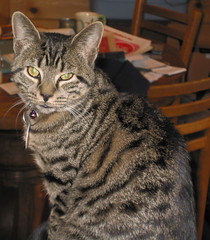
Could be a distant relative, though.
At first I thought it was a critter that had never been seen before (“New species…discovered,” etc.), but the article makes it clear that scientists knew of its existence for a long, long time. Only now did they get around to noticing the difference in its pelt and doing a DNA sample.
Two inch long canines on a foot long body¬—definitely a miniature saber-tooth.
It’s interesting to note the number of new species coming to light as scientist probe the interior of this jungle habitat.
I’m just glad Chester doesn’t have two inch long canine teeth. At just over a foot in length he weighs in at 10.5 pounds of muscle.
Could be a distant relative, though.
Wednesday, March 14, 2007
1 + 1 =...oh, sh*t
Slow Slippage Could Predict Huge Earthquakes
So, if we take the "surprising activity under Yellowstone" which is, according to the article in the last post, slow and add the information of this article we get exactly what? An Eruption? (Capital "E" because it would be huge.)
So, if we take the "surprising activity under Yellowstone" which is, according to the article in the last post, slow and add the information of this article we get exactly what? An Eruption? (Capital "E" because it would be huge.)
Friday, February 09, 2007
"The Doomsday Vault"
Charlottesvillain, over at TigerHawk, has a post up called: The Doomsday Vault. It’s about the efforts of a group called The Global Crop Diversity Trust to build a repository for “three million batches of seeds from all known varieties of the planet's crops.” The premise sounds fascinating and the facility looks like Superman’s Fortress of Solitude. Cool. Go read the post then follow the link there to the original article.
The question of the viability of the seed after 20 or 30 years of storage. As I commented there, the DNA content of the seed itself (some 400 baggies of500 seeds of each variety) will allow scientists in the future to resurrect these plants ala Jurassic Park dinosaurs. (Hopefully without the attendant mayhem produced in the film. So beware the snapdragons!)
He (Charlottesvillain) also provides links to other groups doing similar work, namely Native Seeds/SEARCH and Seed Savers Exchange. These two can be used by current gardeners who wish to see old varieties of fruits, vegetables and flowers kept thriving.
This was the best post I saw today as it contained nothing about politics, or global warming, or Anna Nicole Smith. Thank you Charlottesvillain!
The question of the viability of the seed after 20 or 30 years of storage. As I commented there, the DNA content of the seed itself (some 400 baggies of500 seeds of each variety) will allow scientists in the future to resurrect these plants ala Jurassic Park dinosaurs. (Hopefully without the attendant mayhem produced in the film. So beware the snapdragons!)
He (Charlottesvillain) also provides links to other groups doing similar work, namely Native Seeds/SEARCH and Seed Savers Exchange. These two can be used by current gardeners who wish to see old varieties of fruits, vegetables and flowers kept thriving.
This was the best post I saw today as it contained nothing about politics, or global warming, or Anna Nicole Smith. Thank you Charlottesvillain!
Tuesday, February 06, 2007
Flash: The Sun Is Hot!
Jeez, ya think this might have anything to do with “Global Warming”?
Paragraph one:
They better be careful, someone on the Weather Channel may want to strip them of their credentials.
Go read the whole thing.
Via the aptly named Cold Fury
Hotter-burning sun warming the planet
Paragraph one:
The sun is burning hotter than usual, offering a possible explanation for global warming that needs to be weighed when proceeding with expensive efforts to cut emissions of greenhouse gases, Swiss and German scientists say.
They better be careful, someone on the Weather Channel may want to strip them of their credentials.
Go read the whole thing.
Via the aptly named Cold Fury
Polar Bears on Parade
Polar bears have been in the news and in the blogsphere a great deal lately.
LauraW has posted a piece over at Ace of Spades HQ about some of the faulty numbers being used to proclaim global warming: F%#@in' Polar Bears Again
***********
Ann Althouse chimed in several days ago about the use of polar bears to play upon emotions in: The polar-bears-on-the-melting-ice-cap photo.
(As a bonus she details the origins of the Teddy Bear.)
***********
Did Al Gore stop in Iceland on his way back from Davos?
Read about the polar bear problem being faced by Icelanders over at in this article from The Telegraph (UK): Iceland fears bears that go with the floe
(I really liked this photo posted by a commenter to the Iceland story—so is stole it:

LauraW has posted a piece over at Ace of Spades HQ about some of the faulty numbers being used to proclaim global warming: F%#@in' Polar Bears Again
***********
Ann Althouse chimed in several days ago about the use of polar bears to play upon emotions in: The polar-bears-on-the-melting-ice-cap photo.
(As a bonus she details the origins of the Teddy Bear.)
***********
Did Al Gore stop in Iceland on his way back from Davos?
Read about the polar bear problem being faced by Icelanders over at in this article from The Telegraph (UK): Iceland fears bears that go with the floe
Thick pack ice, the like of which has not been seen for decades, stretched into the western fjords as temperatures plummeted and a bitter wind blew in from -Greenland.
(I really liked this photo posted by a commenter to the Iceland story—so is stole it:
Subscribe to:
Posts (Atom)