Showing posts with label digiscoping. Show all posts

Saturday, December 13, 2008

Avian Visitors

On Thursday afternoon when the snow was just starting to fall we had many, many birds at the feeders. They have maintained their presence now that everything is under a blanket of six to eight inches of white stuff.

Here are a few of the pictures I took from the deck on Thursday.


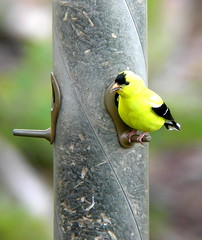
Goldfinches have been present in large numbers. They tend to hog the feeders and squabble with the other birds--and one another.


White-breasted Nuthatches generally arrive alone or with one or two others at most. They will climb down the trees and telephone poles--head first, of course--swoop in to steal a seed or a nip of suet and then dart back to the woods.


Downy Woodpeckers also come in on their own or with one or two others. They will hit the suet and, on occasion, the sunflower seeds in the hanging feeders.


Another bird that's present in large numbers is the Dark-eyed Junco. We have mostly the Slate-colored variety around the Aerie but will sometimes see the dusky brown ones as well. They prefer to feed on the ground or the tray feeders. Seldom will they land on one of the perch feeders as they like to scratch for their food.


Friday, October 31, 2008

Some birding today

I went over to Hammond Lake and the Ive's Run Recreation area this morning to do a little birding. I was curious as to whether or not there would be rafts of waterfowl on the lake as they make their south-bound migration. I was disapointed in that respect. The Corps of Engineers drew the lake down back in August, possibly to combat some invasive species that have found their way into the waters, and they have yet to begin raising the lake levels. Perhaps they are hoping the cold winter temperatures will play havoc upon the eurasion millfoil and what ever else the lake holds. In any case, the water levels are way, way down and the exposed shallows are now expanses of grass and mud. There were a few dozen Canada Geese who like that sort of thing, a handful of Killdeer, one lonely Common Merganser and a flock of Ring-billed Gulls.

The prize, as far as I was concerned, was the presence of eight (8) Bald Eagles. There were six immature Eagles and two adults perched on the exposed tree trunks and stumps along the edge of the channels. They were a good three to four hundred yards from the nearest approach for observation so my digiscoping equipment was stretched to the max. I used the digital zoom on the Nikon camera too which makes focusing even more difficult. Shooting over such a distance is not a means for obtaining great results.

Having made all my excuses (except for the one about the possibility of needing to clean all the lenses), I present the two best photos I came up with.


Two adult Bald Eagles.


One of the six immature Bald Eagles that were along a short stretch of one of the channels running through the flats of Hammond Lake.

And here is the complete list of birds I saw in the little more than two hours I was there:

Location: Ive's Run-Crooked Creek
Observation date: 10/31/08
Notes: Clear, cold morning with temperatures starting at 34 degrees and rising to near 50.

Six immature Bald Eagles and two adults were perched on exposed logs and tree trunks in the very low waters of Hammond Lake.
Number of species: 20

Canada Goose X
Common Merganser (North American) X
Ring-necked Pheasant X
Bald Eagle X
Red-tailed Hawk X
Killdeer X
Ring-billed Gull X
Mourning Dove X
Blue Jay X
American Crow X
Black-capped Chickadee X
American Robin X
Gray Catbird X
European Starling X
Field Sparrow X
Savannah Sparrow X
White-throated Sparrow X
Dark-eyed Junco (Slate-colored) X
Northern Cardinal X
American Goldfinch X

This report was generated automatically by eBird v2(http://ebird.org)


Monday, August 18, 2008

More Bird Pics from Sunday morning.

Sunday morning while standing on the deck getting buzzed by the Ruby-throated Hummingbirds, I also took pictures of some of the other visitors to the feeding area. Using the digiscoping equipment (Nikon Fieldscope ED III and Nikon Coolpix P1) I was able to capture some of the larger visitors who were willing to sit still long enough. The smaller ones (Tufted Titmouse, Chipping Sparrow, Black-capped Chickadee, White-breasted Nuthatch, Red-breasted Nuthatch, Dark-eyed Junco, Hairy Woodpecker, Downy Woodpecker) were either too quick for me--zooming in for a seed and disappearing into the trees before I could focus, or just too doggone jittery for a good picture. Others, like the American Robin and Eastern Towhee stayed too far afield for me to get them in the scope before they moved on.


An immature Northern Cardinal. You can tell it's an immature by the spikey, bright red Mohawk it is sporting. (Actually, the gray on the back and mottled white breast help too.) This is probably a male (again the Mohawk is prominent) and he'll be bright red in a couple of weeks.


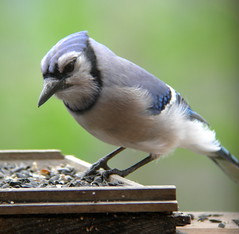
Another immature bird. This time it's a Blue Jay. Man, that's a face only a mother could love! Lucky for this bird, it will sport much brighter and colorful facial feathers in a week or two. Male or female? Only a member of the opposite sex could be sure!


That immature Blue Jay was accompanied by at least one adult.


Several (okay, make that over a dozen) Mourning Doves have found the yard a good place to pick up a free meal from the spilled seed. Unfortunately, several have fallen prey to the local semi-feral cats who like to stake out our feeders for a (nearly) free meal.


Tuesday, July 01, 2008

Cedar Waxwings

The former owner of the land upon which the Aerie sits had two spare telephone poles put in. One carried the power line from the main line to the trailer that was used as the domicile and the other…well, it just is. Maybe it had something to do with the windmill he had on the property but I doubt it. I believe the windmill was in the open field on the other side of the woods about 100 yards away. (He also strung all kinds of wire and wire fencing through the woods for some reason and it’s been a b*tch but I’ve gotten some of it out. Lots more to go though.)

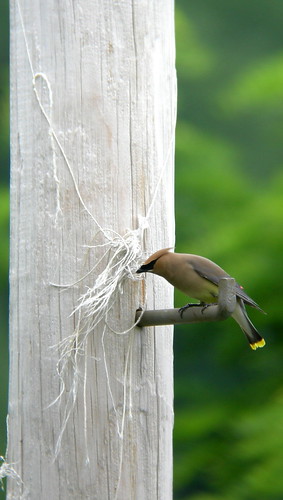
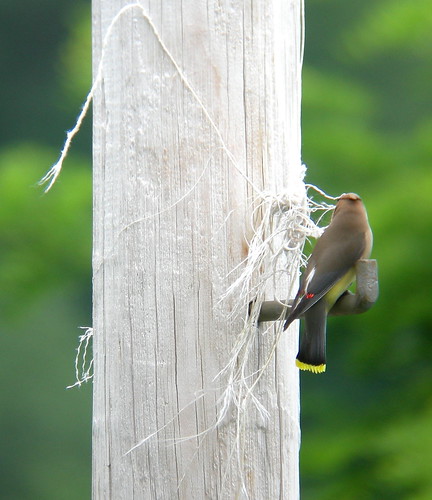
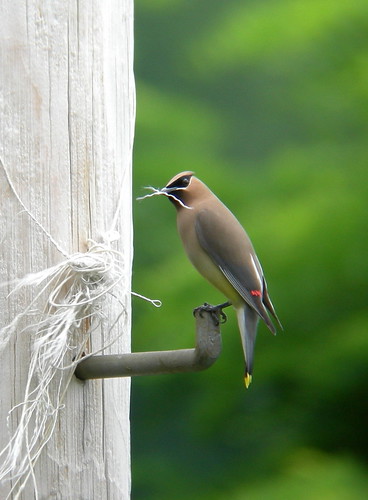
Up on top of one of the spare telephone poles (the one that seems to have had no use but which has the metal climbers on the sides) there is a piece of nylon twine that has been buffeted about by the wind until there are several nicely frayed ends.

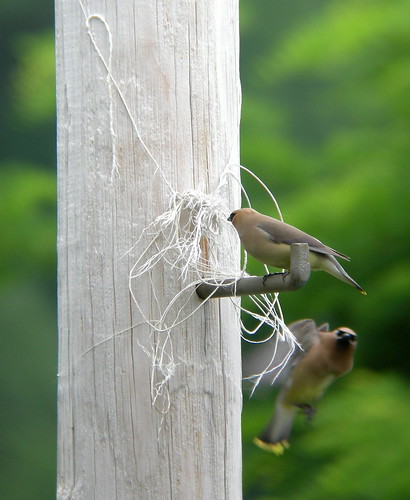
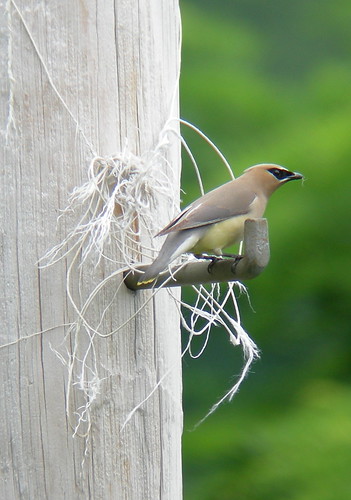
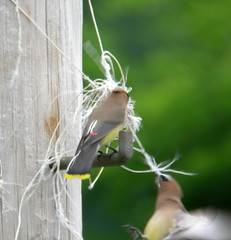
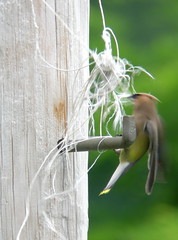
A pair of Cedar Waxwings has decided sometime during the last two days to use this twine to—I can only assume—build a nest. They will grab one of the frayed ends and tug and tug until a small piece breaks free. Because the twine is too long for them to get a good tug on it while they sit on the metal step, they will often grab it and flutter out from the pole while putting all their weight and might behind the effort of gathering nest material. Sometimes their antics can get quite comical. The funniest was when each bird grabbed the twine from opposite sides of the pole and fluttered out at the same time trying to pull the soft stuff off. It was a regular tug of war.

I finally decided to set up the digiscope and take some pictures. Of course after I managed to shot eight or so pictures, they quit collecting for the day and went in search of some food. (Many wild strawberries and service berries about.)
Cedar Waxwing 07
DSCN0555
DSCN0556
DSCN0557
Cedar Waxwing 06
Cedar Waxwing 05
Cedar Waxwing 04
Cedar Waxwing 02
Cedar Waxwing 01

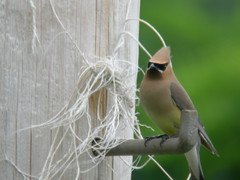
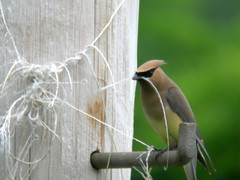
These are really beautiful birds with their crisp black mask, a little crest like a Cardinal, and the bright red wing tips and yellow tail tips that look like they’ve been playing with acrylic paints. The buff brown is such a subtle shade of color and sets off the little bright highlights.

UPDATE: They came back for more string sometime before 8:30 PM and succeeded in taking nearly the entire supply off the pole. Whether they were able to carry it all away or merely dropped it into the weeds below, I've not been able to determine. Just a single strand remains fluttering in the light breeze. That should be easy for them to haul away since it's not wrapped around the pole as far as I can tell.

Northern Flicker

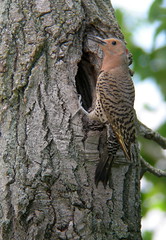
In the days before Terry and I traveled to California for Laura and Joe’s wedding, I was at the Much on the western side of Wellsboro helping to do some repairs to the blind on the boardwalk. Being early (as usual) I was in the parking lot observing some birds when a Northern Flicker flew to a tree on the edge of the lot and approached a small hole on the side. From inside came the unmistakable sounds of small birds wanting to be fed.

Sure enough, the Flicker stuck its head inside the knothole and rapidly moved it up and down in a motion suggesting it was shoving food down a very hungry maw. It then entered the nest hole and carried out the equivalent of a bird’s dirty diaper, which it then flew off with into the woods.

It was back a few minutes later with more food and I snapped this picture of the parent bird right after it fed more food to the nestlings.
Northern Flicker

Sunday, May 11, 2008

Eastern Towhee

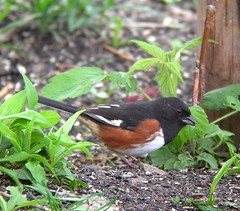
From the tops of the trees (Indigo Bunting) we go to the forest floor. It’s among the leaf litter of the deciduous forest that you will find the Eastern Towhee. Actually, you’re far more likely to hear his song (“Drink your teeeeeaaaaa!”) or his scratching and kick of the leaves before you’ll spot this Robin-sized bird. But when you do see the male, I think you’ll admire his black back and hood and the rich brown of his rufus sides. It looks like a vest peeking out from beneath a long frock coat.

Eastern Towhee


Indigo Buntings: Flashes of bright blue

When we started building the Aerie two years ago, each morning we would have an Indigo Bunting land in the tops of the poplar trees and sing to welcome the morning sun over the mountain. Last year this tiny blue jewel repeated the performance and stayed active around the feeders almost all summer. Earlier this week, I thought I saw one come in to the same spot but, since it was back lit, I couldn’t be 100% sure. It did sound right however and the profile seemed to be the right shape and size, but it might have been a Purple Finch. Today there was no question as to the identity of the two that came into the feeders
Indigo Bunting
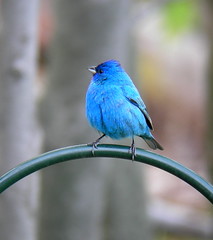
This brightly colored little bird seems to be saying, “Hallo! My name is Indigo Bunting. You stole my seed. Prepare to die!”

And, as this one perched upon the shepherd’s hook upon which the feeders hang, I could only think of the Captain Morgan Rum ads. He definitely appears to have a bit of the Captain in him.

Indigo Bunting

In reality, the Indigo may be a very shy little bird. He sings from the tippy-tops of the trees; often hidden amongst the leaves--and not much bigger than the leaves, either.

American Goldfinch: A yellow jewel of a bird

The American Goldfinch is the state bird of New Jersey but in my 50+ years as a resident of that state, I seldom saw them. Even in the farmlands of Warren, Hunterdon and Sussex Counties, the Goldfinch did not appear to be terribly abundant. Only when I started visiting the Adirondacks of New York State did I start to see them in large numbers as flocks of Goldfinches would scavenge the roadsides near farms for any grain, flower, or weed seeds. It would not be unusual to see 30 or 40 of the birds whirl along the edge of the road as you drove along. Half of that number would be the brightly colored males looking dapper in their yellow and black with just a few spots of white on wings and tail.

American Goldfinch

I was pleased when I found Goldfinches to be regular visitors to the Aerie’s feeders last spring and summer. Not so pleased at the amount of thistle seed I went through when the regular 25-30 Goldies decided to make my feeders a regular stop in their daily rounds. (Little did I know that they would be a mere blip on the radar compared to the massive numbers of Common Redpolls that showed up this winter!) For some reason, the Goldfinches seem to be focusing on the black oil sunflower seeds this year and leaving the thistle alone. Perhaps it has gone stale? I’ll have to dump the thistle feed and scrub the feeder before refilling it just to make sure.

Blue Jays

Blue Jays are loud, raucous birds that can set the entire woods into Defcon 5 when they start squawking. Usually they sound off whenever there is a potential threat. They will mob a hawk or owl sitting quietly in a tree and harass the hell out of it until it gives up and moves on. (Why the hawks never seem to take any active resistance to this harassment and attack and eat one of its tormentors, I don’t know.) I’ve seen the Blue Jays set up a series of shrill warnings as a fox walked through the woods and was even alerted to a large buck one time when the Blue Jays’ alarm system went off.

Occasionally, however, the Blue Jay community will send out false alarms that will send all the smaller birds diving for cover and leaving the feeders completely at the Blue Jays’ mercy.

The bright blue, black, white and even gray of the Blue Jay is a welcome sight in the winter. But not so much in the spring when they may sneak into some unsuspecting bird’s nest to eat either the eggs or newly hatched chicks.

Blue Jays around the Aerie have been appearing in swarms. As I said the other day, they remind me of Viking raiders of the first millennium. They swoop in to wreak havoc on the feeders. Chasing all the smaller birds away, spooking the larger mourning doves and generally marauding and pillaging until they are sated. Then they disappear for a time only to return once their crop is empty and they want more easy pickings.

Blue Jay

Monday, April 07, 2008

He's ba-ack.

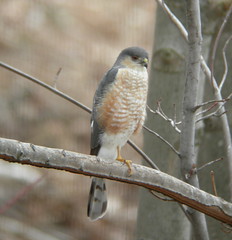
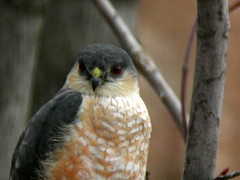
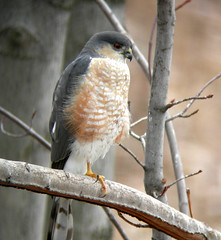
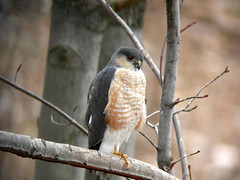
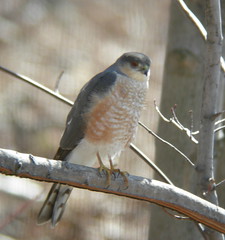
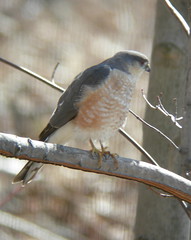
The Sharp-shin came back to day to dine at the fast food joint I call my bird feeders. He landed in the exact same spot as yesterday. I could tell because I hadn’t moved the tripod the camera was on and when I turned the camera on—voila! He was right in the view finder. This time I moved the camera and slid the porch door and screen out of the way so there was nothing between the lens and the bird. The pictures came out much, much better.

DSCN0461

DSCN0467

DSCN0471

DSCN0482

As you can see, I also played with the digital zoom on the camera a bit. Man, I love those red eyes!

Oh, and the smaller birds? They seem to have found it in their hearts to head north or somewhere. Could be because of the Sharp-shin. Could be because the neighbors' cats are out there when the hawk isn't. Then again, it could be because the wind has been blowing out of the south for two days and it's been pretty warm here. (Add the sound of wood frogs and spring peepers to the signs that spring may have actually arrived.)

Sunday, April 06, 2008

A sharp-shin!

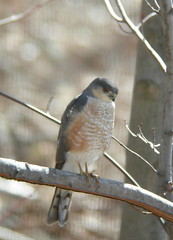
A rather the small hawk has taken to calling our small feeding birds, “Lunch.” It has been here before. I saw it take a small bird early last week and then spotted it again as it swooped past last Thursday. Saturday I spotted it perched on a branch on the other side of the yard as it waited for some small bird to come to the feeders but it flew off just as I got the digiscope set to take a picture. Today, when I got back from Princeton, I noticed there were no birds at the feeders—which wasn’t really surprising since I wasn’t here to put seed out this morning. But then I saw him—sitting pretty as you please in the sunlight directly above the feeders on the side of the house. I set the scope up inside the house, not wanting to spook him from his perch by opening the sliding door and snapped one picture after another through the glass f the door. There’s some fuzziness to the pictures despite my toying with the focus on the scope as I snapped shots. I think it may have been caused by shooting through two panes of glass at an angle.

Last summer we had one that chased several birdsin what could have been described as an aerial dogfight. The prey trying desperately to get away would dart in every direction with the small hawk duplicating its every move. Twice I saw such action end in puffs of loose feathers as dinner was captures. Only once did I see the prey escape in the branches of a pine.

DSCN0456


DSCN0455

DSCN0441


Sharp-shinned Hawk
And more here.


Wednesday, February 06, 2008

Hoary Redpoll

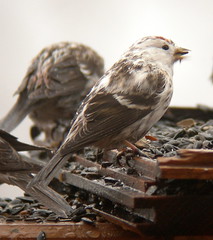
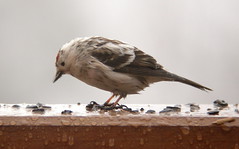
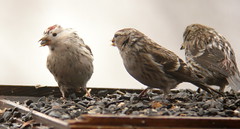
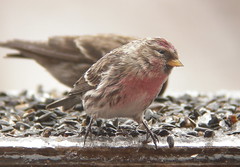
I’ve become almost blasé as to whether or not there are Hoary Redpolls among the huge flock that arrives here daily. Compared to the Common Redpoll, any Hoary would be quite rare. However, I continue to see one or two individuals that are much lighter than the rest of the flock and those are the ones I suspect of being Hoary Redpolls. Today I got a couple of excellent (for the weather conditions and the fact that I shot the pictures using my digiscoping equipment through the front window) photos of one individual that seemed downright snowy in comparison to the others. If this is not a Hoary redpoll, then I don’t know what is.

Hoary Redpoll

Hoary Redpoll

Now compare the two: Hoary on the left; Common Redpoll on the right.

Redpoll Comparison

And another shot of a Common Redpoll male having some red on his breast.

Common Redpoll

From the Cornell Lab of Ornithology’s All About Birds:
Hoary Redpoll
Common Redpoll

Monday, November 19, 2007

Visitors

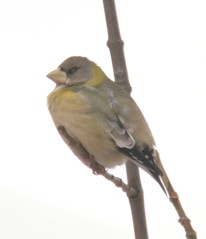
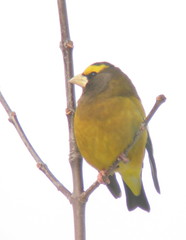
With this morning’s snows came a small flock of Evening Grosbeaks. At first the half a dozen birds simply sat in the tops of the poplars in front of the Aerie but, as they watched me shovel the deck and the chickadees, nuthatches and titmice visited the feeders, they too decided to sample the sunflower seeds.

Male evening grossbeak
Male Evening Grosbeak.

Female evening grossbeak
Female Evening Grosbeak.

This is the first time in a long time that Terry and I have seen this species and a first for the Aerie. Just last week, members of the Tiadaghton Audubon Society were wondering where these lovely birds have been.

Sunday, August 12, 2007

Some bird pics

I took my digiscoping equipment over to Ives Run this morning to see if I could get any decent pictures. Ives Run, on Hammond Lake, is where we went Birding on Thursday and had some excellent views of Great Blue Herons, Ospreys and Bald Eagles as well as numerous smaller birds. Today the big guys weren't quite as cooperative. The Great Blues took off as soon as I was within a hundred yards and the Ospreys and Eagles stayed 150 to 200 yards from me. I tried using the zoom function on the camera, but mixed with the field scope it was too much to hope for. I did get two or three pictures of the Osprey that weren't too bad but there were none of the immature bald eagle that are worth even showing.

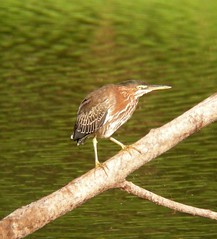
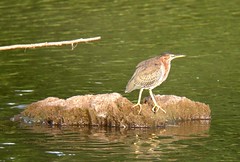
Still, I did get 17-18 shots of a very cooperative Green Heron that fished from a rock/log just 20 yards from the fishing pier.

Green Heron 16 8-12-07

Green Heron 11 8-12-07

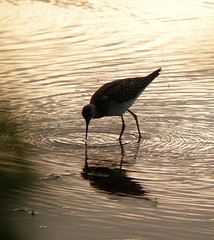
And there were several Greater Yellowlegs wading in the water that gave me some nice silhouettes.

G. Yellowlegs 2 8-12-07

So the day wasn't a total waste.

Here's one of an Osprey taken using the zoom function on the camera. You can see why I wasn't thrilled about it.

Osprey 2 8-12-07

I think it was just a little too far for the focus to narrow in on the bird. Oh well, live and learn.

One good thing about digital photography, you get osee your mistakes quickly and they don't really cost you a bundle to have them developed.

Friday, June 29, 2007

Backyard Bird Photography

I took my digiscoping equipment (field scope and digital camera) out on the deck this morning and photographed half a dozen species of birds while sipping my morning coffee. In all, I took 85 photographs. After running them through Picasa to crop, sharpen and adjust the lighting, I’ve come up with 6 photographs to share with you.
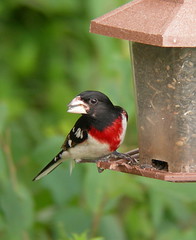
Rose-breasted Grosbeak
The Rose-breasted Grosbeak is one of the more dapper looking birds in the yard. Its black head, very white belly, bright red bib, and white-spotted black back really make this robin-sized bird a dazzler. It’s just too bad he can’t do anything about that Jimmy Durante sized schnoze.
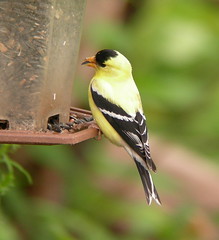
Goldfinch
The male American Goldfinch is also a sparkler. It’s brilliantly yellow body is set off by the white-barred black wings and black forehead patch. These birds are the state bird of New Jersey but I seldom saw them there. I did sight several flocks along the roadside near the Bolt Hole in the Adirondacks, but the sheer number that attached themselves to the feeders in January and the 20 or so who have remained loyal astounds me.
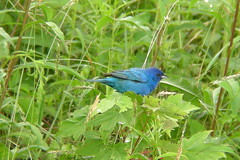
Indigo Bunting
The Indigo Bunting is a real jewel. Completely blue it stands out clearly against the green of the forest and shrubs. Early in the morning I can usually count on this little guy being perched at the very tippy-top of the poplars across the driveway as he sings his heart out to the rising sun. He will come into the platform feeders but seems to prefer to take his seeds on the ground. As is often the case in the bird world, the female is quite drab and nondescript.
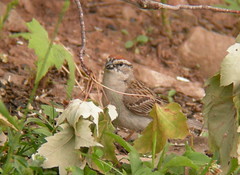
Chipping Sparrow
Another year-round resident around the Aerie is the Chipping Sparrow. One of the smallest of birds, this little guy is sometimes overlooked. He wears his russet little cap like a beret. And his rapid, constant, repetitive, simple little call: “chip, chip, chip, chip…” ad nauseam, not only provides the source for his name but also can increase sales of aspirin.
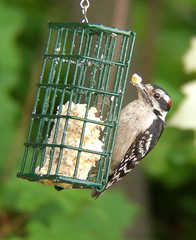
Downy Woodpecker
Yet another year-round resident, the Downy Woodpecker often comes to the suet feeder. This smallest of woodpeckers was taking chunks of suet to feed a fledged youngster that hung on a tree just a short distance away.
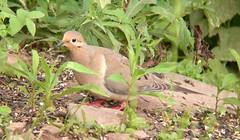
Mourning Dove
The Mourning Dove also resides year-round in the area of the Aerie. These buff colored birds are not only subtle in their coloration, but their gentle “coo-coo” sometimes gets mistaken by beginning birders for the “who-who” of an owl. Despite a rather rickety looking nest, the Mourning Dove pair may produce 10 or 12 eggs during the course of a season. They lay two eggs for each clutch and may have 5 or 6 clutches a year. Perhaps that is why, despite being a game bird in many states, the Mourning Dove is one of the most abundant birds in the US.
You can learn more about these and other birds by clicking on the link for All About Birds over on the left. That will take you to the Cornell Labs website and its wonderfully informative entries.