Posts

Showing posts with the label gorse

riddling glass and spreading mulch II

The SE quarter consisted of the site of a defunct shed, a midden, and the base of an old greenhouse. There's a patch maybe 9sq yards which may once have been cultivated but was weeds when I took over, and I used it to keep flammable rubbish pending bonfires - and it saw several of them. The former shed's site has now been riddled down to a depth of 1ft, and boy did it need it. I suspect the shed was there because the ground beneath was more slag or clinker than it was earth. It took me all of this year's growing season, but it's done: all good topsoil, albeit without structure, for the time being. That area makes up about a quarter of that SW quarter. I planned to riddle it all, but that would involve struggling on through the winter, and giving up all of next year too, and maybe not being finished by end of 2018, for goodness' sakes. And the more I read and thought about the soil and permaculture, the more unnecessary and even barmy this toil began to seem. T...
Hedgerow Update: Gorse, brambles, a few holly, figs...

Image
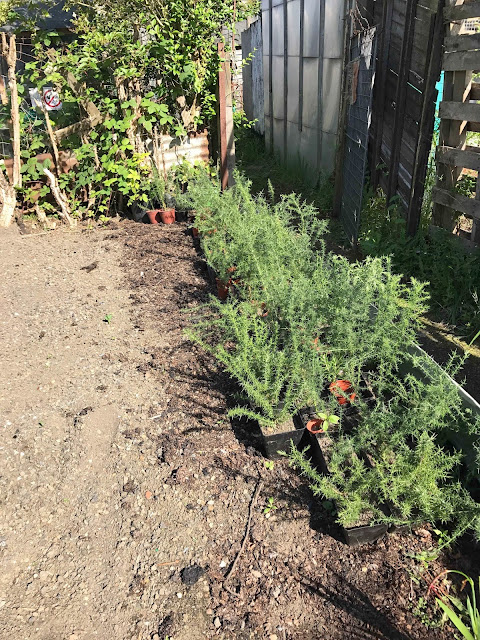
Eighty-something gorse, and a dozen or so brambles. Three of the figs - abandoned in their module tray - turned out to have survived. When I was working at Greenwich University last summer, I uprooted several tiny holly volunteers, and brought them home in coffee cups and some SW London earth. I potted them on earlier this year. Three of them have taken root. They, and the figs, will go in the ground a year or so from now, maybe winter 2018/19. The gorse and brambles will be planted some time this coming winter. They'll be joined by a row of white forsythia, referred to here . I put them across the west bed when I was still bothered about dividing the plot into five beds of equal size. AND to help there with drainage, but between the rubble and french drains, and the hedgerow, I don't think they're required for that now. So they will join the hedgerow, too. All of which means, the hedgerow is a done deal, and 100% decommodified. I will probably grow another hundred o...

Billhook Therapy and then Revisiting the Hedgerow

Image
Weeds have grown on the unriddled section of the 5th bed. There's a patch of borage and poppy which I'm happy to leave for now, but the rest were real weeds, which needed dealt with before they went to seed. So I set about them with the billhook. More satisfying than a punchbag in a gym, by far. Then to a more peaceful pursuit. When I potted on the gorse plants from modules, I put a dozen or so into the heavy plastic fish basket, and the rest near the edge of the 4th bed, where they've since been overwhelmed by the comfrey on one side, the field beans on the other. The comfrey I want for compost, and the seed pods on the field beans are at last beginning to dry-out and blacken, ready to harvest. So the gorse needs moved out of the way. I weeded each pot, and chopped the tips off each gorse plant. The tips are new and soft, which made me wonder, are they food for deer?  If that's so, trimming the tips would be part and parcel of how they grow in nature. I got a dozen...

It comes to something when the weeding is a bit of light relief...

Image
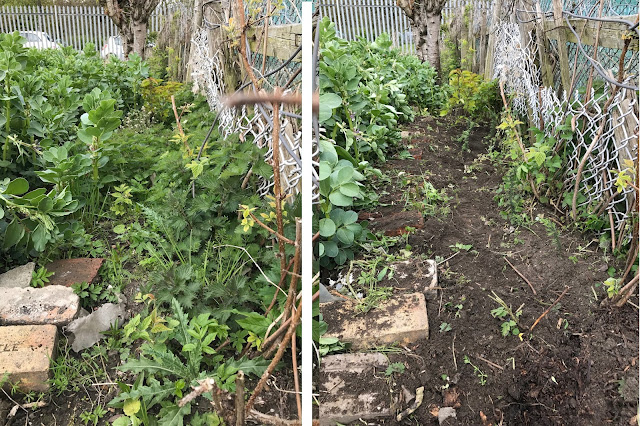
I'm relaxed about how things are going at the allotment, that's the whole point. But the state of the hedgerow does prey on my mind. Planting the gorse so early in its life was a blunder. For future reference, hedgerow trees and shrubs grown from seed need at least a year in a pot, growing to 1ft or so, before they're ready for planting out on the hedgerow line. But anyway, here's a 10ft section of the hedgerow, in the middle of the Eastern boundary, before and after weeding. The weeds consisted of ground elder, nettles, thistles, and a few mares' tails. After weeding we're left with gorse, (which was not thriving amongst the weeds), with brambles and suckers from the cherry tree's rootstock, (neither of which gave a shit about the weeds). The hedgerow on the western boundary, in particular, is getting choked by grass, and I really need to put a few hours aside to deal with that and save the gorse there.

Hedgerow update: Rubus fruticosus - encouraging a thug

When I took on the plot, there were already several brambles growing. They were quite out of control: mostly growing around the boundary, and giving fruit, but I regarded them as more of a nuisance than anything else. A few of them I dug up completely and consigned to bonfire piles. As the allotment's edges began to be tamed I started to merely cut them back, relocating some of them. This year, they can come into their own. I've made a blunder with the gorse. I was over-keen to get it into the ground. The dogs, when they were still permitted at the allotment, would run around the fringes of the plot where the gorse was planted, and a lot of them got uprooted. Over winter, grass has been growing on those that remained, and I'm going to have to do a lot of weeding. It's preying on my mind, every day makes the weeds worse, but and old injury to my knee cartilage has flared up, which makes getting down to the plants' level for a good weeding problematical, so I...

Enjoying rejects was a job for Poor Paddy. (7, 7)

Weather forecast notwithstanding I took the dogs to the plot yesterday and between showers dug a spade-wide trench down part of the Western boundary, and then across the NW bed to the central path where it should flow down into the pond. I had the pleasing sight of it actually working, the trench filling with water, which followed me as I dug in the direction of the pond. Gorse, apparently, doesn't like wet, boggy ground. It's planned to be the staple plant of the hedgerow at the central area of the Western boundary, so the drainage needs to work well if it's going to thrive. It might be that along this section of the hedgerow, I'll need to plant pyracantha . I've bought 100 seeds, but have a feeling in my bones that it's going to become the mainstay, and I'll likely want more.

screen shot with hedge

Image
As you can probably see, my horticultural skills exceed my Paint2 ones. I hope. That's the hedge in 2 shades of green. The section at the bottom of the picture is the Middle East bed, and is now a straggly hedge-line consisting of 12 or so gorse, brambles, suckers from the roots of the cherry trees, and the cherry trees themselves. On the bottom right of the picture is represented a double row, berries and currants in the front, and some proper "hedgerow" plants I was given : hazel, blackthorn, crab apple, dog rose and elder. West of the path, a row of gorse by the fence, fattening up to a double row in the corner, (likely to be a ned entry point), all fronted by berries and currants, which continue round along the West boundary for a way, again backed by gorse at the fence. The fruit runs out 1/3 along that line, and thereafter it's a double row of gorse.

100 gorse: planted

Tell you what, working full time, teaching, marking essays, on top of all one's usual domestic arrangements, doesn't half interfere with the allotment and the piano. However, I managed a few hours this weekend at the plot. The boundary along the mid and north west beds was thick with weeds: some of this was clover and phacelia I'd planted myself, but there was also ground-elder, nettles and grass invading from the next plot. I was 2 hours clearing a few yards of an area less than a yard wide. But I got there eventually. One thing to note: phacelia has extremely shallow roots, and can be pulled up just raking it. Clover's another story, it roots like field beans, and can't be pulled up by hand, but needs a trowel or even a spade. Anyway, I planted a row of gorse behind the currants and berries on the NW corner, filling in gaps in the front row where the transplanted fruit hadn't taken. And then the whole of the midwest bed's boundary was a double row of g...

100 gorse: planted

Tell you what, working full time, teaching, marking essays, on top of all one's usual domestic arrangements, doesn't half interfere with the allotment and the piano. However, I managed a few hours this weekend at the plot. The boundary along the mid and north west beds was thick with weeds: some of this was clover and phacelia I'd planted myself, but there was also ground-elder, nettles and grass invading from the next plot. I was 2 hours clearing a few yards of an area less than a yard wide. But I got there eventually. One thing to note: phacelia has extremely shallow roots, and can be pulled up just raking it. Clover's another story, it roots like field beans, and can't be pulled up by hand, but needs a trowel or even a spade. Anyway, I planted a row of gorse behind the currants and berries on the NW corner, filling in gaps in the front row where the transplanted fruit hadn't taken. And then the whole of the midwest bed's boundary was a double row of g...

Hedgerow & Potatoes

Image
Still playing catch up at the allotment, after those 6 weeks away. I cropped the 2nd earlies, and got 1 1/2 coffee sacks full. Which is satisfying, from 2kg of spuds from Lidl, costing less than ÂŁ1 in total. But, I must say, maris peer are not-bad salad potatoes, but somewhat bland in flavour. The main crop desiree are still in the ground, some of the foliage showing signs of yellowing, so ready to crop in a few weeks perhaps. And the last couple of evenings, I've gone back to the Northern boundary. On the east side, the hedge is pretty much planted, but badly needed weeding, which I did. On the west side, near the path are a couple of gooseberries and bramble plants which I had to cut back when I was doing some emergency weeding during a visit home a few weeks ago. They've took that treatment well, and are flourishing better than ever. On that part, there's only the front row of the hedge planted; the back row will be all gorse. I planted 4 of them tonight. I was tempt...

Hedgerow - Yet Another Update

Maybe it's something primeval, the need to secure a growing space with a hedge. The Secretary Formerly Known As Bee Lady has not gotten back to me about more bare root hedging plants. I don't know what the story is there, but must proceed under my own steam for now. This winter I'll plant the gorse right around the boundary, in a staggered row with gaps to be filled subsequently. Assuming the seedlings don't get waterlogged or dried out over the summer, there are 200, enough for a staggered row 1ft apart around most of the boundary. For the rest, I'm going to buy (yes, I know) blackthorn seeds , and stratify them this winter to plant next winter. Also silver birch , (the first tree I learned to recognise when I was a small child). Thinking further ahead, maybe several thousand years further ahead, I'm going to stratify yew , (the price of rootballed yew is outrageous - so there's a big profit margin if you have a bit of ground and patience). Holly has ...

Reframing Brambles

Image
I had a big ugly "bramble" in the old midden, near the SE corner. There were a number of "berries" amongst the original fruit bush area. I'd come across plants around the boundaries which I partially recognised from their leaves, and wondered, "Are these brambles or blackberries or raspberries or what are they?"  You know, sometimes my own numptiness astonishes me. I've at last, this morning, as drizzle keeps me and the dogs indoors, woken up to the wonderful possibilities of the genus Rubus. First of all, "bramble" according to Wikipedia is a generic term, usually referring to Rubus fruticosus, aka the blackberry. A year ago, I was in too much of a hurry to get everything cleared, taking a Year Zero mentality which I abandoned after a few months when the plot itself, kind of, pointed out its absurdity. But I do recall that, amongst the feral blackcurrants, nettles and thistles, there were both blackberries and raspberries. They ha...

...Hedgerow Update...

Image
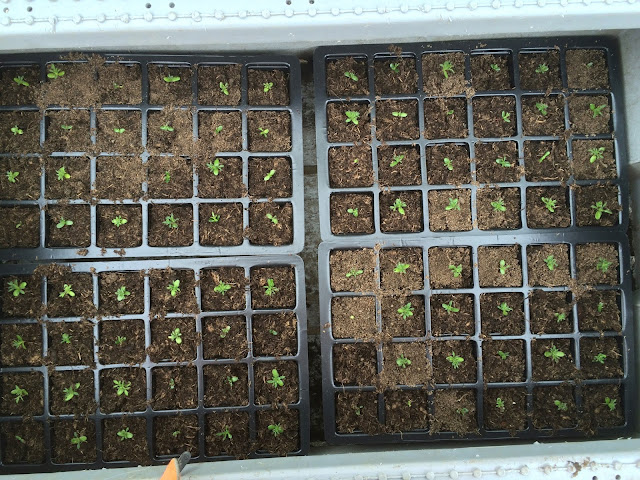
That's 96 of the gorse seedlings pricked out into 4 plug trays with ordinary multipurpose compost. A few of them you can hardly see because they've obviously only just germinated in the last few days: that's worth noting. I sowed them in trays on 27th April , and reported a lot of them germinating 11 days later . But as I've learned this morning, some of them were germinating some 6 weeks after sowing. So, let's say, Ulex europaeus appears to germinate at temperatures around 20c in between 1 and 6 weeks. In the shallow trays I used, (recycled tin trays from supermarket ready-to-roast chickens), it wouldn't have been wise to leave them much longer than 6 weeks, as some of them had already impressive root systems, up to 6ins long. The plug trays I got from Tesco, 5 trays of 24 plugs. I filled them all this morning, but have only pricked out 50% of the seedlings, so will fill another 4 or 5 plugs. Even if I lose a few along the way, we're looking at 200ish...

How many pallets can you fit in the back of a Fiat 500?

Image
At least 1. Maybe I could have got 3 altogether, at a pinch. Also 200+ gorse seeds, which have begun to look in danger of damping off, so I'm thinking they'll be better off at the allotment in the fresh air. I'm worried about slugs, snails and woodpigeons, though, so I put them in a wheelbarrow, covered with a net. Also this morning, planted a row of beetroot detroit.

The South East Bed

The SE bed, I don't speak of much. This is currently where the old shed is, a pile of half burned old timber and ground elder roots and God knows what else that will go on a bonfire when I get time... The plan is that here will go the oomska (right by the gate), and a herb/perennial bed. There's also a midden hidden there, and lots of bricks and all kinds of other mysteries. Today I was laying the skinny brick path on the South west bed, peas this year, to facilitate weeding prior to planting. Anyway, there are partly buried rows and stacks and lines of bricks on the SE bed. So I was mining them for the path. I don't think this SE side has EVER been gardened. Apart from the bricks, I found that the ground is a mixture of stones (pebbles, probably from the subsoil, and broken bricks and concrete) and what I'm thinking of as the original topsoil, when this was farmland more than a century ago: a kind of blueish clay, not as heavy as the glacial till of the subsoil, bu...

...another hedgerow update...

As of last Thursday, I had 100+ gorse germinated, but that seems to have perhaps doubled over the weekend, so many it's tedious to count them, and new ones still coming through all the time. Mind, I estimated 400 seeds, and the test batch gave me 6/10, so 200-300 plants seems likely. I'll prick them out once they have all got secondary foliage, couple of weeks away, and then down to the allotment ready for transfer to the boundary in late summer.

...hedgerow update...

I reported a few days ago that the gorse seeds had gone berserk , and I can say that their exuberant behaviour has continued all week. As of this morning, there were 110 approximately, with no sign of abatement in germination. Assuming all of those seedling survive to the planting-out stage, that's already enough for a single line of hedging down the W boundary, which is the direction casual, uninvited visitors are liable to try to get in from. The fence by the SW bed is elderly, wooden and wobbly: I could kick it down myself in a few moments, so there's nothing to stop an amphetamine-fueled, mischief-bent Ned doing just that. It'll be maybe 3 years before the gorse can stop him, of course, but allotmenteering is all about delayed gratification, and I just need to be sure there's nothing a Ned would want to steal or even vandalize meanwhile.

Brassica botrytis?

Image
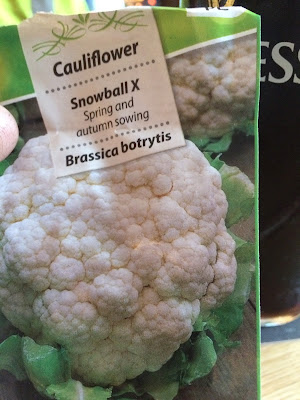
Is it just me or does "botrytis" sound like something that would keep you off work with a toilet roll cooling in the fridge, and some comfort telly lined up?  That's the botanical for cauliflower, anyways. This afternoon I got a row of these put in: 49p ones from Lidl. So that's 3 rows in the brassica bed now: neeps, oregano, and caulis. I'm using an old dibber left behind by The Predecessor, and it's exactly 17ins from handle to tip, so that's how far I'm spacing my rows, just to have a bit of uniformity. Enough to get up & down with the hoe, rake, or barrow... Also today: The Carer at the community plot next door asked me to take the the barbed wire off the new(ish) fence, (that's the W boundary), as somebody had hurt themselves on it, and it was giving him a whole load of Council Health & Safety Risk Assessment stuff to deal with. Well, fair enough. I want to keep Neds out, obvs, but don't want to injure any innocent passers by...

...hedgerow latest...

The gorse seeds in the trays have gone berserk. Last night there was only 1 thriving germinated seedling. This morning there were 6 more breaking through. By midday, 9. Just now this evening, 19. In other news, I sowed the roses in a tray on a different windowsill. In a proper seed tray this time, following carefully the advice Prof. Google had to offer.  There are still only 3 alder, but they're handsome wee seedlings. I'll plant them together, in the wettest bit of the West bed, above the French drain.

Transplanted Fruit

Image
This is the most vigorous of the fruit bushes transplanted over the winter. I think it's a gooseberry. I've planted them in what will be the front row of the hedge, about 1ft apart. So their main job is hedgerow rather than fruit production. Nonetheless I expect gooseberries etc in due course. I'm glad about 75% of the fruit bushes have taken so enthusiastically to their new homes, because it must be said that other aspects of the hedgerow are not working out; no hawthorns whatsoever germinated after 2 month stratification of 100s of seeds; only 3 alder after 3 months stratification; the gorse has now joined this unhappy list, I got 6/10 in a trial (in a 4in pot) but only 1 so far (of several hundred seeds) in the trays. The common factor in failure seems to be the recycled tin trays I'm using, (formerly used to roast a supermarket chicken). I'll get  proper seed trays for the last leg of the experiment, the roses, which have now been stratifying in the fridge...