It’s been over 2 years since the nuclear disaster at Fukushima and it still seems to be making headlines (I'm sure officials were assuring us a few weeks after the disaster occurred that all was well and it couldn't possibly melt down) so I thought I'd do a little survey of recent news.
A few weeks ago I started noticing reports that there was something of a push to restart the Japanese nuclear industry (against the wishes of Japanese voters), which had been shutdown in the wake of the reactor meltdowns. The reports soon prompted speculation of a jump in uranium prices as yet another mini-nuclear renaissance was forecast.
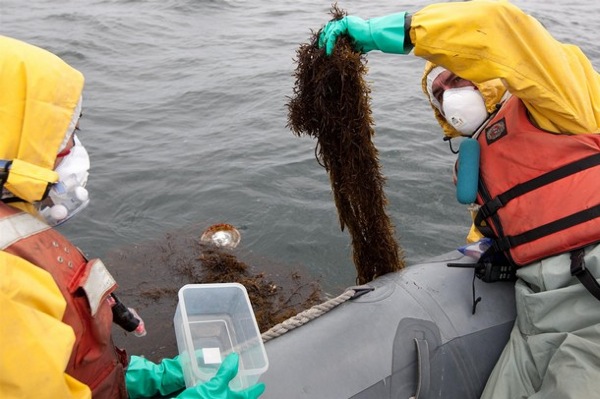
Since then TEPCO has admitted that the plant was leaking 300 tons of radioactive water per day into the Pacific Ocean after denying the leak for months (as per their standard approach of denying any problem exists until doing so was no longer tenable).
The Japanese authorities have now raised the threat level for the plant to a level three "serious incident". It was this leak that led the the widely pilloried "ice wall" approach to be proposed as a solution.
The precise location of the leak has not yet been determined and may not be repaired for years. Besides the "ice wall" idea construction of a concrete seawall around the whole site is also being mooted (another leak has since been reported within the site).
In the aftermath of the disaster, alternative energy solutions have been gaining in popularity. Japan and China have been recording record demand for solar PV (forecast to reach 9GW in the second half of 2013) with a 100% increase on the first half of the year, and a 70% jump over the previous year. Japan's growth alone has been 150 per cent compared to 2012 and is forecast to be over 5GW mid-2014.
The Japanese are also experimenting with energy storage to supplement the expansion of wind and solar on Japan's electric grid with two large-scale battery systems being constructed in the north. A 60 MWh redox-flow battery will be installed on the island of Hokkaido along with a 20 MWh lithium-ion battery in the Tōhoku region.
In the wake of the Fukushima nuclear plant disaster, Japan has struggled to stem the flow of radioactive material from the site. As Bloomberg reports, a new idea would see pipes installed around the failed plant, through which coolant would be pushed from on-site refrigeration units. The pipes would be installed between 20 and 40 meters (66 and 132 feet) below the ground, turning a mile-long stretch of earth into a frozen wall. The Japanese government wants to keep the ground frozen for six years, starting in July 2015.
The idea isn't new: the concept of freezing soil was first used in the 1860s to "shore up" coal mines, and more recently ice walls have been used to support the building of subway tunnels. The US also experimented with the idea that frozen earth could protect against nuclear radiation at a laboratory that produced plutonium for atomic weapons. Tokyo Electric Power, the company in charge of maintaining the plant, recently raised the status of the radioactive leaks at Fukushima to "emergency," a stance that's echoed by Japan's Priime Minister Shinzo Abe who now describes the leaks as an "urgent problem."
The Diplomat has a look at the cost of cleaning up the Fukushima nuclear disaster - Fukushima Decontamination and Cleanup Will Cost $50 Billion. Presumably this isn't included in most levelised cost of energy numbers disseminated by nuclear power promoters...
In another blow to recovery efforts in the prefecture hit hardest by the 3/11 tsunami and nuclear meltdown, Japan’s National Institute of Advanced Industrial Science and Technology have estimated the cost of decontamination and cleanup to be more than $50 billion. The central Japanese government has earmarked only $11 billion in aid to the struggling region.
“The group has estimated that the decontamination in the no-entry zones will be at around $20 billion, while the other surrounding areas will cost another $31 billion,” said the Japan Daily Press. “The estimates are based on the unit costs that the government provided as well as information collected from the affected municipalities. It also includes the expenses that will be incurred in the removal, transportation and storage of radioactive waste like the contaminated soil and water.”
The New York Times reports that Japan's Prime Minister during the Fukushima disaster thinks the country should completely abandon nuclear power - Japan’s Former Leader Condemns Nuclear Power.
In an unusually stark warning, Japan’s prime minister during last year’s nuclear crisis told a parliamentary inquiry on Monday that the country should discard nuclear power as too dangerous, saying the Fukushima accident had pushed Japan to the brink of “national collapse.”
In testimony to a panel investigating the government’s handling of the nuclear disaster, the former prime minister, Naoto Kan, also warned that the politically powerful nuclear industry was trying to push Japan back toward nuclear power despite “showing no remorse” for the accident. ...
In his testimony, Mr. Kan said that Japan’s plant safety was inadequate because energy policy had been hijacked by the “nuclear village” — a term for the power companies and pronuclear regulators and researchers that worked closely together to promote the industry. He said the only way to break their grip was to form a new regulatory agency staffed with true outsiders, like American and European experts.
“Gorbachev said in his memoirs that the Chernobyl accident exposed the sicknesses of the Soviet system,” Mr. Kan said, referring to the 1986 explosion of a reactor in Ukraine, which spewed radiation across a wide swath of Europe. “The Fukushima accident did the same for Japan.” ...
He complained that nuclear regulators and the plant’s operator, Tokyo Electric Power, or Tepco, kept him in the dark about crucial details in the days immediately after a huge earthquake and tsunami on March 11, 2011, knocked out cooling systems at the Fukushima Daiichi plant, causing three of the plant’s reactors to melt down.
He said he tried to be fully open with the public and hid nothing. But he seemed to undermine that claim when he disclosed that in the early days of the crisis he feared it could spiral out of control, even as his own ministers were giving public reassurances that they had the plant under control.
He said he feared additional meltdowns could “release into the air and sea many times, no, many dozens of times, many hundreds of times the radiation released by Chernobyl.”
Those fears led to the most extraordinary moment of the crisis, when Mr. Kan walked into Tepco’s headquarters after being told the company wanted to evacuate its staff from the crippled plant. He demanded that they stay, saying he was prepared to put his own life on the line to prevent the disaster from worsening.
He also defended his visit to the plant on the day after the earthquake, which has been widely criticized for distracting plant personnel at a crucial juncture in their efforts to save the overheating reactors. Mr. Kan told the panel that he wanted to get an assessment directly from the plant manager because he felt Tepco officials in Tokyo were not giving him enough information.
But his strongest comments came at the end of his testimony, when a panel member asked if he had any advice for the current prime minister. Mr. Kan replied that the accident had brought Japan to the brink of evacuating metropolitan Tokyo and its 30 million residents, and that the loss of the capital would have paralyzed the national government, leading to “a collapse of the nation’s ability to function.”
He said the prospect of losing Tokyo made him realize that nuclear power was just too risky, that the consequences of an accident too large for Japan to accept.
“It is impossible to ensure safety sufficiently to prevent the risk of a national collapse,” Mr. Kan said. “Experiencing the accident convinced me that the best way to make nuclear plants safe is not to rely on them, but rather to get rid of them.”
Japanese firms are looking at building several geothermal plants in a volcanic zone in the area worst hit by last year's nuclear disaster, a project that could gain momentum after the government eased restrictions on drilling this week.
The head of a group of firms that have studied the potential of a geothermal project in Fukushima said on Friday a consortium of about 10 companies would meet local people by early May to explain their plans to build plants with a total capacity of 270 megawatts, which would be Japan's biggest.
The consortium plans to work with local communities, including those who run hotels and inns at hot springs, to develop geothermal energy, Masaho Adachi, the chairman of Japan Geothermal Developers' Council said.
The council has already held a meeting with local government officials in the central zone of Fukushima, home to the nuclear plant crippled by an earthquake and tsumani last year, he said.
Along with high costs, protests by local communities fearful of the impact of a geothermal plant on hot springs have prevented such projects from taking off in the past.
"We should spend together a period of more than 10 years before having geothermal plants running," he said in an interview with Reuters on Friday, referring to activities such as collecting data, test drilling and environment assessment. Adachi declined to name the companies forming the consortium.
The Nikkei newspaper earlier said that the Fukushima project by a consortium of companies including Idemitsu Kosan Co and Inpex Corp would cost around 100 billion yen ($1.2 billion), with operations set to start in 2020.
Since the crisis, interest in renewable energy has jumped and a government subsidy scheme, similar to those in many countries in Europe, to force utilities to buy renewable electricity is due to start in July. ...
Studies show Japan, a land of volcanoes, ranks as the world's third-richest nation in geothermal power. A government study last year showed it has the potential for business to derive 14,000 MW of energy, but it currently has only 540 MW worth of commercial plants due to restrictions on development in national parks, where most resources lie.
The wheel in the sky keeps on turning — or at least it will if a Japanese renewable energy professor’s “Wind Lens” turbine design is realized. Resembling giant white rims, these offshore turbines have the potential to produce up to three times as much energy as a standard offshore one.
Yuji Oyha, a professor of renewable energy dynamics and applied mechanics at Kyushu University in Japan, and his team presented their wild vision for wind power recently at the Yokohama Renewable Energy International Exhibition. The “Wind Lens” design is essentially a hoop roughly 360 feet in diameter — a brimmed diffuser — that functions like a magnifying glass. Blades turn quickly within the diffuser, so quickly that they could increase the energy output two or threefold, according to CNN International. One of these “lenses” should be able to power a household.
Broad areas around the stricken Fukushima Daiichi nuclear plant could soon be declared uninhabitable, perhaps for decades, after a government survey found radioactive contamination that far exceeded safe levels, several major media outlets said Monday.
The formal announcement, expected from the government in coming days, would be the first official recognition that the March accident could force the long-term depopulation of communities near the plant, an eventuality that scientists and some officials have been warning about for months. Lawmakers said over the weekend — and major newspapers reported Monday — that Prime Minister Naoto Kan was planning to visit Fukushima Prefecture, where the plant is, as early as Saturday to break the news directly to residents. The affected communities are all within 12 miles of the plant, an area that was evacuated immediately after the accident.
The government is expected to tell many of these residents that they will not be permitted to return to their homes for an indefinite period. It will also begin drawing up plans for compensating them by, among other things, renting their now uninhabitable land. While it is unclear if the government would specify how long these living restrictions would remain in place, news reports indicated it could be decades. That has been the case for areas around the Chernobyl plant in Ukraine after its 1986 accident.
Since the Fukushima accident, evacuations have been a sensitive topic for the government, which has been criticized for being slow to admit the extent of the disaster and trying to limit the size of the areas affected, despite possible risks to public health. Until now, Tokyo had been saying it would lift the current evacuation orders for most areas around the plant early next year, when workers are expected to stabilize Fukushima Daiichi’s damaged nuclear reactors.
The government was apparently forced to alter its plans after the survey by the Ministry of Science and Education, released over the weekend, which showed even higher than expected radiation levels within the 12-mile evacuation zone around the plant. The most heavily contaminated spot was in the town of Okuma about two miles southwest of the plant, where someone living for a year would be exposed to 508.1 millisieverts of radiation — far above the level of 20 millesieverts per year that the government considers safe.
Rice futures in Tokyo surged in their first appearance on the bourse since 1939, triggering a suspension of trade, on concern radiation from the stricken Fukushima nuclear plant may spread to crops and curb supply. ...
The exchange listed rice contracts today for the first time since the start of World War II to boost flagging volumes and profit. The resumption comes as fallout from the Fukushima Dai- Ichi power plant may spread after it was found cattle had been fed cesium-tainted rice straw. Spinach, mushrooms, bamboo shoots, tea, milk, plums and fish have been found to be contaminated with cesium and iodine as far as 360 kilometers (224 miles) from the station operated by Tokyo Electric Power Co.
Tokyo Electric Power Co., operator of Japan’s crippled Fukushima Dai-Ichi nuclear plant, said it detected the highest radiation to date at the site.
Geiger counters, used to detect radioactivity, registered more than 10 sieverts an hour, the highest reading the devices are able to record, Junichi Matsumoto, a general manager at the utility, said today. The measurements were taken at the base of the main ventilation stack for reactors No. 1 and No. 2.
The Fukushima plant, about 220 kilometers (137 miles) north of Tokyo, had three reactor meltdowns after the March 11 magnitude-9 earthquake and tsunami knocked out power and backup generators. Radiation leaks displaced 160,000 people and contaminated marine life and agricultural products.
The Times Union reports that the Japanese are growing suspicious of offical claims and are starting to measure radiation levels themselves - Japanese monitor radiation on their own.
Kiyoko Okoshi had a simple goal when she spent about $625 for a dosimeter: She missed her daughter and grandsons and wanted them to come home.
Local officials kept telling her that their remote village was safe, even though it was less than 20 miles from the crippled Fukushima Daiichi nuclear power plant. But her daughter remained dubious.
So starting in April, Okoshi began using her dosimeter to check nearby forest roads and rice paddies. What she found was startling. Near one sewage ditch, the meter beeped wildly, and the screen read 67 microsieverts per hour, a potentially harmful level. Okoshi and a cousin who lives nearby worked up the courage to confront elected officials, who did not respond, confirming their worry that the government was not doing its job.
With her simple yet bold act, Okoshi joined the small but growing number of Japanese who have decided to step in as the government fumbles its reaction to the widespread contamination, which leaders acknowledge is much worse than originally announced. Some mothers as far away as Tokyo have begun testing for radioactive materials.
More gravely serious truths about the severity of the Fukushima nuclear power plant disaster following the earthquake and tsunami of March 11 have emerged.
Two things are now clear and they justify the following charges: the nuclear experts that the Australian media relied upon should never be trusted again; and social media real-time raw and unfiltered audio and video reports are providing a more truthful and relevant coverage of the aftermath of the continuing nuclear crisis than the selective and filtered copy being carried by print and wire agencies.
While the Bloomberg news report overnight of two extremely high radiation readings being recorded at the Fukushima complex of nuclear plants on August 1 and August 2 are alarming, other significant disclosures are also made in this story.
* The reading of 10 sieverts of radiation per hour outside the damaged reactor buildings was the highest level the equipment used could have detected, meaning the lethality of the contamination was off the scale; and
* For the first time a tenured nuclear expert Tetsuo Ito, the head of the Atomic Energy Research Institute at Kinki University concedes that the melted cores of one or more reactors may have melted through the supposedly failure proof containment vessel floor, sinking deeper into the subsoil and given the nature of the radioactive material concerned, into a position where it can spread a very long distance directly through the subsoil water table.
It took TEPCO and nuclear apologists until last month to even concede that “partial meltdowns” had occurred in up to three of the reactors, even though the only plausible explanation for the caesium contamination detected outside the reactors within 48 hours was the rupturing of the caesium sheaths surrounding the uranium rods upon their exposure to air following the draining of coolant fluid, setting up the requirements for a melt down to occur.
In what would be consistent with a deliberate policy of gradually revealing the truth some months after the event, the Japanese nuclear authorities and government are also now routinely referring to the fact that contamination levels outside the exclusion zone around the Fukushima Daiichi complex include hot spots that are as highly affected as they were around the Chernobyl reactor that exploded in the former Soviet Union 25 years ago.
Which is where social media in Japan is making itself felt.
In a series of widely viewed and replicated YouTube videos a Japan nuclear expert, Professor Tatsuhiko Kodama, has told Japan’s lower house Diet that the nation has failed miserably to make a timely evacuation of the at risk population worst affected by Fukushima radioactive fallout compared to the massive relocation that occurred in the Ukraine in the two weeks after the Chernobyl disaster.
In the English language transcripts of these videos, notably on the Penn-Olsen Asia tech blog, Kodama says he is shaking with anger at the incompetence and dishonesty of the government and nuclear authorities and the TEPCO power company in the aftermath of the accident. He attacks the use of simplistic readings that ignore for example the accumulation of deadly isotopes at the foot of slippery slides in children’s playgrounds in favour of readings at the top from which rain has washed away the contamination.
The readings, like the children, are being cooked, either by ignorance or intent.
Kodama says the uranium equivalent of the contamination released by the three affected reactor cores and four cooling ponds at Fukushima was that of 20 Hiroshima-sized atom bombs:
“What is more frightening is that whereas the radiation from a nuclear bomb will decrease to one-thousandth in one year, the radiation from a nuclear power plant will only decrease to one-tenth.
“In other words, we should recognise from the start that just like Chernobyl, Fukushima I Nuclear Plant has released radioactive materials equivalent in the amount to tens of nuclear bombs, and the resulting contamination is far worse than the contamination by a nuclear bomb.”
Kodama’s testimony, poorly reported in the established Japan media, is circulating in social media in tandem with raw videos of government officials telling a meeting of Fukushima residents demanding urgent help in evacuating to other parts of the country that they should stay put and trust them to reduce radiation. The meeting becomes increasingly angry after one official tells the residents they could evacuate at “their own risk”, while they shout at them for telling them to stay put and die.
The bigger context to these reports from Japan is that the guidance given by nuclear scientists and apologists alike to the media in Australia was disgracefully inaccurate and patronising. The reality of the caesium contamination was ignored, and the quoting of initial radiation readings in the wrong metric was ignored (and later found to be fictitious as well as mischievous, when TEPCO confirmed that it didn’t actually have any capability of measuring contamination within key parts of the complex).
The constant refrain that Fukushima would never be a level-seven disaster such as Chernobyl contained longer in the Australian media than anywhere else, even after the nuclear authorities in France and US broke with the usual protocol of not commenting on other national agencies, and said that it could reach level six or level seven and expressed a lack of confidence in their Japan counterparts.
One thing that is becoming apparent after this disaster is that the truth, like the fallout, is going to force itself on the authorities no matter how much the business, political and scientific establishments try to play it down.
The Climate Spectator has a look at the elevated level of skepticism about nuclear power - Nuclear: too hot to handle.
Recent reports about the potential of BHP Billiton to delay uranium production from its massive Olympic Dam project, and Resource Minister Martin Ferguson’s urging of the NSW coalition government to overturn the state’s ban on uranium mining, suggests differing views about the outlook for the nuclear industry.
That the much anticipated “nuclear renaissance” has been stalled – at least in western democracies – appears to be beyond doubt, at least in the short term. But the medium- to long-term outlook is subject to much conjecture, and seems to depend on how you answer two questions: Who is going to want it? And who is going to pay for it?
In the immediate aftermath of the Fukushima nuclear crisis, we noted that the nuclear industry was unique among energy sources in that it relied on the indulgence of public opinion – unless, of course, you live in a country like China – to be built. This has been borne out by events in Germany and Italy, and the continuing angst in Japan.
But it’s not the only problem – even in those countries where nuclear is supported by the government, the question remains, who is going to pay for them? And it seems clear that the private sector is not.
Advocates for nuclear power in this country like to present the industry as the lowest-cost clean energy alternative to fossil fuels. But this ignores the fact that nuclear plants are massively expensive and involve huge up-front costs, invested well in advance of a commercial return because of the long lead times.
And it is completely dependent on government support. As Citigroup analysts pointed out in a 2009 analysis on the economics of the nuclear industry, there hasn’t been a plant in the world built without the relevant government assuming much of the construction, operating and financing risk. There is not a single insurer, banker or construction company in the world that is willing to assume that risk.
France is often cited as the glowing example of low cost nuclear energy, but the French government effectively wrote off the capital investment of its nuclear fleet, meaning that the operating companies such as EdF and GDF Suez have been able to book what the International Energy Agency described as billions of dollars in “nuclear rent."
Now, the assumption that nuclear will be cheaper than competing “clean” technologies such as coal with carbon capture and storage is being questioned again, particularly in light of the extra costs that will become an inevitable consequence of post-Fukushima safety reviews.
Nomura Securities analyst Kyoichiro Yokoyama last week released a detailed assessment of competing clean baseload technologies, in which he concluded that the cost of nuclear was considerably higher than that of even coal with carbon carbon and storage.
Yokoyama noted that low costs had been a key selling point for nuclear power, underpinned by an analysis from the IEA and the OECD’s Nuclear Energy Agency last year that suggested that the levelised cost of energy (LCOE) for coal-fired plants with CCS comes out 25-40 per cent higher than that for nuclear plants, with or without a carbon price. But Yokoyama said that, since the Fukushima Daiichi incident, an increasing number of people have been questioning the real cost of nuclear power generation.
“Some observers have noted that the cost of the various subsidies paid when nuclear plants are constructed is not factored in and it has also been pointed out that the estimation of costs associated with spent fuel has tended to be overly optimistic,” he wrote. “In many cases, the details of these amounts are unclear or unspecified, which makes calculating the actual cost of nuclear power generation somewhat problematic.”
He drew on research from MIT that noted how the cost of disposing of spent fuel and numerous regulatory and political risks associated with operating licences, including gaining the approval of residents, meant the capital costs were considerably higher (around 2-3 percentage points) than for thermal generation. MIT suggested that this translated into a LCOE for nuclear power generation of $US60-$US65/MWh for the US and Germany and $90/MWh for the Czech Republic. These costs are roughly the same as for coal-fired generation with CCS.
The question of costs and the ability of the private sector to come to the party has been raised on several occasions in recent weeks in the UK, which is keen on pressing ahead with its nuclear rollout. A joint venture between France’s EDF and the listed UK utility Centrica plans to roll out of three or four nuclear plants by the end of the decade.
Last week, Lakis Athanasiou, the utilities analyst with London-based investment bank Evolution Securities, warned that Centrica should "not touch (the new nuclear venture) with a barge pole," particularly if the UK government is unwilling to take construction risk.
The Evolution Securities view reinforces renewed concerns expressed by other investment specialists such as Citigroup, which a week earlier said new nuclear was not an investable option for public equity markets and listed companies such as Centrica or Germany’s RWE.
“The cost of capital based on those risks would be way too high to give you an electricity price which is affordable,” Citigroup’s utilities analysts told reporters at a briefing in London. "You would be looking at a project cost of capital of at least 15 per cent. That would require a power price of about 150-200 pounds per megawatt hour (based on 2017 money) to make that project work," he said, noting it is three to four times as much as current UK spot power prices.
"We think (nuclear energy) is uninvestable for public equity markets. EDF may be willing to take on the construction risks but none of the other (big utilities) are willing to do that." EDF, he noted, is an exception because it is majority-owned by the French government.
In that 2009 report, Atherton noted that three of the risks faced by developers – construction, power price, and operational – are “so large and variable that individually they could each bring even the largest utility company to its knees financially. This makes new nuclear a unique investment proposition for utility companies.” He noted that UK government policy remains that the private sector takes full exposure to the three main risks. “Nowhere in the world have nuclear power stations been built on this basis,” he said.
Further delays and cost overruns at new generation nuclear plants being developed in Europe by French companies have also raised questions about the cost factor, particularly with the extra safety measures that would appear to be an inevitable consequence of the Fukushima incident. EDF said the new generation European pressurised reactor (EPR) at Flamanville, in north-western France, has been further delayed and is now expected to open in 2016 (rather than 2014), and its budget has now jumped out to €6 billion ($8 billion). It was originally to be built by 2012 at a cost of €3.3 billion.
Another French company, Areva, is experiencing similar problems at its EPR plant in Finland.
A Swedish man who tried to build a nuclear reactor in his kitchen says he started the experiment "just for fun".
Richard Handl, 31, from Aengelholm municipality in south-western Sweden, was detained by police two weeks ago and says he started the project as a hobby. "I have always been interested in nuclear physics and particle physics," he said.
In May, he launched an English-language blog, Richard's Reactor, in which he charted his progress in the project, complete with pictures.
His plan was "to build a working nuclear reactor. Not to gain electricity, just for fun and to see if it's possible to split atoms at home." ...
Mr Handl's blog can be found at http://richardsreactor.blogspot.com.
SP at TOD ANZ has a look at the safety myth that existed in Japan about nuclear power - Mythonium.
Easier to create than Unobtainium, and with a longer half life than any of the transactinides, it is a powerful and necessary element in any public relations effort.
Myth creation is common during a crisis. Some of them are deconstructed below.
The first major myth concerns Japanese technological prowess. As a nation the Japanese have a strong technological history, but they are not alone in having a long cultural history of avoiding (or outright denying) uncomfortable “truths”.
The first article below is an extensive cut and paste from the New York Times (follow the link for the complete story). I have edited out more from the start of the original piece and highlighted some of the more boring technical or “factual” statements that normally get relegated to the bottom of the journalists pyramid. ...
Over several decades, Japan’s nuclear establishment has devoted vast resources to persuade the Japanese public of the safety and necessity of nuclear power. Plant operators built lavish, fantasy-filled public relations buildings that became tourist attractions. Bureaucrats spun elaborate advertising campaigns through a multitude of organizations established solely to advertise the safety of nuclear plants. Politicians pushed through the adoption of government-mandated school textbooks with friendly views of nuclear power.
The result was the widespread adoption of the belief — called the “safety myth” — that Japan’s nuclear power plants were absolutely safe. Japan single-mindedly pursued nuclear power even as Western nations distanced themselves from it.
As the Japanese continue to search for answers to the disaster at the Fukushima Daiichi plant, some are digging deep into the national psyche and examining a national propensity to embrace a belief now widely seen as irrational.
Because of this widespread belief in Japanese plants’ absolute safety, plant operators and nuclear regulators failed to adopt proper safety measures and advances in technology, like emergency robots, experts and government officials acknowledge.]
Banri Kaieda, who runs the Ministry of Economy, Trade and Industry, which oversees the nuclear industry, said at a news conference at an International Atomic Energy Agency meeting in Vienna on Monday. “It’s a fact that there was an unreasonable overconfidence in the technology of Japan’s nuclear power generation.”
With radiation levels too high for workers to approach the reactors, the Japanese authorities floundered. They sent police trucks mounted with water cannons — equipment designed to disperse rioters — to spray water into the reactor buildings. Military helicopters flew over the buildings, dropping water that was scattered off course by strong winds, in a “performance, a kind of circus” that was aimed more at reassuring an increasingly alarmed Japanese population and American government, said Kenichi Matsumoto, an aide to Prime Minister Naoto Kan.
Japan lacked some of the basic hardware to respond to a nuclear crisis and, after initial resistance, had to look abroad for help. For a country proud of its technology, the low point occurred on March 31 when it had to use a 203-foot-long water pump — shipped from China…
But perhaps more than anything else, the absence of one particular technology was deeply puzzling: emergency robots.
Japan, after all, is the world’s leader in robotics. It has the world’s largest force of mechanized workers. Its humanoid robots can walk and run on two feet, sing and dance, and even play the violin. But where were the emergency robots at Fukushima?
The answer is that the operators and nuclear regulators, believing that accidents would never occur, steadfastly opposed the introduction of what they regarded as unnecessary technology.
“The plant operators said that robots, which would premise an accident, were not needed,” said Hiroyuki Yoshikawa, 77, an engineer and a former president of the University of Tokyo, Japan’s most prestigious academic institution. “Instead, introducing them would inspire fear, they said. That’s why they said that robots couldn’t be introduced.”
The rejection of robots, Mr. Yoshikawa said, was part of the industry’s overall reluctance to improve maintenance and invest in new technologies.
“That’s why the safety myth wasn’t just an empty slogan,” said Mr. Yoshikawa, now the director general of the Center for Research and Development Strategy at the Japan Science and Technology Agency. “It was a kind of mind-set that rejected progress through the introduction of new technology.”
After Chernobyl, the nuclear establishment made sure that Japanese kept believing in safety.
The plant operators built or renovated the public relations buildings — called “P.R. buildings” — attached to their plants. Before Chernobyl, the buildings were simple facilities intended to appeal to “adult men interested in technical matters,” said Noriya Sumihara, an anthropologist at Tenri University who has researched the facilities. Male guides wearing industrial uniforms took visitors around exhibits consisting mostly of wall panels.
But after Chernobyl, the facilities were transformed into elaborate theme parks geared toward young mothers, the group that research showed was most worried about nuclear plants and radiation, Mr. Sumihara said. Women of childbearing age, whose presence alone was meant to reassure the visitors, were hired as guides.
In Higashidori, a town in northern Japan, one of the country’s newest P.R. buildings is built on the theme of Tonttu, a forest with resident dwarfs. The buildings also holds events with anime characters to attract children and young parents…
Here in Shika, more than 100,000 guests last year visited the P.R. building where Alice discovers the wonders of nuclear power. The Caterpillar reassures Alice about radiation and the Cheshire Cat helps her learn about the energy source.
The nuclear establishment also made sure that government-mandated school textbooks underemphasized information that could cast doubt on the safety of nuclear power. In Parliament, the campaign was led by Tokio Kano, a Tepco vice president who became a lawmaker in 1998.
In 2004, under the influence of Mr. Kano and other proponents of nuclear power, education officials ordered revisions to textbooks before endorsing them. In one junior high school social studies textbook, a reference to the growing antinuclear movement in Europe was deleted. In another, a reference to Chernobyl was relegated to a footnote.
The nuclear establishment itself came to believe its own safety myth and “became entangled in its own net,” said Hitoshi Yoshioka, an author of a book on the history of Japan’s nuclear power and a member of a panel established by the prime minister to investigate the causes of the Fukushima disaster.
"Fukushima is the biggest industrial catastrophe in the history of mankind," Arnold Gundersen, a former nuclear industry senior vice president, told Al Jazeera.
Japan's 9.0 earthquake on March 11 caused a massive tsunami that crippled the cooling systems at the Tokyo Electric Power Company's (TEPCO) nuclear plant in Fukushima, Japan. It also led to hydrogen explosions and reactor meltdowns that forced evacuations of those living within a 20km radius of the plant.
Gundersen, a licensed reactor operator with 39 years of nuclear power engineering experience, managing and coordinating projects at 70 nuclear power plants around the US, says the Fukushima nuclear plant likely has more exposed reactor cores than commonly believed.
"Fukushima has three nuclear reactors exposed and four fuel cores exposed," he said, "You probably have the equivalent of 20 nuclear reactor cores because of the fuel cores, and they are all in desperate need of being cooled, and there is no means to cool them effectively."
TEPCO has been spraying water on several of the reactors and fuel cores, but this has led to even greater problems, such as radiation being emitted into the air in steam and evaporated sea water - as well as generating hundreds of thousands of tons of highly radioactive sea water that has to be disposed of.
"The problem is how to keep it cool," says Gundersen. "They are pouring in water and the question is what are they going to do with the waste that comes out of that system, because it is going to contain plutonium and uranium. Where do you put the water?"
Even though the plant is now shut down, fission products such as uranium continue to generate heat, and therefore require cooling.
"The fuels are now a molten blob at the bottom of the reactor," Gundersen added. "TEPCO announced they had a melt through. A melt down is when the fuel collapses to the bottom of the reactor, and a melt through means it has melted through some layers. That blob is incredibly radioactive, and now you have water on top of it. The water picks up enormous amounts of radiation, so you add more water and you are generating hundreds of thousands of tons of highly radioactive water."
Independent scientists have been monitoring the locations of radioactive "hot spots" around Japan, and their findings are disconcerting.
"We have 20 nuclear cores exposed, the fuel pools have several cores each, that is 20 times the potential to be released than Chernobyl," said Gundersen. "The data I'm seeing shows that we are finding hot spots further away than we had from Chernobyl, and the amount of radiation in many of them was the amount that caused areas to be declared no-man's-land for Chernobyl. We are seeing square kilometres being found 60 to 70 kilometres away from the reactor. You can't clean all this up. We still have radioactive wild boar in Germany, 30 years after Chernobyl."
Radiation monitors for children
Japan's Nuclear Emergency Response Headquarters finally admitted earlier this month that reactors 1, 2, and 3 at the Fukushima plant experienced full meltdowns.
TEPCO announced that the accident probably released more radioactive material into the environment than Chernobyl, making it the worst nuclear accident on record.
Meanwhile, a nuclear waste advisor to the Japanese government reported that about 966 square kilometres near the power station - an area roughly 17 times the size of Manhattan - is now likely uninhabitable.
The Climate Spectator has a report on Softbank’s interest in the Japanese energy sector in the wake of the Fukushima meltdowns - Utilities beware: here come the telcos.
There may never have been a more rapid and dramatic conversion to the green economy than that of Japanese billionaire businessman Masayoshi Son. The CEO and president of the telecoms giant Softbank, and rated by Forbes as the richest man in Japan, has become an evangelist for renewable energy since the tsunami and nuclear crisis at the Fukushima plant in March.
The 53-year-old Son wants Japan to dump its nuclear plans and instead triple the amount of renewable energy to 30 per cent of its electricity supply by 2020, and he will invest some of his own money rolling out a series of 10 large-scale solar PV plants, totaling around 200MW and costing some $1 billion, which will be constructed in some of the land rendered useless by the twin disasters.
But his most influential move may be his decision to take on the country’s national and regional energy monopolies, demanding the networks be freed up to new participants. His first target is the owner of Fukushima, Tokyo Electric Power. In short, he wants to do to the power industry what he did to the telecommunications industry a decade ago, when he successfully dismantled the monopoly held by the venerable NTT. His progress will be closely watched elsewhere in the world.
The privileged position enjoyed by power utilities in many of the world’s energy markets has been fiercely protected by political indulgence (much of it is state-owned) and regulation for nearly a century.
This privileged position was expected to come under gradual assault over the coming decade with the rapid development of new and smart technologies, and the growing need to control soaring energy demand and reduce emissions development. But while the changes were expected to be gradual, the ambition and influence of Son may be a game-changer, and will be closely observed by other commercial giants that also have ambitions in this area – such as Google, Amazon and Johnston Controls, who are fighting their own war against protectionist energy regulation in the US so that they too can enter the energy market.
Son says the initial solar power project could lead to bigger opportunities for Softbank, and he expects that experience from his telecommunication business can be combined with that of power-distribution systems, and help cash in on the demand for more efficient power grids using information technology. This is the same opportunity being eyed by Google and a host of other software and IT developers.
“The question is how this nation is going to survive after cutting nuclear power," Son said at a government panel meeting this week. “A framework should be designed in a way to make the power business open for anyone who has the will to start it."
The Guardian reports that Tepco has admitted that reactors 2 and 3 at Fukushima also suffered meltdowns - Japan nuclear plant confirms meltdown of two more reactors. I can just hear the zealots at BNC squawking about how this isn't a big deal and how the nuclear renaissance is still just around the corner...
The operator of the Fukushima Daiichi nuclear power plant said fuel rods in two more reactors were likely to have suffered a meltdown soon after they were crippled by the 11 March earthquake and tsunami in north-east Japan.
Confirmation by Tokyo Electric Power (Tepco) that fuel in the cores of reactors 2 and 3 had melted came days after new data confirmed a similar meltdown in reactor 1 about 16 hours after the disaster.
The utility, which last week suffered the biggest annual loss by any Japanese firm outside the financial sector, said most of the melted fuel in all three reactors was covered in water and did not threaten to compound the world's worst nuclear accident since Chernobyl. ...
It said the fuel rods in the reactors 2 and 3 had started melting two to three days after the earthquake and tsunami, which knocked out vital cooling systems.
Tepco officials repeated their insistence that the reactors had been crippled by the waves, but speculation has mounted in recent days that the quake itself had been responsible, casting doubt on Tepco's claims that the plant was able to withstand even the most violent seismic shifts.
SP at TOD ANZ has a look at the failure of the nuclear power zealots at "Brave New Climate" to provide accurate or unbiased commentary when looking at the Fukushima disaster - Fukushima was always worse than thought.
While a prominent Australian based pro nuclear site went in hard and fast (prematurely) extolling the safety of the Fukushima Daiichi nuclear reactor and its operators; decrying any popular press report of dangers as alarmist, two months on a clearer picture begins to emerge.
Several themes were proposed about the failure in the face of the massive earthquake that struck the Tohoku region. But one, which increased in height with time, was that no one could have foreseen the danger presented by the Tsunami. This has now been revealed as false. It was foreseen; TEPCO was warned. ...
Through out the early phase of the disaster BNC continued to claim that no damage had occurred to the containment. Many fancy annotated pictures (the site loves them) with big arrows were posted. In fact investigators are now conducting an inquiry reassessing the time-line of events and now believe that the reactor containment may have been damaged by the earthquake. This is not totally surprising given the size of the earthquake.It also explains the later leaks. ...
Much is made of the "defense in depth" strategy adopted by nuclear power plants. But defense in depth surely means more than just repeating the same (potentially flawed) subsystem over and over. Two examples. Almost all of the diesel generators were located in the basement. Mainichi Daily termed this a "lack of diversity".
Alexis Madrigal at The Atlantic has an article noting how successful the PR blitz was at hiding the truth during the first 2 months of the disaster - "One of the Japanese nuclear reactors experienced a total meltdown, but we're only finding out two months after the accident" - Meanwhile, the Disaster at Fukushima Continues.
The No. 1 nuclear reactor at Fukushima Daiichi melted down in the first day after the massive quake and tsunami cut power to the plant, the Tokyo Electric Power Company admitted Sunday.
As Nature News' Geoff Brumfiel reports, workers went into the unit recently "to recalibrate some of the sensors on the reactor." Much to their surprise and dismay, they found that the core experienced a total meltdown. The zirconium alloy tubes that hold the uranium fuel pellets during normal operation all warped and the uranium is now lying at the bottom of the pressure vessel, or possibly even outside of it in the basement below or outside the concrete containment building. With all the fuel piled up at the bottom, there is some danger that the nuclear reaction could have restarted. As of now, engineers on the scene aren't sure what happened.
The revelation that the reactor experienced a total meltdown doesn't change the situation at Fukushima that much. The temperatures inside the reactor now appear to be low enough that whatever happened to the fuel is not continuing. The same cooling and cleanup operations must happen.
But what the information does highlight is that when a nuclear reactor gets damaged, the people in charge have to make a lot of decisions with imperfect information. The scary thing about a nuclear disaster like this is that here we are two months later and new (and very important) news about what happened is still coming out.
The same thing actually happened at Three Mile Island, where eight months after the accident, an Oak Ridge National Laboratory scientist declared, "Little, if any, fuel melting occurred, even though the reactor core was uncovered. The safety systems functioned reliably." A few years later, robotic sorties into the area revealed that half the core -- not "little, if any" -- had melted down.
When I wrote about Three Mile Island and the data problems they had back in 2009, I hoped that better sensors and great computing power might make it easier to understand a nuclear disaster as it happened. As more information has emerged from Japan, it's clear that no matter how many drones and computer models we throw at a nuclear meltdown, it can still defy our capacity to understand it in real time. And that unknowability has to be incorporated into how we evaluate the risk of nuclear power disasters.
A Wall Street Journal examination of the first 24 hours after the Fukushima Daiichi accident shows that disaster piled on disaster, worsening the nuclear crisis faster than anyone had initially thought could happen. Here's a more detailed look at some of the other problems that the stricken plant, regulators and operator Tokyo Electric Power Co. were grappling with.
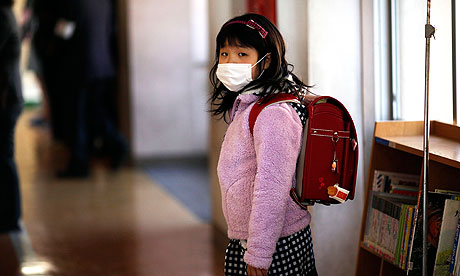
The Guardian reports that Japanese authorities have relaxed their radiation standards (by a factor of 20) in order to allow Fukushima students to go back to school - Fukushima parents dish the dirt in protest over radiation levels. Presumably biology classes will feature 3 eyed fish...
Furious parents in Fukushima have delivered a bag of radioactive playground earth to education officials in protest at moves to weaken nuclear safety standards in schools.
Children can now be exposed to 20 times more radiation than was previously permissible. The new regulations have prompted outcry. A senior adviser resigned and the prime minister, Naoto Kan, was criticised by politicians from his own party.
Ministers have defended the increase in the acceptable safety level from 1 to 20 millisieverts per year as a necessary measure to guarantee the education of hundreds of thousands of children in Fukushima prefecture, location of the nuclear plant that suffered a partial meltdown and several explosions after the earthquake and tsunami on 11 March.
It is estimated that 75% of Fukushima's schools may have radiation levels above the old safety level of 1 millisievert. The local authorities in Koriyama have tried to ease the problem by digging up the top layer of soil in school and day centre playgrounds, but residents near the proposed dump site have objected.
The new standard of 20 millisieverts a year – equivalent to the annual maximum dose for German nuclear workers – will mean those schools remain open, but parents and nuclear opponents are angry that safety concerns are being ignored.
Bloomberg has an update on the Fukushima nuclear disaster - Radiation Readings in Fukushima Reactor Rise to Highest Since Crisis Began. Weirdly this story has changed since it was first published, which initially claimed radiation readings had fallen to zero - http://www.bloomberg.com/news/2011-04-27/tokyo-water-radiation-falls-to-zero-for-first-time-since-crisis.html.
Radiation readings at Japan’s Fukushima Dai-Ichi station rose to the highest since an earthquake and tsunami knocked out cooling systems, impeding efforts to contain the worst nuclear crisis since Chernobyl.
Two robots sent into the reactor No. 1 building at the plant yesterday took readings as high as 1,120 millisierverts of radiation per hour, Junichi Matsumoto, a general manager at Tokyo Electric Power Co., said today. That’s more than four times the annual dose permitted to nuclear workers at the stricken plant.
Radiation from the station, where four of six reactors have been damaged by explosions, has forced the evacuation of tens of thousands of people and contaminated farmland and drinking water. A plan to flood the containment vessel of reactor No. 1 with more water to speed up emergency cooling efforts announced yesterday by the utility known as Tepco may not be possible now.
“Tepco must figure out the source of high radiation,” said Hironobu Unesaki, a nuclear engineering professor at Kyoto University. “If it’s from contaminated water leaking from inside the reactor, Tepco’s so-called water tomb may be jeopardized because flooding the containment vessel will result in more radiation in the building.”
An official at Tokyo Electric Power Co., the operator of the crippled Fukushima Daiichi nuclear power plant, admitted Wednesday that fuel of the plant's No. 1 reactor could be melting.
In Japan, Tokyo Electric Power Co. workers have begun "the unprecedented and potentially risky measure" of flooding the containment vessels of three troubled Fukushima nuclear reactors with water. The Asahi Shimbun reports that this is the first known attempt ever in the world to saturate an entire containment vessel with water in order to cool the pressure vessels inside, and in turn, cool the reactor cores within.
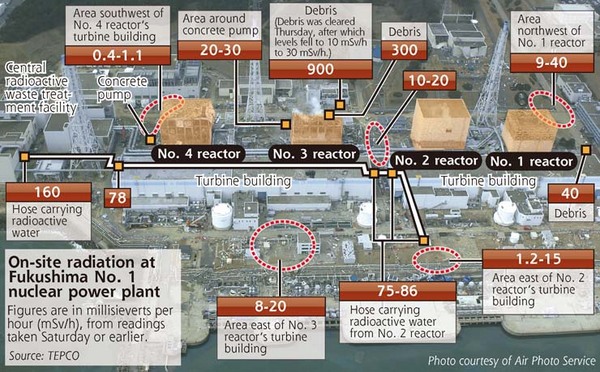
In related news, TEPCO has released to the public for the first time a map of the Fukushima No. 1 nuclear power plant detailing radiation levels throughout the site.
It's early morning on April 26 in Kiev, Ukraine, where the Chernobyl nuclear disaster happened exactly a quarter century ago. On this day in 1986, reactor number four at the plant exploded, setting off a catastrophe that still reverberates far beyond the 30-kilometer exclusion zone.
Demonstrations are taking place throughout Europe. In Tokyo, anti-TEPCO protests mark the occasion and its parallel to the still-unfolding disaster at Fukushima. The "liquidators" who were sent in to clean up the radioactive mess at Chernobyl back in 1986 received medals Monday from Russian president Dmitry Medvedev, but controversy still surrounds the health impact of the dangerous work they performed. The so-called "sarcophagus" surrounding the disaster site in Kiev is leaking, and world leaders have pledged "to provide $780 million for the construction of a shelter designed to house the toxic remains for another century." But even if and when that new container is finally in place, the radioactive mess will remain active—and hazardous—for many thousands of years more.
Magnum Photos has a disturbing photo collection lookingat the fallout in the years following Chernobyl in Belarus - Chernobyl's Legacy.




 Posts
Posts