"History, it turns out, didn’t end for Big Tech. ...
"Take Alphabet, which took plenty of flak for its control of the search engine market. Dominance, sure. But forever dominance?
"OpenAI’s new AI-enabled Atlas browser directly threatens Google’s Chrome browser, as well as its search business, by replacing the URL bar with conversational AI. What Washington lawyers couldn’t do to Google, technological competition just might. ...
"The cycle endures: IBM begat Wintel, which begat Google—and now OpenAI is queuing up next. These 'forever companies' are discovering that in tech, forever lasts about 20 years, and the bill for staying that long runs to roughly half a trillion bucks a year. ...
"That’s the real lesson. Market power in technology is temporary because the underlying technology isn’t.
"Even if these winners of the past are also the winners in futurity, they will find themselves utterly transformed by the AI revolution as they provide users with new kinds of value."
"The [Government and] Commerce Commission ha[ve] spent two years assembling [their] case [against supermarkets.] Supermarkets, we’re told, hold all the power. The evidence? Mostly grievances. The method? Identify the culprit, then look for supporting facts.
"So, when Foodstuffs released a price comparison of 20 everyday grocery items, suggesting Pak’nSave prices were cheaper than Australia’s (and the UK’s)—after removing GST—Grocery Commissioner Pierre van Heerden had a problem.
"It turns out Australia’s apparently cheaper prices are not so cheap when GST is accounted for. That’s because Australia doesn’t tax grocery food. New Zealand does. Removing GST to compare like with like should be uncontroversial. It’s what every duty-free shopper on earth does.
"But ... the Grocery Commissioner of New Zealand—the [bureaucrat] charged with understanding retail markets—thinks adjusting for tax differences is sneaky. ...
"According to figures published by Foodstuffs ... of every “grocery dollar” [spent] ... supermarkets are responsible for just 19 cents: four cents profit, fifteen for costs like wages, rent, and refrigeration. GST takes the remaining thirteen.
"[The Commissioner's] response? ... Clamp down on the supermarkets and their [four cents profit] for negotiating too hard.
"This is the intellect safeguarding [sic] our $22 billion grocery sector."
Tech billionaires aren't crawling to Trump because they're powerful, argues Johan Norberg in this guest post. It's because they're weak...
The Flattery Towards Trump Reveals Fear
by Johan Norberg
TECH MOGULS AREN'T FLATTERING TRUMP because they're drunk on power, but because they're afraid. The political arbitrariness that began with Biden risks becoming even worse with Trump.
Mark Zuckerberg, Jeff Bezos, and Elon Musk were among the guests at Donald Trump’s inauguration.
At Trump's inauguration, the new president was surrounded by a grinning, applauding Forbes list. Among them were the world’s three richest men, Elon Musk, Jeff Bezos, and Mark Zuckerberg, as well as relatively less wealthy figures like the CEOs of Apple and Google. Sitting in more prominent seats than the incoming cabinet members, it certainly looked like the happy plutocrats had bought themselves a president.
They all donated to the inauguration fund and have, in other ways, signalled an approach. Bezos blocked the Washington Post’s official endorsement of Kamala Harris, and Zuckerberg admitted that Facebook became too woke and now needs to be more Texas.
Is the U.S. on its way to becoming a tech oligarchy? Biden’s speechwriters are among those warning of a tech-industrial complex with so much power that they threaten to disable democracy.
As a liberal, I’m conflicted. The only thing worse than a Trump administration run by big corporations is a Trump administration not run by big corporations. Since their position isn’t built on charming inflamed MAGA fans, but on solving technical and business problems in a global economy, they will exert a moderating influence. When Trump wants to imprison opponents, stop global trade, deport all migrants, or invade Greenland, they will try to get him to count to ten (though I no longer dare rule out anything regarding Musk).
Tesla’s 15% stock increase after Trump’s victory shows that someone's proximity to power is disturbingly valuable.
On the other hand, it’s impossible not to feel deep concern when the most powerful state and the largest capital are in the same boat. Tesla’s 15% stock increase after Trump’s victory shows that someone's proximity to power is disturbingly valuable. When I recently interviewed Musk, he said the state should act as a referee but not interfere in the game, which was wise. But it doesn't get better when a player wants to play referee.
Money doesn't buy elections—after all, Harris had more than the eventual victor—but it can buy influence with its recipients. Especially with someone as notoriously "transactional" (we used to say unprincipled) as Donald Trump. Just a year ago, Trump wanted electric car supporters to "rot in hell." Today, he is pro-electric cars, “I have to be because Elon endorsed me very strongly.”
But unsuitability is not the same as oligarchy. In fact, tech companies haven't assumed this role because they're so strong, but because they're so weak.
THIS IS MISSED IF YOU simply follow stock prices, but the big change in recent years is that Big Tech has gone from being everyone’s hero to everyone’s villain. After Trump’s 2016 victory, previously friendly Democrats started seeing social media as sewers of disinformation and demanded strict content control. The Biden administration also launched potentially devastating antitrust proceedings.
And no matter what they do, someone takes a swipe at them. When platforms became cosily progressive and moderated more content (even stories that turned out to be true), the right started seeing them as leftist censorship machines. Republicans like J.D. Vance and Josh Hawley demanded regulation and breakups. Trump threatened fines and monopoly laws to crush Amazon and Google. With few watertight principles for such power exercises, there are real risks of political arbitrariness. During the election campaign, Trump threatened to imprison Zuckerberg for life.
Tech giants suddenly realised they had lost all political allies.
This is especially dire as they simultaneously face existential risks in key foreign markets. Regulation-happy EU threatens their business models. Many were also shocked last year when Brazil's Supreme Court responded to Musk's refusal to block a series of X accounts by shutting down the entire platform and freezing Starlink’s assets—a completely different company with other stakeholders.
If Big Tech wants a chance in international battles over antitrust, censorship, and taxation, they need the U.S. on their side. Zuckerberg explicitly stated this in his recent repentance speech. The world wants to censor us, and “the only way we can counteract this global trend is with support from the American government.”
This isn't about people who love Trump. Except for Musk, none of the major players supported him before his victory. On the contrary, they’ve long fought against him but lost and are now pleading for mercy—and protection. Musk’s new role made it even more important to be there as a counterbalance to him since he's a tenacious critic who, among other things, has said that Amazon is a monopoly that needs to be broken up. Contrary to the notion of a homogeneous flock of bros, these men are jealous rivals vying for each other’s market shares. And suddenly a new Chinese AI model comes along that threatens all their inflated valuations.
So, the tech moguls aren't flattering Trump because they’re power-drunk, but because they’re scared. Bezos doesn’t humiliate himself with an ingratiating Amazon Prime documentary about Melania Trump because he can do whatever he wants, but because he can't.
The sad spectacle of the past few weeks has many calling for a mightier state to put the plutocrats in their place. On the contrary, I feel an urgent need for a few more independent billionaires who aren’t subject to such political arbitrariness that they constantly anxiously follow political trends.
* * * *
Johan Norberg is a Swedish author and historian of ideas, devoted to promoting human progress, economic globalisation and classical liberal ideas.
This post is translated from Blacksmith, where it first appeared.
"Many people distrust Big Business: Big Tech, Big Pharma. Big Oil, even Big Grocers – any large corporations. They believe these companies have grown big by exploitation and coercion that they are able to perpetuate due their sheer size. Therefore, these people think the government should control these companies’ size to ensure 'fair competition' and to prevent monopolies. [The reaction to the recent discussions about supermarket 'monopolies' is an example] .... [C]ommentators relish the prospect that using (non-objective) ... laws, the government could cut [supermarket chains] to size ... "Those distrustful of Big Business fear that large corporations grow too 'powerful” and therefore can coerce and control us to do business with them, to buy their products and services, and to prevent us from competing with them. However, that fear is misplaced. Corporations, small or large, in free and semi-free countries (absent government intervention) don’t have the power to coerce. They cannot prevent anyone from acting or to force them to act against their will. "As Ayn Rand has observed, the only power business has is economic power: the power to produce and trade, which depends on its ability to obtain the voluntary co-operation of others through persuasion. ... Only the government possesses political power: the power to use physical force, or the threat of it, to restrain and punish those who initiate it. "The failure to distinguish between economic power and political power leads people to believe that large corporations have grown through coercion. ... "[A]bsent government favours and protectionism, companies grow large because they act morally. It means that they are productive: they continually develop and produce [and sell] goods and services that customers value. ... Only with the government’s help – protectionism and cronyism [and the RMA] – could [supermarket chains] coerce: to prevent competition from entering its markets, charge artificially high prices, sell subpar products, and to provide lousy customer service. ... "Instead of condemning Big Business, we should appreciate large corporations for producing the material values we need and want. "But we should condemn the government for initiating force to interfere in markets."
UPDATE: Why is there a "cosy duopoly" of Big Grocers here in New Zealand? Simple: the bureaucratic costs for new competitors to enter our distant market are too damn high, making a significant barrier to entry. (Call it bureaucratic drag.) Eric Crampton excerpts
" 'What we've been told by these players is when they come and they want to open up a large store in New Zealand, the cost to get a spade in the ground is double that of Australia,” he says in a new episode of the Of Interest podcast.
" 'Now that is significant. And when they look at 'do we open up a store in Wagga Wagga or Tamworth or wherever in Australia' versus coming to open up in Auckland where there is massive demand or any of the other centres, really, the cost is double that of Australia. And the timeframe often is more than double as well. So when they do their business cases, they look at that and say, 'well, we're going to be better off by going elsewhere rather than here.' Now the government is saying that they're going to change things to make New Zealand more competitive for international players. And that's really what we're looking at.' "The Commerce Commission released its first annual grocery report on Wednesday which revealed ComCom’s efforts to boost grocery competition over the past year hasn’t had much impact'."
Later in the podcast, he says that Costco would already have expanded to more places in NZ if expanding in NZ weren't so freaking hard. It shouldn't be surprising that the grocery regulator hasn't chalked any wins as yet. The real problem is largely out of the regulator's hands: RMA, Overseas Investment Act, Council processes.
The emphasis there is mine. Eric's post has more detail on council clusterfucks.
The ill-named Commerce Commission (whose oxymoronic* job it is to hobble the market so as to somehow make it freer) has been considering how best to hobble supermarkets to (somehow) deliver lower prices. Everything they are considering will do the opposite.
Under present consideration from a commission consultant is a gold-plated proposal to force the two major supermarket owners to "divest" themselves of their stores in any region in which their market share exceeds 27%.
What would be the effect of such a thing, aside form the loss of market freedom? Simple:
banning them from going past some market share threshold tells them, when at the threshold, to stop competing. That doesn't seem like any kind of good idea.
The Commerce Commission is full of such non-good ideas, as are the consultants they favour -- most of like men with a hammer looking for a nail on which to use it, while blind to the fact that nails are not even needed (and are anti-productive). Not that they care. They're mighty happy trying to work out how best to build bigger regulatory barriers so that the two major supermarket owners will be coerced into lowering their prices; they don't want to be told that the real solution would be to remove all the barriers to new entrants so that there are more than two major supermarket owners.
But that might do some of the hammer-throwers out of their make-believe jobs.
* The Commerce Commission clearly has zero problem with the concentration of power represented by govt departments like itself, only that the productive might have it instead of themselves.
"[These] IT giants are household names. They haven’t just transformed their own industries; they’ve transformed life itself. When I crave knowledge, I Google. When I seek consumer products, I Amazon. When I socialise, I Facebook. When I market my ideas, I Twitter. Hundreds of millions of customers around the world can say the same. If you’d described my future back in 1993, I would have laughed at your optimism… and I’m a confirmed optimist!
"What would have seemed most absurd to me back in 1993, however, is that all of these companies provide tons of free services. I’ve never paid a dime to Google, Facebook, or Twitter. Even Amazon hands out tons of freebies... "Given all this, you might expect these giants of the internet age to be popular, admired, even loved. Instead, they’re drowning in resentment. How often does a pundit or politician give a speech thanking them for their astounding work? Virtually never. Instead, we live in a world where punditsbemoanthemarketleaders‘ allegedfailures – and politicians casually threaten to regulate them – or even treat them like public utilities.
"You could remind me that, 'Actions speak louder than words.' People who contently use Google, Facebook, Twitter, and Amazon far outnumber the complainers. This is a fine observation – if you want expose the pettiness and myopia of the critics. 'If company X is so bad, why do they have hundreds of millions of repeat customers?' is not a decisive response to complaints, but it is a mighty response nonetheless. "So who cares what the naysayers say? Sadly, every satisfied customer of these great companies should care, because in politics, words speak louder than actions. Pundits and politicians seek fame and power by saying and doing what sounds good, even when the consequences are awful."
Here’s a post from February that is relevant again today in the wake of the Commerce Communist Commission’s prohibition of the Fairfax/NZME merger. ACT’s David Seymour calls the Commission a dinosaur, suggesting it had its day once. It’s more like a dangerous man-made virus that should never have been released into the wild at all.
So Vodafone and Sky want to merge with each other. And so do Fairfax and NZME. But the Commerce Commission has ruled the former two may not, and has now declared the latter two must not.
Who is this Communist Commission when it’s at home, and what gives it the right to tell shareholders of major businesses what they should do with their property? I went to their website to find out:
The Commerce Commission [they say] enforces legislation that promotes competition in New Zealand markets and prohibits misleading and deceptive conduct by traders. The Commission also enforces a number of pieces of legislation specific to the telecommunications, dairy and electricity industries. In ensuring compliance with the legislation it enforces, the Commission undertakes investigation and where appropriate takes court action; considers applications for authorisation in relation to anti-competitive behaviour and mergers; and makes regulatory decisions relating to access to telecommunications networks and assessing compliance with performance thresholds by electricity lines businesses.
So we have a monopoly that allegedly fights monopolies, a Quango that allegedly “promotes competition”; as if it were possible for bureaucracy to do that, or a bureaucrat to even fathom what competition looks like and how it works in the real world – as if “competition” itself were a primary, and not the result of the freedom of free people to do deals and make contracts with each other which are the job of governments to enforce.
That enforcement is the real job of government here. Instead, we have a quango enforcing what for them is a floating abstraction –so-called pure and perfect competition – a thing never seen alive in the wild -- so no wonder they can frequently be seen, for example, “enforcing” competition by prosecuting for “price gouging” when prices are too high, for “predatory pricing” when they’re too low, and for collusion when they’re the same. Such is the nature of bureaucratic enforcement of something they know nothing about. Yet due to their random decision-making all business activity becomes less certain, so by that amount already decreasing the range of options open to consumers – and so making monopolies even more likely, not less.
They are morons given power by idiots.
The idiocy leads to more idiocy. The Communist Commission's draft decision to discourage (in February) and now ban altogther the Fairfax NZME merger on the basis it creates a monopoly saw analysts tell Fairfax that if it doesn’t merge then it must withdraw from NZ, which would of course create the same alleged monopoly over which the Commission is this week wringing its hands. (I say alleged monopoly because the Commission ignores all the other national and international news sources by which New Zealanders may acquire their news now and in the future, many far superior to the superficial offerings of these two fat-headed giants.)
Meanwhile the Commissars’ determination that that Vodafone and Sky must not merge leaves shareholders in both already poorer, and consumers less able to access the sport the Commissars have decided is a human right -- and gives existing telcos less competition than would have otherwise been the case, the very reason some of these non-competitive vultures are crowing today: because they can now safely put their prices up.
We should prosecute the Commissars themselves for false advertising:
They say they act to prevent monopoly, but their actions often encourage it;
They say they act to prevent monopoly, yet fail to break up government monopolies or (where they would face the same capital costs as their competitors) to call for their divestiture;
They say they enforce competition, yet they fail to recommend the abolition of legislation (such as the RMA, the OSHA, corporate taxes etc.) that helps prevent small companies being able to compete with big companies;
They say they enforce competition, yet in telecommunications especially they penalise the most competitive company and keep less competitive companies alive;
They allege to have consumers’ interests at heart, yet they delay mergers from which operational synergies can be gained -- thereby raising costs, lowering wages and profits, and thus further reducing capital accumulation and real wages; and
They allege to have consumers’ interests at heart, yet their months-long meddling raises investment uncertainty and thus capital costs and hurdles to new investment, so that new services that might benefit consumers are still born, never to see the light of day – and older services, that might have merged in a way that makes them compeittive again, are prohibited from simply trying to stay alive.
Quite simply, they are the legislative manifestation of the tall-poppy-syndrome - they attack any big private business and do nothing meaningful to the protected positions of bloated, wasteful, bullying government organisations just like themselves.
They are not a dinosaur, as David Seymour suggests, they are a dangerous man-made virus that should never have been introduced into the wild.
The idea that a bureaucrat could command competition sounds like it would be a product of a central planning mindset, yet the Communist Commission was not even a product of Muldoon’s command economy – it was a creation of Roger Douglas, a product of the flawed floating abstraction of 'pure and perfect competition' held by the Chicago economics he espoused, a floating, 'Platonic,' idea of competition bearing so little relation to the real world that it needs a bureaucracy with government power to try unsuccessfully to make it happen, damaging all and sundry in the process.
They should prosecute themselves as a predatory monopoly.
So Vodafone and Sky want to merge with each other. And so do Fairfax and NZME. But the Commerce Commission has ruled the former two may not, and has already declared the latter two should not.
Who is this Communist Commission when it’s at home, and what gives it the right to tell shareholders of major businesses what they should do with their property? I went to their website to find out:
The Commerce Commission [they say] enforces legislation that promotes competition in New Zealand markets and prohibits misleading and deceptive conduct by traders. The Commission also enforces a number of pieces of legislation specific to the telecommunications, dairy and electricity industries. In ensuring compliance with the legislation it enforces, the Commission undertakes investigation and where appropriate takes court action; considers applications for authorisation in relation to anti-competitive behaviour and mergers; and makes regulatory decisions relating to access to telecommunications networks and assessing compliance with performance thresholds by electricity lines businesses.
So we have a Quango that allegedly “promotes competition,” as if it were possible for bureaucracy to do that, or a bureaucrat to understand it – -- as if “competition” itself were a primary (“enforcing” competition frequently meaning prosecuting for price gouging when prices are too high, for predatory pricing when they’re too low, and for collusion when they’re the same). And in their random decision-making all business activity becomes less certain, so by that amount already decreasing the range of options open to consumers.
The idiocy leads to more idiocy. The Communist Commission's draft decision to discourage the Fairfax NZME merger on the basis it creates a monopoly saw analysts tell Fairfax it must withdraw from NZ if it doesn’t merge, creating the same alleged monopoly.
Meanwhile the Commissars’ determination that that Vodafone and Sky must not merge leaves shareholders in both already poorer, and consumers less able to access the sport the Commissars have decided -- and gives existing telcos less competition than would have otherwise been the case, the reason these vultures are crowing today.
We should prosecute the Commissars themselves for false advertising:
They say they act to prevent monopoly but their actions often encourage it;
They say they act to prevent monopoly yet fail to break up government monopolies or call for their divestiture (where they would face the same capital costs as their competitors);
They say they enforce competition yet they fail to recommend the abolition of legislation that prevents small companies being able to compete with big companies (the RMA, the OSHA, corporate taxes);
They say they enforce competition yet in telecommunications especially they penalise the most competitive company and keep less competitive companies alive through advocating corporate pork policies;
They allege to have consumers’ interests at heart yet they delay mergers from which operational synergies can be gained, thereby raising costs, lowering wages and profits and thus further reducing capital accumulation and real wages; and
They allege to have consumers’ interests at heart yet they raise investment uncertainty and thus capital costs and investment hurdle rates, such that new services that might benefit consumers are still born, never to see the light of day.
Quite simply, they are the legislative manifestation of the tall-poppy-syndrome - they attack any big private business and do nothing meaningful to the protected positions of bloated, wasteful, bullying government organisations.
The idea that a bureaucrat could command competition sounds like it would be a product of a central planning mindset, yet the Communist Commission was not even a product of Muldoon’s command economy – it was a creation of Roger Douglas, a product of the flawed floating abstraction of 'pure and perfect competition' held by mainstream economics, a floating, 'Platonic,' idea of competition bearing so little relation to the real world that it needs a bureaucracy with government power to issue decrees trying unsuccessfully to make it happen, damaging all and sundry in the process.
They should prosecute themselves as a predatory monopoly.
Since it’s on my masthead, and since so many (including presidential candidates) confuse capitalism with the regulatory state, here – for all of you – is the news:
Regulation poisons everything, even the thing most people associate with capitalism: competition:
The former mayor of London, who is a keen classical scholar, argues that the past 2,000 years of European history have been characterised by repeated attempts to unify Europe under a single government in order to recover the continent’s lost “golden age” under the Romans. “Napoleon, Hitler, various people tried this out, and it ends tragically,” he says. “The EU is an attempt to do this by different methods. “But fundamentally what is lacking is the eternal problem, which is that there is no underlying loyalty to the idea of Europe. There is no single authority that anybody respects or understands. That is causing this massive democratic void.” Mr Johnson’s potentially inflammatory comparison to Hitler comes at a critical time in the referendum campaign, with senior Tories on either side publicly attacking each other in blunt terms.
So seen in context then, Johnson is not in fact saying what the headline writers report, nor is it at all “inflammatory” to point out that unifying Europe politically has been tried and failed before.
His main point, overlooked in the screaming headlines, is “that there is no underlying loyalty to the idea of Europe” whose strength has always been not in its centralisation, but its opposite. The point is echoed by Louis Rouanet below in today’s guest post.
The European Union is Anti-European Guest post by Louis Rouanet
What is Europe? It seems that no rigorous answer can be provided. Europe is not exactly a continent. It is not a political entity. It is not a united people. The best definition, in fact, may be that Europe is the outcome of a long historical process that engendered unique institutions and a unique vision of what men ought to be. The idea that men ought to be free from violent government interference. Europe has no founding fathers. Its birth was not orchestrated but completely spontaneous. Its development was not imposed by armies and governments but was the voluntary product of clerics, merchants, serfs, and intellectuals who were seeking to interact freely with each other. Europeans were united by their freedoms and divided by their governments. In other words, Europe was builtagainst States and their arbitrary restrictions, not by them.
After the fall of the Roman Empire a period of political anarchy followed where cities, aristocrats, kings, and the church all competed with each other. Therefore, as Dr. Ralph Raico noted in his article “The European Miracle,”
Although geographical factors played a role, the key to western development is to be found in the fact that, while Europe constituted a single civilisation — Latin Christendom [born out of Greco-Roman paganism] — it was at the same time radically decentralised. In contrast to other cultures — especially China, India, and the Islamic world — Europe comprised a system of divided and, hence, competing powers and jurisdictions.
In other words, over the centuries, a long evolution of the institutions gave birth to personal liberty. Although the European aristocracies and states were restricting freedom, they were forced to grant more autonomy to their subjects, for, if they did not, people were opting out by migrating or using black markets. As Leonard Liggio puts it, after 1000 A.D.:
While bound by the chains of the Peace and Truce of God from looting the people, the uncountable manors and baronies meant uncounted competing jurisdictions in close proximity. ... This polycentric system created a check on politicians; the artisan or merchant could move down the road to another jurisdiction if taxes or regulation were imposed.
Europe was where the road to freedom began. It was in Europe that the values of individualism, liberalism, and autonomy rose from history and gave humanity a sense of progress that no civilisation had ever experienced to such an extent before. Unfortunately, the values and institutions that made Europe great vanished under the pressures of political centralisation, nationalism, statism, socialism, and fascism in the nineteenth and twentieth centuries. Today, however, a new danger looms over Europe — the European Union.
The European Institutions Against the Free Market
Contrary to what is often said, the European Union has nothing to do with peace, freedom, free trade, free capital and migration movement, cooperation, or stability. All this can very well be provided in a decentralised system. The European Union is nothing more than a cartel of governments that tries to gain power by harmonising the fiscal and regulatory legislation in every member State. Article 99 of the Treaty of Rome (1957) clearly states that indirect taxation “can be harmonised in the interest of the Common Market” by the European Commission. As for Article 101 of the same Treaty, it explicitly restrains regulatory competition “where the Commission finds that a disparity existing between the legislative or administrative provisions of the Member States distorts the conditions of competition in the Common Market.”
Since the very beginning, with the creation of the European Coal and Steel Community (ECSC) in 1951, the European institutions were more planning agencies than anything else. Indeed, the coal and steel industries at the time were mostly nationalised, and the goal of the ECSC was not to liberalise activity but to coordinate governments’ activities in these two sectors.
This fact, that the ECSC was not about free trade but about government planning, was known by everybody at the time. It was Robert Schuman, the French minister of foreign affairs, who proposed in his declaration of 9 May 1950, that the Franco-German coal and steel production be placed under a common High Authority within the framework of an organisation in which other European countries could participate. Also, the ECSC created for the first time European anti-trust legislation, which as Austrian economists [and Objectivists] understand, is nothing less than government planning in the name of an erroneous vision of what competition is. Even the Treaty of Rome (1957), the basis of the EU as we know it, despite enacting the free movement of goods, capital, and persons, remains a highly statist treaty. Indeed, it is often forgotten that among other things, the Treaty of Rome created a “European Investment Bank,” a “European Social Fund,” the highly protectionist creator of butter mountains and subsidised empty farmlands: the “Common Agricultural Policy,” the “common transport policy,” and reinforced European anti-trust legislation. Therefore, if in the short and medium run, the Treaty of Rome, by breaking the neck of protectionism, was a boon for the European economy, it created institutions that could and did expand their regulatory power in the future.
Many free marketers support the European Union on the ground that even if their regulations are bad, they are still far better than those produced by our very prolific national governments. Such a line of argument, often used in more socialist countries such as France, is sheer nonsense. It is the equivalent of saying: “I don’t mind being robbed twice because the second thief will be much nicer to me.” The question is not how to make “better” regulations but how to expand free trade.
Europeanism: True and False
In 1946, F.A. Hayek wrote a pathbreaking article named “Individualism: True and False” in whichhe distinguished two different individualist intellectual traditions. One, as Hayek calls it, is “true individualism,” based on evolutionism, the idea that institutions and individuals’ behaviors are not planned consciously but are rather the result of a spontaneous process. True individualism follows the tradition of the Scottish Enlightenment. It is “bottom up.” False individualism, on the contrary, is based on extreme rationalism and solipsism. False individualism is based on the idea that society, freedom, and markets, can be planned and should be planned. This false individualism is the heir of the 1789 and — even more clearly — of the 1793 French Revolutionaries. It is imposed, or attempted to, from the top down.
These two sorts of individualism are today at the root of two different sorts of Europeanism.
True Europeanism admits that most of what made Europe was not planned but rather spontaneous. The implications are that we ought to have as much decentralisation as possible for Europe to continue to strive and to safeguard human liberties. False Europeanism on the other hand thinks that Europe can only truly become Europe if planning exists by virtue of common political institutions.
False Europeanists believe that the only alternative is between Nation States and the European Union. Their defense of a centralised European political entity is based on the erroneous idea that society, law, markets, prosperity, and the “European spirit” ought to be designed by rulers – that political centralisation is positively linked to the process of civilisation itself. Europe during the Middle Ages, those thinkers say, lacked trade integration because it lacked political unification. It follows that we must be grateful today for the existence of the European Union. In their narrative, economic progress took place only when “Europe” slowly began to develop new trading alliances that combined some aspects of military protection with something akin to a free-trade area. But this version of history is very far from the truth. In the Middle Ages for instance, the lex mercatoria, the law of merchants, was purely private. Furthermore, the protective tariffs were mostly ignored anyway by Europeans. Smuggling was so widespread that England in the late Middle Ages for example should be in fact considered not as a nation of merchants but a nation of smugglers. As Murray Rothbard noted in Conceived in Liberty:
Too many historians have fallen under the spell of the interpretation of the late nineteenth-century German economic historians (for example, Schmoller, Bucher, Ehrenberg): that the development of a strong centralised nation-state was requisite to the development of capitalism in the early modern period. Not only is this thesis refuted by the flourishing of commercial capitalism in the Middle Ages in the local and non-centralised cities of northern Italy, the Hanseatic League, and the fairs of Champagne. … It is also refuted by the outstanding growth of the capitalist economy in free, localized Antwerp and Holland in the sixteenth and seventeenth centuries. Thus the Dutch came to outstrip the rest of Europe while retaining medieval local autonomy and eschewing state-building, mercantilism, government participation in enterprise — and aggressive war.
Thus, the idea that a centralised authority, in our case the European Union, is necessary for free trade is pure fantasy, It is false Europeanism. Its constructivist approach has prevailed in European institutions since the beginning. For example, one of the goals advanced by the Treaty of Rome was to “create markets” through a unified European Anti-trust legislation. Similarly, the official justification of the Common Agricultural Policy introduced in 1962 was to create a unified agricultural market. But markets do not need States or treaties to exist and they certainly do not need the European Union.
The parallel between false Europeanism and false individualism is also relevant when it comes to their respective imperialistic tendencies. Whereas the French revolutionaries wanted to invade Europe to impose their “universal values” through force, the European Union does not tolerate, in the name of Europe, independent States that do not want to submit to Brussels. Switzerland, for instance, is forced by the European Union to adopt countless regulations concerning food safety and gun ownership. If the Swiss confederation does not comply with many provisions of European law, the European Union threatens to cut off Switzerland’s access to the single market.
The most incredible political success of the European Union zealots is their constant shaming of those who refuse to submit to a European hegemonic super-State. But we must understand that only so-called “Euro sceptics” can truly be pro-Europe. Only “Euro sceptics” can be loyal toward the history and liberal values of their continent. In other words, the European Union itself is a highly anti-European institution.
We Need Decentralisation
On June 28, 2016, the British will vote on whether they want to stay in the EU or not.
If the NO vote wins, it might be the end of the European Union as we know it. Historically, Britain played a major role in the maintenance of a fairly decentralised European order. Whether it was with Napoleonic France, or the German 2nd Reich, or Nazi Germany, it has always been Britain that ultimately helped to break up the hegemonic endeavours of empires on continental Europe. The question is, then, will Britain play its historical role this summer against the imperialistic European Union?
We should consider any attempt to establish a more decentralised system with more competition between States as a boon for Europe and the Europeans. To be sure, the Nation-States must be dismantled, but not if it means the creation of an even bigger European Leviathan. It is, on the contrary, the regionalists and independence movements that must be supported, whether it is Scotland, Catalonia, or Corsica. The European miracle can be revived only through extreme political decentralisation. What history teaches us is that Europe is greater than the individuals that compose it only insofar as it respects liberty. Insofar as it is controlled or directed by a monolithic and central political authority or by bellicose Nation-States, Europe is limited by the inability of Europeans to escape the arbitrary restrictions of their governments.
Louis Rouanet is a student at Sciences Po Paris (Institute of Political Studies) where he studies economics and political science. His post first appeared at the Mises Daily. [Image source: Peter Kurdulija https://www.flickr.com/photos/peter_from_wellington/]
This guest post by Frank Shostak explains that Nobel Prize-winning economist Jean Tirole comes from that school of economists who consider when reality doesn’t fit their faulty models of the economic system, they demand laws written to change the reality.
Frenchman Jean Tirole of the University of Toulouse won the 2014 Nobel Prize in Economic Sciences for devising methods to improve regulation of industries dominated by a few large firms. According to Tirole, large firms undermine the efficient functioning of the market economy by being able to influence the prices and the quantity of products.
Consequently, in the game according to Tirole, the well-being of individuals in the economy is undermined.
On this way of thinking the alleged inefficiency emerges as a result of the deviation from the “ideal state” of the market as depicted by mainstream economics’ idealised model of“perfect competition.”
The “Perfect Competition” Model
In the idealised world of “perfect competition” so idolised by the mainstream, a market is characterised by the following features:
There are a perfectly infinite number of buyers and sellers in the market (or, at least, so many that none can affect outcomes)
Products traded are all homogeneous – that is, they are all perfectly alike
Buyers and sellers are all perfectly informed
Obstacles or barriers to enter the market are all perfectly non-existent.
This describes an economic system that never was, ignoring everything that makes economics an actual system.
“The so-called improved competitiveness resulting from currency depreciation in fact amounts to economic impoverishment. The "improved competitiveness" means that the citizens of a country are now getting fewer real imports for a given amount of real exports. While the country is getting rich in terms of foreign currency, it is getting poor in terms of real wealth — i.e., in terms of the goods and services required for maintaining people's lives and well-being.” - Frank Shostak, ‘Will Currency Devaluation Fix the Eurozone?’
“[F]lexible exchange rates preclude an efficient allocation of resources on an international level, as they immediately hinder and distort real flows of consumption and investment. Moreover, they make it inevitable t hat the necessary real downward adjustments in costs take place…in a chaotic environment of competitive devaluations, credit expansion, and inflation… “I do not believe we shall regain a system of international stability without returning to a system of fixed exchange rates, which imposes on the national central banks the restraint essential for successfully resisting the pressure of the advocates of inflation in their countries — usually including ministers of finance.” - F.A. Hayek, quoted in ‘An Austrian Defense of the Euro’ by Jesus Huerta de Soto -
Anyone promoting or considering the merits of so-called public-private partnerships (PPPs)– a collusion between public force and private profits that is simply an invitation to cronyism, corruption and worse – should examine the tainted history of American railroading in the Gilded Age. Why? Because it’s precisely what PPPs will produce again today. In 1962 Ayn Rand gave a lecture titled “America’s Persecuted Minority: Big Business” in which she identified two types of businessmen, later called “economic and political businessmen,”—the first were self-made men who earned their wealth through hard work and free trade, and the second were men with political connections who made their fortunes through special privileges from government. It is the second type, the moochers, that public-private partnerships encourage, as this short case-study by Ryan W. McMaken of classic Gilded-Age cronyism helps demonstrate…
The latter can only figure as “growth” if the way you measure growth is based on consumption rather than production, which is exactly what so-called Gross Domestic Product measures – measuring spending on retail goods or by government (which is all consumption spending) as production, but ignoring most of the production that makes this spending possible.
It’s like judging a rock star’s success not by how many great records he’s produced and sold, but by how many lines of coke he puts up his nose.
This is not just nonsense, it’s dangerous nonsense.
Mark Skousen is one of the few economists clear-eyed enough to understand this, and for years has been arguing that production figures should measure all production – not just beer sales to consumers, for example, but all the hops, barley, malted barley and yeast production that go into beer, not to mention the packaging, warehousing and transporting of the stuff around the country.
And it looks like Skousen will finally be rewarded, in the US at least, because as he writes …
Starting in spring 2014, the Bureau of Economic Analysis will release a breakthrough new economic statistic on a quarterly basis. It’s called Gross Output, a measure of total sales volume at all stages of production. GO is almost twice the size of GDP, the standard yardstick for measuring final goods and services produced in a year. This is the first new economic aggregate since Gross Domestic Product (GDP) was introduced over fifty years ago. It’s about time. Starting with my work The Structure of Production in 1990 [highly recommended, by the way] and Economics on Trial in 1991, I have made the case that we needed a new statistic beyond GDP that measures spending throughout the entire production process, not just final output. GO is a move in that direction – a personal triumph 25 years in the making.
This might sound trivial, but it’s really big news because, while Gross Output is still not perfect, it is “a better indicator of the business cycle, and most consistent with economic growth theory” than so called Gross Domestic Production – which we could more accurately call Net Domestic Consumption. Or in Skousen’s words:
GO is a measure of the “make” economy, while GDP represents the “use” economy… I believe that Gross Output fills in a big piece of the macroeconomic puzzle. It establishes the proper balance between production and consumption, between the “make” and the “use” economy, and it is more consistent with growth theory.
Most importantly, measuring the “make” economy tells us much more about what happens when things go wrong – and tells us much earlier when they might be heading that way. In other words, it offers more enlightenment for those who try to avoid economic disasters, and fewer excuses for those who cause and prolong them.
In short, by focusing only on final output, GDP underestimates the money spent and economic activity generated at earlier stages in the production process. It’s as though the manufacturers and shippers and designers aren’t fully acknowledged in their contribution to overall growth or decline.
Gross Output exposes these misconceptions. In my own research, I’ve discovered many benefits of GO statistics. First, Gross Output provides a more accurate picture of what drives the economy. Using GO as a more comprehensive measure of economic activity, spending by consumers turns out to represent around 40% of total yearly sales, not 70% as commonly reported. Spending by business (private investment plus intermediate inputs) is substantially bigger, representing over 50% of economic activity. That’s more consistent with economic growth theory, which emphasizes productive saving and investment in technology on the producer side as the drivers of economic growth. Consumer spending is largely the effect, not the cause, of prosperity.
Second, GO is significantly more sensitive to the business cycle. During the 2008-09 Great Recession, nominal GDP fell only 2% (due largely to countercyclical increases in government), but GO collapsed by over 7%, and intermediate inputs by 10%. Since 2009, nominal GDP has increased 3-4% a year, but GO has climbed more than 5% a year. GO acts like the end of a waving fan. (See chart at right.) … In my own research [says Skousen], I find it interesting that GO and GDE are far more volatile than GDP during the business cycle. As noted in the chart above, sales/revenues rise faster than GDP during an expansion, and collapse during a contraction (wholesale trade fell 20% in 2009; retail trade dropped over 7%). Economists need to explore the meaning of this cyclical behaviour in order to make accurate forecasts and policy recommendations… In conclusion, GO or GDE should be the starting point for measuring aggregate spending in the economy, as it measures both the “make” economy (intermediate production), and the “use” economy (final output). It complements GDP and can easily be incorporated in standard national income accounting and macroeconomic analysis.
Let’s hope some forward-thinking soul in the NZ Treasury or elsewhere takes up the initiative here.
Just as the economic bust we’re now enduring is the inevitable flipside of the earlier (credit-induced) boom, so too is Cyprus-style bank theft the inevitable flipside of the debts built up by governments during and after the credit boom--inevitable because, as their spending continues to increase even while the bust refuses to go away, governments are increasingly desperate to find money (by any means necessary!) with which to pay back that debt.
Both bust and theft are inevitable results of the earlier boom, that illusion of wealth created by the unlimited credit expansion produced by banks licenced to turn debt into currency.
Can we stop this never-ending cycle? Are the boom and bust of the business cycle inevitable? Economist Ludwig Von Mises reckons not. Here’s a quick “twelve-minute” summary of his argument as it appears in the new book The Illusion of Wealth: Ludwig von Mises on the Business Cycle, edited by Robert P. Murphy:
Ludwig von Mises: Real vs. Paper Wealth Ludwig von Mises (1881–1973) is the economic theorist who did more than anyone to sweep away the mystical view that business cycles just happen to us, like bad weather and aging. He brought scientific logic to bear on the problem. He drew on the fields of money, interest, capital theory, and international capital flows to map out a general theory of what causes business cycles, the parameters of how they play out in the real world, and how they might be ended.
With an economy addicted to credit expansion and absurdly low interest rates (not even Mises could have foreseen zero or negative rates!), we all wonder what is real and what is not. The book gives us the tools to make that discerning judgment.
Mises’s general idea is that cycles begin with loose credit provided by a banking system that is protected from facing the economic consequences of unsound lending by the existence of the central bank. The boom turns to bust when the resources to sustain it go missing.
In a market, banks want to lend; they are restrained by risk. Government guarantees encourage risky lending. Artificially low interest rates — always cheered by indebted governments — signal to borrowers that there are more savings in the system than really exist. Business in particular expands production in a way that is unsustainable. This loose money policy creates a boom — the illusion of wealth — that is not justified by economic fundamentals. The correction takes place when the illusion of wealth is revealed in the course of time, kicked off by tightening credit or when the boom times are tested by reality.
In the 1920s and the first half of the 1930s, Mises’s view came to be almost commonplace in the English-speaking world, mentioned and discussed by the mainstream as the top contender. After World War II, the theory ended up being stamped out by the newfound faith in macroeconomic planning, with John Maynard Keynes as its leading profit.
Today, that faith in macroeconomic management is now at another low point, but the baseline assumption that business cycles have a psychological origin is still with us. As Robert Murphy explains in the introduction, the goal of this book is to provide the most coherent possible explanation of the entire theory from its roots to its conclusions.
Mises begins with a discussion of money. It is not neutral to every transaction, affecting all prices in all places the same way. Changes in purchasing power of money are a feature of normal market activity. There is no such thing as perfect stabilization. Prices changes as human valuations change. Money is nothing but a medium of this interpersonal exchange. Prices are objective, but value is subjective, an expression of people’s eagerness to acquire goods and services.
Money makes possible economic calculation. This is the ability to assess and truly measure the economic merit and viability of anything. All the technology, all the discoveries, all the laboratories and manufacturing in the world are useless without the ability to calculate profit and loss. The capacity to calculate and assess the relative merits of various production paths is the key to unlocking every innovation and making it real. Without the ability to calculate, society itself would crash and burn. This is the social function of prices. Nothing can substitute for them (not central planning or engineering or intuition). Prices are building blocks of civilization and require private property and markets for their emergence.
Increasing the amount of money in an economy does nothing to brush away the problem of economic scarcity. Money is merely a tool for calculation. Producing more of it only changes its purchasing power and distorts decision-making. It does nothing to make speculation or entrepreneurship more or less successful.
Appearances to the contrary (“This whole generation is great at investing!”), the seeming prosperity is illusory and indicates a false boom. New money only ends up hiding incompetency and delaying the day that it is revealed. The only vehicle for authentic economic progress is the accumulation of additional capital goods through saving and improvement in technological methods of production.
In a market, entrepreneurs can profit or they can take losses. Errors result in losses and success results in profits. There is, in a market economy, no systematic tendency for one tendency to prevail over others. False prices are checked by competition. Errors are never general and social. They are specific and cleared away when discovered. “The market process is coherent and indivisible,” writes Mises. “It is an indissoluble intertwinement of action and reactions, of moves and countermoves.” But there is no such thing as a general under-consumption in markets, as Keynesians like to believe.
Conventional economic modelling cannot capture the time horizons of millions of capitalist investors and producers. The real-world structure of production includes production plans of one day or 50 years or several generations. What allows coordination between these many plans are markets with free-floating prices and interest rates that respond to real savings and the actual plans of entrepreneurs and capitalists. Interest rates themselves reflect the time horizons of the public. They fall when people save and rise when people prefer consumption over saving. The loan markets reflect these varying plans.
When the central bank lowers rates, it creates “forced saving” — the appearance, but not the reality. Forced saving causes an inflow of resources to capital goods industries, because investors make longer-term plans. It looks like capital expansion. It is really what Mises calls “malinvestment” — meaning bad investment in lines of production that would not otherwise take place.
The reality is that all credit expansion tends toward capital consumption. It falsifies economic calculation. It produces imaginary or only apparent profits. People begin to think they are lucky and start spending and enjoying life. They buy large homes, build new mansions, and patronize the entertainment business. These activities all amount to capital consumption.
Credit expansion also raises wage rates in a way that is not sustainable. Entrepreneurs become addicted to expansion in order to enlarge the scale of their production. This requires ever more infusions of credit. The boom can last only as long as the system expands credit at an ever-increasing pace. When this ends, the plans stop too and business starts selling off inventory, wages fall, and the economy begins to fall into recession. Mises describes this as the collapse of an “airy castle” — something beautiful that has no substance.
Artificial credit expansion doesn’t always produce price inflation. When it does happen, inflationary expectations can cause a general tendency to buy as much as can be bought. That can lead to the crackup of the whole of the economy. At the same time, the effects of inflation can be disguised as rising stock prices or increasing home values. But it always leads to relative impoverishment. It always makes people poorer than they otherwise might be. But Mises specifies something very important here. It doesn’t mean society will revert exactly to the state it was in before the boom. The pace of capitalistic expansion is so great that it has usually outstripped the “synchronous losses” caused by malinvestment and overconsumption.
10 Takeaways
Economic calculation is indispensable to the creation of society and civilization; it is what unlocks and applies all-over knowledge discoveries.
Prices are true and functioning only in a market economy with private property and competitive markets.
Production processes take place over time, with each capitalist forming a different time horizon and configuring plans based on that.
Artificial increases in the money supply, released through the banking system, lower the rate of interest. This is akin to forced savings.
Forced savings accelerate the pace of economic progress and the improvement in technology, but this is unsustainable.
Credit expansion makes some people richer and some people poorer, but it can never raise the standard of living of the whole of society. It causes people overall to be poorer than they would otherwise be.
There is nothing wrong with falling prices. That is the natural state of the market.
The “wavelike movement” of the economy is the unavoidable outcome of the attempt to lower the market rate of interest by means of credit expansion.
All present-day governments are fanatically committed to an easy money policy.
The moral ravages of credit expansion are worse than the economic ones. It creates feelings of envy towards those who receive “first use” of the easy credit, despair and frustration among the victims of the crash, and discourages people who would otherwise be excellent inventors, workers, and investors.
Why does a good theory of the business cycle matter? Understanding the process as it unfolds helps reveal the source of the problem, which is not in our heads or hearts or in some other strange force of history, but more specifically in the government-protected banking cartel. In short, it is not the market that deserves the blame, but the interventions in the market. This theory helps in assessing whether reforms are geared toward fixing the problem or making more problems. For example, further regulation of the monetary and banking systems is not likely to do much toward addressing the underlying cause of the business cycle.
Conclusion Mises’s theory predicts that a society addicted to artificial credit stimulus would probably enjoy unusual amounts of technological progress, but relentlessly declining real income. It would depend on increasing rates of technological improvement, but this would never be enough to raise incomes and prosperity over the long term. Mises was writing before the age of the fiat dollar, but he foresaw precisely what we have today: advances in technology, declines in standards of living, and endless waves of boom and bust with no increases in the capital and savings that make long-term prosperity possible.
Ludwig von Mises (1881–1973) was an Austrian economist who enjoyed enormous fame in Europe before the Great Depression. The rise of the Nazis forced his emigration, first to Geneva in 1934 and then the U.S. in 1940. His first decade in the U.S. was spent as an unemployed writer trying to restart life. He ended up teaching a private seminar at New York University that taught a new generation. Instead of being the last of a great line of economists, he sparked a revival of free-market thought. Today, many hundreds of thousands count themselves among his students and followers.
This summary is part of a new series of 12-Minute Executive Summaries produced for the Laissez Faire Book Club.
Listening to a new report on the just-released American GDP numbers while reading Rothbard’s America’s Great Depression made me realize how relevant and important this work is relative to today’s poorly performing economy. The book briefly summarizes Austrian Business Cycle Theory and applies the theory to the period of the Great Depression from 1929–1933. The book is especially relevant in that it provides policy guidance for dealing with an economic crisis, based on both historical evidence and Austrian Business Cycle Theory. The policy recommendations include actions to avoid, as well as positive actions government could undertake to speed recovery. Unfortunately, the official reaction to the present crisis has been a virtual match to Rothbard’s “don’t do” list, while the few positive actions have been conspicuous by their absence in most mainstream policy discussions. Even more important for future prosperity is the need for monetary reform, the key to preventing future boom-bust cycles and thus avoiding depressions altogether.
Preliminary US GDP numbers for 4th quarter 2012 were just released and, in the words of the Wall Street Journal, indicated that the “[r]ecovery shows a soft spot” with GDP declining 0.1%. As Jeffrey Tucker reports in “The GDP Shock”:
Hardly anyone anticipated this. USA Today and other purportedly reliable venues immediately assured the world that this does not mean recession. Somehow after hanging onto to GDP numbers for three years—recovery is here despite your internal sense that the economy is still in a ditch—now we are told that the GDP figures are really just misleading. Recovery is still here, says the mainstream press.
A one-quarter contraction of economic output doesn’t mean the economy is formally in recession, but it is unusual for such contractions to happen in the middle of economic expansions.
Austrian economists are keenly aware that “GDP figures are really just misleading.” Inclusion of government spending in any measure of economic production or growth is inherently misleading. Business cycles are characterized by greater fluctuations in the capital goods industries relative to consumer goods. Malinvestment during the boom is followed by capital restructuring during the depression/recovery. Maintaining a coordinated structure of production is essential for maintaining a given level of prosperity, and lengthening the structure is a necessary condition for an improvement in the material standard of living. When one fully incorporates capital theory into macroeconomic analysis, it becomes clear that consumption is not the “engine of the economy” (see John Papola’s “Think Consumption Is The ‘Engine’ Of Our Economy? Think Again”in Forbes online, or Mark Skousen’s “Gross Domestic Expenditures (GDE): the Need for a New National Aggregate Statistic”). Per Rothbard (Americas Great Depression, pp. 58–59):
Savings, which go into investment, are therefore just as necessary to sustain the structure of production as consumption. Here we tend to be misled because national income accounting deals solely in net terms. Even “gross national product” is not really gross by any means; only gross durable investment is included, while gross inventory purchases are excluded. It is not true, as the underconsumptionists tend to assume, that capital is invested and then pours forth onto the market in the form of production, its work over and done. On the contrary, to sustain a higher standard of living, the production structure—the capital structure—must be permanently “lengthened.” As more and more capital is added and maintained in civilized economies, more and more funds must be used just to maintain and replace the larger structure. This means higher gross savings, savings that must be sustained and invested in each higher stage of production.
Even though GDP is a highly inaccurate measure of economic activity, and regardless of whether or not one quarter of negative growth in real GDP indicates an economy on the verge of a double-dip recession, the number does provide further evidence of an economy struggling to recover from the depression which followed back-to-back Fed induced boom-bust cycles. This is an economy essentially stagnating since the reported end of the “Great Recession” in June 2009, nearly four years ago.
Mainstream economists have given competing explanations of why this is the worst recovery since the Great Depression. Many Keynesians, including Paul Krugman, have argued the recovery is slow, not because the policy response was wrong, but because it was not big enough. The policy response was strong enough to save the economy from a bigger disaster, but despite an $800 billion fiscal stimulus, deficits of over one trillion dollars leading to a public debt of over $16 trillion, and a tripling of the Fed’s balance sheet, the policy response was still too small. Carmen M. Reinhart and Kenneth Rogoff, also defend the policy response, but in This Time is Different, they argue that recoveries from recessions accompanied by a financial crisis have, based on historical evidence, always been slow compared to recessions not accompanied by financial crisis. While fiscal and monetary stimuli have not generated a speedy recovery, these policies did prevent the crisis from being even worse. According to Rana Foroohar in Time, “The Risks of Reviving a Revived Economy”:
Ironically, the stimulus is also a reason the recovery has been so slow and will continue to be for the next three to five years. Harvard economist Ken Rogoff, who, along with his colleague Carmen Reinhart, has been the best rune reader of the past few years, says that historically during financial crises “to the extent that you act to slow the deep, sharp economic pain, you also slow the recovery.”
Contra Rogoff and Reinhart, Michael Bordo has done some excellent work showing that throughout US economic history, recovery has actually been quicker following financial crises. His work has been used by John B. Taylor to bolster his argument that policy activism and the accompanying policy uncertainty, both monetary and fiscal, have impeded business planning and recovery. Much of the debate can be accessed here. Austrian economists like Robert Higgs and myself, and fellow travelers such as Mary L. G. Theroux, have pushed the uncertainty argument even further to include regime uncertainty as the key element retarding recovery.
However, readers of Rothbard’s America’s Great Depression should not have been surprised that the recent bust was not a sharp depression followed quickly by a return to prosperity and sustainable growth, albeit not necessarily to the levels expected by those fooled by the false expectations created by monetary mismanagement due to malinvestments and wealth destruction during the previous two booms (see Salerno’s “A Reformulation of Austrian Business Cycle Theory in Light of the Financial Crisis,” Ravier’s “Rethinking Capital-Based Macroeconomics,” and most recently Shostak’s “Fed’s policies expose mainstream fallacies”). While the first part of Rothbard’s great book is devoted to explaining the Austrian boom-bust theory of the business cycle, defending the theory from critics, and illustrating its applicability to the events leading up to the 1929 crisis/bust, the second part of the book is devoted to examining governmental interventions and policy errors that retarded recovery and turned a “garden variety recession” into a Great Depression.
Rothbard notes two things of significance for both then and now:
1. “[T]he longer the boom goes on the more wasteful the errors committed, and the longer and more severe will be the necessary depression readjustment” (p. 13). The current boom-bust had its roots in the boom during the late 1990s, which resulted in a bust/recession, recovery from which was aborted by aggressive Fed action beginning in 2003, which added new malinvestments and misdirections of production to the unresolved malinvestments left over from the previous boom (see my article “Hayek and the 21st Century Boom-Bust and Recession-Recovery”).
2. Unemployment, if recovery is not impeded by interventions, will be temporary. Per Rothbard (p. 14):
Since factors must shift from the higher to the lower orders of production, there is inevitable “frictional” unemployment in a depression, but it need not be greater than unemployment attending any other large shift in production. In practice, unemployment will be aggravated by the numerous bankruptcies, and the large errors revealed, but it still need only be temporary. The speedier the adjustment, the more fleeting will the unemployment be. Unemployment will progress beyond the “frictional” stage and become really severe and lasting only if wage rates are kept artificially high and are prevented from falling. If wage rates are kept above the free-market level that clears the demand for and supply of labor, laborers will remain permanently unemployed. The greater the degree of discrepancy, the more severe will the unemployment be.
When the crisis hit in 2007 and 2008, the correct policy would have been the response Rothbard recommended in 1982 in the introduction to the fourth edition (p. xxi) of America’s Great Depression:
The only way out of the current mess is to “slam on the brakes,” to stop the monetary inflation in its tracks. Then, the inevitable recession will be sharp but short and swift[emphasis added], and the free market, allowed its head, will return to a sound recovery in a remarkably brief time.
While, as mentioned above, Rothbard only briefly discusses Austrian Business Cycle Theory (p. xxxviii), “a full elaboration being available in other works,” America’s Great Depression, elaborates on the theory’s implication on government policy: “implications which run flatly counter to prevailing views [both then, 1963, and now].”
What are these implications? First and foremost (p. 19), “don’t interfere with the market’s adjustment process” [emphasis original]. The more government blocks market adjustments, the “longer and more grueling the depression will be, and the more difficult will be the road to complete recovery.” Rothbard argues it is possible to logically list the ways market adjustment could be aborted by government action and such a list would coincide well with the “favorite ‘anti-depression’ arsenal of government policy.” The list almost perfectly matches with policy responses to the crisis during both the Bush (see Thornton’s “Hoover, Bush, and Great Depressions”) and Obama administrations.
Here is Rothbard’s “Don't Do” list (pp. 19–20), with my comments in brackets:
1. Prevent or delay liquidation “Lend money to shaky businesses, call on banks to lend further, etc.” [Done. Tarp, auto bailouts, and the Fed’s mondustrial policy. See recently John B. Taylor in the Wall Street Journal: “The low rates also make it possible for banks to roll over rather than write off bad loans, locking up unproductive assets.”]
2. Inflate further “Further inflation blocks the necessary fall in prices, thus delaying adjustment and prolonging depression. Further credit expansion creates more malinvestments, which, in their turn, will have to be liquidated in some later depression. A government ‘easy money’ policy prevents the market's return to the necessary higher interest rates.” [Done in spades.]
3. Keep wage rates up “Artificial maintenance of wage rates in a depression insures permanent mass unemployment. Furthermore, in a deflation, when prices are falling, keeping the same rate of money wages means that real wage rates have been pushed higher. In the face of falling business demand, this greatly aggravates the unemployment problem.”
4. Keep prices up “Keeping prices above their free-market levels will create unsalable surpluses, and prevent a return to prosperity.” [3 and 4 are both direct results of current Fed actions, including price inflation targets near 2%.]
5 & 6. Stimulate consumption and discourage saving “We have seen that more saving and less consumption would speed recovery; more consumption and less saving aggravate the shortage of saved-capital even further. Government can encourage consumption by ‘food stamp plans’ and relief payments. It can discourage savings and investment by higher taxes, particularly on the wealthy and on corporations and estates. As a matter of fact, any increase of taxes and government spending will discourage saving and investment and stimulate consumption, since government spending is all consumption. Some of the private funds would have been saved and invested; all of the government funds are consumed. Any increase in the relative size of government in the economy, therefore, shifts the societal consumption-investment ratio in favor of consumption, and prolongs the depression.” [The federal government has expanded from a bloated 18–20% of the economy to 23–25% of the economy under the current administration. The Bush fiscal stimulus in 2008 and the majority of the 2009 Obama stimulus supported consumption relative to investment as did the ineffective recently repealed temporary payroll tax cut.]
7. Subsidize unemployment “Any subsidization of unemployment (via unemployment ‘insurance,’ relief, etc.) will prolong unemployment indefinitely, and delay the shift of workers to the fields where jobs are available.” [Does anything need added here?]
Rothbard (p. 21) argued these were “time-honored favorites of government policy” and the last part of America’s Great Depression was devoted to showing how these were the policies adopted in 1929–1933. Current policy has followed the same path. We should not be surprised that the result has been similar, if not as yet quite as tragic. It is still not too late to change paths, but unfortunately such action, while possible is not likely to happen. Neither will the positive actions recommended by Rothbard (p. 22) to speed recovery be undertaken. Reducing the relative role of the government in the economy while reducing taxes, especially those that bear most heavily on saving and investment, are also, as I have argued previously in “Thoughts on Capital-Based Macroeconomics” (Part III),the correct actions to address the debt and size-of-government crisis.
We are again undone by the “Crisis of Authority,” the urge to action, the incorrect, but too often, as explained by Pierre Lemieux, unchallenged belief that Somebody in Charge[1] is a solution to recessions. The correct government depression policy is “Nobody in Charge.” Laissez-faire is thus the untried alternative and the preventative of depression. Sound, free market money is the untried alternative to government money. Laissez-faire and sound money would replace the recurring boom-bust, and its attendant needless depression and unemployment, with sustainable growth and relative prosperity.
Staying Human: Introduction
-
Staying Human: Introduction
by Thomas Harrington at Brownstone Institute
[image: Staying Human: Introduction]
*[The following is the Introduction to Thom...
OPM - Children’s Edition
-
Long-time readers of The Free Press may recall how Bari Weiss, Abigail
Shrier, and their cohorts exposed the “factory” treatment of minors who
thought they...
Hume’s Philosophical Conservatism
-
Hume approached philosophy conservatively. The result was a politics that
valued inheritance and aimed at the common good.
Atlas Shrugged and Interventionism
-
I. Atlas Shrugged in Brazil
In 1988, when I was 27 years old, I read Ayn Rand for the first time. It
was her novel *Atlas Shrugged*, in its just-released ...
The Flock Camera Backlash Is a Very Good Sign
-
The backlash against automated license plate readers is not really about
traffic cameras. It is about a public that no longer assumes the people in
charge ...
Sound Money, Explained
-
The more people understand the nature and functions of money, the better
they can hold their elected officials accountable for maintaining sound
money.
Fake polling as a “short term social experiment”
-
The Telegraph has picked up an interesting story from the Los Angeles
Times: “Polling putting Democratic Socialist in the lead was fake, admits
firm”
Po...
How weird
-
I’ve never accepted that. Britain is the fifth largest economy in the
world. We’ve built the NHS, developed life-saving vaccines and invented the
world w...
Daily review 19/08/2026
-
Daily review is also your post. This provides Standardistas the opportunity
to review events of the day. The usual rules of good behaviour apply (see
the P...
Capitalizing untethered AI agents
-
That is my latest piece of writing, co-authored with Sonia Farrell Pearson
of Harvard. Here is the opening premise: As early as 2017, the European
Parli...
COVID: OFF-LABEL
-
Medsafe approved Pfizer’s booster at six months. New Zealand moved to five,
then to four, and finally, three. The more interesting story is how the law
cha...
Fear-mongering the “Other.”
-
One of the signs of desperation of a political campaign, movement or
ideology is the resort to fear mongering. Rather than offer a a bias for
hope in the f...
Arthur Brooks: Why Bumble Embraced Human Nature
-
The dating app Bumble is famous for its requirement that women message
first. But last week, it changed its policy due to a simple reality: Most
women want...
Energy Cost Before Energy Generation
-
Energy systems have to satisfy many requirements simultaneously:
reliability, affordability, environmental impact, resource requirements,
infrastructure ...
Big little hexagon
-
A new paper just came out, The Maximum-Area Small Polygon Problem. The
paper solves the problem of finding, for each n, the n-gon with diameter 1
and max...
Who will pay in the Battle for TSB?
-
Jim Tucker writes: Toi’s money has come from profits made by the TSB bank,
not only from clients living in the region, but nearly half from people
living...
Clement Attlee: Apostle of Empire?
-
The post-war Labour government began British decolonisation. But Attlee and
his ministers acted out of financial necessity rather than a strong
anti-coloni...
By the Numbers: Lontalius
-
*Eddie Johnston, aka Lontalius, is a New Zealand singer-songwriter and
producer known for intimate, emotionally direct music that moves between
indie roc...
What the GOPe Genocide means – for the GOP
-
====================== Is it Trump? One take is that it’s all about Trump.
Yes, those stats look good, but Trump’s approach and candidates have failed
in t...
Don Brash & Te Pāti Māori agree on a strategy
-
After 30 years of Mixed Member Proportional (MMP) representation, we may
finally have reached the point where everyone works out how to properly
game the s...
Money to Burn
-
The company which provided the major fire hazard for Grenfell Tower spent
thirty-two million of its insurance money compensating victims and
survivors, and...
Woke 1.0 Is Still Alive in Democrats' Energy Agenda
-
Larry Behrens, RCEnergy
U.S. Rep. Alexandria Ocasio-Cortez let the cat out of the bag when she
conceded: "Woke 1 was crazy!"
The New York congresswoman was...
Barack Obama, Larry David, and the tan suit
-
This comedy video, starring Barack Obama and Larry David, shows that the
ex-President is a natural actor and comedian. (I’ve added a Facebook post
below th...
Grokking My Essence
-
I asked Grok to create a random image inspired by my X account. The result
is stunning.
[image: Image]
We’ve got kids gaming in the foreground, blending ...
Liberal Democracy Is Not Self-Sustaining
-
It endures only as long as its advocates can make a compelling case for it,
as exiled Hong Kong dissident Nathan Law argued at LibCon2026
What Happens If OpenAI Dies?
-
If you liked this piece, you should subscribe to my premium newsletter.
It's *$70 a year*, *$18 a quarter*, or *$7 a month*, and in return you get
a wee...
Porfirio Building / ViGa Arquitectos
-
PORFIRIO takes a clear stance on the consolidated city: to densify without
losing identity. Located less than a hundred meters from Parque Hundido,
the p...
NRL Predictions for Round 25
-
Team Ratings for Round 25 The basic method is described on my Department
home page. Here are the team ratings prior to this week’s games, along with
the ...
Red returns to the Polygon Portal
-
Back by popular demand, reserve your tickets now for another listening
experience featuring the 1974 King Crimson album on Sunday, October 4, in
London.
Socrates’ Turf
-
The philosopher Agnes Callard is one of the most genuinely curious thinkers
I have ever met. Whether she’s writing about unrequited love, parenting,
politi...
Prior Authorization Is Costing More Than We Think
-
It is no surprise that health care costs continue to remain a top concern
for Americans, with recent polling showing almost two-thirds of adults are
worrie...
What’s in your wallet ?
-
“At precisely the moment civilization celebrates digital currencies,
tokenized assets, algorithmic settlement systems, cloud-based records, and
increasingl...
Who Pays for Medicare for All?
-
Plus: Democrats reckon with the rise of the DSA, Trump scales back
America’s military presence abroad, and the case for letting kids play
outside Who Pays ...
Winston is obviously not getting paid
-
Winston First leader today apparently surprised his coalition partner with
"an absolute waste!".
Luxo thought his caucus was "United, I tell ya!", but it...
RODNEY HIDE: The Architecture of Belief
-
I was a materialist from primary school. An atheist without residual
superstition. I had flown in an airplane and seen no old man sitting on the
clouds. Th...
NZTrio’s Space Jump
-
Reviewed by John Daly-Peoples NZ Trio, Space Jump Auckland Concert Chamber
August 16 Reviewed by John Daly-Peoples The title of the NZTrio’s latest
concert...
Far Out
-
There’s a maddening tendency among elected officials and the political
press to equate “far left” and “far right” candidates as occupying equally
extreme, ...
Trump Extends the Jones Act Waiver
-
The Jones Act of 1920 requires that ships engaged in domestic U.S. maritime
trade be built, owned, crewed, and flagged…
The post Trump Extends the Jones ...
The Fauci Case is About More than One Man
-
Behind the controversy over Anthony Fauci's silence lies decades of
American investment in risky virus research as part of a global arms race
The Mother of All Crossroads
-
You'd think someone who'd just won as much power as the 32 year old
Octavian would appreciate a best-selling epic poem in praise of himself.
Only fourteen ...
Realignments
-
“A sane society cannot debate its way out of psychosis. It must diagnose
the patient with lethal precision and restore the ancient boundary between
the mad...
Germany’s Auto Giant Is Losing the Race
-
Automakers from Germany to Detroit are at a crossroads. Do they produce
cars for consumers or for political points? Ford and Volkswagen are finding
out w...
Remembering V-J Day
-
Although Americans remember September 2, 1945, as the day the
representatives of the Japanese government ended World War II by signing
the surrender declar...
An urgent move to not fix anything
-
National's corrupt Muldoonist fast-track legislation has a problem: in
addition to being corrupt and Muldoonist, it allows developers to buy
approval for p...
Equality of Opportunity and the Classless Society
-
The idea of a classless society is often associated with economic equality.
On this view, society remains divided into classes so long as some people
are s...
Donald Trump’s Zombie Zombie Empire
-
Yeah, this is not the kind of promise you keep putting out—again and again
and again—when you can actually win the war.
In news links here and in commenta...
CHRISTOPHER LUXON – Enemy of New Zealand?
-
By John McLean Christopher Luxon might be a bit short on governing skills
but when it comes to selfishness and lack of patriotism he seems to be
right up...
Libertarian Movies for Students: Top Ten
-
Of the nearly three hundred libertarian films and documentaries identified
and reviewed on this site, we picked just 10 (and then got excited and
added two...
The real tragedy of the Jason Arday story
-
It's a well worn cliche that the road to hell is paved with good
intentions, and the tragic death of Jason Arday has highlighted the
signposts to that he...
What can Libertarians Learn from Foucault?
-
Before reading Mark Pennington’s recent book, *Foucault and Liberal
Political Economy**: Power, Knowledge, and Freedom*, it would not have
occurred to...
The Thinker Identity (Part 1)
-
My business coach encourages us to develop a new identity in order to
produce at a higher level — to create more value for more people and
therefore earn...
The Apache Lesson for AI
-
In 1995, the question in the media was whether Netscape or Microsoft would
control the web. The answer, it turned out, was neither.
The Anxiety Epidemic
-
Over the last twenty years the number of people depending on a benefit due
to psychological or psychiatric reasons has increased by 140 percent.
Meanwhil...
Four Nifty Things
-
*A Friday Hodgepodge*
*Editor's Note: I will be recovering from a minor medical procedure next
week and will not be blogging, although I will probably post...
The umlaut premium
-
Bürgen bread, often mistaken as German, was actually an Australian product
created by Doug Leighton, symbolising authenticity through its umlaut
rather tha...
Reader mailbag - prediction markets
-
In today's inbox:
Hello Eric,
My name is [redacted]. I read your article about prediction market
regulation with interest.
As a student in 2013 I plac...
Is Democratic Socialism the Next Big Thing?
-
Just as the nomination of Donald Trump in 2016 should have been a wake-up
call for traditional conservatives, the election of socialist Zohran
Mamdani as m...
Help Me Promote Reason and Curiosity
-
I am planning a wide range of new projects, including more Reason for
Living content, but I can't do it without your support
Review: An Enemy of the People
-
In 1882 Norwegian playwright Henrik Ibsen wrote a play called An Enemy of
the People which was about a scientist who discovers the water used by spas
in th...
Kunterbunt – Geocache of the Week
-
Multi-Cache GCB473J by Mileomy Difficulty: 2 Terrain: 2.5 Location:
Brandenburg, Germany N 52° 27.455 E 013° 46.746 One video can spark an
adventure. That’...
A new paper on high-rise emissions
-
One argument for height limits and similar regulations is that high-rise
apartment buildings generate more greenhouse gas emissions than low-rise
apartment...
Books: “Knife” by Salman Rushdie
-
On its fourth anniversary, Scott Holleran reviews an American author in
America’s memoir of the marginalized August 12, 2022 Islamic assassination
attempt ...
One contradiction in the fear of laissez-faire
-
Here’s one contradiction—of countless such—in the fear of unregulated
markets. The contradiction is implicit in the oft-heard claim that the
financial cris...
Global Shield Briefing (August 2026)
-
The UK's resilience action plan and national risk register, and new polling
on public perceptions of global threats
Google's unprecedented lapse
-
On August 3, a bug in Google's automated security system disabled hundreds,
and probably thousands, of Blogger blogs. 
[image: A classical portrait of ...
Britannia’s Rules
-
We’re often asked what entrepreneurs in our network think about the
country. The truth is, it’s been hard to give a precise answer. Until now.
This week ...
Morphing
-
When institutions rely on predefined indicators, dashboards, and
standardized categories, they begin to treat these tools as reality itself.
Willingly
-
Stuart K. Hayashi I keep hearing from Sam Harris fans that neuroscience
proves that humans don’t have free will. They want me to mull over their
case and c...
Kids Outside, Cops Called: FOUR SEPARATE TIMES
-
Over at Reason you’ll find my story of one Ms. Gordon (no first names —
she’s been harassed enough). Ms. G lives in a leafy Philly suburb, has
three sons...
The Sunshine Redistribution Act
-
On July 14, the House of Representatives passed the Sunshine Protection Act
(“SPA”) by a vote of 308 to 117. The bill would abolish the twice-yearly
clock ...
On becoming less full of shit
-
This post is inspired by a series of articles that Dan Williams wrote on
the subject of “becoming less left-wing.” While I found that series
interesting in...
Intelligence is not the main bottleneck
-
Confessions of a naive hamster: why the smartest people in the room keep
missing that intelligence is often not the main bottleneck in the real world
In Roosevelt’s Arena
-
PERC joins America's conservation leaders at the grand opening of the
Theodore Roosevelt Presidential Library
The post In Roosevelt’s Arena appeared firs...
In Roosevelt’s Arena
-
PERC joins America's conservation leaders at the grand opening of the
Theodore Roosevelt Presidential Library
The post In Roosevelt’s Arena appeared firs...
The Declared Principle of America
-
With the recent 250th anniversary of the American Declaration of
Independence, I thought it was appropriate to write about the key idea, the
Declared Princ...
Twisted Teens: Florida Water Blues
-
Way back in 1963 in his liner notes to the Beatles' debut album Please
Please Me, the PR man/reviewer Tony Barrow opened his extensive liner essay
with “...
The Dynamite Fishermen of Democracy
-
Party politics increasingly treats voters like fish to be stunned before
election day. But when campaigns win by blasting the civic lake,
communities are l...
Newberry Books
-
For over five decades, Michael Newberry has painted, taught, and written
about art with a single conviction: that art is the technology of the soul.
These ...
The cars that ate Vivian Street - part 1
-
Wellington City boasts an enviable location, nestled tightly around a
sheltered port on a harbour that curls in from the ocean. It’s a dense and
lively c...
Project: 'Rural' Renovation, 2012
-
I've been asked again about old projects. About which I really should talk
more.
Here's one that was slightly unusual, renovation of a large old colonial ...
AI’s Builders Are Both Arrogant and Afraid
-
The builders of the terrible, doomed tower of Babel sought to reach the sky
to make a name for themselves. Was their sin one of overweening ambition?
In ...
Five Ideas to Survive a Hot, Dry Summer
-
The West is dry, overdue for fire, and running low on water. The
institutions meant to help are struggling to keep up. Here's where to start.
The post Fi...
The Effective Egoist Case for Freedom
-
It is striking, sad, and not at all surprising how little interest there is
in celebrating the 250th anniversary of the Declaration of Independence.
Coase versus Demsetz on the neoclassical model
-
In the modern, Coaseian-inspired view of the neoclassical model, there are
no firms. Harold Demsetz sums up the Coasian view of the neoclassical model
succ...
Relationship Issues
-
We humans aren’t good at imagining things outside our experience so it’s
only human that we’ve now gone and built this thing called AI that’s not
good at i...
utopian usonia
-
Beautiful tour of the Bertha & Sol Friedman Residence in the Usonia
community of Pleasantville, NY, narrated by the owner of the house, Brian
Renz. The hou...
The Practice of Integrated Human Attention
-
The Benedictine Rule and the hesychast tradition of Mount Athos are the
most rigorously tested models of integrated attention ever developed. What
might we...
No, native schools did not ban te reo
-
While considering Elizabeth Rata's recent Research Report into the History
of New Zealand Education -- which I recommend, by the way -- I remembered a
l...
TVNZ – a reassessment
-
Apart from 7 years abroad I have grown up with TVNZ’s channel one and was
privileged to serve six years on its board – 2011 to 2017 Up until recently
I ret...
Fragrant Lamb & Coconut Curry
-
Jonny – this one’s for you! I love a good butter chicken (not that
sickeningly sweet version – I’m talking about the deeply aromatic and
creamy type). Some...
China and the Future of Science
-
[The following post is a polished transcript of a speech I recently gave to
a private gathering of American technologists.
A Morality of Choice
-
There is a great deal of work left to do to turn the completed draft of The
Prophet of Causation into a published book, including sorting through all
the t...
Does China care about AGI?
-
Chinese tech leaders and researchers talk openly about AGI. But Chinese
policymakers don't seem focused on the "race to AGI" like in the US.
All about the latest writing scams
-
There’s a new writing scam doing the rounds just now. Authors are being
stalked online by strangers purporting to represent a ‘book club’, or who
are ‘affi...
Never forgetting the absurdities of fascism
-
‘Classics Revisited’ revisits a publication from a previous century from a
present-day perspective, to show how much, or how little, … Continue reading
"...
The End is Near
-
I am no longer posting on this website. You can continue reading my posts
at jbrianphillips.com
The post The End is Near appeared first on Texas Institut...
Good News Story.
-
*Gospel:* What, after all, is a magic spell, if not a formulation of words
to effect actual change in the real world? Wasn’t that why the Greek
followers ...
The Chinese Academy of Sciences' Space Program
-
Plus overseas announcements from Star.Vision, GeeSpace, and SpaceIoT, lots
more SatNet Satellites, and a Zhuque-3 partial success (plus me on TV!)
👀 🎧 New podcast: ALT BLACK POD
-
Three contrarian voices unpack the culture — identity, power, and the
post-woke internet. Ft. Inaya Folarin Iman, Ralph Leonard and Renie Anjeh
Is free speech a right wing conspiracy?
-
When I was a left wing student, protesting against NZ’s Security
Intelligence Service, the Vietnam War and other trending causes, it would
have been inconc...
Herevana – #206 – Garage Project – Mountain Call
-
Mountain Call, a 7.2% Farmhouse Ale from Garage Project’s Wild Workshop,
combines sour elements with smoky Lapsang Souchong tea. While initially
sweet and ...
Gamal Abdel Nasser's Last Gamble
-
Inside the private conversation where Egypt’s president confronted the
lies, the losses, and an Arab world that wouldn’t fight the war it claimed
to want
Tải App 33win – Lợi Ích Tuyệt Vời Khi Tải App
-
Tải app 33win chính là lựa chọn tối ưu dành cho những ai muốn tham gia giải
trí mọi lúc, mọi nơi. Trong bài viết này, chúng tôi sẽ hướng dẫn chi tiết
cách ...
THE WORKING FROM HOME RACKET BY PUBLIC SERVANTS
-
Last year the government announced the working from home racket by public
servants was to cease from January, 2025. The public service protested and
since ...
Introduction to “The Princess Scientist”
-
As a female and mother who navigated the world of academia in the
biomedical sciences, I have been working on a book that talks about the
real “sex discrim...
10 Ideas for the Interior Department
-
How to accelerate conservation and cut green tape
The post 10 Ideas for the Interior Department appeared first on PERC.
Round 1 2025 — The Smithening
-
I posted my last blog on the Cats on June 6 2023 — a marvel at how we’d
beaten the Western Bulldogs with no midfield to speak of — and it’s fair to
say a...
Tariffs
-
A tariff is a fancy word for a tax. The term usually refers to import
duties, which are fees levied on goods entering one country from another.
Import ta...
-
* Israel’s message to terrorists is simple: ‘Just stop attacking us’*
Israel’s attacks on Hezbollah via exploding pagers and now walkie talkies
are one of...
A long strange trip
-
For readers who don’t already know this, my new blog is over at Substack:
scottsumner.substack.com This will be my final Money Illusion post. The
blog bega...
A Journey of Death
-
"When he was released ahead of schedule from his prison sentence of nearly
20 years, Jiao Zhimin was in his early forties. On his way to his father’s
hou...
Not One of Us
-
Recent attacks by opposition MPs on ACT party MPs Karen Chhour and David
Seymour about not being "Māori enough" and the like reveal more about the
attacker...
The Popehat Report Is Moving To Beehiiv
-
As I mentioned before, the Popehat Report is moving to Beehiiv, a different
platform for blogs and newsletters. You can find it at www.popehat.com. The
nex...
An economic philosopher of the highest rank
-
He explains how capitalism, and only capitalism, can and does make us
prosperous. Alas, he also shows how rare this perspective is by being so
rare himself...
Where I’m Coming From
-
In today’s toxically polarized climate, individuals willing to engage
openly in civil discourse with people they may disagree with are all too
rare and mer...
Is the government staying true to its promises?
-
In November 2023, National released the coalition agreements made with ACT
and NZ First.
The Coalition Government agrees to defend the principle that Ne...
Won't somebody think of the children
-
I’ve been working with children lately. I have been astonished and
astounded by how creative they are. It must be physiological. It’s just a
fact that th...
The BBC and terrorism
-
The language we use matters – it provides clarity to our own thoughts and
enables us to be…
The post The BBC and terrorism appeared first on Continental ...
Some Links
-
(Don Boudreaux) TweetWriting in the Wall Street Journal, NYU physicist
Steven Koonin reports on how the Biden White House inadvertently told the
truth abou...
So They Smashed that Old Man of Whitehaven
-
Hot on the heels of the Theatre Royal in Stratford promoting a Black Out
evening, a performance of the play Tambo and Bones which they...
Highlighting "The Parenting Handbook"
-
This fall, Montessorium was lucky to bring education writer Samantha
Blaisdell onto our content team. Samantha is a former teacher, trained
mechanical engi...
Activity: The Virtue of Beneficence
-
Use this quotation from Adam Smith's The Theory of Moral Sentiments to
discuss whether we can be forced to be generous and kind.
1988: The Meade Report
-
In 1987 Labour 4.0 Prime Minister David Lange gave himself the education
portfolio shortly after winning re-election that year. One of the education
groups...
World Cup Wonderfulness - In Australia
-
I attended a World Cup final this weekend. No it was not the "team of
$55m" wonderfulness final.
It was a T20 cricket one.
In Melbourne.
England v P...
World Cup Wonderfulness - In Australia
-
I attended a World Cup final this weekend. No it was not the "team of
$55m" wonderfulness final.
It was a T20 cricket one.
In Melbourne.
England v P...
Crab Nebula: the Real 4th of July Fireworks
-
On around the 4th of July 1054 a supernova exploded, creating the
spectacular Crab Nebula. It was recorded by Chinese astronomers but was it
also recorded ...
How to Deal with Your Psoriasis Symptoms
-
Learn more about psoriasis, its warning signs and how to treat it.
Psoriasis is a chronic inflammatory skin disease that can impact a person’s
appearance, ...
The Silver Linings of the April CPI Report
-
May 18, 2022 Despite persistent inflation, there are good investment
opportunities ahead in several niche areas.
The post The Silver Linings of the April...
How to Lose
-
Anger is not the answer. I. Calibrating to Humanity The first company I
ever started was with my partner who’s also a software engineer. We had
spoken to a...
Blog Number 7
-
Insert main opening paragraph. Insert main opening paragraph. Insert main
opening paragraph. Insert main opening paragraph. Insert main opening
paragraph...
Customer Agent Rendering
-
A customer representative or perhaps buyer broker is the strategy of a
brokerage or property broker symbolizing a client in an financial
commitment transac...
How to Boost Economic Growth and Sustain it?
-
Economic growth is nothing but GDP increase that refers to the combined
value of products and services a country produces annually. So, obviously
economi...
The Rat Cap Podcast: Episode 13
-
The Rat Cap Podcast: The History of Slavery and the Western Heroes Who
Abolished It (libsyn.com)Slavery has existed everywhere since the beginning
of time....
Two upcoming events.
-
There are two upcoming events that are likely to be of interest to Ayn Rand
Society members. The first event—the one not put on by the ARS—is a panel
at ne...
Remember the Alamo
-
I first learned about the Alamo in earnest from the late John David Lewis.
This Objectivist thinker and teacher demonstrated the central facts about
the ba...
By: Joshua
-
My home is about 4000 feet from a proposed 650 foot 5mw turbine and 7000
feet from another. Can you respond to what your recommended setbacks may be
for th...
Fire Insurance Regs Hurt California Homeowners
-
The unintended consequences of California’s price restrictions on insurance
rates leave insurers unable to cover losses after catastrophic wildfire
damag...
More Evidence of Buyback Failure
-
The Kiwi Gun Blog has been gathering as much hard data as possible to prove
what a disaster the gun buy back was. Here is a classic example – The
wonderful...
Staff Profiles in Courage: Ryan Mann
-
Staff Profiles in Courage: Ryan Mann
There’s a new crew on deck at the mighty Malthouse.
Old faces have left for new adventures, replaced by a new inter...
Publications, January
-
Welcome to the next decade! Exciting, isn't it?
There are some minor changes here too. From now on, I'll post some of my
work on Medium –particularly work ...
Immigration Reform or Revolution?
-
The idea of unconditionally open international borders, and entirely free
migration across them, faces a great deal of resistance. Resistance comes,
not on...
Holding pattern
-
I am to attend the next meeting of the Hamilton Press Club on Friday the
13th – speaker: Patrick Gower – so should have a report to post next week.
Also th...
Own Jones telling...
-
Via Timmy, I see that Owen Jones *keeps* writing articles...
Why I am campaigning for Labour in this seismic election
Presumably it's because you're an evi...
01/20/2020 – Atlanta, GA
-
MLK Day 2020: Irshad speaks at the official service to commemorate the 91st
birthday and timeless legacy of Dr. Martin Luther King, Jr. From the
sanctuar...
CLP Amicus Brief Gets Coverage in Law360!
-
Law360, a legal news site for professionals, published an article about
three amicus briefs filed in United States v. Facebook. …
Continue reading →
Travel Secrets: In Defense of Men’s Rights
-
The theme of the Travel Secrets trilogy is femininity. In book one, our
heroine, Rachel, was battling her own demons as she conquered her
misconception of ...
The Evil of Equity
-
The New Zealand Government has caught the equity bug. Everywhere you look
they are trying to achieve it. I asked a senior public servant recently
what he ...
The Land of the Rising Sun: My Trip to Japan
-
Dr. Thomas Sowell has mentioned Japan and Scotland as miracles numerous
times in his works, so I thought I will visit it. And was he correct, Japan
really ...
14 Practical steps to improve Cash Flow
-
A positive cash flow keeps the heart of any business pumping, but a
negative cash flow will eventually cause the business to fail. A growing
business may...
Encouraging Problem Solving
-
“Never help a child with a task at which he feels he can succeed.” –Maria
Montessori This quote speaks volumes to what the end goal is in a
Montessori ed...
Internationalization of the Yuan Continues Apace
-
To the unobservant, which includes most politicians, the United States
remains a strong and resolute empire. Just witness the statements from
Democratic ...
The value of value-added in schools
-
We’re developing New Zealand’s first contextualised value-added model to
help evaluate New Zealand secondary schools on a variety of outcome
measures. Joel...
Chipping in for Kane on The Spinoff
-
sportreview.net.nz was lucky enough to contribute to top website The
Spinoff, plumping for Kane Williamson as our greatest ever batsman, despite
him only b...
Hang them High!
-
Car thieves.
Preferable drag-hang the scum!
Our car has had a window broken, ignition switch mangled and the dash trim
torn apart by an inept, useless shi...
Ockham on Induction
-
Summa Logicae, part 3-3, chapters 31–36, trans. John P. McCaskey, September
18, 2017 The text here is from Opera Philosophica,
The post Ockham on Inducti...
A New Green Thumb Tool for Planners
-
A New Green Thumb Tool for Planners James Brasuell Wed, 07/12/2017 - 09:00
Primary Image
[image: Philadelphia Park]
"A joint venture between The Nature Con...
The Argument for Stopping Urban Sprawl
-
It's true that only about 1 part in 125 of New Zealand's land area is
covered over in sprawl, with much less than that being actually built on
(much of the...
Half-formed thoughts of the day
-
I was thinking about the Women’s March on Washington, and the global nature
of it, and also the global nature of the White Nationalist movement: Trump,
Put...
Sherman Booth House For Sale
-
The Sherman Booth House in Glencoe, Illinois is for sale. The asking price
is $1.9 million. The house is a late Prairie Style design, dating from
1915. T...
Richard Neutra Pillow
-
*Vendor: *Printful
*Type: *Pillow
*Price: * 34.00
A simple way to dress up any sofa, chair, bed, or room with a pop of color
and a bold double-sided gr...
Ichigo Ichie, Moment Hunters, new work by Mina
-
[image: NewlyDrawnGirl.jpg]
*Ichigo Ichie, Moment Hunters - new work by Mina opening 12 March, 5 - 8 pm*
On a recent trip to Japan, Mina fell in love wit...
What’s the Best Sparkling Water for Cocktails?
-
We’re here to talk about sparkling water in cocktails. But first: My
Obsessive Nature, a.k.a. A Briefish, Seemingly Unrelated Disclaimer on Why
Its Hard to...
Prices Only Going Up in Auckland
-
New figures showing Auckland’s median house price have reached a record
high of $820,000 comes as no surprise to Affordable Auckland spokesman
Stephen Berr...
The Right to Die: Philosophy in Action Podcast
-
On Sunday's episode of Philosophy in Action Radio, I answered a question on the
right to die. The question was:
Should a person who does not wish to live b...
Liz Cheney: Obama is uniquely dangerous president
-
Above video is set to start at 9 min 46 sec. Transcript Megyn Kelly: Do you
think that President Obama is dangerous? Liz Cheney: Yes … I think there’s
no q...
IP Anyone?
-
Intellectual Property Anyone? Tibor R. Machan There is a debate afoot now
about whether one ever owns the likes of a novel, poem, computer game,
song, arra...
Willing and Eager Subjects in Training
-
Obama recently cautioned a group of graduating college kids that some of
the arguments flowing to them via their "iPods and iPads and Xboxes and
PlayStatio...


 Frenchman Jean Tirole of the University of Toulouse won the 2014 Nobel Prize in Economic Sciences for devising methods to improve regulation of industries dominated by a few large firms. According to Tirole, large firms undermine the efficient functioning of the market economy by being able to influence the prices and the quantity of products.
 It’s like judging a rock star’s success not by how many great records he’s produced and sold, but by how many lines of coke he puts up his nose.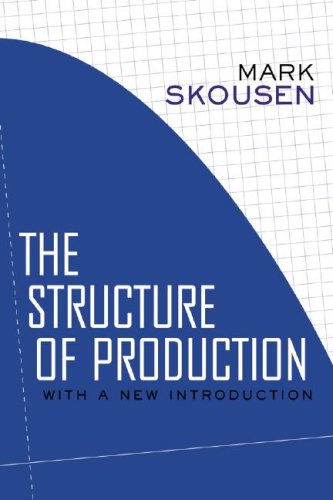

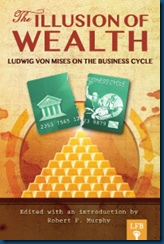


 Back in 2008, when even politicians started to notice the economic fertiliser had begun hitting the blade-rotating ventilation device,


 Posts
Posts

