Showing posts with label Provenance. Show all posts

Sunday, 26 July 2026

Bookplate of Thomas Story Spedding

Above and below are images of the heraldic exlibris bookplate of Thomas Story Spedding (1800–1870). The bookplate appears in a bound volume of various parts of the Library of Useful Knowledge (1827–38). Three more volumes of this broken set, each containing one of these bookplates, are presently available here. There is also a copy of Scott’s Quentin Durward (1823) for sale online for USD666(!) (here).
Thomas Story Spedding was an English barrister who lived at the famous Mirehouse estate in Keswick, a historic manor house in Cumberland on an estate that had been left to the Spedding family by Thomas Story in 1802. Thomas served as magistrate and High Sheriff of Cumberland in 1855, but he is much better known for his literary connections.
Thomas’s younger brother James Spedding (1808–1881) was famous for his edition of the works of Francis Bacon. Because of his family's standing, James’ literary connections, and the location of Mirehouse in the Lake District, the Speddings were especially close friends with various “Lake District” writers.
Thomas was close friends with Thomas Carlyle (1795–1881)—who wrote movingly of Thomas after his death—and frequently hosted William Wordsworth, Samuel Taylor Coleridge, Alfred, Lord Tennyson and Edward FitzGerald (author of the Rubáiyát of Omar Khayyám).
The Mirehouse estate quotes the recollection of Canon Hardwicke Rawnsley (here), which describes the convivial atmosphere of the library at the Spedding family’s Mirehouse estate:

There are those who would fain have that library filled again with the voices of old time. Tennyson’s deep-chested tones, FitzGerald’s laugh, Monckton-Milne’s wit. Carlyle’s strong Northern brogue, James Spedding’s dignified speech, and Tom Spedding’s humour.
* * * * *
There are no images online (that I can find) of this Thomas Spedding ex libris bookplate—one of the few Speddings to dignify their books with a bookplate—and below are most of the tiny number of photos I could find of the library at Mirehouse, either from the estate website or from the Mirehouse Facebook page (here). Since Mirehouse is regularly open to the public I expected to find many more images, but the main attraction seems to be outdoors: the stunning gardens and area generally.

Monday, 10 April 2023

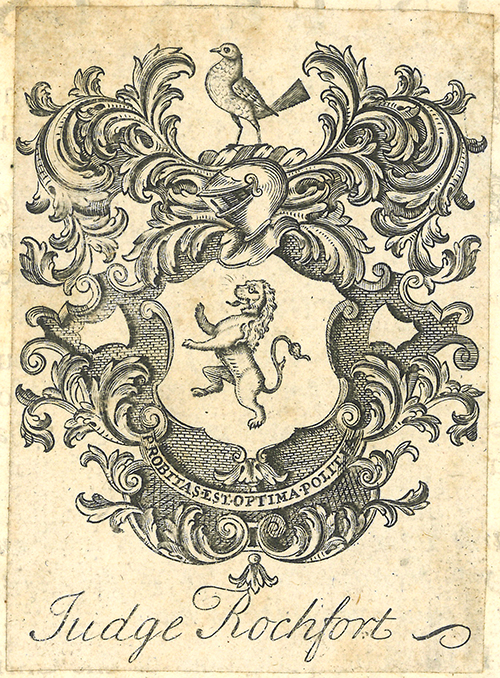
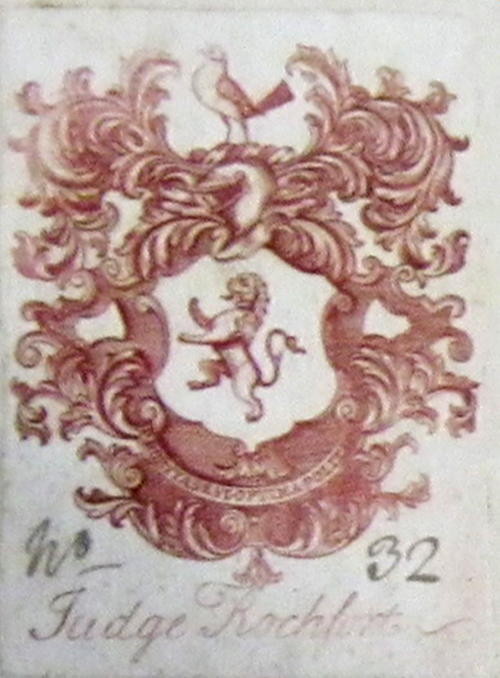
Judge Rochfort exlibris bookplate, ca. 1760


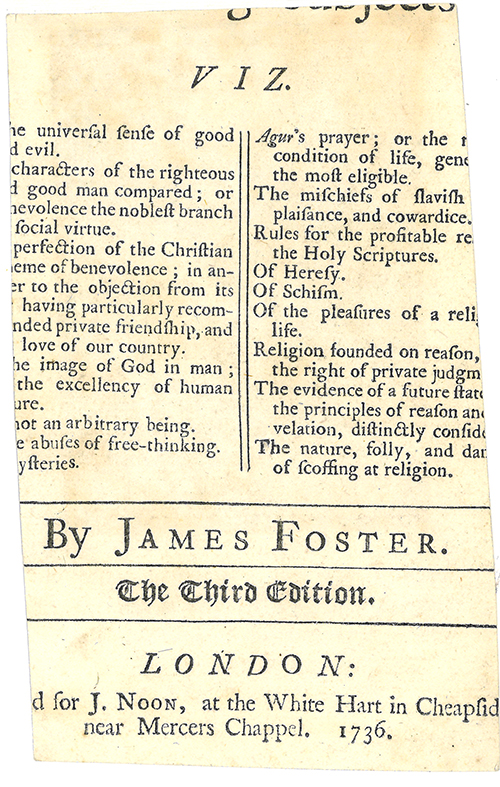
A biblioclast cut this early eighteenth century Judge Rochfort exlibris bookplate from a copy of James Foster, Sermons on the following subjects, viz. …, 3rd ed. (1736) [ESTC: n24146 (recording 15 copies); here]. I know this because, the bookplate was, and still is, fixed to the back of the titlepage, as you can see:


Bookplates are usually attached to front (fixed) endpaper, not to the title leaf; most likely, there was already a bookplate on the front endpaper, when Rochfort went to add his plate, so it was placed on the verso of the title leaf instead (more on this below).

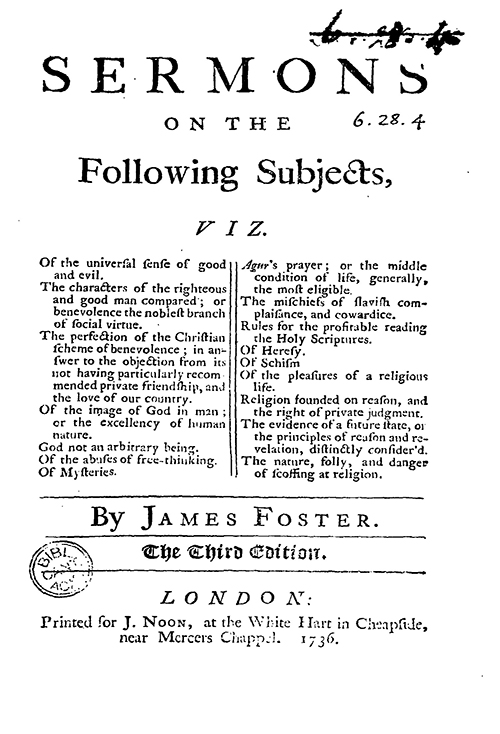
There is a copy of this edition of Foster's Sermons on ECCO, but not freely available online (yet—probably), but there are copies of the first edition of 1733 (here) and the fourth edition of 1745 (here) for anyone interested in Rochfort’s reading or book-buying preferences. Below is the full title page, taken from the University of Cambridge Library copy on ECCO:


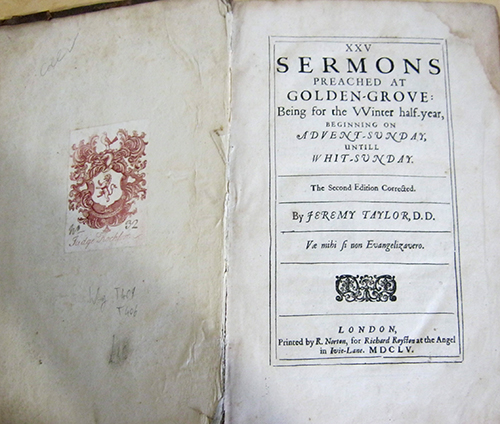
Although I have been unable to find a reference to any other Judge Rochfort bookplates in library catalogues online—or on ESTC under “Copy Specific Notes”—there is actually another book from Judge Rochfort’s library available at present on ABE (here):


The title of this book is not well represented in this ABE catalogue listing, but it is a copy of Jeremy Taylor, Eniautos. A course of sermons for all the Sundays of the year, 2nd ed. (1655) [Wing T330; ESTC: r10569 (recording 40 copies); here]. As you can see, this copy of Rochfort’s bookplate is printed in red, which is very unusual I believe.


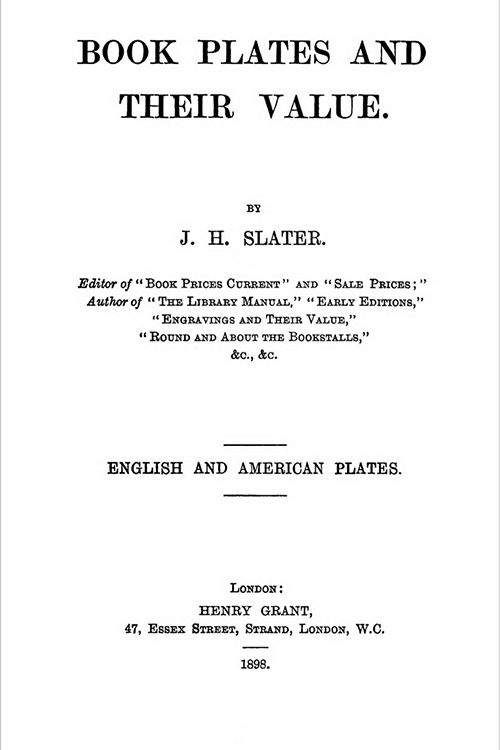
Although there is no image of it online, this armorial bookplate features in J. H. Slater’s, “Alphabetical List of Noted Book-Plates” in his Book Plates and Their Value (London: Henry Grant, 1898), 203 (online here):


According to Slater, there are actually two Judge Rochfort bookplates, mine being “distinctly ‘Jacobean’ with elaborate mantling”—although he dates is to “about 1760” (long after the Jacobean period)—but both feature the crest and motto: “Probitas est optima politia” [honesty is the best policy].

Slater, who is styled J. Herbert Slater in the books of his I have on my shelves, was particularly well informed, so I am inclined to accept his date for the bookplate. As I noted above, the unusual positioning of the bookplate suggests that Rochfort was not the first owner of his 1736 copy of Foster’s Sermons—any more than he was the first owner of his 1655 copy of Taylor’s Eniautos on ABE.

* * * * *

As for who was Rochfort—like St John Broderick, the other stray Anglo-Irish bookplate I bought in the late 80s (and blogged about here)—he is: Judge Rochfort, of Streamstown, Co. Westmeath, Ireland; High Sheriff of Westmeath in 1736.

Judge Rochfort was related to the much-better-known Rochforts of Gaulstown (Gaulstown is only about 25kms by road from Streamstown), but the link between the two families is somewhat distant, and the families may even have been at odds.

The Gaulstown Rochforts “were close friends of [Jonathan] Swift’s, and both George and John figure frequently in Swift’s letters and poems. John seems to have been a particular favorite: He was named by Stella one of her executors; and he was selected a member of the Lunacy Commission appointed, in 1742, to in quire into the state of Swift's mind” (Katherine Hornbeak, “Swift’s Letter to a Very Young Lady on Her Marriage,” Huntington Library Quarterly, Vol. 7, No. 2 (February 1944): 183).

Swift was a regular visitor to the Rochfort family at Gaulstown House—a very famous estate, which you will find information about here) and here). “It is said that it was when Dean Swift looked across the expanse of Lough Ennell one day and saw the tiny human figures on the opposite shore of the lake that he conceived the idea of the Lilliputians featured in Gulliver’s Travels” (here).

“A number of Rochforts family served in the Irish House of Commons for constituencies in Westmeath” (here); Robert Rochfort (1652–1727), of the Rochforts of Gaulstown, “had a highly distinguished career, being Speaker of the Irish House of Commons and Chief Baron of the Irish Exchequer. Robert’s grandson, also named Robert, was created 1st Earl of Belvedere in 1756. Their principal residences were Gaulstown House and, later, Belvedere House in Westmeath, of which only the latter still exists.”

Belvedere House is about 10kms from Gaulstown, but still only 25kms from Judge Rochfort in Streamstown—assuming that Judge Rochfort actually resided in Streamstown, which is by no means certain. The population of Streamstown is tiny, even today, although it is rapidly rising (increasing from 378 in 2016 to 519 in 2022; see here), and, as Arthur Sherbo notes, various members of the Rochfort family that Swift numbered among his friends were “resident in Dublin” at the time (Arthur Sherbo, “From the Westminster Magazine: Swift, Goldsmith, Garrick, et al.” Studies in Bibliography, Vol. 41 (1988), 276; here).

* * * * *

Returning to Judge Rochfort: Judge (here) was the son of Charles, son and heir of Charles Rochfort Esq. of Streamstown (ca. 1636–92; here and here), eldest son and heir of Lt.-Col. “Prime Iron” James Rochfort (ca. 1600–1652), who was court martialed and executed for killing his Major (in a duel) in Cromwell’s Army (here and here)—Lodge’s The Peerage of Ireland, vol. 3 (Dublin, 1754), 374–76 (here) provides the connections between all the otherwise disconnected references provided above.

Judge married Jane Donnellan (here), and had three daughters: Jane (here), Rebecca, who married (on 17 November 1779) Thomas Edwards, Esq. “an eminent surgeon” (here), and an un-named third daughter mentioned here.

Judge’s daughter Jane Rochfort married Rowland Rochfort (here)—a distant cousin—and had two daughters (only Harriet mentioned here, but two daughters mentioned here).

Rowland was the great, great, grandson of Lt.-Col. “Prime Iron” James Rochfort, and great grandson of Robert Rochfort (1652–1727; here; Prime Iron’s youngest son)—and wife Lady Hannah Hancock (d. 1733; here)—the friend of Swift.

Judge and his immediate family—indeed, most of the Streamstown Rochforts—have “no dates”—that I can find anyway—Robert, his ancestors, and descendants (i.e., the Gaulstown Rochforts), do. Lt.-Col. James Rochfort (d. 1652) was the father of Robert Rochfort (1652–1727), who was the father of the Rt. Hon. George Rochfort (1682–1730), who was the father of Arthur Moore Rochfort (1711–1774), M.P. for Westmeath, who was the father of Rowland Rochfort. Rowland’s father, Arthur, was the brother of Robert Rochfort, 1st Earl of Belvidere (1708–1774), aka “the wicked earl” (more on him below).

Meanwhile, the nearest dates that I can find for Judge’s immediate family are his grandfather (Charles, born ca. 1636), and the weddings of his daughters: Rebecca’s in 1779 and Jane’s (no date), but to Rowland, the brother of Lt.-Gen. George Rochfort (ca. 1739–1821).

* * * * *

I will end this ridiculously long post with a brief account of “the wicked earl” (based on the sources linked above, esp. here, here and here).

Apparently, Robert Rochfort, the 1st Earl of Belvidere, heard rumours that his young wife (Mary) had often visited—and had been having an “intrigue” with—his brother Arthur, the father of Rowland (Judge's son-in-law). According to a contemporary source: “[Arthur was] very well-bred and very well in his person and manner …[while] she is extremely handsome and has many personal accomplishments.”

As punishment, Robert had his wife locked up in the family house at Gaulstown, alone apart from her children and servants, for 31yrs. He also sued Arthur for “criminal conversation” for £2,000—a huge sum at the time; unable to pay, Arthur was thrown in a debtor’s prison where he eventually died.

Meanwhile, Mary was left so severely damaged by her long imprisonment “that she took to wandering the house and talking to portraits as if they were real people. When she was finally released after Robert’s death in 1774, Mary had become a deranged hag incapable of recognizing her own sons.”

George, the 2nd Earl of Belvedere, who freed his mother from imprisonment, demolished the Gaulstown House (where she had been imprisoned) and built a smaller house in the grounds for her. But Mary refused to stay; instead, she set sail for France, where she became a nun and lived the rest of her life as a hermit.

Given Robert’s character, if Judge allowed his daughter to marry Rowland, during the life of the wicked earl it seems very unlikely that he was at all close to Robert or the Gaulstown Rochforts—but perhaps this occurred after Robert bled to death, alone (and probably unrepentant), with his head caved in, on the grounds of his estate.

[Corrected: 15 June 2026]

Thursday, 30 March 2023

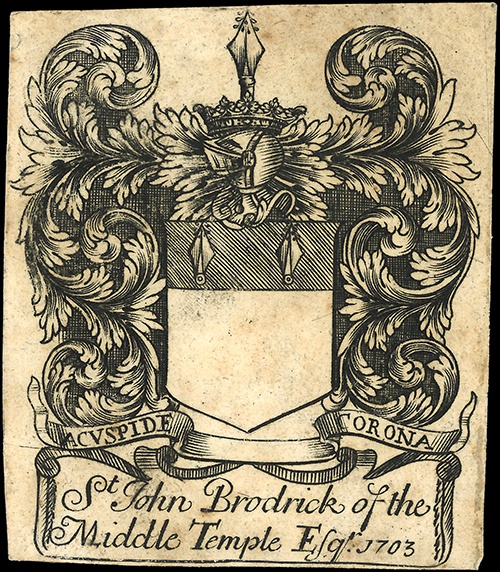
St John Broderick of the Middle Temple, 1703


This “Early Armorial” Restoration exlibris bookplate (Ginn, slide 14; see below) was created for St John Broderick of the Middle Temple, later The Honourable St John Brodrick (ca. 1685–1728), son of Alan, Baron Brodrick (ca. 1655–1728)—who outlived his son by only six months (Wikipedia pages here and here).

The short Wikipedia entry on St John Broderick characterises him as “an Anglo-Irish politician who sat in the Irish House of Commons from 1709 to 1728 and in the British House of Commons from 1721 to 1727”; since he was a parliamentarian, a few more details appear in Romney Sedgwick’s The History of Parliament: the House of Commons 1715–1754 (1970; online here).

Combining details from Wikipedia, Sedgwick and C. M. Tenison’s “Cork M.P’s, 1559–1800,” Journal of the Cork Historical and Archaeological Society, vol. 1, 2nd ser. (1895): 177 (here), the details of his life can be summarized as follows:

St. John Brodrick of Ballyanane, alias Midleton, was the eldest son, by his first wife, of Alan Brodrick, M.P., who was afterwards created Viscount Midleton. He was educated at Eton, 1698, and King’s College Cambridge, 1700, and was admitted to the Middle Temple, 1700; barrister-at-law, Ireland; Recorder of Cork, in succession to his father, 1708.

Brodrick was M.P. Castlemartyr, 1709–13 (then “of Cork”); Cork City, 1713–14 (then “of the Middle Temple”); Cork County, 1715–27; and 1727 (then Right Hon. St. John Brodrick) till his death in 1728. Brodrick was M.P. also for Beeralstown, county Devon, 1721–27; a Privy Councillor, 1724.

He married Anne, daughter of Michael Hill, of Hillsborough. She died 1752, leaving five daughters, of whom Anne married James Jeffreys, and Mary married Sir J. R. Freke, M.P. (q.v.). He died s.p. and s.p.m., 21st February, 1728.


A “Sketch Pedigree exemplifying the Brodrick M.P’s” is in Tenison here and a “Pedigree of Broderick” (that includes St. John and his daughters) can be found here

* * * * *

I found only a few references to this 1703 bookplate. It seems that Broderick owned a copy of Donne's Poems (London, 1633), now at Texas Tech University, Lubbock (here, but no photograph).


There appear to be no modern photograph or scan of St John Broderick’s bookplate online, but Egerton Castle reproduced a copy of this bookplate in his English Book-plates: Ancient and Modern (1893), 60 (above; text here); and this image was used by both Linda K. Ginn, for her 2017 lecture on “Digital Bookplates: Old Technology and New Applications” [University Libraries Workshops and Presentations, 6 (pdf online here]) and Paul Magrath in his 2021 post for the ICLR [Incorporated Council of Law Reporting for England and Wales] on “(L)ex Libris — the art of the legal bookplate” (here).


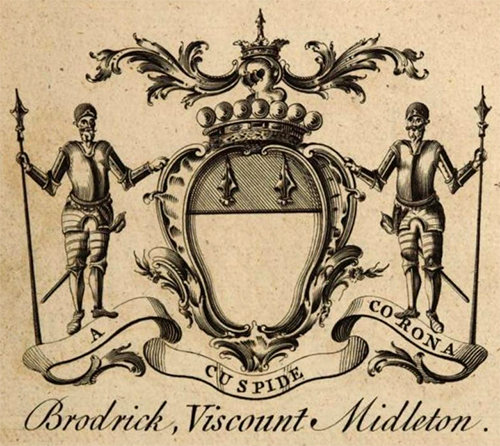
Regarding the Brodrick family motto: “a cuspide corona” can be translated as “from a spear, a crown” (i.e., one receives honour [a crown] for military exploits [a spear]). This motto can also be seen on the 1754 engraving above, taken from John Lodge, The Peerage of Ireland, vol. 3 (Dublin, 1754), pl. 29 (here).

* * * * *

I have no record, and no clear memory of when I acquired this bookplate—but I think I have had it and a one other anglo-Irish bookplate (which I blogged about here) for decades, probably since the late 80s. I have a pretty strong aversion to supporting “breakers”—biblioclasts who disassemble books for engravings, or sammelbands and nonce-volumes for individual works, especially plays—so I can only assume that I bought the collection of bookplates [1] not from the beaker themselves (to avoid encouraging this sort of thing) and [2] out of a desire to protect bookplates themselves.

As you can see, I have managed to protect this one so far. But it occurred to me recently, when I was going through my ephemera, that it might be even better to post images and information about some of my ephemera here. Destruction is only a bushfire away after all and the bookplates are both very attractive—as the appearance of this one in Egerton Castle’s English Book-plates suggests.

Tuesday, 30 January 2018

Catterall and Cowley in Sydney, 1835

When I was visiting Sydney during a university holiday in 1989, I bought a copy of The Works of Mr Abraham Cowley, 6th ed. (London: J. M. for Henry Herringman, 1680). As the photos in this blog post show, the book is in very poor condition, very badly foxed, no frontispiece, boards taped on with duct-tape. Despite its age, it would also not even now be considered a rare book—ESTC (r14069 = Wing C6654), records thirty-nine copies. But, since I had rarely seen a seventeenth-century literary folio at anything approaching a price I could afford in 1989, and I felt protective of the poor, damaged thing, I coughed up A$110 for it.


According to the Reserve Bank of Australia Inflation Calculator, I paid the equivalent of about A$250 in today’s terms. The fact that there is a nicer copy online now, rebound, with the frontispiece, for about A$150 (here) tells you everything you need to know about the rise of the internet (supply) and the passing of the Baby Boomer generation (demand) on Antiquarian book prices. In fact, there are thirty-one copies of The Works of Mr Abraham Cowley, printed between 1668 and 1700, on ABE at the moment, priced from USD75. Notwithstanding the fact that I would have been better off financially if I had invested my $150 in almost any other way—including Batman memorabilia—I am glad I bought this book. I was glad before antiquarian book prices collapsed, and I was glad afterwards.

The reason I was very glad to have my very own seventeenth-century folio of The Works of Mr Abraham Cowley—no matter how battered—when I bought it was because it made my first experience of reading Cowley uncommonly memorable … and romantic. In fact, the more my copy of Cowley showed the passage of three hundred years the better it served my purpose. I read Cowley by candle-light, during the winter of 1989. I discovered in this way that it takes a lot of candles to be able to read a badly foxed seventeenth-century folio with ease, and that a lot of candles generates a lot of wax, which is hard to remove from carpet, and a lot of heat, which will warm up even a very large and otherwise-unheated room in a cold Hobart winter. My landlord was not happy about the wax, or the soot-covered walls, but the experience of reading Cowley night-after-night, in the dark of winter, was so perfect that I will remember it with pleasure for ever.


The reason I am very glad to have my very own seventeenth-century folio of The Works of Mr Abraham Cowley—no matter how battered—now, is because, since the internet makes provenance research so much easier, I am now able to identify the person who owned this book in 1835. As you can see below, Joseph Catterall inscribed his name on the front fixed endpaper, and dated the inscription to 1835. The inscription is position above a patch of glue residue, indicating that a bookplate has been removed, but the relationship between the two is unclear: whether the inscription pre- or post-dates the bookplate, or whether the bookplate belonged to Catterall, is unknown.

* * * * *

Although, in 1989, I had no easy way of discovering who Catterall might have been, Professor Google now informs me a good deal about him. Joseph Catterall (1812–82), the youngest son of Paul Catterall, late of Lytham, in the county of Lancashire, Esq., was educated at private schools and at the University of Göttingen in Germany. He was twenty-two when he inscribed his book. He married—in Sydney, in the same year—Georgiana Anne Sweetman, who was aged twenty. This establishes that my copy of The Works of Mr Abraham Cowley has been in Australia for more than half of the book's existence (183 of 338 years), and for four fifths of the modern history of Australia (183 of 230 years). Catterall is considered “Australian Royalty”; at least, he features (here) on a website of that name. In reality, he seems to have been an all-round arsehole. The marriage ceremony was performed by the great Australian, John Dunmore Lang—the “Scottish-born Australian Presbyterian minister, writer, politician and activist” (Wikipedia)—an early advocate for the end of transportation, Australian nationalism and an Australian republic (and, therefore, all-round Australian legend, if not genuine "Australian Royalty" too).


According to Lang, Joseph and Georgiana—“a person of prepossessing appearance, … of a respectable family, and of good education” (i.e., the child a free settlers)—“had been living for some time previous in a state of concubinage.” Since Georgiana was pregnant, Lang was willing to lend his services to enable Joseph “to do his utmost to repair the wrong which I supposed he had done her”—i.e., perform a marriage—and the marriage took place “either shortly before or shortly after the birth of their first child.” Their daughter, Georgiana Ann Catterall, was born 16 February 1835 and died two months and thirteen days later. A second child, James Dillon Catterall, was born and died on 17 January 1836. Shortly thereafter, it appears, Catterall “left his wife in new South Wales, and proceeded via India” to England.

Once he had retuned to England, he instituted a suit against Georgiana, to “obtain a decree of nullity of marriage.” He argued that, although he was married to Georgiana by Lang, “an ordained minister of the Church of Scotland,” neither he or his wife were members of the Church, nor did they sign a declaration to that effect. The relevance of this is that an act had been passed in the colony “to remove doubts as to the validity of certain marriages” which he interpreted to imply that, for these reasons, his marriage was “null and void for non-compliance” with the act. This case was disputed and, apparently, abandoned. Later, Catterall filed for the marriage to be dissolved “on the ground of alleged adultery on the part of his wife.” Although Lang stated in 1846 that Catterall failed a second time, on the basis that the House of Lords had no power to examine witnesses in New South Wales to test the validity of his claim, he was in fact granted the divorce in 1847 on the basis that his wife had given birth to another child one year after Catterall left Sydney. (Seemingly, John Sydney Catterall, who was born in 1837.)

Lang’s 1846 account of Catterall is colourful and unflattering. Referring to him fleeing his responsibilities and his lack of success in putting aside an inconvenient marriage, Lang writes:

I do not think [Catterall] either deserves or is likely to meet with much sympathy … for when a young man marries a young woman whom he has previously seduced, or who has otherwise lost her character beforehand, he may be supposed to have made up his mind to undergo the very calamity which Mrs. Catterall alleges has befallen him, and which he so feelingly deplores. … Mr. Catterall, it will be recollected by the older colonists, is a person who has been before the public in this colony long ago. He had a farm somewhere in Argyle a few months before his marriage, with a farm house and other building upon it, in which he was residing with his paramour, when a ferocious attack was made upon it by armed bushrangers. He had a very brave man, known as an overseer at the time, of the name of Shepherd; who, in defence of the person and property of his master (who remained all the while within doors, within hearing of the shots), gallantly stood the fire of the bushrangers, by whom, if I recollect aright, he was severely wounded, and succeeded in beating them off. Mr. Shepherd got great credit on the occasion, for it was one of the most heroic actions that had been performed in the colony; but Mr. Catterall got about as much sympathy as he is likely to get now under the failure of his repeated attempts to set aside his colonial marriage.

And so it seems, Catterall was a coward, as well as a cad. What stands out for me in this passage is the reference to “a farm somewhere in Argyle a few months before his marriage … in which he was residing with his paramour [i.e., Georgiana].” Argyle County was (according to Wikipedia, one of the original Nineteen Counties in New South Wales, in the area around Goulburn, 195 kilometres (121 miles) south-west of Sydney. Georgiana—who also appears on the “Australian Royalty” website (here)—was, in November 1828, a thirteen-year-old “servant, to W. Cordeaux Esq, Minto,” in the Southern Tablelands, 48 kilometres (30 miles) south-west of Sydney. It is not clear how long she stayed in Minto, and how she ended up ninety miles away seven years later.

Lang said that he did not know if “Catterall had seduced the young woman in the first instance, or whether she had been of indifferent character previous to their acquaintance”—but it appears that Georgiana’s social standing was low, and her vulnerability high, prior to finding herself in “a state of concubinage” with Catterall (i.e., she was a servant); while his social standing was high, and his vulnerability low (as a university-educated, Gentleman adventurer). Consequently, I am inclined to blame Catterall for their situation, and her fate.

It is not known what hardships Georgiana endured after the cad-coward Catterall departed, but I gather that he left behind some of his belongings from the fact that more than a century and a half after he slunk away, his copy of The Works of Mr Abraham Cowley remained in Sydney. We can’t know whether Georgiana sold this book and his other belongings in the 1840s to pay for food and shelter, or clung to it in the hope he would return, or because she wished to pass it down to her descendants. I do know that her fifth child, Effield “Frank” Catterall survived into adulthood and that his four daughters—one married—mourned his death in 1892. (The cad’s two children died in infancy, while Georgiana’s two other children disappear from the records after their birth.) So it is possible that Cowley remained in the family for a lengthy period.


Unfortunately, if anyone other than Catterall left a name on the volume, it is no longer there. All that remains other than Catterall’s inscription, and the residue of a long-removed bookplate, are the marks of booksellers. From the number of prices inscribed onto the endpaper, it seems that this book circulated in the Sydney second-hand book market for some time. One of the partly-erased prices is in pounds, which dates it to before Valentine’s Day 1966, when Australia adopted a decimal currency. Not surprisingly, after almost thirty years, I have a pretty weak memory of buying this book. All I recall is buying it from a down-market antique shop in the city. A temporary-looking, run-down, second-floor shop—dusty, with stained walls and peeling plaster, and filled with a mass of not-very enticing antiques. And I think I paid the $110 asked of it, partly because I felt an obligation to rescue the book from immanent destruction. Given all the pleasure it has bought me, I am glad that I did.

Saturday, 12 December 2015

Harvard Library Company, 1793


I have an octavo volume of Eliza Haywood's The Female Spectator which, acording to a printed label in it (above), was once "The Property of Harvard Library Company, constituted January 1793." The label has a section for a price; the annotation in this area has been erased, but other annotations (below) suggest that the book was disposed of by the Harvard Library Company by 1845, since the new owner ("W.D."?) has added "Bought at Auction Feb. 17/45" and "No.58" to the fixed endpaper.


I have been unable to find a trace of the Harvard Library Company, constituted (by coincidence?) in the same month as the execution of Louis XVI, by guillotine, at the Place de la Révolution. Which is a shame, it would be nice to know more about a library founded, it seems, in imitation of The Library Company of Philadelphia sixty years earlier. If you have any information on this Library Company of Harvard, I'd love to hear from you.

Monday, 26 October 2015

Lisping Booksellers and La Belle Affemblee

Earlier this year I stumbled bought two odd volumes of Haywood’s La Belle Assemblée. I located the first (below) in a general search of eighteenth-century books on eBay—which surprised me, way since I have a number of searches which run continuously on eBay that should have picked it up and sent me an alert. It took a moment to realise why none of my searches had worked: the book was listed as La Belle Affemblee!


Since just about everyone reads the long esse and an eff the first time they see it, it should have occurred to me before to go looking for lisping versions of her titles. But it hadn’t. So I did a search for Belle Affemblee and found another odd volume straight away. What amused me about the second one was, while the first seller was obviously an enthusiastic amateur, the second was sold by “World of Rare Books”!

You’d think, that a specialist “rare book” dealer—who has sold 37,656 items on eBay, has over one hundred and twenty thousand books presently listed, including over five hundred eighteenth-century books—could distinguish an esse from an eff. But that would be a no.

However, “World of Rare Books” did know exactly how much to charge for it: an excessive amount, but not so excessive that I wouldn’t buy it. That I bought it at all, as a duplicate no less, says something about my present priorities. (And, possibly, that there really is a sucker born every minute.) Here is the description:

Brown leather hardback with gilt lettering and decoration to spine. Prelims missing. Internal hinges cracked. Wear and tear to pages with some losses. Heavy use marking, foxing and tanning present. Some pages creased. Text remains clear and legible throughout on yellowed pages. Illustrated. Binding has weakened due to hinge cracking. Heavy scuffing, edge wear and use marking present with sunning to spine. Bumped and torn corners.

I believe this is called lowering buyer expectations. I wish I could say that this was the ugliest Haywood volume I have bought, but it isn’t, not by a long shot. (this one might be, or possibly this one.)

* * * * *

Returning to the first Belle Affemblee—which had an old diary cover sticky-taped over the original full calf binding (so, also ugly)—I am grateful to the vendor (Billy), who bought this camouflaged volume, without realising it, in a huge box of books at an estate sale in West Virginia. Not only is there a battered Caesar Ward and Richard Chandler trade card pasted onto the front fixed endpaper (below; compare this to my other copy here)—which suggests both that Ward and Chandler may have been the original vendors of the volume and that it was sold, bound, with their trade card in place—but there is also some provenance and reading records in this volumes, which are gold for my present research.


A faded note has been tapped onto the front free endpaper; it reads:

To John from Cystlina Feb. 1953 | [I] bought this book over | from England when I | returned after 11 months | absence”

“John J. Jones, Malden WVA” and “John J. Jones — Malden, W Va. | Telephone WA53-838” are stamped on the endpaper and in the middle of the volume. There are also two dates, which appear to indicate where John (?) had reached with his reading, when he picked up the book nine years later: “Sep 29, 62” (on page 194) and “Dec 27, 62” (page 198). And, as you can see on the title-page at the head of this post, John (?) worked out that his book was 234 years old in 1966, which he updated to 238 years in 1970.

It is not clear whether it was, but it is certainly tempting to conclude that the huge box of books Billy bought was, from the estate of John J. Jones, of Malden, West Virginia. It is also not clear whether it was, but it is certainly tempting to conclude that it was, John who (read and) annotated this volume. But whether or not there were other owners since Cystlina in 1953, John is certainly the most important for my purposes. So, if anyone reader knows anything at all about John J. Jones, Cystlina or even Malden, West Virginia—the Wikipedia entry here is not particularly informative—I’d be grateful if you could drop me a line.

Thursday, 8 October 2015

Little Victories


Above and below are photos of a set of four volumes of Eliza Haywood’s The History of Miss Betsy Thoughtless, 5th ed. (London: H. Gardner, 1772)—Ab.67.8 in my Bibliography of Eliza Haywood (2004), but now Ab.67.8a for reasons I explain at the end of this post.

What makes this set remarkable is not its rarity, though I could only locate three sets in 2004, but both the provenance and the fact that I bought volume 4 in 2005 (from a US dealer) and volumes 1–3 last month (from a UK dealer who has had his incomplete set in his back room since the mid-1980s). The UK dealer bought his three volumes while he was in the States, but it seems unlikely that we bought our volumes from the same dealer, twenty years apart. Rather, I suspect the original vendor sold the volumes, at different times, to different dealers. Whether or not I am right, this “broken” set, which I have just re-united, had been broken for at least thirty years.


The reason that I don’t think that all four volumes were sold by the same vendor is that [1] no dealer worth their salt would sell an incomplete set unless that were 100% sure that the set was really incomplete—since incomplete sets are worth less than complete ones— and [2] the volume I bought in 2005 has been “improved” in a way that the other three volumes have not. Notice (above) that a pink-red tint has been applied to the leather binding of volume 4 and that the upper edge (below, fourth volume from the left) has been sanded in an attempt to brighten the dust-darkened page edges, so that it matches the un-darkened lower edge (below, right).


(That volumes 1–3 were not darkened after the set was broken is evident from the uneven effect that the sanding has on gatherings in volume 4 which are sewn in lower than the others. Beyond the reach of the sandpaper, these low-set gatherings remain dark—just as dark as the volumes that were not sanded. As well as removing dust, this sort of sanding damages the paper in distinctive ways, softening the edges, giving the paper a rounded and blurred look which is hard to describe.)

Re [1] above, there will always be dealers who disregard their own best interests, who sell odd volumes so vacuous ninnies can advertise their ignorance by decorating their homes with odd volumes, but such dealers are rare. And re [2] it is possible that the hack-dealer who slapped on some leather stain and sanded the edges of volume 4 bought this volume from a dealer who had bought a complete set but sold it off in odd-volumes, but this also seems unlikely.

I think that it is more likely that the vendor sold off the volumes at different times, to different dealers. My reason for thinking this brings me to the second remarkable thing about this set: their provenance: I think it is possible to trace the history of these volumes from eighteenth-century to today.

* * * * *

This set is half bound in early twentieth century brown roan morocco. All volumes contain the book label of “Richard Ashhurst” which has been removed from the original endpapers and reattached to new endpapers.


Richard Ashhurst appears to be Richard Lewis Ashhurst (1784–1809) who, ca. 1809, married Elizabeth Beck Crotto (1777–1857)—a widower; Richard and Elizabeth were the parents of Catherine Helen Ashhurst (1814–1910); mother of Richard Ashhurst Bowie (1837–87), father of Richard Henry Bayard Bowie (b. 1868), who sold the 11,887 volumes of his father’s “most interesting and very remarkable” library to Harvard in 1908 for USD10,000, stipulating “that any books containing the name or bookplate of Richard Ashhurst … be removed as belonging to Bowie's grandmother.”


All of the books belonging to Bowie's grandmother were removed (set aside, or preserved) from among those going to Harvard and kept by Mr. R. H. Bayard Bowie of 171 Walnut Street, Philadelphia. It is unclear what happened after 1908, but it seems likely that Mr Bowie spent some of this ten thousand dollars on having this set rebound. The family portraits—including portraits of Richard Ashhurst, his wife Elizabeth and daughter Catherine—and the “Richard Ashhurst” library were passed onto his son Richard Henry Bayard Bowie Jr. (d.1961) and then to Williams Cadwalader Bowie, who died, childless, in 1991 (his wife died in 1996).

I suspect Williams Cadwalader Bowie was the one who sold the “Richard Ashhurst” library, though it is possible that the volumes had passed to other family members and were sold off before the mid-1980s. Williams Bowie dropped out of University to join the Marines, unlike his many university-educated, gentlemanly, ancestors, and, also unlike his every ancestor back to Richard Ashhurst, he did not stay in Philadelphia, so he seems like a good candidate for disposing of the family heirlooms.

(Two of the important family portraits by Thomas Sully, mentioned above, were given away after the death of Williams’ father in 1961, including one of Elizabeth Crotto (1833) [below]; reproduced in Charles H. Hart, “Portrait of Mrs. Richard Ashhurst, painted by Thomas Sully,” Art in America, vol. 5 (April 1917): 140–43 [available here and here]; and Lewis Richard Ashhurst (1833). See also “The Misses Ashhurst” reproduced in The Life And Works Of Thomas Sully, 1783–1872 (Philadelphia, 1921), 124 [here] and Mrs. Thomas Ashurst.)

* * * * *

James E. Walsh's account of the “Richard Ashhurst Bowie Collection” (in A Catalogue of the Fifteenth-Century Printed Books in the Harvard University Library, vol.5 (1997), 21–25 [here]), which I have drawn on above, describes Richard Ashhurst as “Bowie's maternal grandfather,” but Richard Ashhurst was actually the grandfather of Richard Ashhurst Bowie—the book collector—not his son Richard Henry Bayard Bowie, who sold his father’s library, and whose actions are the subject of Walsh's account at this point.


It is possible that Walsh has confused father and son and that he is referring to Richard Ashhurst Bowie’s maternal grandfather, so that, when he says “books containing the name or bookplate of Richard Ashhurst” belonged “to Bowie's grandmother” he means that books containing the name or bookplate of Richard Ashhurst belonged to Richard Ashhurst’s wife: the book-collector’s grandmother, Elizabeth Crotto (above).

But it is also possible Walsh is simply inconsistent: mistaking Richard Ashhurst as “maternal grandfather” to the man selling off the library, but correct in identifying “books containing the name or bookplate of Richard Ashhurst” as belonged “to Bowie's grandmother”: the book-seller’s grandmother, Catherine Helen Ashhurst (below, at right; daughter of Elizabeth).


It is unclear why, if Elizabeth Beck Crotto—daughter of Henry Crotto and Catherine Van Flick, who married (first) Captain Joseph Hughes on 17 June 1794 (ætat 17) and (second) Richard Ashhurst ca. 1804 (ætat 27)—did own this set, it would contain the name plate of her husband. But if the books belonged to her daughter—Catherine Helen Ashhurst (1814–1910), who married Thomas Latimer Bowie—the presence of the name or bookplate of Richard Ashhurst in them would suggest that Catherine inherited them from her father’ meaning that Richard Ashhurst was, in fact, the original owner of this set (as his name-plates suggest).

I am inclined to think that the latter is true, that Walsh is inconsistent, and the relevant passage should read:

He [R.H.B. Bowie] stipulated a few conditions: first, that any books containing the name or bookplate of Richard Ashhurst, [R. A.] Bowie's maternal grandfather, be removed as belonging to [R.H.B.] Bowie's grandmother.

(And since I am in the middle of marking undergraduate essays, I have to say avoid implied subjects—and don’t start a new paragraph with an implied subject—or, perhaps, just unclear!. This confusion of father and son is exactly the sort of muddle that occurs when writers make liberal use of implied subjects—Walsh refers to “he” twice before he gets to “stipulated”, by which time even the author has forgotten who “he” is.)

Unfortunately, the Thomas Sully portrait of Richard Ashhurst, “Merchant” of “No. 263 Arch St., Phila. … begun March 7th, 1826, finished April 13th, 1826” was “destroyed” prior to 1921 “having been injured beyond repair.” Consequently, I do not have a portrait of the man behind the name, but it is certainly satisfying to be able to trace this set—re-united after having been “broken” for at least thirty years—through six generations of the Ashhurst and Bowie families, from the eighteenth century through to the twenty-first.

* * * * *

As a final note, I should mention that I had not thought to buy another copy of this fifth edition, but I was offered the volumes with another Haywood item that I very much wanted. As a result I now have three complete sets of the fifth edition, and a fourth (incomplete, but seemingly unique) set of an undated re-issue that I did not know about when my Bibliography was published (thus Ab.67.8a and Ab.67.8b).

Four sets might be considered excessive but—as David Levy reminds me—there are no duplicates in the hand press era. And so, already having a Haywood item is “no reason to hinder a man from the buying of [another], if he has the money that is demanded for [it]”—as Richard de Bury writes—“unless it be to withstand the malice of the seller or to await a more favourable opportunity of buying.”

Saturday, 24 January 2015

A Typical Research Day

Although, for me, only one day each week is flagged as a research day—a day on which I am not expected to either teach or attend meetings—I do research at all times of the day and all days of the week. I expect my colleagues do the same. The advantage of a research day is that it does give me the opportunity to do things that require extended focus, or extended meandering. If I were a very disciplined and well-organised person, I would make use of this time to write article after article. And sometime I do get to do this, but more often than not I use my time to follow up on the interesting leads captured in files and folders that litter my computer desktop.

Thursday was typical of that second kind of day. Last week I happened upon a blog post (here) that alerted me to the fact that the University of Virginia Library has acquired a copy of the French translation of Ab.9.2 The Rash Resolve; Or, or the Untimely Discovery (1724): Emanuella, ou la découverte premature. Par Madame Élise Haywood (Paris, an IX [1800/1801]). I located only two copies of this book in 2004 (both in Europe), so it was a pleasure to add a third.

While updating the holdings listed in my Bibliography, I took the opportunity to look for more copies, which led me to a series of discoveries: the Bavarian State Library have scanned their copy of Emanuella and it is now on Google Books (here), so I added it to my list of Haywood texts online here and revised my entry in my Bibliography; I found two new listings for the translation in French literary journals, and was able to correct the date on the one I listed in 2004 (adding this and this, and correcting the details of this); and—via the latter—I found a (very short) review of the translation here), so I have posted the review and translation here and added it to my list of Haywood reviews here and in my revised Bibliography.

After all this updating I still haven't got around to mentioning what first struck me about the University of Virginia copy of Emanuella: it contains the bookplates of Paul Lacroix (1806–84) the French author and journalist (famous enough to have his own Wikipedia page here) and André Breton (1896-1966), the founder of Surrealism (also on Wikipedia here). As David Whitesell points out in his blog entry, it is fitting that Salvador Dalí designed Breton’s "arresting" bookplate.

The University of Virginia copy was (owned and) donated by the renowned "angliciste," Professor Maurice Lévy (1929-2012; also on Wikipedia here), author of, among other things, Le Roman “Gothique” Anglais, 1764–1824 (PhD. thesis, 1968), Roman et société en Angleterre au XVIIIe siècle (1978) and some important articles on Mathhew Lewis. A pencil notation is visible on the photo of the endpaper posted by Whitesell, which suggests Levy paid one thousand francs (ca. A$220) for it—though when he did so is not clear.

The Levy collection is relatively small, but choice. As the collector himself explains (here), a "distinctive feature" of the French editions of (British) gothic novels—a feature "not shared by corresponding English volumes"—is that they are "individually illustrated with frontispieces by (most of them) reputed engravers." Nicole Bouché explains that "almost all" of Levy's late eighteenth century and early nineteenth century volumes are "in their original, often quite striking French bindings." That is, these French gothic novels are gorgeous: beautifully illustrated, printed and bound.

Anyone, like me, who has gone looking for a fetching illustration to use in a lecture on a gothic novel—such as Vathek, The Castle of Otranto, The Monk or Zofloya—will recognise the truth of Levy's observation: if you can't find a French edition, you may as well give up! My lectures on the gothic novel in my units "The Dark Hero" and "The Shadow of Reason" and "Reading the Past" are a hymn in praise of French engravers.

Until I read the posts by Whitesell and Bouché about the Levy collection, I had never heard of Levy's Images du roman noir (Paris: Éric Losfeld, 1973)—but as soon as I did, I knew I needed a copy, so I ordered one. (There appears to be only one copy in any library in Australia!) Nor was I aware of CERLI (the "Centre d'Études et de Recherches sur les Littératures de l'Imaginaire" [Centre for Studies and Research on the Literature of the Imagination (here)] until I read the Wikipedia entry (it is not mentioned in the Whitesell and Bouché posts), but I quickly found CERLI online, went straight to the bibliography page and was greeted by some very welcome headings: Fantastique; Littérature gothique; Vampires; Merveilleux; Fantasy; Science-fiction …

This site will going straight into my reader for the Dark Hero. Actually, I will have to do it next week now. Until then, I will just leave a screen-cap of the site on my desktop to remind me ...

Tuesday, 18 November 2014

Chatteris Family Bible, 1599


On three blank pages between the Old and New Testaments, in a “1599” Geneva Bible (above; the date is false, the Bible was probably printed after 1640) appears some genealogical records in an early hand. The pages were filled up out of sequence. I reproduce them and transcribed them below (in the logical sequence) in case they are of any use to descendants of Edward and Grace Chatteris (which seems to be the correct spelling of Chatterris).

It seems that Edward and Grace had thirteen children, four of whom are recorded as having married or had children of their own (Edward [no.5], Henry, John and Elizabeth [nos. 10, 11, 12]). The genealogical account focusses on John’s three children, especially his son Cornelius, who is recorded as having three children of his own by the first decade of the eighteenth century, when the records stop.

From the fact that most of the details concerning Edward and Grace are recorded in one hand in an orderly fashion and, it seems, at one time, I assume that the Bible was owned by John who, in ca.1676, recorded all of these details concerning his family. From the focus of the later entries it seems that that he passed the Bible down to Cornelius; if so, the two later handwriting styles are probably those of Cornelius and Sarah his wife, whose final entry records the death of Cornelius in very faint ink.

The only other name to appear in this Bible is John Peacock, who recorded that this was “His Book” on 10 January 1795.

* * * * *

[page one]

Edward Chatterris and Grace Smith were Marryed on the first day of May in the year 1629

Edward Chatterris Husband to Grace Chatterris was buryed September the 16th in the year 1654

Grace, the Wife of Edward Chatterris was Bureyed December 1681

[2] Two twins Born in the year 1630 and was Buryed before they were Baptised

[3] Margaret Chatterris Daughter to Edward Chatterris & to Grace his wife was Baptised November the 20th 1631. And was Buryed December the 24th in the year 1651

[4] One other child Born in the year 1652 and Buryed before it was baptised

[5] Edward Chatterris sonn to Edward Chatterris & to Grace his wife was Baptised August the 31th in the year 1634. And was Buryed

[6] Grace Chatterris Daughter to Edward Chatterris & to Grace his Wife was Baptised March 26th in the year 1637. And was Buryed on the 23th of October in the year 1639

[7] Annis Chatterris Daughter to Edward Chatterris & to Grace his Wife was Baptised February the 11th in the year 1638. And was Buryed on the 27th of November in the year 1639

[8] Grace Chatterris Daughter to Edward Chatterris & to Grace his Wife was Baptised on the 4th of October in the year 1640. And was Buryed on the 29th of December in the year 1651

[9] William Chatterris son to Edward Chatterris & to Grace his Wife was Baptised on the 23th of April in the year 1643. And was Buryed on the 25th of May in the year 1646

[10] Henry Chatterris son to Edward Chatterris & to Grace his Wife was Baptised on the 6th of April in the year 1645. And was Buryed on the 21st of May in the year 167[.]

* * * * *

[page two]

[11] John Chatterris son to Edward Chatterris & to Grace his Wife was Baptised on the 17th of October in the year 1647.

John Chatterris & Sarah Fring[.] was Married January 29th 1674

[12] Elizabeth Chatterris Daughter to Edward Chatterris & to Grace his Wife was Baptised on the 23th of May in the year 1649.

William Crosby & Eliz: Chatterris were Married Janua: 30th 1672

[13] Job Chatterris son to Edward Chatterris & to Grace his Wife was Baptised on the 2nd of August in the year 1654. And was Buryed on the [ ]th of June in the year 1673

[1] Cornelius Chatterris son to John Chatterris & Sarah his Wife was Baptised on the 21th day of November in the year 1675.

[2] John Chatterris son of John Chatterris & Sarah his Wife, was born June ye 23th 1677. And he was buryed October the 28th in the same year.

[3] Sarah Chatterris Daughter to John Chatterris and to Sarah his Wife was born January the 15th a bought tenn of the clok in the fore none and was Baptised January the 26th in the year of our Lord 1685.

John Chatterris was buryed March the 13 & buryed at Conington, 1688

Sarah Chatterris wife to John Chatterris was buryed att Conington October the 30 1689

Cornelius Chatterris son of John Chatterris & Sarah his Wife was maryed to Sarah [Smithe?] at Croxton November the 25 [1745?]

* * * * *

[page three]

Edward Chatterris & Joyce Prynne were marryed on the fourth day of November in the year 1664

Joyce the wife of Edward Chatterris Departed this life June the seventh 1672; whose Body Lyeth buryed at Little Waltham in Essex

Edward Chatterris was buryed the 4 day of October 1678

John and William Chatterris sons to Cornelius Chatterris and to Sarah his wife was born September the 26 170[.]

William Chatterris was buryed November the 15 170[.]

John Chatterris was buryed March the 20 170[.]

Thomas Chatterris sone to Cornelius Chatterris & Sarah his wife was born February the 8 baptised the 14 1702/3

Cornelius Chatterris [sonne] of John Chatterris & Sarah his Wife Lyeth buried att Conington October the 18 170[.]


Wednesday, 6 March 2013

Frankenbook; Or, What Goes Around, Comes Around


As you can see, this copy of Eliza Haywood’s Memoirs of an Unfortunate Young Gentleman has had a hard life. Verryyy hard.


At some point in the eighteenth century this book was the treasured possession of a schoolboy who used the blank pages at the back of the book to record the cost of his education (see below).


Did his rough handling detach the boards and break the spine? Did he sew the detached boards back on? It seems unlikely, but I guess it is possible. Was this caring act driven by love or frugality? And what of the missing pages? Were they still closed into the book when it was pushed to the back of a shelf and forgotten? And then what?


[...] payd to Mr Johnson
[...] for blotting paper £287-19-9
payd to Mr [F]illis for quils
and everything proper 1986-18-85
Total £2073-18-5
thus nothing farther payd
for my education.

* * * * *

This book’s early, turbulent history has marked it heavily. It’s recent, turbulent history, hardly at all. I bought this “Internally clean” book in 2001 for GBP250 (at the time, about A$600) from Dead Mens Minds in Wales, even though it was described as “split in half at page 123.”

For me, a PhD student at the time, this was an eye-watering sum. But this was one of the few important Haywood books I could get at a reasonable price: because only I knew it was by Haywood. (I think this is called insider-trading.) And I knew that, after I published my Bibliography—and the world knew that Eliza Haywood was the author of Memoirs of an Unfortunate Young Gentleman—prices would rise.

(As it happens, it took ten years before a bookseller listed a copy under Haywood’s name, and that one listing is still the only listing for Memoirs of an Unfortunate Young Gentleman under Haywood’s name. So no price rise and—happily, I guess—it is still possible to buy copies of this book at reasonable prices.)

Anyway, when the book arrived I realised that it was not just split in half, but missing five leaves (A1, E11, E12, H12, I1). I mentioned this to the bookseller, expecting him to offer to discount the book. No such luck. He was extremely sceptical and demanded that I return the book. And so I very reluctantly posted this six hundered dollar Frankenbook back to Wales.

Since 2001 I have bought for myself five more copies of the first volume, two copies of the second and a copy of the not-by-Haywood third volume. I have also helped three local libraries obtain sets. One of my five copies arrived missing a few leaves and when I mentioned this to the bookseller, he reacted in exactly the way I had expected the proprietor of Dead Mens Minds to react: he reduced the priced from USD500 to USD35.

(I wish I could remember who the bookseller was so I could memorialise their kindness, but they probably wouldn’t want me to publicise the fact that they had sold a defective copy anyway, so perhaps it is just as well I didn’t record it.)

You might think I had grown tired of this book, or that the eight volumes on my shelf would have lessened my appetite for more. No chance. So when a particularly ugly copy turned up on eBay recently I made sure to buy it. And, after I bought it, I was informed by the vendor that, by accident, the fact that this copy was missing pages was not mentioned. But that the missing pages had been taken into account when pricing the book.

After a few emails we agreed on a reduced price (GBP75), the book was sent and I got to inspect my purchase. And when I inspected it I noticed a small pencil notation of the date: “11.12.1”—in my handwriting! Only then did the penny drop. This was the same book I had bought from Dead Mens Minds, and returned to them eleven years earlier! My Frankenbook has travelled from Wales to Melbourne to Wales (again) to Melbourne (again).

And so I have been wondering again, as I did in 2001—what was the proprietor going to do/what did the proprietor do with this book? Did he sell it as an incomplete book, or try to pass it off as complete again? Did it go into his “hospital” (which all decent bookshops have) and, if so, how came it to be sold off by someone else on eBay eleven years later. (I have asked the vendor but, alas, no answers are forthcoming!)

I have also been wondering, as I have done many times since 2001, how large a percentage of the Haywood books sold in the last decade have come to me. What percentage of the market do I occupy? Have I driven up prices? I seem to have bought most of the copies of Memoirs of an Unfortunate Young Gentleman, so I guess it is inevitable that I would get this one back. But in book collecting the accepted wisdom is You. Do. Not. Get. Second. Chances.

And so I have tried not to let any chance pass me by. As the great Richard de Bury wrote concerning “What we are to think of the price in the buying of books” in Chapter 3 of his Philobiblon:

From what has been said we draw this corollary welcome to us, but (as we believe) acceptable to few: namely, that no dearness of price ought to hinder a man from the buying of books, if he has the money that is demanded for them, unless it be to withstand the malice of the seller or to await a more favourable opportunity of buying.

So, um, disregard dearness of price (check), but beware the malice of sellers (check), await favourable opportunity of buying (check). Thanks Rick.

The other moral to this story it is in the subtitle above. If you try to charge a small fortune for a frankenbook, you get nothing, and the buyer gets the book (eventually) for a pittance. Or, what goes round (the world), comes round (the world—again)!

PS: This machine-stitched frankenbook has nothing on my beauty!
[UPDATED 2016.02.24: reinstated images]

Sunday, 22 July 2012

Ann Lang versus Lady Stanley


Kathryn R. King comments, "in Haywood criticism Ann Lang is nearly inescapable." This is because Edmund Gosse wrote an essay, "What Ann Lang Read," which appeared in his Gossip in a Library in 1891 (see here). Gosse, a serious book collector and professional dilettante of literature, "become the happy possessor of a portion of [Ann Lang's] library." He used this "portion" as a springboard for an essay on Haywood and her typical reader. And because Gosse wrote fatuous drivel about Haywood he has become the straw-critic extraordinaire for Haywood scholars.


As TV Tropes explains, a straw critic is:

Any character in fiction who is described as a well-known or influential critic, an editor, or as an English professor, is likely to be a Straw Critic as well as an insufferable snob … Critics and editors often attract the ire of writers, because it's their job to tell people when stories suck. Needless to say, "Your story sucks" is not something most writers want to hear …

A few examples of Gosse's insufferable snobbery: [Haywood's works were] "strictly popular … non-literary … [Haywood] ardently desired to belong to literature … [but] never recognised [by intellectuals] … Plot was not a matter [she] greatly troubled herself [with] … All that distinguished her was her vehement exuberance and the emptiness of the field … [her play] is wretched … no one says that she was handsome … she was undoubtedly a bad actress … [after Pamela appeared Haywood's readers] must have looked back on [her novels] with positive disgust."

[Edmund Gosse, insufferable snob]
As for Ann Lang (and all Haywood readers): [she was] "a milliner’s apprentice or a servant-girl … lower middle class … servants in the kitchen … seamstresses … basket-women … ‘prentices … straggling nymphs … [who usually] read [a book] to tatters, and they threw it away … [or] drop warm lard on the leaves …  tottle up her milk-scores … scribble in the margin … dog’s-ear … or stain it, or tear it … [and who read Haywood because they] must read something"

So, Haywood sucks and her readers were ignorant gits. Right. Time to smash-cut to Lady Stanley.


Like—but unlike—Gosse, I am a dilettante book collector and professional critic (certainly when it comes to Haywood) who has become "the happy possessor of a portion" of the library of a Haywood collector. I probably have access to more information about Lady Stanley than he did about Ann Lang—the lives of aristocrats being, in general, better recorded than those of commoners—but I will resist the ad hominem arguments that he favours.

It is not clear whether, the Lady Stanley who previously owned my copy of the 3rd edition of The Female Spectator was Lady Elizabeth Stanley of Hooton, nee Paray (d.1761) or Lady Mary Stanley of Alderley nee Ward (widowed in 1755), or another, yet-to-be identified, Lady Stanley. And, really, it hardly matters. Although aristocrats occasionally married milliner’s apprentices or servant-girls, it is unlikely that Lady Stanley resembles Gosse's Ann Lang in this or any other respect.


Indeed, the only way in which Lady Stanley resembles Gosse's typical reader of Haywood's "strictly popular publications of a non-literary kind" is a way that Ann Lang does not resemble Gosse's portrait of the typical reader of Haywood's "strictly popular publications…" That is, while Ann Lang's books were in lovely condition, Lady Stanley's copy of The Female Spectator is not. But perhaps, in the same way that Ann Lang's atypically-cleanly books establish her working-class credentials, Lady Stanley's atypically-ratty books would, for Gosse, establish her aristocratic credentials.


Needless to say, there is plenty more evidence to prove that Gosse was writing fatuous drivel on this subject. I have blogged on this subject a few times (here and here for instance) and I have a few articles—perhaps even a book—in the works on Haywood's readers.

[UPDATE: 29 June 2021: Updated Google Books link]