Showing posts with label peace. Show all posts

Tuesday, February 24, 2009


Be patient with Obama on Iraq? While how many more die?
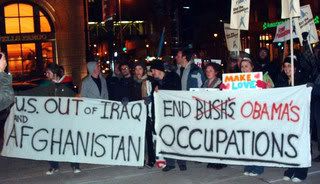


We were at an Iraq Moratorium vigil in downtown Milwaukee last week when a young man stopped to say, with a rueful smile, "Can't you give him a little time?"

He was referring to the sign a couple of students were holding, calling for an end to "Obama's occupations."

The vast majority of the people at that vigil voted for Barack Obama. There may have been a few Green votes. I'd bet my bottom dollar there weren't any McCain backers in the crowd.

So, should we be patient?

I pointed out to the young man that while it's true Obama's only been in office a month, that's been enough time for him to decide to send 17,000 more troops to Afghanistan.

Meanwhile, he's waffled on his campaign pledge to bring US troops home from Iraq in 16 months. And the report today is that he is leaning toward a 19-month withdrawal.

What's three more months when you've already been there for six years?

Not much in the grand scheme of things, right?

Unless, of course, you are one of the people who will lose their lives during those extra three months, or be wounded, or widowed, or have a loved one killed or maimed or permanently damaged psychologically.

Depending upon who's counting, more than a million Iraqis have died, several million have become refugees, and 740,000 or more women have been widowed -- almost 10 per cent of the female population between the ages of 15 and 80.

We don't know for sure how many Iraqis have been killed, because we don't even care enough to count their dead.

This is not a time to ask the antiwar movement to be patient, to quietly wait an extra three months.

It's time to ask the question John Kerry asked about Vietnam: Who will be the last one to die for this mistake?

We might add: How many will die for this mistake after Obama had said it would be over?


There's more: "Be patient with Obama on Iraq? While how many more die?" >>

Thursday, February 19, 2009


Congress members: Lobby us to get out of Iraq

This is not exactly a man-bites-dog story, but at least three members of Congress have expressed their support for a campaign to contact members of Congress and urge them to end the occupation of Iraq.

And a fourth has joined protesters at their regular vigil.

Representatives Barbara Lee, Lynn Woolsey, and George Miller -- all California Democrats -- have written the Raise Hell for Molly Ivins campaign to encourage it to continue raising hell. Meanwhile, Rep. John Conyers, a Michigan Democrat, joined a vigil in Wyandotte, MI. (He's at left in photo)

The Ivins campaign has been urging people to use the Third Friday of every month -- Iraq Moratorium day -- to contact Congresspeople in their home offices and ask them to get US troops out of Iraq. Friday, Feb. 20, is Iraq Moratorium #18.

"Please keep fighting," wrote Lee, a longtime opponent of the Iraq war.

Late last fall, Woolsey, Lee and Maxine Waters organized 92 members of Congress to sign a letter putting then-President Bush on notice that "we will only authorize funding for Iraq that is used for the safe and orderly redeployment of our troops and military contractors," Woolsey said. "We will have many serious issues to deal with in the coming months under a new President, but I will not forget that ending this occupation must be a priority for this Congress and for this nation," her letter said.

Miller cited President Obama's promise to bring the troops home from Iraq in 16 months, and said he and others will be working to accomplish that. He also "heartily endorsed" the Ivins efforts.

Miller, however, did not sign the Woolsey letter, which had its critics, too, including David Swanson of AfterDowningStreet.

The proof, of course, will be in the pudding. Letters and statements from members of Congress are encouraging, but actions speak louder. All three have a track record of opposition to the war.

Miller voted against the war to begin with, and said this in 2006:

Mr. Speaker, there is no more pressing issue in our country today than bringing an end to the war in Iraq as quickly as possible.


But Miller's recent letter to the Ivins campaign reads more like a polite acknowledgement of contact from a constituent, blames everything on Bush and says Obama will change things.

So, don't set aside your skepticism, or even your cynicism.

But do try to meet with, talk with, and confront your member of Congress personally when they are back in the district. And ask them for a commitment to end the war and occupation. Not a statement saying how much they admire what you do -- a commitment about what they will do.

Friday, Feb. 20, marks the 18th monthly observance of the Iraq Moratorium, a grassroots movement uniting people and groups who act to call for an end to the war and occupation of Iraq.

Many activities, individual and collective, large and small, are planned. The Iraq Moratorium website includes a listing as well as ideas for individual actions.

If your plans aren't listed there, please submit them here.

Afterward, please send a brief report of what you did, with photos or videos if they're available. Here's the easy form to do that: Form. It only takes a minute, and sharing your experiences can inspire others to act.

One more thing: The Iraq Moratorium, an all-volunteer operation, is a low budget organization. But it can't operate as a no-budget organization. If you can, please make a donation of whatever you can spare, knowing that we will put it to immediate and effective use in the cause of peace. Here's the link.

Thanks for all that you do, on Friday and every day, to help bring peace.


There's more: "Congress members: Lobby us to get out of Iraq" >>

Tuesday, February 10, 2009


What did you do to end the war, Daddy?

When your child asks, in 10 years, "What did you do end the war in Iraq, Daddy? (Mommy?), what are you going to say?

"Well, we worked really hard at it for years. We marched, and wrote letters, and held vigils, and called up Congress, and did a lot of other stuff -- oh, and a lot of meetings, too.

"So did you keep it up until you made them end the war?"

"Well, not exactly. See, we worked to elect this guy who was running for president and said he would end the war if he got elected. And he won.

"So he ended the war and then you could quit protesting?"

"Something like that. More like we quit protesting and hoped he would end the war."

"Did it end?"

"Yes, but not right away. It took a few years. Quite a few, actually."

"Do you think maybe you quit too soon?"

"It's getting pretty late. How about a bedtime story?"

* * *

Friday, Feb. 20, is Iraq Moratorium #18.

It is not the time to opt out of the effort to end the war and occupation of Iraq. It is a time to turn up the heat, or, at a minimum, to keep things simmering. Do something, large or small, to show you want US troops home.

And, whatever you're planning, please list it here.

Members of Congress are going to be home next week for a recess. It's a great chance to tell them face-to-face that we want our troops home. And talk to them about spending priorities, using the billions we are wasting in Iraq to do something constructive.

From United for Peace and Justice, the nation's biggest antiwar coalition:
The time is now to mount a campaign to cut the military budget by ending the war and occupation of Iraq and redirect the spending of our national budget.This is also an opportunity for the antiwar movement to work with economic and social justice groups in organizing joint delegations.

Don't go to their offices alone! Join with labor and community groups to make the first recess of the new Congress the beginning of a surge to compel them to end the war, cut the military budget and fund human needs.

If your Congressional representatives refuse to meet, or opposes the need for urgent emergency government action to respond to the economic crisis or bringing all the troops home: picket or vigil outside their office and call the press!

The opening of the debates on priorities for the next Federal Budget will follow this Congressional recess. We need to make our priorities clear! Ending the wars and occupations in Iraq and Afghanistan are the first steps to making larger cuts in the military budget and change the priorities of Federal spending.
That's just one idea. There are hundreds of things you can do to observe the Iraq Moratorium. Need ideas? Visit the website: IraqMoratorium.com.

What are you and me gonna do to end the war, Daddy and Mommy?


There's more: "What did you do to end the war, Daddy?" >>

Friday, January 16, 2009


An easy thing to do today for Iraq Moratorium


Today (Friday, Jan. 16) is the day: Iraq Moratorium, a day to interrupt our daily routines and do something, whatever it may be, to call for an end to the war and occupation of Iraq.

Here's one simple thing you can do that only takes a minute:

With the inauguration of Barack Obama just days away, ask Obama, through his change.gov website, to act at once to begin the process of withdrawing US troops. Tell him how strongly you feel about it.

Here's another simple, warm, indoor activity, while we in Wisconsin and elsewhere (like the people pictured in Rice Lake WI) endure sub-zero temperatures: Help keep the woefully underfunded Iraq Moratorium alive with a contribution, large or small, one-time or monthly. Just click here to donate. We'll put it to immediate and effective use in the cause of peace

Whatever you decide to do, please send a report (photos or videos, too, if you have them) by using this brand new, even simpler form.

Folks across the country would like to hear about what you do, even an individual action. You can inspire others to act.

Thanks for whatever you do in the cause of peace.


There's more: "An easy thing to do today for Iraq Moratorium" >>

Wednesday, January 7, 2009


Iraq Moratorium: Now more than ever


Sometimes we think we should just call it the War Moratorium.

We all want to end the war and occupation of Iraq -- but not to free up more troops for Afghanistan.

Violence continues to rage on a daily basis in both of those war-torn countries.

And now Gaza has been added to the mix, with innocents dying on both sides.

A new president takes office in less than two weeks -- someone whose candidacy was launched and sustained in its early stages by his opposition to the Iraq war.

He, and other policy makers, need to hear from us, loudly and clearly, that we elected them to follow a path to peace -- in Iraq, in Afghanistan, in Gaza, and around the globe.

What better time than Friday, Jan. 16, Iraq Moratorium #17, four days before the inauguration?

The Moratorium offers a chance for people across the country to speak out for peace with a united voice, in their own communities, all across the country. Since it began in September 2007, it has sparked more than 1,500 local events in 43 states and 260 communities.

Please join us this month. It's easy. You simply have to disrupt your regular routine and do something on January 16 to call for peace in Iraq. The Moratorium is a big umbrella. You decide what to do -- as an individual or with a group. Aside from unity on Iraq, there is plenty of room for other messages -- to convert military spending to health care or other urgent needs, for example, or to stop the bloodshed in Afghanistan and Gaza.

The main thing is that we all do something -- and that we share that information with others, so that it can inspire them and let them know that they are not alone, but truly part of a national grassroots movement that is mobilizing in local communities.

Please check our website to see if there's an event listed in your community. Here's the list.

If not, please send us the information on any group or individual action you're planning for January 16. Just use this form.

Afterward, we hope you'll share your experience by sending us a short report, with photos or video if possible.

This is not a time to relax our efforts. It is a time to renew and redouble them, knowing that we're no longer trying to speak to a President and Congress with deaf ears on this issue. There is a lot of talk about hope these days, and we should be hopeful, too -- but take nothing for granted.

Thanks for all of your efforts to date, and for whatever you can do this month in the cause of peace.


There's more: "Iraq Moratorium: Now more than ever" >>

Tuesday, November 18, 2008


The War on People

This is about collateral damage, aka the killing of civilians during war. The "war on terror" is really a war on people. Those people are not easily categorized, but I know who they aren't. They aren't white, they aren't rich, they aren't American, and they don't usually speak English. The exception to this are the few accused 'leaders' of terrorism which the U.S. says it wants to capture; bin Laden is presumably wealthy but the hunt for bin Laden has been declared phony more than once recently. (They need a Bad Guy or the war on terror itself is phony). So if the war on terror is phony, that means the war on terror is really a war on people who are "Other" than American. That's like our government saying, "World, watch your back!"


The following is a good book review for a new book on collateral damage. I heard the two authors discuss this last week on CSPAN for the Miami Book Fair. (You can watch the whole panel here). It's written by Chris Hedges (a pro-peace independent journalist) and Laila Al-Arian. From their discussion of their book, and what I have read in the last 4 years, it's obvious to me that the 'war on terror' has desensitized the American people to conclude that killing people in far-away countries in order to keep us safe, whatever that means, is perfectly OK. Proof of anything about their threat to our safety is optional. And unfortunately, this war on people is not going to end with a new administration.


Obviously the war-keeps-us-safe point of view overlooks the fact that we have never been, and will never be, "safe". We could cross the street and be hit by a car, or our house could be burglarized tomorrow, or a neighbor's dog could attack us. We could lose our jobs and our health insurance. Surely these situations all threaten peoples' safety. Women in the U.S. know they are never safe, and never will be, as domestic violence and rape and dying in childbirth are always a threat. So a war to keep us safe seems as ridiculous as promising us "heaven" or 72 virgins after we die. It's a fantasy.


There's more: "The War on People" >>