Showing posts with label Budget. Show all posts

Thursday, May 20, 2021


Labour actually does something

So, against expectations, the Labour government has actually done something, reversing the 1991 benefit cuts with a significant increase to benefits to levels at least (and usually higher) than those recommended by the Welfare Expert Advisory Group (and yes, I checked). Its good, it corrects a historic wrong, and it will help - at least until landlords raise rents to steal it all for themselves. Which highlights the need for more work, especially around housing and renter's rights.

But before we get too carried away, they're also planning to shift unemployment benefits to an ACC-style "social insurance scheme" with a limited duration. I'm really not sure this is a good idea. While (short-term) rates will increase, there's the obvious question of what happens when the support period runs out and how it copes with long-term unemployment. It will also make the scheme subject to the same pressures as ACC around interest rates, and allow the right to perpetually scaremonger about how it is "going bankrupt" and use that as an excuse to cut rates or worse, privatise it (something they tried to do to ACC in the late 1990's). Direct government control and a pay as you go system means there is direct government responsibility, matching our social expectation that no-one in this country should go hungry or homeless. An insurance model seems to undermine that.

And then there's climate change, which Grant Robertson explicitly says is next year's problem. He blamed this on the timelines set by the Zero Carbon Act, but this is bullshit. Nothing stops the government from acting in advance of the Commission's recommendations, and starting work on cutting emissions now. Except of course their own propensity for foot-dragging and delay. This is not a problem we can afford to piss around on; instead we have to throw everything at it now, otherwise we won't have a future worth living in.

Update: So, there's $300 million for as-yet-undefined EV incentives. That's a start, but we're going to need a lot more than that to decarbonise within a decade like we need to.
Friday, May 31, 2019


How Australian

Something nasty was hidden in the details of yesterday's budget: the government will spend millions on stopping non-existent refugee boats:

Efforts to prevent boats of asylum seekers heading to New Zealand will receive $25 million in funding.

The initiative will have New Zealand work in other countries to prevent people smuggling ventures, and is part of a wider boost to immigration enforcement announced for Budget 2019 .

The Government says the focus on "Maritime Mass Arrival Prevention" is consistent with long-held policy. But talk of mass arrivals was a "dog whistle" to appear tough on migration, a refugee campaigner says.


Just to put this in context, on March 15 a racist arsehole murdered over 50 people because he thought they didn't belong here. And the government responds by spending millions to prevent refugees claiming asylum here - effectively pandering to that racist and his supporters. How Australian.

Thursday, May 30, 2019


A deckchairs budget

The government has formally released its budget today, highlighted as being all about wellbeing. There's some valuable initiatives in there, including almost $2 billion for mental health, a move to index benefits to wages rather than inflation, and a $1 billion investment in rail infrastructure. All of this is great. At the same time, there's something huge missing from the budget: climate change.

Oh, it got a mention in the speech as part of environmental measures, and there's some token funding: a few million to manage the ETS and keep the independent climate change commission running, $50 million for trees, and a token boost of ~$11 million to research spending on agricultural greenhouse gases. But there's no major policy announcements on how the government is going to deal with it, and no major new initiatives to reduce emissions.

Climate change is the most important problem facing New Zealand. The Prime Minister called fighting it "my generation's nuclear free moment". Its the only policy that matters, and next to it everything else is deckchairs on the Titanic. But that's what we got: deckchairs. No money for a major decarbonisation of our electricity system. No money for a major decarbonisation of our transport system. No money, in short, to stop us poisoning the planet.

Governments show what they value with money. Jacinda Ardern's government has shown what it values today, and it is not the future. It is not what the Prime Minister says she values. And when we have so little time left, that is a huge wasted opportunity to move us towards a more sustainable path.

Thursday, May 17, 2018


A downpayment

I think that's the best way of describing today's budget. There were no huge policies, and no surprises - the first because they'd all been dealt with in December, the latter because of the now-usual process of pre-announcement. Neither was there masses of new money for health and education. But there were increases, targeted pretty clearly at rebuilding those key public services so they can begin to meet people's expectations of them. Its a budget which begins to undo the damage of nine years of National vandalism - but only begins. The infrastructural, service, and social deficits National left will take more than a single budget to fix, but this one sends the message that the government is at least starting the job.

Thursday, May 25, 2017


It must be election year

Today was budget day, and National has delivered a budget with a supposed $2 billion "family income package" consisting of tweaks to tax thresholds and Working For Families. There's some nasty clawbacks in that around abatement rates and cuts, but it will definitely make some people better off - not people right on the bottom, but pretty much everyone above that. Its the sort of centrepiece policy you might expect from a Labour government. Which is a guess a sign that National is genuinely afraid in election year.

Unfortunately, that fear doesn't extend to dealing with the big problems. The housing crisis? Nothing. No capital gains tax, no funding for their promises of more houses, nothing. Clean water? Nothing - though they are committing $6 million to making it worse by subsidising irrigation. Climate change? No moves to make polluters pay or push for the radical decarbonisation we need. Transport? Still all about the roads, with nothing for Auckland rail. Beyond the big election-year policy to sweeten up middle-class voters, the rest of the budget is business-as-usual, doing as little as possible other than keeping things ticking over. Its a budget from a government which has no idea what it actually wants to do in office. Which given that this is National, is a hell of a lot better than the alternative.

Oh, but the big trend of the last few years has continued. Despite their utter incompetence and repeated negative reports from the Inspector-General, the spies are getting even more money, with an extra $20 million of the SIS and $40 million for the GCSB. And meanwhile other departments are facing zero increases or cuts. It's a telling reminder of National's priorities: spies rather than support, privacy invasion rather than public services. And a reminder than every dollar we spend on these fuckers and their paranoid, self-important little games is a dollar stolen from the mouths of the needy. Its time to take that money back, by defunding the spies entirely. Its not a hell of a lot in the great scheme of things, but it could make a real difference in the right places.

Thursday, May 26, 2016


No money for housing, more money for spies

New Zealand currently has a housing crisis, with people being forced to live in cars and garages in Auckland due to a bubble and insufficient state housing. So is the government doing anything about it in today's budget? There's the $41 million of emergency housing spending over four years, and an inflation adjustment to income related rents subsidies (because rents are skyrocketing while incomes are stagnating). In other words, business as usual, rather than a credible response to the crisis.

Meanwhile, they're shovelling money at the spies, with an extra $178 million over four years. GCSB gets an extra ~$15 million a year and SIS between $18 and $35 million extra a year to hire more staff to deal with the "threat" of "foreign fighters" and invade our privacy even further. But really, what's more of a threat to New Zealand? Homelessness? Or imaginary "terrorists".

This speaks volumes about National's priorities. No money for the real needs of real kiwis, but buckets of it for spies.

Thursday, May 15, 2014


The Budget

The government delivered the Budget this afternoon, and it was pretty much as expected: steady-as-she-goes, with a "surplus" delivered by shoving costs into the future (in this case, the cost of ACC levy reductions) and a slight increase in paid-parental leave to 18 weeks with an increase in eligibility. There was also a surprise: an extension of free healthcare to all under-13s. The message: Labour has won the argument on paid parental leave and on free healthcare, and National is having to give ground in order to stay in power.

But while that's the good news, there's also a lot of bad: more roads (in fact, they spent as much on new Auckland roads as the city rail link would cost), more cuts to key areas of health and education. And the spies, whose budget should be being zeroed, get a $2 million increase. I guess that's what you get for knowing who John Key calls.

Monday, September 10, 2012


Hacking the Budget

This year, Treasury decided to cut the cost of presenting the Budget by releasing a smartphone app, allowing them to reduce the number of paper copies they printed. Someone was curious about this, so they used FYI, the public OIA request website, to request a copy of the app's source code. They were unsuccessful, but a subsequent request attempting to discover why turned up an interesting fact: someone tried to use the App to hack the Budget:

Of greater concern is that release of the code would cause significant security risks to the integrity of the Budget app, as well as premature release of future Budget material, which potentially could be market-sensitive. This is something we are particularly conscious of given last Budget attempts were made to infiltrate servers and reverse engineer the Budget app to gain early access to Budget-sensitive information.
This is big news; I wonder whether the police have any suspects? Maybe some journalists should ask and see?

As for their claim that this justifies refusal to release information, security through obscurity isn't. The way you ensure security is by publishing code so that bugs can be found well in advance, not by hiding it and hoping no-one notices if you've done a bad job.

Friday, June 29, 2012


The policy of prescription charges

In the Budget this year, the government announced it would be raising prescription charges from $3 to $5 an item, causing serious concerns around access to healthcare. Today, in their post-Budget dump, they released the policy documents around that decision, and they tell a very ugly tale.

The idea was, of course, cooked up by Treasury, driven by a desire to cut health spending [PDF]. Their initial report on the matter, T2011/2570: Improving the Targeting of Co-payments in Primary Care [PDF], pushed for cuts in both prescription charges and subsidised doctor's visits. However, that paper also noted the potential downsides - that it could decrease use of health services, and that this could increase costs elsewhere (for example, if people stop getting their statins or asthma inhalers and instead end up in hospital). it presented two options: an increase to $5 and to $10, with savings of $45 - $50 and $160 - $170 million a year respectively. In a subsequent paper on Savings Options in Health [PDF] they pushed for an even higher increase, to $15 or $20. Their estimated savings for these options "assume no behavioural impacts i.e. no reduction in prescription volumes", but presented such a drop largely as a saving due to reduced pharmaceutical costs, offset marginally by greater subsidies to high-volume users.

That's right: in Treasury-land doubling or tripling the price of something, or even increasing it sixfold does not reduce demand. Which is some very interesting (but convenient, in that it lets them completely ignore the obvious negative consequences) economics.

(There's a more explicit version of Treasury's methodology here [PDF]: take the number of prescriptions last year, multiply by the cost increase, and that's the "saving". Given that the primary purpose of increased charges is to influence behaviour, this suggests that they are either being highly dishonest, or do not believe in the supposed benefits of their own policy).

In April, Treasury recommended [PDF] an increase to "the lesser of $10 or the cost to the pharmacy for each prescription item", with reduced exemptions. The health budget could then be cut by $50 to $75 million "to return the savings to the centre". It seems to have taken some "Free and Frank advice on increasing the pharmaceuticals co-payment" [PDF] on the problems of such a system (both implementation difficulties, and the negative side-effects) to talk them out of it.

So, it looks like we got off lightly. But like rust, Treasury never sleeps; I'm sure they'll be back pushing for an even greater increase next year.

Thursday, May 24, 2012


More nonsensical projections

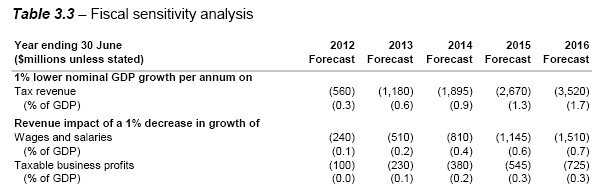
Today's budget included the Budget Economic and Fiscal Update, the government's forecast of economic performance, which underlies its projections of the government books. And as usual, it has some heroic assumptions about unemployment and wage growth [PDF, p. 3]. Unemployment will apparently remain above 5% all the way to 2015. Meanwhile, wages are expected to grow by nearly 4% a year over that period.

As I've pointed out before, this flies in the face of the historical record. We don't get that sort of wage growth without unemployment below 4% and labour laws designed to promote collective bargaining. So, Treasury is basically publicly dreaming - just as they have every other Budget.

So what does this mean? I think the table below, from the Risks and Scenarios chapter [PDF, p. 9] speaks volumes:

budget2012risks

Basically, if they fail to meet those wage-growth dreams, then that's their 2015 surplus gone. And given that they are already planning to enact "reforms" to crush collective bargaining, I think we can say it now: there will be no surplus in 2015.

Shuffling the deckchairs

Bill English is presenting the Budget at the moment. The first impression? He's shuffling the deckchairs. Money is being shifted from one program to another, usually at the expense of the poor, but the fundamental problems facing the government - the tax cuts for the rich which have crashed the books - remain unaddressed.

Apparently, there will be a surplus in 2015. In reality, exports just dropped by 17% today. So if you believe their forecast of surplus nirvana, I have a round building in Wellington to sell you.

As noted above, the victims of the government's changes are largely the poor. The low-income tax credit will be cut. Prescription charges will be increased. ECE subsidies will be cut (on the Treasury-logic that doing so will somehow increase participation). The latter in particular is hugely shortsighted, in that ECE is one of the most beneficial investments a government can make. But National regards it as babysitting, so it gets cut to allow the rich to keep their tax cuts.

Students, of course, get whacked with a big stick. Allowance threshold freezes, student loan repayment increases, no allowances for postgrad (which also means teacher training). The message is clear: tertiary education isn't worth it. Or, if it is, its because you're fleeing to Australia and leaving your debt behind you.

This is a budget without hope and without solutions. And if its National's vision for New Zealand, then its time we got rid of them.

Thursday, May 18, 2006


Expectations and reaction

What was I expecting from the budget? Not much - this being a boring year where the money had already been spent - but perhaps a modest increase in official development assistance, and maybe some action on carbon payments to forest owners or tighter regulation of vehicle imports as part of the rework of climate change policy. What I got was no real increase in ODA (it will move from 0.27% of GDP to 0.28%. Big deal), and $100 million in contingency funding for biofuels and climate change policy. The latter sounds good (though I'm still scrabbling for details on how it is to be spent), but the former is very disappointing. The UN benchmark for foreign aid is 0.7% of GDP. Not only is the government not even coming close - its not even coming close to its own self-determined (and incredibly lax) benchmark of 0.35%. So much for keeping their promises.

I expected the government to spend on roads - but I didn't expect quite so much. The extra money can only be described as a major investment, though unfortunately its almost all going on roads rather than giving Auckland the rail network it deserves. There's an interesting graph in the Treasury documents which is quite revealing about the trends in spending in this area over the past decade:

So, National funded roads at about 0.8% of GDP during the 90's, whereas Labour has already seen it rise to 1.0% of GDP, and is planning to increase it to 1.3%. In nominal terms, the increase is even more impressive. And yet, National continues to bang the drum about roading and imply that Labour has not spent enough. I think their past performance in this area gives the lie to their argument and shows which party really invests in rather than running down our infrastructure.

For those still banging on about surpluses without tax cuts, Cullen had some interesting titbits in his preamble about where that money came from. $2.5 billion of it was due to windfall returns from Crown Financial Institutions - the Cullen Fund, EQC and the Government Superannuation Fund. They're part of the crown, and so their profits naturally go on the government books and improve its net financial position - but it can't (or rather, shouldn't) be spent on anything other than the purpose it was invested for. Once, the National Party understood this - but now they seem to be in the same camp as people who react to an unrealised increase in the value of their super scheme (and one which could disappear, to boot) by splurging on a sports car. There's only one word to describe such people: fools. And I'm very glad they're not running the country at the moment.