Showing posts with label Books. Show all posts

Thursday, May 25, 2023

Recent Acquisitions


The VGH Thrift Store on East Hastings near Slocan remains my favourite place for used books. I was there Tuesday and saw three books I'd been meaning to read, all of them side by side. The first was the Penguin Modern Classics edition of Thomas Mann's Death in Venice (1912), which I had read as a teen (with his two shorter novellas, Tristan, 1903, and Tonio Kröger, 1901, included); an almost impossible book to find these days in Matthew Derby's language-writing-to-the-point-of-science fiction, Super Flat Times (2003); and a book I had been meaning to read -- the kind of book you only buy if you see it before you -- Mary Gaitskill's  Bad Behaviour (1988).

I "met" Mary Gaitskill during those Ryberg curated YouTube presentations back in the late-2000s. After my presentation text was published, Mary wrote me a note, which was very nice, and I made a point of adding her to my To-Read list. I'd made a similar point some years before when writer Evelyn Lau told me she preferred Mary Gaitskill's short stories to her novels, an unexplained preference apart from the context of our conversation, which, now that I think about it, concerned Evelyn being done with prose. "Bad Behaviour," said Evelyn nodding. "Yeah, Bad Behaviour's the one you want to read first."

Yesterday I read the first story in Bad Behaviour, "Daisy's Valentine". This is a story that would never be published today because Evil goes unpunished and no one triumphs. Nor is mental health treated with care. Nor is drug dependency explained. Nor is there any evil.

Joey works in the clerical division of a giant used bookstore in Manhattan, where he stumbles upon(?) an attraction to Daisy, who, like Joey, is in a relationship. Joey pursues Daisy, who warns him she's only attracted to those who treat her poorly, and Joey seems fine with that. In fact, as things move along one gets the sense that no matter how bleak their lives are each has met their match. Upon completion of the story I thought of a grittier Raymond Carver, who anyone with any interest in writing stories was reading at that time, and another story collection that wouldn't be published for another four years, Denis Johnson's Jesus' Son (1992).

Thursday, May 4, 2023

Recent Acquisitions


A remarkable haul from yesterday's thrifting. A 4.5" high ceramic pot by Charles Fergus Binns; a small pink Royal Art Pottery bowl; the DVD set of Hans-Jürgen Syberberg's Parsifal (1983), which I saw upon its release at the Oak Bay Theatre in Victoria; Rebecca Solnit's Men Explain Things to Me (2014), whose required-reading title essay features that distinctly U.S. elephant in the room known as social class; and Anthony Powell's  The Acceptance World (1955), a novel that begins with Nicholas telling us about his Uncle Giles, a bachelor "nearing sixty" who lives in the Uflord, a once grand "private hotel" comprised of "two corner houses" just west of Queensway, when 25 years later I lived in a similarly eccentric -- if not decrepit -- private hotel just east of Queensway (at Inverness Terrace).

A bit more on the Uflord:

"... that the two houses were an abode of the dead being increased by the fact that no one was ever to be seen about, even at the reception desk. The floors of the formerly separate buildings, constructed at different levels, were now joined by unexpected steps and narrow, steeply slanted passages. The hall was always wrapped in silence..." (8)


Friday, April 28, 2023

Autobiographies By Those Other Than Their Subject


Paul Radin's Autobiography of a Winnebego Indian (1926) is the story of Sam Blowsnake (aka Big Winnebago, aka Crashing Thunder), as solicited, transcribed and edited by the anthropologist Paul Radin.

I admired this book as an anthropology major at UVic in the early- to mid-1980s (Radin insists that the narrative is "authentic" because Blowsnake's words were "translated literally,"), but because I was taking electives in English and Political Science, where I was reading French post-structural theory (Derrida, Foucault, et al.), I came to question the authenticity of all narratives.

It was years later that I saw Gertrude Stein's The Autobiography of Alice B. Toklas (1933) and zeroed-in on the fact that it, too, was written by someone other than its titular subject. How vain of Stein, I thought, as I stared at the 1961 Vintage cover of Stein's impatient face, looking off or in profile. Years after that, How accurate, because the book is not about Toklas but the conversation that is Stein and Toklas -- as written by Stein on behalf of someone who, she determined, would never get around to being her Boswell.

A couple summers ago I read Toklas from cover to cover after pecking at it in my bathroom for a year or so prior. A great history of Toklas's life prior to 1933 (she was born in 1877; Stein died in 1946), but also of a Paris scene where artists and writers didn't have children but ideas. In addition to that, political details about the First World War -- an account by two women who were, as they say, in the midst of it. Stuff like this:

"Then came the days of the invasion of Belgium and I can still hear Doctor Whitehead's gentle voice reading the papers out loud and then all of them talking about the destruction of Louvain and how they must help the brave little belgians. Gertrude Stein desparately unhappy said to me, where is Louvain. Don't you know, I said. No, she said, nor do I care, but where is it." (147)

Friday, January 14, 2022

Yesterday's Mail


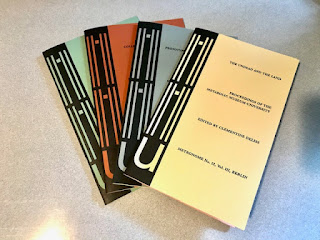
Lots of mail yesterday. New chapbooks from rob mclennan, Volumes I-IV of Clementine DeLiss's Metronome, No. 12. and my alma mater's alumni magazine, Torch.

rob adores his wife and two daughters and they are everywhere he is and does. One of his daughters likely provided the cover of his Autobiography (Ottawa: above/ // /ground press, 2022). Here are the opening lines of his opening poem "Autobiography of Green":

Each poem, at a particular time. A line of versets,
iambic feet. The children                       ,dither: compass

the backyard. Their summer playhouse, builds.

They wait, they wait.

Their perpendicular step.

rob's Touch the Donkey series features six poets. Issue #32 is comprised of poems by Carrie Hunter, Emily Brandt, Lillian Nećakov, David Buuck, Hugh Thomas and Natte Logan. Here's a stanza from Hunter's opening poem, "The Chorus of Condemnatory Shrieks from the Entourage":

Don't take measurements of the situation, of life,
comparisons. Just look at ewe and prunes; keep using
semi-colons, it never ends, but it sort of does.

Metronome is new to me and its volumes carry a conversation on the concept of the Metabolic Museum-University. Among those gathered are Krista Belle Stewart, a Syilx Nation Citizen Aüslander living in Berlin and the UK writer Tom McCarthy. At one point Stewart tells the story of her land inheritance, how she kept a bucket of that land with her on her travels, often driving around town with it. Shortly after that, McCarthy, a Humean thinker prone to association, recalls Count Dracula's importation of soil from his native Transylvania to his London property, and then reminds us that Dracula's author Bram Stoker was an Irishman living in England, and that "[t[here's a colonial history there too." (Vol. III, p. 12). Hmmm, how will Stewart respond to McCarthy's association? I read to the end of the volume, yet find no sign of Stewart. (With silence, then? But what kind of silence? Operative? Diffident? There are many kinds of silence.) 

Billed as "The Brain Issue", Torch features the usual balance of achievement in the Arts, Sciences and Business, and includes a profile on Dorian Fraser (MA, '13), the curator behind UVic's Legacy Maltwood Gallery's Pop Anthropology exhibition of artist, Western Front co-founder and UVic alum Eric Metcalfe (BFA, '71, Hon DFA '21), the only artist I know of who hangs his degrees on the wall of his home. Dorian is the child of a judge (Peter Fraser), who, as a lawyer in the 1970s, wrote the Western Front's constitution and, as Dorian put it, "played in the Western Front's kazoo band." 

Tuesday, April 21, 2020

Save-On


The Save-On at King Edward & Knight has a magazine rack that brackets the bathrooms. An aisle to the east of it advertises cleaning products -- and books! But where? Where on the shelves are these books? I open a scouring pad and turn to Page 50: George Stanley's "Vancouver in April".  Five stanzas down:

I lived here three months
in a house where I never once
heard anyone say please or thanks.

This from someone born and raised in the States, who moved to a country known to use "please" and "thanks" as verbal punctuation. Or was this a house without Canadians? There were number of U.S. Americans living in Vancouver in the early-1970s, people George knew from the San Francisco poetry scene. Rob Blaser, Stan Persky. Never knew Persky to say such things. Never knew Blaser either, though I met him more than once.


Thursday, June 20, 2019

Zen and the Art of Motorcycle Maintenance (1974)


I tried reading Robert M. Pirsig's Zen and the Art of Motorcycle Maintenance when I was fifteen (three years after it was published), and again in my early 20s, but could never get into it. More recently, while assembling a bibliography of postwar "road" literature, I considered adding it, only to find a copy a week later at the YWCA Thrift Shop on Main Street.

Jinhan Koh was there and I asked him if he had read it.

"Oh yeah, when I was teenager. I tried reading it again, in my twenties, but -- you know."

Well, now that you mention it.

As of last night I am 76 pages into it and continue to cringe every time Pirsig lectures at the expense of his fellow travellers. Hopefully sooner than later I will learn something from this know-it-all biker -- not from what he tells us, but from how (if at all) he handles his humility.

"John nods affirmatively and I continue." (33)

"'And what that means,' I say before he can interrupt..." (35)

"John looks too much in thought to speak. But Sylvia is excited. 'Where do you get all these ideas?'" (36)

Another book at the YWCA Thrift Shop was Christopher Lasch's The Culture of Narcissism (1979), published five years later.


Time to read it, too, see if Pirsig makes an appearance.

Friday, January 15, 2016

Vidal and Mailer


Despite continuing with the Wild Rose Cleanse and its lunch bucket of herbal laxatives, I have yet to finish Robson's essay (see yesterday's post), returning instead to the writings of Vidal and Mailer, of which I have one book each.

Robson tells us that Vidal's strong suit is his non-fiction, but the book I have is his best-known: the novel Myra Breckinridge (1968). As for Mailer, who is known for his fiction, I believe his most enduring book will be the one in my library, his heavily researched "true life novel" The Executioner's Song (1979).

After re-reading the first twenty pages of Myra, I gave up and took the book not to the shelf where it sat all these years but to the out-box I keep in my laundry room. Which is a shame (at least symbolically) because Myra is, according to the glbtq.com encyclopedia, "the first instance of a novel in which the main character undergoes a clinical sex change," and the "sex change" is big news now that, as the coffee roaster down the street keeps telling me, "Trans is the new Gay." (But then, sincerity is the new satire, so who [under 45] would not look down on a book that treats its subject as such, particularly a book as stiffly written as Myra?)

As for The Executioner's Song, and in keeping with the ongoing thematic re-arrangement of my library, I have moved it from the "M"s to its new home -- a neighbourhood that includes Truman Capote's In Cold Blood (1966) and Lynn Crosbie's Paul's Case (1997).