Showing posts with label imaginary. Show all posts

Wednesday, January 17, 2024

Square Root of Negative One

(Click on the comic if you can't see the full image.)
(C)Copyright 2024, C. Burke. "AnthroNumerics" is a trademark of Christopher J. Burke and (x, why?).

Obviously, Blarney the dinosaur was inspired by St. PaT-Rex.

The students are diminutive versions of three of Ken's students. Or perhaps they're derivative?

But one thing is certian: I love you ... coming to visit my page. Come back often and I'll post more content.

More ideas coming. Let's see if time permits, especially now that I'm trying to keep up with my writing. (See below.)


I also write Fiction!


You can now order my newest book Burke's Lore, Briefs: A Heavenly Date / My Damned Best Friend, written by Christopher J. Burke, which contains the aforementioned story and a bonus story.
Order the softcover or ebook at Amazon.

Also, check out In A Flash 2020, by Christopher J. Burke for 20 great flash fiction stories, perfectly sized for your train rides.
Available in softcover or ebook at Amazon.

If you enjoy it, please consider leaving a rating or review on Amazon or on Good Reads.


Come back often for more funny math and geeky comics.


Friday, July 16, 2021

Argument of a Complex Number

(Click on the comic if you can't see the full image.)
(C)Copyright 2021, C. Burke. "AnthroNumerics" is a trademark of Christopher J. Burke and (x, why?).

They're not out of line here. Well, maybe above the line.

That's one problem with Algebra: there's always a lot of arguments!

The mathematical definition of Argument of a Complex Number is left as an exercise for the reader. But it's 3π/4 in this example.

It wasn't my intention to take a week off. It just worked out that way between life and the heat. Likewise, I considered doing something special for Comic #1750 (if I haven't started misnumbering again), but I settled for not doing a "mini" or a "quickie".

Final note: some of you might remember Negative Kitt from the other universe that was Through a Window, Darkly.

I also write Fiction!


Check out In A Flash 2020, by Christopher J. Burke for 20 great flash fiction stories, perfectly sized for your train rides.
Available in softcover or ebook at Amazon.

If you enjoy it, please consider leaving a rating or review on Amazon or on Good Reads.

Thank you.


Come back often for more funny math and geeky comics.


Monday, January 06, 2020

I vs i

(Click on the comic if you can't see the full image.)

(C)Copyright 2020, C. Burke. "AnthroNumerics" is a trademark of Christopher J. Burke and (x, why?).

Know what I talkin' bout?

A long time ago, I did a "Pop i" that had big sailor forearms, but then the Roman I would've needed arms, too, but not a Gladius

I did a Pi vs. Pi comic years ago. I never did draw the followup.


Come back often for more funny math and geeky comics.


Monday, April 29, 2019

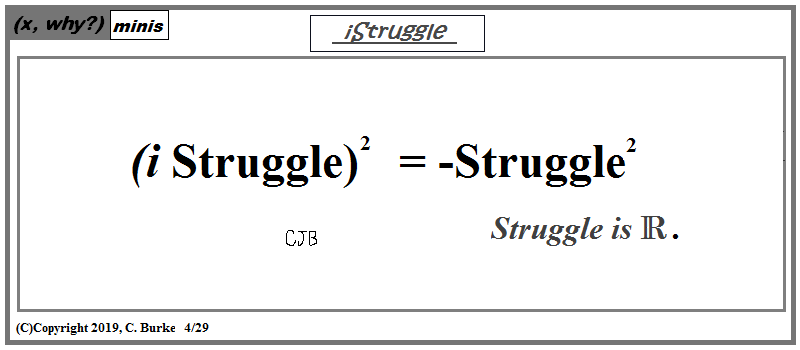
(x, why?) Mini: iStruggle

(Click on the comic if you can't see the full image.)

(C)Copyright 2019, C. Burke.

iStruggle is imaginary or a trademark of a certain corporation ...


Come back often for more funny math and geeky comics.


Monday, June 04, 2018

Imaginary

(Click on the comic if you can't see the full image.)

(C)Copyright 2018, C. Burke.

I wonder if he could imagine asking a girl to the pizza parlor after school ....

I actually thought about having the new girl like Vaughn who likes Missy (who seemed indifferent) because that would create ...

A love triangle. What could be more mathematical than that?


Come back often for more funny math and geeky comics.


Friday, February 23, 2018

Snow Bored

(Click on the comic if you can't see the full image.)

(C)Copyright 2018, C. Burke.

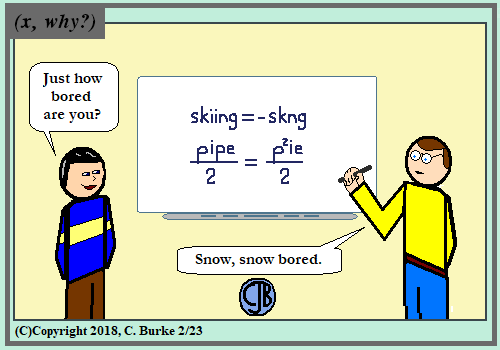
Got stuck trying to do something with 'curling'.


Come back often for more funny math and geeky comics.


Thursday, March 17, 2016

Happy St. Paddy's Day 2016

(Click on the comic if you can't see the full image.)
(C)Copyright 2016, C. Burke.

Obviously, they're imaginary! The spuds, that is.

Don't let historical inaccuracies (like letters walking across the beach) spoil a good comic!

Happy St. Patrick's Day!


Come back often for more funny math and geeky comics.


Friday, July 10, 2015

Imaginary Friend

(Click on the comic if you can't see the full image.)
(C)Copyright 2015, C. Burke.

You can't expect rational behavior from an imaginary friend.


Come back often for more funny math and geeky comics.


Wednesday, July 08, 2015

(x, why?) Mini: Real

(Click on the comic if you can't see the full image.)
(C)Copyright 2015, C. Burke.

If we want to be successful real numbers around here, don't say 'i'!


Come back often for more funny math and geeky comics.


Friday, July 03, 2015

What's a Conjugate?

In Algebra, what is a conjugate? First, it's a noun, not a verb, and it's pronounced something like CON-juh-git, depending on your regional accent, but NOT as con-jyoo-GATE, like a big Language Arts scandal blasted across front pages of the tabloids.

The conjugate of a binomial, an algebraic expression with two terms, is a second binomial with the same terms but the sign between them has changed from plus to minus or minus to plus.

For example, 3x - 7 and 3x + 7 are conjugates.

What makes them interesting? One property of conjugates is to make things GO AWAY, and if there's one thing that Algebra students like is when things go away. And since I refuse to leave, this is the next best thing.

Add, Subtract, Multiply

If you add two conjugates, you double the first term and eliminate the second: (3x - 7) + (3x + 7) = 6x
If you subtract two conjugates, you elimated the first term and double the second: (3x - 7) - (3x + 7) = -14
-- keeping the sign of the term in the first binomial.

If you multiply them, something interesting happens:


You get a Difference of Squares. That is, the square of the first term minus the square of the second term. When you do the Distributive Property, you should get two more terms -- and don't you forget that! -- but in this case, those terms will cancel out! (-xy) + (xy) = 0.
(3x - 7)(3x + 7) = 9x2 + 21x - 21x - 49 = 9x2 - 49.

This can be useful not just for multiplying binomials, but for multiplying actual, honest-to-goodness, Real numbers, too!
Take, for example, (16) X (24). Not really easy to do in your head, but if you split the difference, you can see that it is the same as (20 - 4)(20 + 4).


Voila! The answer is 384! Wasn't that easy? Isn't this the greatest trick?

Nah, it's not. Just Kidding, really.


Just use a calculator. Seriously. No one really wants to square "bad" numbers in their head and then subtract them! But sometimes, it's kinda cool and you can impress your friends if you carefully pick your numbers!

Radicals!

BUT WAIT, THERE'S MORE!

Suppose you have a binomial where one of the terms is a radical number. Wouldn't you like that to go away, too? Well you can! Just multiply it by the conjugate.

I know, I know what you're thinking. You're thinking, "Yeah, that's okay, Mr. Burke. I'm cool with the radical. I'll just leave it alone!"

That's nice that you're cool with it, but you can't leave it alone. Suppose you have two divided by (6 plus radical 7). If there's a radical in the denominator of a fraction, it has to go away. That's just the rule. We're going to "simplify" it by multiplying both the numerator and the denominator of the fraction the conjugate, like this:

Isn't that so much better? It is, isn't it? Worth it, right? Right?

Imaginary Numbers

The same way that conjugates work for radical numbers, they can work with imaginary numbers.

If you have 3 + 4i, for example, in the bottom of a fraction again, you can make it real by multiplying by the conjugate, 3 - 4i.

Using our rule from about (3 - 4i)(3 + 4i) = 9 + 16 = 25, which looks suspiciously like a part of a Pythagorean Theorem problem -- but that's for another night.

Monday, June 08, 2015

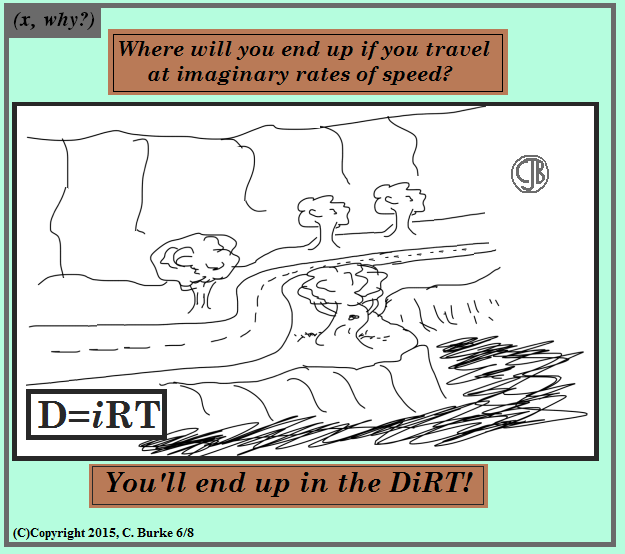
Distance

(Click on the comic if you can't see the full image.)
(C)Copyright 2015, C. Burke.

Actually, any great speed I imagine is usually in a rocket of some kind, so DiRT isn't as much of a problem.


Come back often for more funny math and geeky comics.


Wednesday, June 18, 2014

Algebra 2/Trigonometry Regents for the Algebra 1 Student & Teacher

Today was the New York State Algebra 2/Trigonometry Regents exam. I don't teach this course, so I won't comment personally on how good a test it was for Trig students, other than to say that a couple of colleagues called it a "fair exam". What I can say about this exam is this: Algebra 1 teachers can use many of these multiple choice questions in their own classes with little to no adjustments. If I might so boldly and "arrogantly" claim, the top students in my Algebra 1 class could have solved 8 of the first 9 problems. An above average student would've gotten at least five of those correct.

With this in mind, I'd like to once again go over the Algebra 2 problems which I believe Algebra 1 students could handle, even if only as challenge problems.

Algebra 2/Trigonometry

1. Which survey is least likely to contain bias?
1. surveying a sample of people leaving a movie theater to determine which flavor of ice cream is the most popular
2. surveying the members of a football team to determine the most-watched TV sport
3. surveying a sample of people leaving a library to determine the average number of books a person reads in a year
4. surveying a sample of people leaving a gym to determine the average number of hours a person exercises per week

Not having my students the entire year, I didn't get to "bias" in Common Core Algebra (I believe the previous teacher should have touched on it). I know it was covered in the Integrated Algebra course. The second, third and fourth choices are going to places to ask a question pertaining to the place where the questions are asked; e.g., readers at a library. Only the first one goes to a place where you will find different types of people, not just ice cream lovers. Could there be bias in Choice 1? Of course, it could. Not all people go to movies. But it is still less biased than the other three.

2. The expression (2a)-4 is equivalent to ...?

If you know that a negative exponent means to (basically) take the reciprocal, then you'll get 1/(16a4 as your answer.

Question 3 is a trigonometry question. We'll skip that.

4. Expressed in its simplest form,

is

This could easily be used in Algebra 1 without the negatives under the radicals. It could be used as an extension if there's time. Some of my students knew about imaginary numbers, even if they weren't sure exactly what they were. And they knew they had something to do with square roots.

It's also easy to reason out the answer from the choices. Once you realize that i is involved in both radicals and can be factored out, you've eliminated choices (1) and (2). Realizing that you're subtracting a bigger number from a smaller number indicates that the answer will be negative, eliminating choice (4). (3) is the answer.

5. Theresa is oomparing the graphs of y = 2x and y = 5x. Which statement is true?

First of all, both graphs have a y-intercept of (0, 1). Choices (1) and (4) are silly. (Really, "neither graph has a y-intercept"?) Of the two, y = 5x is steeper. You can check this in your graphing calculator if you weren't sure.

6. The solution set of the equation

is

For Algebra 1 students (and some Trig students), the fastest method is to plug in the choices. Trying -2 doesn't work. Trying 2 does work. Only one solution set contains 2. It also contains 4, which also works.

How are you supposed to solve this? Square both sides and solve the resulting quadratic equation. For multiple choice, plugging in is much faster.

7. The expression is equivalent to

(2)(2) = 4; (-3)(x)^.5 X (-3)(x)^.5 = 9x; (2)(2)(-3)(x)^.5 = -12(x)^.5
The correct choice is (3).

8. Which step can be used when solving x2 - 6x - 25 = 0 by completing the square.

Okay, I never did completing the square in Integrated Algebra. It might've been there in the textbook, but it wasn't covered in the curriculum, and it wasn't on the Algebra Regents. That said, it was in the Common Core Algebra this year, and my students picked it up pretty easily. (Well, most of them did.)

To complete the square, you need to halve the -6, getting -3, and then squaring that, getting 9. So +9 is added to each side of the equation and +25 is also added to each side of the equation to get rid of the -25 on the left. The correct choice is (1).

9. Which graph represents a function?

Seriously? This is an Algebra 1 question. If there aren't two y values for the same x-value, then it is a function. Choice (1).

Question 10 is a trigonometry question. We'll skip that.

11. What is the common difference of the arithmetic sequence below?
-7x, -4x, -x, 2x, 5x, . . .

Algebra students should recognize the pattern and deduce that the "common difference" is 3x.

Jumping ahead...

14. What is the product of the roots of the quadratic equation 2x2 - 7x = 5?

I should include questions like this. There's no reason not to, and it will get an extra step of them. First solve the quadratic equation, and then multiply the roots. The only problem I have with this -- and maybe it isn't a problem at all -- is that the most common mistake my students make in solving quadratics in flipping the sign. If they flipped both signs and then multiply the answer, then the mistakes will cancel out.

Quick use of the quadratic formula will get you ... two radical conjugates. Okay, so this goes beyond the scope of Integrated Algebra, but a teacher could modify this one a little. But anyway, the product is one-sixteenth of (49 - 89), which is -5/2.

It's actually simpler than this: the rule for product of roots is c/a, which is -5/2. Introducing this right after doing a long problem might be a good way to make them remember the shortcut. It also reinforces the fact that if you can't remember the formulas and shortcuts, it helps to know where they come from, so you can derive them if you have to.

* * *


Continuing the thread...

15. What is the equation of the circle passing through the point (6, 5) and centered at (3, -4)?

This question gets asked on the Geometry Regents at least 3 or 4 times on every test. The only difference here is that the radius is an irrational number, but big deal. Geometry students need to deal with irrational numbers, and the square of the number is needed anyway. (6 - 3)2 + (5 - -4)2 = 90. So the equation is
(x - 3)2 + (y + 4)2 = 90.

16. The formula to determine continuously compounded interest is A = Pert, where A is the amount of money in the account, P is the initial investment, r is the interest rate and t is the time, in years. Which equation could be used to determine the value of an account with an $18,000 initial investment, at an interest rate of 1.25% for 24 months?

As complicated as this looks, this is a simple substitution question. It could be given to my freshmen as an extension, just to see if they really can parse a question. You don't have to explain e yet, if you don't want to be, because it could be considered just any variable for the moment. (I realize that it's a constant, but let's not confuse matters at the moment.) The only "trick" to the problem is to remember that 24 months is 2 years. This trips up some students with I=PRT, too.

Question 17 is interesting. Without the "+ 1", it's a simple proportion that leads to a quadratic equation if you don't factor the difference of squares and multiply the fraction on the right by (x + 3)/(x + 3). The "+ 1" makes the addition a little more interesting. Lots of possibilities with this equation for Algebra students.

18. The graph below shows the average price of gasoline, in dollars, for the years 1997 to 2007. [GRAPH NOT SHOWN] What is the approximate range of this graph?

Seriously? Range measures the y values on the graph. The lowest point appears to be about 1.00 or lower, and the highest point is between 2.00 and 2.50. The correct choice would be 0.97 &lt y &lt 2.38. Choices 1 and 2 relate to the domain of the graph.

What are your opinions of all this?

Monday, May 13, 2013

If You Want to Get Real About It

(Click on the cartoon to see the full image.)
(C)Copyright 2013, C. Burke.

That Mr. 0. Always putting the 'berate' in 'be rational'.

Be as I say not as I am.
(I.e., Rational is a subset of Real.)


Monday, December 31, 2012

Happy New Years Eve 2013

(Click on the cartoon to see the full image.)
(C)Copyright 2012, C. Burke. All rights reserved.

40 log sin(x)

This might explain it better.
Happy New Year 2013


Wednesday, December 05, 2012

Getting Real

(Click on the cartoon to see the full image.)
(C)Copyright 2012, C. Burke. All rights reserved.

It doesn't get more Real than squaring an unknown value and calling a math teacher a moron.


Wednesday, July 04, 2012

Declaring Independence

(Click on the cartoon to see the full image.)
(C)Copyright 2012, C. Burke. All rights reserved.

It's a fact: i can declare as much as i will, but i will never be completely independent of others.


Monday, January 23, 2012

If You're Interested...

(Click on the cartoon to see the full image.)

(C)Copyright 2011, C. Burke. All rights reserved.

If you're interested in a problem with four funny math 'numbers'.

To some of the guys I work with, all paper currency is imaginary dollars...


Saturday, August 27, 2011

Being Positive

(Click on the cartoon to see the full image.)

(C)Copyright 2011, C. Burke. All rights reserved.


I don't mind the negative ones so much as the guy that keeps going back and forth.


Thursday, August 25, 2011

Ready to Sail

(Click on the cartoon to see the full image.)

(C)Copyright 2011, C. Burke. All rights reserved.


The anchor weighs about a ton, Cap'n.


Friday, May 06, 2011

Down on the Farm

(Click on the cartoon to see the full image.)

(C)Copyright 2011, C. Burke. All rights reserved.


Because e i e i = -7.389056..., and e i e i 0 is just zero and that's boring.

Wolfram Alpha's explanation

Update: I wasn't going to run this comic today because of yesterday's Spiked Math, but Mike encouraged me to post it anyway.


Popular Posts

My Blog List

Blog Archive

Labels

About Me

My photo
Mr. Burke is a high school math teacher in New York as well as a part-time writer, and a fan of science-fiction/fantasy books and films. He started making his own math webcomic totally by accident as a way of amusing his students and trying to make them think just a little bit more. Unless otherwise stated, all math cartoons and other images on this webpage are the creation and property of Mr. Chris Burke and cannot be reused without permission. Thank you.