A blog originally for keeping track of my hobby of being a Beekeeper which has evolved to include Home Brewing and even more recently to follow me and my families approach to "The Good Life". Eventually I hope to include baking recipes and stories of our flock of chickens also reporting on the success and failure at the allotments.

Showing posts with label mead. Show all posts

Sunday, 4 November 2012

Wakefield and Pontefract Beekeepers: October Meeting - AGM

This Monday just gone was the WPBKA October meeting and also the AGM (annual general meeting). This meeting is more about the running of the association and less about the actual Beekeeping although it did include the yearly report from the regional Bee inspector. I can't remember all that was said in the report but the point was that this year has been the worst year for Beekeeping in living history with honey yields at a record low. My personnel yield being about 5 pounds of honey from 1 of my 2 hives, or an average of 2.5 pounds per hive, which is pretty diabolical!

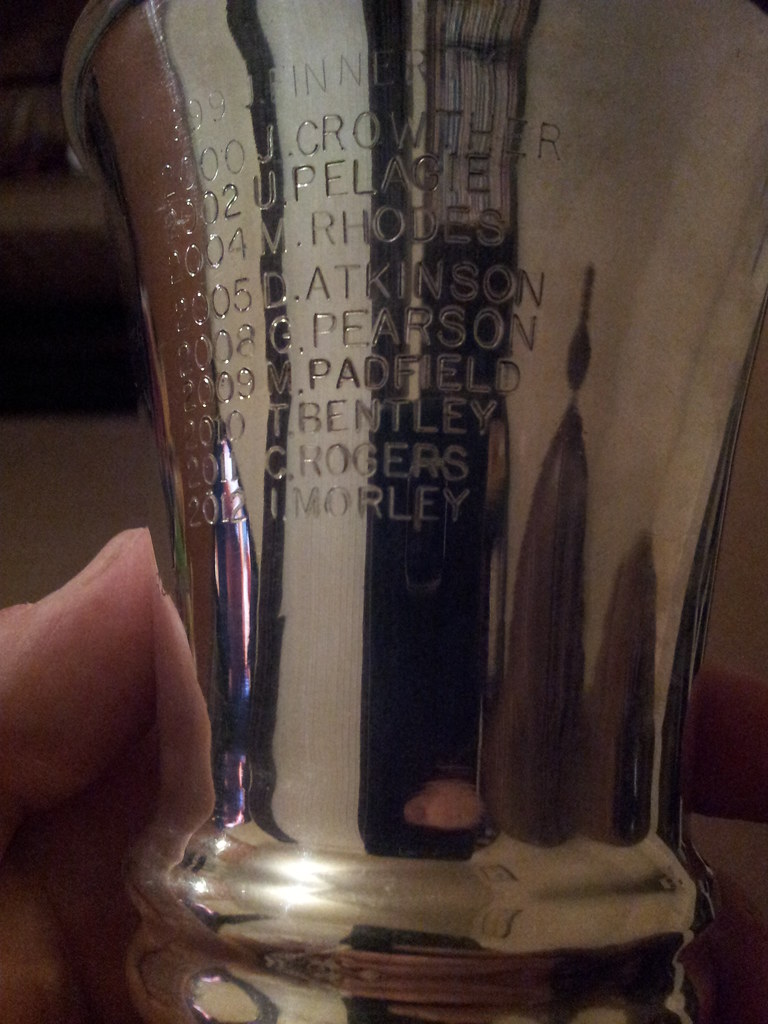
There were a lot of statistics about the financial side of the association along with how the website is going. The committee members were all voted in again without change, except for the secretary who stood down this year and a new one was voted in. The last part of the meeting was a little more interesting; it was where the various awards were given out. Most of the awards went to familiar faces, there seems to be 3 or 4 people who always do well and a couple of people that do really well but the best part for me was when they called my name out to receive a trophy for winning the Novice class at the Emley Show! I believe my face may have gone a little red when called up as I wasn't expecting an award! Even better still was when the cup was being handed to me the presenter said that even though my entry was in the novice class it could have held up in the other classes! Something to think of for next year.

After the presentation of all the awards we stopped for a tea break and I got talking to a few people, mainly people congratulating me! One guy I was talking to (the same guy I bought the huge sack of sugar from last month) had one most of the awards again this year and I jokingly said to watch out as I now have the taste for winning awards and he seemed very positive about me entering more next year. He even said that if at any point I wanted any advice he would be glad to share all he knows with me, which is great to know seeing as though he wins so many awards. He always wins the mead classes so I asked him what kind of yeast he uses and I was surprised to hear that he uses regular bakers yeast like I have been using for my mead! The rest of the meeting was taken up with the raffle, I was not so lucky this month and didn't win anything.

BeeKeeping Honey Award
First time I've seen my name engraved on a trophy!

Sunday, 27 May 2012

Apiary Inspection 25/05/2012

After all the rubbish weather we've had in Wakefield this May the last few days have been a really refreshing change, the weather has been absolutely smashing! For nearly a week now we have had glorious sunshine and I have been desperate to get to my apiary and see how my hives are doing, but have been stuck doing the late shift at work; this Friday was my first day off and as luck would be the weather was still great so I did my inspection.

When I got to the apiary I got suited up and just watched the Bees for a few minutes; there was lots of bees returning with pollen and nectar from both hives. So far so good. With the weather being so nice there would be a much reduced number of Bees in the hive as they are out foraging; due to this I decided to be brave and didn't use smoke. The first hive I went into was my original hive which had queen cells in it last time I checked. I was hoping to find the queen and mark her so I would be able to find her easier in the future. Within a couple of frames my hopes where raised when I could see eggs in the cells but a second later they were dashed slightly as I noticed some of the cells had multiple eggs in them. More than one egg in a cell can be a sign of worker Bees laying but sometimes newly mated queens lay more than one egg until they get used to laying. Also the eggs were right at the bottom of the cells which is also encouraging as laying workers will lay at the side of the cell as their abdomens aren't as long. I continued searching but was unable to find the queen. There was plenty of honey stored in the brood area and lots of pollen as well, they have even started storing some honey in the supers.

The second hive was a lot simpler. I found the queen in the second frame so there was no concerns. The hive had plenty of stores and also plenty of room to expand into the new frames. All in all I was very happy with the progress of this hive. When I moved onto the super I had a very pleasant surprise, they had started storing loads of honey and some of it looked like they where about to start capping it. This means I could be harvesting some honey very soon! As the majority of the honey will probably be from oil seed rape flower I will have to hurry up with extracting the honey as oil seed rape honey has a tendency to set solid in the cells! Hopefully that won't happen but if it does I'll just have to scrape it all out and maybe dissolve it in water to make mead!

Monday, 20 February 2012

Birthday Beekeeping and Homebrewing Gifts

It was my birthday last week and no surprise I got some presents relating to my hobbies. I received other presents but I'll only show the gifts relevant to this blog.

A beer making kit from my soon-to-be mother in law (less than 3 weeks!). I have already started this kit off and it is sat in a warm place busy fermenting. In a few weeks I will have around 40 pints of bitter!

A cookie jar shaped like a beehive. Inside there were some tasty chocolate truffles! This was off my soon-to-be aunt in law.

From my soon-to-be wife. I have only skimmed through this but intend on ready it in full in the coming weeks.

A new hydrometer and siphon tube from my sisters.

From my daughter. Hope she got mummy to buy this, not sure it would be right if they had served a 14 month old mead!

And last but by not least, again from my daughter. She was fed up of reading anatomically incorrect stories about Bees. One such book was about a male bumble Bee with 1 set of wings collecting pollen to make honey, then returning to his W.B.C. hive to make the honey comb. She is only 14 months but know how wrong it is so bought me the above book which is much better! Clever girl!

Tuesday, 24 January 2012

Home Made Lager and Other Homebrew

This is my first post of the new year as I have been too busy to write up what I've been up to. You may (or may not) remember that I started a batch of home brewed lager in my last post. Since then I have bottled and started drinking it. I didn't get any pictures of the bottling process as it was a little tricky to keep control of the siphoning tube while getting the next bottle ready and making sure the bottle I was working on didn't overflow! The process was fairly simple and at the end of it I had about 20 bottles with a litre of lager in them. Prior to bottling I had added a teaspoon of sugar to each one to allow it to ferment a slight bit more; this is what gives it bubbles. After that I put the bottles in a box and placed them next to a radiator for a few days then moved them somewhere cooler and like magic a couple of weeks later I had a lager that was not only drinkable but also quite nice!

A box of litre bottles

Bottles after being sterilized

The lids being sterilized

The finished product (and I was worried it wouldn't have enough fizz!)


I have also racked a demijohn of wine and a couple of meads. As it would be a little repetitive posting pictures of it I haven't done so. The wine I racked was my second batch of raspberry. I had a sneaky taste while I was racking and I believe this will be a strong tasting wine, my partner didn't approve too much of it. The meads I racked were a JAO mead and the ginger mead I started in late February last year! The ginger mead is tasting nice but will be better when it has aged a few more months, I intend on bottling it fairly soon. The JAO is looking like the best I have made so far. It is very clear and has a lovely golden colour to it, I didn't taste this one as I have a good idea what it tastes like already. This will be bottled soon also and possibly 1 bottle will be hidden away for 17 years as a birthday present for my daughters 18th!

Friday, 16 December 2011

Wine and Mead Bottled

I have been busy over the last few days bottling and racking some of my home brew. The brews I have done in the last few days have been ones where I was unable to get a initial gravity reading so I won't know how strong they are but that's half the fun.

To start with I bottled my dandelion wine (original post can be found here) as this was a smaller batch and one of the older ones. I have had a sneaky taste of it and so far it tastes quite nice, actually a lot nicer than I was expecting although this could be the flavour of the red grape juice I used. Either way if the taste gets better from what it is at the moment then I'm on to a winner and will make a much larger batch next year. I got 3 full bottles and a part bottle, the part bottle is in the fridge ready to drink and the others I have stored in the loft to age; by ageing the wine I hope to further improve the flavour.

Dandelion wine in home made Demijohn, dilute pop bottle!
Bottles I've been collecting. Soaking to try to loosen the labels. The next step was to sterilize them.
The finished product bottled and now away in storage in my loft. 

The next thing I bottled was the remainder of the second batch of mead I made at the start of the year (again link for that post here). This was a really large batch and I already have 3 gallons of it stored in my earthenware demijohns (link to that post here; in that post it says I have 4 demijohns but actually I had 5) that my granddad gave me at the beginning of the year. That left me with 2 demijohns with the mead in; one of these I have left alone and the other I added more honey to a while ago although I can't find the post that says how much honey was added, oh well! I got 6 bottles from each demijohn and have stored them along with the dandelion wine. I had a small taste of the mead as it was being bottled and it has got some taste, more than it has in previous tests, it may turn out nice after all when it's aged a while.

Bottled up and ready for storage.
The sweetened mead ready for storage.
Once I'd bottled all the mead I had a few empty demijohns so while I had the equipment out I also racked one batch of raspberry wine. This batch has been going since July so is also nearly ready to bottle up but I now have a shortage of wine bottles so will be asking my dad to start saving them again for me. The raspberry wine had developed a thin layer of sediment on the bottom, which is to be expected as this was the second time I racked it, the first time it had a very thick layer of sediment. Next time there will, hopefully, be little to no sediment for when I bottle it.

And finally with the remaining demijohns I had I've made 2 further batches of J.A.O. mead as this is my favorite and easiest to do. I followed the method on this page but as with the last batch of this I made I have upped the amount of honey to 1.8kg so now have 3 demijohns full of this at various stages of development! I hope the extra honey doesn't spoil it but I doubt it will, they are all smelling rather nice and the oldest of the 3 is clearing nicely.

Solidified honey.

Not even 1kg yet. 

1.8kg dissolving in boiled water that has been left to cool for about 30 minutes

This much honey takes a long time to dissolve even with vigorous stirring


Monday, 10 October 2011

More Mead

Last Thursday should have been the day I went up to see the Bees and remove the last stage of their varroa treatment however for those who live in my area may remember that the weather was atrocious that day; there was high winds and lots of rain, hardly good weather to be opening the hive up. Instead of wasting a day I decided it would be a good idea to start another batch of mead.

So far out of all my mead I have made there has only been one I've tasted as it's a simple and quick mead that is ready in 2 months unlike others that take literally years to age properly. A lot of people would turn their noses at this mead with it being ready so fast but I don't care. It's quick, easy and it works, also to me it tastes great. The recipe can be found here. The only difference I made to the recipe was to add slightly more honey to make it a bit sweeter. This may affect how long it takes to be ready but that's no problem. I added 1.8kg instead of 1.6kg and the S.G. for this was 1.090 so at the end I will be able to work out the alcohol level rather than just guess.

I did make a slight change to the method for making this as well but it was only slight. Rather than just adding the yeast straight to honey water I added it to the sample I'd taken out to do the gravity reading. This was in a half pint glass. When I'd added the yeast to this small sample I left it 10 minutes covered in cling film (or plastic wrap if you're american!) and then returned to see how it was doing. I wasn't expecting it to have properly started in that time but I was wrong and it had already started foaming out of the glass so I moved it into a pint glass until I was ready to add it to the honey water and other ingredients. When everything was put together I placed the demijohn out of the way and will return in a couple of months (Christmas time) to see if it's ready to drink!

1.8kg of honey dissolving in boiled water.

Half pint sample with yeast in bubbling over!

Tuesday, 4 October 2011

An Update on Homebrew

Over the weekend I decided it was time to bottle my second batch of mead, which was started all the way back in January. I didn't have a hydrometer when I first started so no gravity reading was taken, which means I won't know the alcohol level of this batch.

This batch was a really large one so I have four demijohns of it to process,three are unaltered and one has been sweetened with extra honey. The unaltered ones were all that I had time to do. I started by sterilizing the vessels that the mead would be going into, in this case I am using my earthenware demijohns for this; the two earthenware vessels hold the same as the three glass ones I'm transferring from. I also added a campden tablet to the mead before in the glass demijohns; this helps by killing off wild yeast and bad bacteria. When everything was sterile I started to transfer the mead into the stone vessels.

A campden tablet crushed ready to be added.

Once completed I put a rubber bung into the larger of the two and attempted to put a cork in the smaller one. I say attempted as the hole was slightly too large for the cork. I had picked up a tip from a friend to make corking easier, which was to soak the cork first to make it go in the hole easier. I thought that this could be why the cork was too small so I tried a dry cork and found this to be same. As I had no other corks at this stage I had to start getting inventive. I thought the most suitable thing to use would be beeswax. I quickly melted some wax and then poured it around the cork making it a complete seal. I'm not totally sure if it's worked so will check it again later and use more wax if needed.

The only thing to do now is wait. During the process I have tried to mead on several occasions and unfortunately it hasn't tasted too great, in fact it tasted pretty bland though ageing the mead is supposed to improve flavour. If after a year the taste is still poor then I will still drink it but use something to mix in it, possibly ginger ale. In the future when experimenting with recipes I will make smaller batches so not as much honey is used. I still have plenty of honey that my dad acquired for me so will keep using that rather than experimenting with my own honey!


Monday, 22 August 2011

Racking

Due to recent death of my mother this is my first post in a couple of weeks so my blog has fallen behind a little. She was an exceptional mother and grandmother who always encouraged me to do the things I'm passionate about so would have wanted me to carry on with my blog. I have several things I would like to post about and the first is the racking of my mead and wine.

I had several days at racking as I have a lot of mead on the go at the moment. The 30 litre batch that I started at the beginning of the year was split into 4 demijohns a few months ago so that took a couple of days to rack. This batch is just a straight mead with no other flavourings apart from 1 of the demijohns which I added extra honey to sweeten. Though I didn't have a hydrometer to begin with I have since roughly worked out the starting gravity or S.G. to be 1.060 and the current gravity is 0.97 which would give a ABV OF 12%. This batch is also clearing nicely and will be bottled next month and then set aside to age, hopefully this will make it taste nicer!

The dandelion wine, which is in a 3 litre pop bottle, was also racked and that has a nicer smell than it had before! The colour is still similar to red wine, due to the red grape juice added, but it appears a little clearer. No gravity readings have been taken at any point on this wine so will be a wild card when it is drunk.

The lemon and ginger mead I started in March was the next. This had a S.G. of 1.090 and is now about 15-16% ABV. I did mention in a earlier post that I would bottle this at 12% but as it's already gone over I will now leave for it to run it's course. I didn't taste this while racking so am unaware if it's got a nice taste yet but in time will find out.

Finally I bottled my second batch of JAO mead. This followed the same recipe as the first batch I did but am unsure what it tastes like yet as I haven't tried it yet. I didn't write a post about this when it was started and  haven't recorded the gravity at any point so again I am unable to tell how strong it is. Oh well, that just adds an extra layer of fun when drinking it!

The dandelion wine.

Racking from the earthenware "johns"
MEAD!!!!!!

Saturday, 16 April 2011

Still Waiting

As the title suggests, I am still waiting to get my Bees. The course that I will be attending is getting ever nearer and there will be a chance to purchase Bees there. I am strongly considering buying some elsewhere as this will guarantee I get them this year as the course describes having very limited numbers of nucs available. Due to the amount of time I've been researching and preparing I would be so gutted if I didn't get going this year.

There is still much preparation needed in my Dad's allotment; the allotment committee require a 6' fence erecting around the apiary, however this will only require a days work as my Dad has already got the fence, it just needs putting in place. We plan on planting Bee friendly flowers around the apiary site to brighten it up a bit and make the Bees feel more at home.

Over the last few days I have received a couple of emails; one from Wakefield Beekeepers Association and another from DEFRA advising of European Foul Brood (or EFB) been found in a hive within 5km of me. Though this is bad news, I am glad that they have contacted me, although it won't affect me just yet (again back to the lack of Bees). I plan on adding EFB to my pests and diseases section but for the mean time I will say that it's a disease that Bees can get that effects the brood, potentially causing massive damage to the colony. There is another similar disease that is more nasty called American Foul Brood (or AFB) and I will also put this on my pests and diseases page. The American equivalent is more severe but not as common in the UK as far as I'm aware.

Recently I acquired a few more pieces of equipment from someone my sister knows who has unfortunately had to stop Beekeeping due to an allergy. The equipment I have received is mostly unused, such as frames and supers. I also got some packs of unopened wax foundation but as these had been in the garage a while had turned brittle and unusable in a hive. Not wanting to waste this wax I decided to melt it down; I used a large tall tuperware in a pan of hot water and added the foundation into the tuperware until all the wax was melted. I then let it cool and set so I can use it at a later date. There is more equipment they have available for me to purchase but I will have to wait to payday to afford any more.

My second batch of mead is going to be bottled in the next couple of days. In one of the demijohns I have added something to stop fermentation then added more honey to make it sweeter. As mentioned in one of my previous posts, my second batch didn't turn out as planned, being that I added far too little honey. This is why I'm experimenting a little with this one by adding extra honey after fermentation. As I have 4 demijohns with this batch I will probably experiment further with it by adding fruit juice to two of the other demijohns and leaving one with no additives.

Going back to my very first batch of mead, (the JAO mead) I have all but finished this off now. I tried, in vain, to store some to age, but as it was "hidden" in plain sight ended up getting opened and is now almost finished. This first batch was very sucessful and everyone who tried it agrees. There is another batch of this recipe brewing at the moment, but with slight difference being that I added a little lemon juice. Hopefully this won't change it too much. I think next time I do a large batch I will stick to the tried and tested JAO mead.

Sunday, 6 March 2011

Mead!!!!

I have finally bottled my first batch of mead, the JAO. It produced approx 3.5 Litres. The recipe I followed doesn't mention adding anything to stop secondary fermentation, however I added a campden tablet prior to bottling just to make sure no further fermentation took place. I did this as I really don't want exploding bottles of mead; one reason being I've waited a long time for it but more important is I don't want to risk hurting anyone, especially my young daughter.

This picture shows the bottled product. These are 1 Litre bottles. The mead at this point is rather cloudy but I'm advised that it will clear if left a couple of months and the taste will be better. I'm not sure I will be able to wait this long as I have already opened one of these bottles!!

In these 2 glasses are the last bits to be syphoned out of the demijohn. It is cloudier than the bottled product as part of the sediment was sucked through the tube. It was still very tasty but had a slight off taste that my unrefined palate couldn't name, but I'm putting this down to the sediment as further drinking from the bottled product had a much nicer taste and cleared appearance. If I was to try to describe the taste of the bottled product I would say it was sweet but not overly sweet, with subtle orange flavour and a warming after taste. I will certainly be making more!

The hard part now is saving at least one bottle to allow to mature. It's recommended to leave at least 2 months but I'm not sure I'll be able to. As I consider this batch a success next time I may make a larger batch, that way I would have more chance of saving some to mature. Also when I finally get some bees and am harvesting my own honey, the mead produced should be better quality. At the moment I am still using bulk commercial honey.


While searching the net for more mead recepies I came across the following guide on High Wycombe Beekeepers Association website

2 lb. honey in 1 gal. gives S.G. 1.060, potential alcohol 7.8%.
3 lb. honey in 1 gal. gives S.G. 1.090, potential alcohol 12%.
4 lb. honey in 1 gal. gives S.G. 1.120, potential alcohol 16.3%.

Dry Mead: Starting S.G. 1.085-1.105. Finish S.G. 0.990-1.000.
Medium Mead: Starting S.G. 1.105-1.120. Finish S.G. 1.000-1.005.
Sweet Mead: Starting S.G. 1.120-1.130. Finish S.G. 1.005-1.015.

Using this bit of info I tried to work out roughly how much alcohol my second batch of mead would produce. I started off working in litres and kilograms so my first step was to convert to gallons and pounds.

Using google to convert:-

6kg > 13.2lbs
30L > 6.6 gal  (in my original post it says 25L but later I checked and it was closer to 30L)

This would give a 2:1 Honey:Water ratio and approx S.G. of 1.060, potential alcohol 7.8% which is much lower than I originaly thought. I should really have used upto twice as much honey in the mix. Due to this and the lack of activity over the last few days in the recently racked mead I will be doing a hydrometer test on it soon. If the gravity reading is 1.005 or less then I believe the fermentation will have stopped and the mead will be ready, even though slightly weaker than anticipated.

Thursday, 3 March 2011

Racking The Mead

I have decided it is time to rack my second batch of mead.  I'm doing this to separate the mead from the layer of sediment at the bottom; the sediment is known as the lees.

The first step was to make sure all my demijohns are sterile. I used a sterilising powder mixed with warm water then left for 10 minutes to do it's work. I have put some kitchen towel in the necks to stop dust getting in the demijohns.

I then brought my primary fermentation vessel into the kitchen and lifted it onto a chair. This was rather heavy as it contains 25-30 litres of mead!

Next was to put the siphoning tube into the large fermentation vessel and give the tube a good suck so that the mead was travelling down the tube. I managed to get a little in my mouth so I will count that as my tasting. If I'm honest it doesn't taste too nice at the moment but it definitely has a boozy edge to it.

This shows the airlock applied to the 2 gallon demijohn.

These pictures are the same again but for the smaller demijohn....

 ....and again for the glass demijohns. In the photo on the left I've had to raise the demijohn as my siphoning tube wasn't long enough to get to the bottom of the big fermentation vessel.

 This is the sediment or Lees that is left behind. It looked and smelled rather nasty so was disposed of rather quickly!

In the above photo from left to right; Ginger and Lemon Mead, JAO Mead and the last 4 are the Mead I just racked. The JAO Mead is really near to being ready to drink as it's nearly totally clear. These are all in my daughters room at the moment; she is still sleeping in my room as she is only 3 months old. This is due to her room being the warmest and darkest as she has very thick curtains.

Tuesday, 1 March 2011

Ginger and Lemon Mead

I have started another batch of mead. This one is very experimental and again I haven't followed a strict recipe. This mead (as it contains honey, lemon and ginger) will be called medicinal mead!


To start this one off I copied instructions I had found for making a yeast starter. This involved putting a teaspoon of wine yeast in a jam jar with a couple of teaspoons of ginger and a couple of teaspoons of sugar. I then gave this a good shake and then added the juice of a whole lemon. The next thing to do was to put a piece of kitchen towel over the top to stop dust getting in. Within half an hour it was fizzing quite happily.

The next day I added another couple of teaspoons of grated ginger and the same amount of sugar. By this point it was fizzing like a freshly opened can of ginger beer and smelling like one as well!! I left the jam jar for about 12 hours then made the mead. To start I boiled a large pan of water and left it to cool; this is done to get rid of the chlorine in the water. I then weighed out 1.5kg of honey. This was easier said than done as all my honey has now solidified and I did bend a spoon or 2, I eventually went for the wooden spoon option. The honey was then dissolved in about 2 litres of the pre boiled water which was still warm so dissolved fairly easily. This honey water was then put in to a 1 gallon demijohn. The juice of 2 lemons and the rind from 1 was added into the demijohn along with a handful of sultanas and about a tablespoon of grated ginger (I didn't measure this and just added to taste). The last thing to go in was the contents of the jam jar. When all the ingredients were in I put further water in the demijohn to make it up to 4.5 litres.

Using my newly bought hydrometer I then took a gravity reading that was 1.080; this is known as the specific gravity or SG. When the mead has fully fermented I will take a further reading and then be able to work out roughly how much alcohol is in the brew by using a formula. The formula is quite complicated so I will be using an online calculator. About half an hour after adding all the ingredients and looking on the Internet at different SG levels I decided my level wasn't quite high enough so I added sugar to make my SG level 1.090. After I applied an airlock I checked back on it after about half an hour and found it to already be bubbling away very happily, almost worryingly fast!

I will now leave this in a warm place for a few months and then rack it and take another gravity measurement. If the alcohol level is 12% or above I will probably bottle it then.

This picture was taken a day after everything was put in the demijohn and you can see a layer of foam forming at the top as it is fermenting so rapidly. The bottle that is partly in the shot, to the right of the main bottle, is my first mead which is still not quite ready.


I would also like to add a note thanking my proof reader and editor, Steph, for the work she does correcting my grammar before I publish new posts. She has started writing her own blog about chickens, I think you should follow this link and have a read!

Thursday, 24 February 2011

Homebrewing Gifts from Grandad

I visited my Grandad the other day as he had told my Dad he had a demijohn or 2 that I could have. When I got there he started bringing all sorts of pieces of equipment out of a plastic bag plus had 4 Demijohns lined up behind his chair ready for me to take.


 In the image you can see a 2 gallon and 1 gallon earthenware Demijohn, these are really heavy but look excellent, they really don't make them like they used to! In front of them are 2 glass Demijohns that I believe used to be cider bottles, these are also 1 gallon. Between the 2 glass Demijohns there is a couple of lengths of tubing that are used to syphon mead/wine out of the Demijohn and in to bottles. To the front of the picture there is a variety of bits of equipment. There's a wooden corking machine, several bungs, a bag of labels, a bag of corks and 4 boxes of aluminum foil caps for adding a professional touch to the finished bottled product! If you look carefully on the red boxed equipment on some of them you can see they have a very old Boots logo on them and also on has a pre decimalisation price sticker on, though this isn't visible in picture. This shows how old some of this equipment is but all still perfectly usable if I sterilise it well. There was also a receipt in the bag that showed what I believe is last time my Grandad bought equipment and this is from 1990!


A couple of days later he brought me a bottle of his last wine he made that is from around this time, so over 20 years old, and in my opinion it was very tasty though my better half was a bit dubious. We think it is Sloe wine made from Sloe berries (obviously). He has told me he has a couple more Demijohns I can have but these still have wine in them from one of his relatives that was made before he was born, so the content of that will be at least 86 years old! I'm not sure how nice they'll be but I may have a small glass then leave it 24 hours to see if I get ill and if not then I'll drink it!


Update on current Meads

My first batch of Mead, the Jao, is very nearly ready. I find myself checking it every couple of days and each time the liquid looks slightly clearer, I reckon another week and it'll be ready to bottle. My second batch is still active but has really slowed down. Now I have all the extra demijohns I am in a good position to start racking it and then I'll get a better idea of how its going, as the container its in at the moment isn't see through.


Update on Beekeeping

Not much to say at the moment but I am now a member of BBKA and have received my welcome pack. This means I now have the liability cover needed to keep Bees in my Dad's allotment. I have also received details of the course I will be attending in May/June.


Update on Allotment

Again not much to say here. I have not heard anything back from a couple of members of my group to get my allotment so have requested these members be removed, which will put me back to needing 2 members. Finding another 1 member isn't going to be a problem but finding the second could be. I will have to put another appeal for members on Facebook. My Dad will let me use part of his allotment for growing but I would rather have my own within walking distance

Thursday, 10 February 2011

Allotment

Some time ago I did some research into acquiring an allotment and found information on http://www.landshare.net/letsgrow/ that states all I need is myself and 5 other people who pay council tax to apply together and the local council should provide allotment space. I then went on to create a group on the website and since have been patiently waiting for my group to fill up. Today I was successful in filling my group with 6 members including myself, the last 2 members where acquired rather rapidly after putting a plea on facebook. After looking at my group and list of members I got slightly annoyed as I noticed 2 members of my group have postcodes that are a long distance from me. One is in Manchester and another is in York. Upon finding this I decided these members needed contacting to see if this was just a error on the site or if they truly don't live close to me. I have sent them a pleasant email asking them to confirm if they are interested or not and hope to hear from them soon. I am going to give them a few days to get back to me before contacting the website to try to get them removed from my group, as unfortunately there is no facility to remove members from your group. I hope they respond quickly but if not a back up plan is available. As I am facebook friends with 2 interested members I can easily contact them, another member of my group seems active and lives fairly close so I will contact him through the landshare site and try to obtain his details. I do have a couple of other people who may be interested so will add their details as well and then I should have 6. Then using the template on the landshare website I will send my own letter to the council. I have no idea how long it will then take for the council to respond and then how much longer it will take for them to act upon it. Hopefully I will have a allotment area before the end of the year or next year at the latest, I certainly want one before my daughter is old enough to help. She can even have her own little corner, away from my bees, where she can plant flowers and grow what she wants (or make mud pies!).

The reasons I want to have my own allotment is so I can have somewhere close to keep my bees and grow fruit and veg. I would also consider having a couple of chickens. Also a allotment is a good outdoor social activity. I have visions of all 6 plot owners working hard in the spring and summer and then towards the end of the growing year, when it is still warm and sunlight lasts into late afternoon, clubbing together and having a outdoor feast and drink using produce from the plots. I could provide the mead from the bees and by using outdoor stoves we could cook a pot of chili with a fresh as possible side salad and baked potatoes. I would also consider building a small outdoor clay oven so we could have outdoor baked flat breads or pizzas. I will try to keep putting updates on my success or failure in this matter.

Saturday, 5 February 2011

Wakefield and Pontefract Beekeepers: January Meeting

On 31st January I attended my second Beekeepers meeting with Wakefield and Pontefract Beekeepers Association. This months meeting was about British Beekeepers Association examinations and qualifications and was hosted by a lady called Val Francis. In the presentation she covered all the certificates available ranging from a Junior Certificate all the way to becoming a Master Beekeeper.
I am too old to do the Junior Certificate but this seems to aimed more at school children or scout groups etc with the intention of hopefully getting new people into the idea of Beekeeping from a young age. I will be encouraging my 8 week old daughter to help with the Bees and do the Junior Certificate when she is slightly older!
A requirement for the first certificate I will be able to go for, the Basic Assessment in Beekeeping certificate, is that you need to have kept bees for over a year so it will be some time before I can apply for this but imagine I will go for it when I can.
After the Basic has been completed there are options as to what to do next. One path leads you down the theory route and another path leads down the practical route. There is also a Microscopy Certificate available at this stage which involves using microscopes to see inside bees to get a idea of their health and spot disease.
If you go down the theory path there are 7 modules that can be taken in any order with the exception of module 8 (there used to be 8 modules but module 4 has been removed) which has to be completed last. When the first 3 modules and any 1 other (except 8) have been completed you will be awarded the Intermediate Theory Certificate, if you then go on to complete all modules with module 8 last you will be awarded the Advanced Theory Certificate.
With the practical side there is the General Certificate in Beekeeping Husbandry and then the Advanced Certificate in Beekeeping Husbandry. These both require you to have kept Bees for a number of years and involve both practical and theory assessment but mainly practical. They involve you being able to demonstrate skills in taking the hives apart and doing checks on the Bees health. In the advanced part you need to be able to demonstrate queen rearing skills also.
When the General Certificate and the Intermediate theory have both been completed then you get the title of Qualified Beekeeper and when both Advanced Certificates are completed then you can call yourself a Master Beekeeper. I will be aiming towards Qualified Beekeeper as soon as I can with a aim of about 10 years to get there. With the Master Beekeeper qualification I won't be giving myself a time scale as there is a lot of hard work to do and it requires me to be a qualified Beekeeper first. Here is a link to the BBKA site with details of examinations and a flow chart explaining this in more detail.
There is also a certificate in becoming a show judge but I don't think this is something that really interests me.


Also at the meeting this month there was a silent auction to get hold of some equipment cheap. Unfortunately I was unsuccessful in any of my bids. Oh well, maybe next time. Also while I was there I paid my £20 subscription so I am now a official member and will have liability cover when I have my Bees. While I was there I paid for the Beginners Beekeepers course which runs through May and June and includes a option to buy a starter Nuc of Bees locally bred at a discount price. I am not sure exactly how much the Bees will be but believe they will be cheaper than I can get elsewhere so will probably try to get them from the course.


While I'm typing I may as well put a quick update on my meads. My first mead is now about half way through it's fermenting and has really slowed down with it's bubbling, it smells really nice and looks to be starting to get clearer. As soon as it is clear I will be having a taste. My other mead is still bubbling away but not as rapid as when it first started. I have changed the airlock to a different kind that makes less noise as the previous one was rather annoying. This second mead is also smelling nice and possibly smells quite a bit stronger. This mead should be ready to drink in June or July but I will need to rack it before then and will post a update at that point!
Tuesday, 25 January 2011

My Second Attempt at Mead

Not content with just having one batch of mead brewing at a time, over the weekend just gone I decided to start a second larger, more adventurous batch.

Though a simpler recipe this mead will be more challenging to make and take a lot longer. The recipe for this batch is just honey water and yeast (plus some yeast nutrients). Also with this batch I am not just following a recipe but deviating slightly and fingers crossed for a good result. I did do a little research before diving in the deep end and got a rough idea of how much honey to water I need to be using. With this I have used approx 6kg of honey diluted in water to make up to about 25 litres. I am using wine yeast due to that being the only yeast available in Wilkinsons! The original recipe I am loosely following asked for champagne yeast. The original recipe also asked for "acid blend" to be added, being unsure what this was and also not seeing this in Wilkinsons I decided to leave this out and hope for the best. Also I'm not sure in ancient times these extra additives would be available! One additive I have bought is Campden tablets, these are used to stop fermentation, I will probably use these as mead has a tendency to stop fermenting and then start again. This causes bottled mead to become dangerous due to risk of fermentation restarting and making the bottles explode! This mead I am making will have a higher alcohol level than my previous mead as it uses a yeast with a higher tolerance, I'm not sure how strong it'll be but am expecting it to be between 15% and 17%. Due to this there will be a much longer fermenting period, approx 6 months. Also this batch will need racking. This is done when there is a layer of sediment in the fermenting vessel and is done by syphoning off all the mead to leave the layer of sediment behind. This is done because this layer of sediment can effect the taste if left in too long. When it has been racked a little extra water is added to bring the level of mead back up to original volume and then it's left again to continue fermentation. Further racking may be required if more layers of sediment collect but hopefully not too many times. When fermentation has finished, and campden tablets have been added to make sure it is fully stopped, then it's time to bottle the mead. I have started saving empty wine bottles and will buy some new corks closer the time they are needed. When it is bottled it can then be left to age but no doubt I will crack a bottle open before it has had any time to age. With 25l I should have plenty of bottles to leave and forget about so they can age. I have read somewhere of mead that has been aged over 10 years but highly doubt I'll be leaving it that long before drinking!


At the moment my smaller batch of mead is bubbling away steadily after having a fast start and my larger batch is going quite vigorously after only been in for a few days, causing a loud bubbling noise approx every 3 seconds. Though I find this a very satisfiying sound it does get rather annoying after a while so will be moving the mead to another room soon. The first mead has developed a thick layer of sediment but the recipe says no to racking so I will resist and wait while march to open it!

Saturday, 8 January 2011

My First Attempt at Mead

In the past few days I have started to brew my first batch of mead. The recipe I have chosen to follow is for Jao The Ultimate Beginners Mead.

I have chosen this recipe due to it's simplicity and how quickly you get results. This mead is ready in little over 2 months. The research on the net I have done prior to making this brew always tries to steer away from using bread yeast but this recipe is designed for it. Using this yeast instead of more alcohol tolerant yeasts does produce a weaker mead but still 12% isn't bad! The honey I am using is not from my own bees (as I still haven't acquired any yet) but has been supplied by a family member in bulk and with any luck this will not affect the outcome too much. I am making approx 3.8 litres but if successful will probably make a larger batch in the future. At the moment fermentation seems to be happening quite happily with the airlock bubbling every minute or two. If I've followed the instructions correctly I should be tasting the mead as early as march and will post my thoughts on the taste as well as the views of anyone else who tastes it. Just need to get some bottles for when the mead is ready so I can store some rather than just drinking it all at once!!

Below is a few images. The first is the demijohn with all ingredients inside and airlock on top. The second is covered in black bin bag to stop too much light getting in, ideally it should be kept in a dark cupboard but I have to keep it in living room due to winter temperatures and living room being only room that is consistently warm. The final picture is a close up of the air lock.


Tuesday, 21 September 2010

Mead

One of the reasons I have decided to get into Beekeeping is obviously for the honey but there are other uses to honey than just spreading it on your toast. One of these uses is for mead production. Again with mead I have no experience making it but decided to give it a go anyway. It will be about a year before I can get started though as without any bees there's no honey and with no honey there's no mead but thought it was a good idea to start researching now.

The process for making mead looks relatively simple once you have all the equipment needed. It basically the same equipment used in making wine. It involves heating up honey and water so that all the honey is dissolved into the water, some people advise to boil the mix to kill any natural yeasts, some don't. When it has cooled you add yeast and leave to ferment for anywhere from a few weeks to a few months. I will continue to research this over the coming year and find a recipe that would be suitable to me and publish my findings. Once the mix has fermented the mead can be left for a considerable length of time, periodically racking your mead (racking is where you siphon from one container to another leaving the sediment behind), until it is ready to be bottled.
Various things can be added to mead in its production to aid fermentation and help the brew clarify but these aren't essential and I will look in to the various options closer the time.
There are many different variations of mead and one that interests me is Melomel or mead made with fruit. As my dad has a allotment that always has a abundance of plums I think at some point I will try a plum Melomel!