Blogroll

    Saturday, December 31, 2011

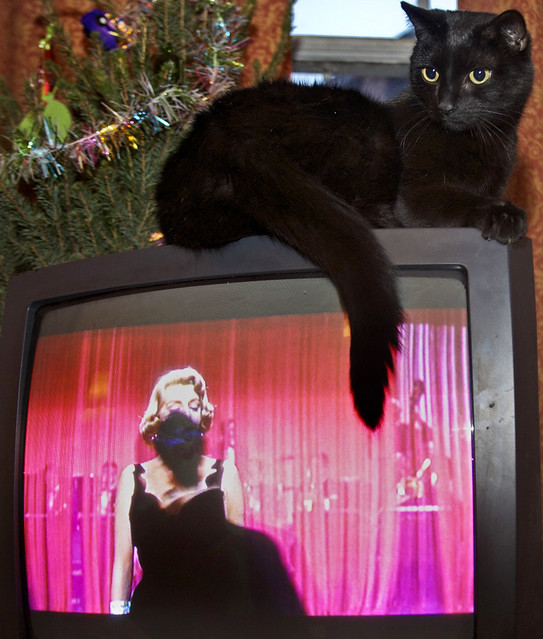
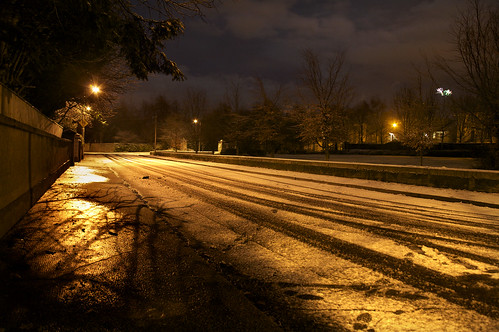
    New years snow (and firework), 12.30 a.m. 2010
    Strange dream last night (though I suppose most of my dreams are strange, after a fashion). Just remember a tiny fragment: walking along a road where a couple of small girls were playing. After I passed them one shouted 'Are you an atheist?'

    Only one answer to that: yes and no. Amis's definition of agnostic (as in acknowledging our immense ignorance in finding the right questions (never mind answers) to the great cosmic Because) is about right.

    Anyway, Happy New Year to all. As your man puts it, 'Live long and prosper' (if the latter wish is not too tall an order under the circumstances).

    Photo above is a view of our snow-crusted road after midnight on January 1st 2010 (you can see a firework going off far right). And here's a little something to go with it, if you're in the mood:

     Dublin, January 2010

    At home, hearing the knock
    of fireworks – the city uncorked

    shaking and shaking its bells –
    he peers out, listens, inhales

    real snow, newly laid
    on steps, road –– a decade’s

    slippage underscored by black
    street-lit tyre-tracks

    looping the hedged corner
    out of what was –– just –– there.

    Sunday, December 25, 2011

    Christmas Cracker

    Christmas Cracker
    Which is the more correct?
    (a) Ho fucking Ho
    (b) Ho fucking Ho-Ho
    or (c) Ho-Ho fucking Ho

    Wednesday, December 21, 2011

    A French Teacher

    French Teacher


    Mr Feutren (Fruity) isn’t from France

    but Brittany. Important. Make no mistake.

    Something –– anger? passion? –– has shorn his face

    to a bald, beak-nosed, hunched-electric presence.   


    Yes, he fought with the SS during the war.

    A Breton nationalist, why should he hide

    what he believes? What he did was justified

    (though I’m not sure who these justifications are for).


    The Irish, so stupide! Hard to believe

    how little we know, and how can we make a start

    when, in restaurants, we ignore the heart

    of artichokes, to nibble at the leaves.


    Now he has lost patience and swoops to wrench

    some slowcoach from his desk. I am in his sights

    and will be next. Because of (or despite)

    whatever he fled, he teaches excellent French. 


    When our French teacher (in St. Conleth's, Clyde Rd. Dublin) died in 2010 he left a load of papers of 'historical interest' (along with a bequest of £300,000) to The National Library of Wales. This created a minor scandal because of his historically interesting past as a Breton nationalist/collaborator in the Bezen Perrot, essentially an SS unit. He even had a proper uniform and title: SS-Oberscharführer. He fled after the war, first to Germany then Wales and eventually Ireland. Though I never learned a word of French (or much else) in school, he was a vivid presence, and apparently (according to my school friends) a brilliant teacher. So I've included him (above), in a sequence I'm working on about my school days (ironically titled 'Academic').


     PHOTO: SS-Oberscharführer Louis Feutren, ID photo for his Soldatenbuch, c. early 1945. (Bezen Perrot archives)

    Saturday, September 24, 2011

    More Spares

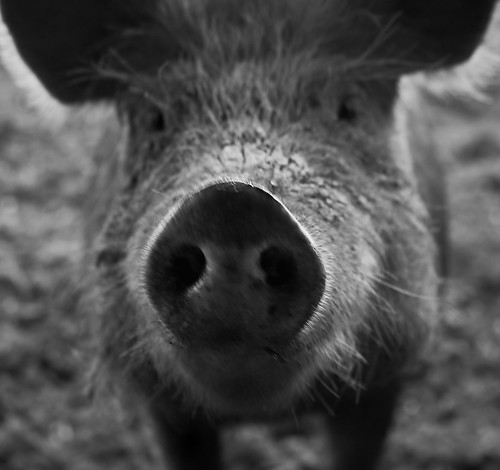
    Wexford Pig (From Tamworth)

    To call someone who has committed some atrocity 'an animal' is a gross insult to all our fellow fauna. Human is one thing, humane quite another.

    Tuesday, September 13, 2011

    The Dust Collector*

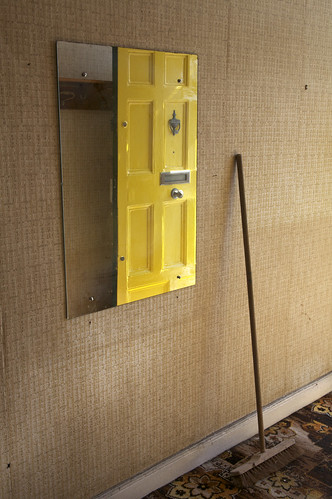
    House For Sale, Glasthule

    The Dust Collector *


    gets down on his knees

    in some corner of a cathedral, not to pray but see


    if there’s a speck, a bloom, a trace,

    or if the infernal place


    is as emptied of history

    as London’s National Gallery or the Uffizi.


    Out of ‘all these actions that took place here’, his eye falls

    on anything at all


    for the scanning electron microscope: his Rose

    Window on the genius


    of what escapes us.


    *Wolfgang Stoecker ‘My Empire of Dust’

    Sunday, September 11, 2011

    Of A Man, Falling

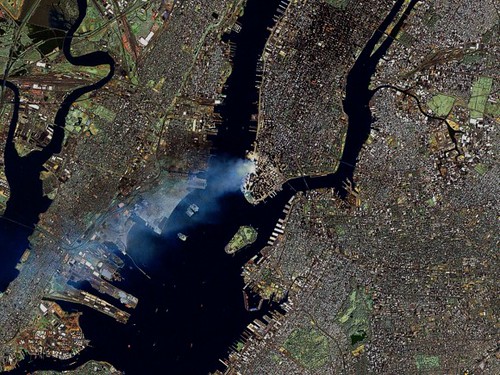
    September 11 from space (NASA/Government Image)

    At-ease-looking, almost poised –
    though his soiled shirt

    has come untucked – he might
    be attempting to pass

    the one-leg-stand test
    or lounging, between drinks,

    at a party, his back
    braced by a wall, if

    the world had not turned
    him upside down

    into the plummet
    of streetwindowsky,

    the brain in its cockpit – flight
    the flight of his thought

    a ten second freight –
    for all we know

    a counterweight.


    From my third collection, Fade Street (Salt, 2010) and my forthcoming New & Selected Poems (Salmon, 2017).

    Image 'September 11 from Space', from NASA

    Thursday, September 08, 2011

    Spares

    autoshop
    Some Epigrams and Aphorisms

    Speaking ill of the dead is one of the surest ways of keeping them alive.

    My grandfather could never master driving, but was a great believer in hitching, especially in his old age. To hitch a lift was to marry two of his pet delights, thriftiness and talk. Getting from A to B was strictly secondary; a car was a vehicle for the captive audience.

    Project ‘Iffy’: to refashion Kipling’s most cherished (and possibly worst) poem. The first stanza might begin:

    Never mind keeping your head, if you’ve some idea
    Where heads are located, while idiots who haven’t a clue
    Are scrambling, rifling the dictionary, the fridge, IKEA…
    Then blaming their headless-chicken-shit on you

    Tragically, the decline of religion in the West has done little or nothing to discourage the average individual succumbing, every now and again, to sociopathic orgies of self-worship.

    God is not Great

    says Christopher Hitchins. I say
    god is great, only
    with a small g
    and atheism with a small a.

    Memo. Beware taxi drivers who talk politics. Especially those who announce ‘I’m voting BNP’ and follow this by declaring ‘They should pull the shutters up!’[sic] These are the kind who may curtail your incredibly naive attempt to discuss such matters with a Travis Bickle glare and the accusatory conversation-stopper: ‘You’re toying with me mate, you’re toying with me!’

    Racism is the refuge of the deranged sheep, the kind that has managed to furiously pull the wool into its own eyes.

    Politics

    we can set aside as easily as the cat its fur-ball,
    the hedgehog its ticks.
    Just remember: any creature can scratch, bring up its gall.

    On Radio 4, a woman on the joys of wandering naked in a garden with fellow ‘naturists’, sniffing the roses etc. As if, while enacting a reversal of Adam and Eve’s shameful discovery, they might forget to notice each other’s nakedness. And that is what naturism is: dressing for indifference, as if this were, somehow, a virtue.

    Unless it is intended to remain hermetic, I think the worldlet created in any given poem should have at least some aspect of the familiar. But its greater obligation is to provide the Three S’s: Surprise, Surprise, Surprise.

    Aerialist

    To condemn the wide-eyed, well-balanced poem for staying on the fence
    that is its glory
    makes as much sense
    as reprimanding a novel for telling a story.

    Auden (who sang the praises of the permeable limestone landscape) called poetry ‘memorable speech.’ I think great, or even just good, poems should have at least an element of this; they should resonate in the way that a good song or piece of music does. If they manage that I will forgive them much, including a good deal of impermeability.

    Historical irony should come tempered with humility. What Milosz called ‘praising art with the help of irony’ can ruin a poem. And weak irony, the smirk behind the frown (or behind the scream, in silly movies such as ‘Fright Night’) is good for nothing but guffaws. Yet irony is the iron in literature’s blood. Life itself is intrinsically ironic, its brightening flare never quite touching the end of the bricked-up tunnel.

    Diversion

    Having long since bypassed the old distillery,
    we overshot the bypass. These days
    most tributaries are in a hurry
    to forget how to praise.

    Saturday, August 13, 2011

    On The Reek

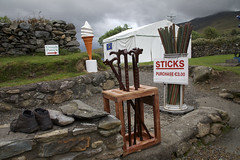
    Boots, Walking Sticks & Ice Cream: Croagh Patrick Pilgrimage, 2011

    Than longen folk to goon on pilgrimages
    Except it isn’t April but the end
    of a dark, damp summer.

    **

    So we drive through Saturday and pull in
    at the evening car park: artic lorries, shops
    for fast food, ice cream, the great white elephantantry
    of shiny statues, rosaries, scapulars, all

    the luggage you might need for what loured ahead:
    blue-green slopes decapitated by cloud,
    the most ominous-looking mountain I ever dreamed
    of setting foot on

    **

    yet already there, above the burger stand,
    the variously coloured trickle is in place:
    people marking a zigzag route, a bright
    sprinkle of hundreds and thousands.

    **

    Only the third tallest in the county,
    somewhere between a mountain and high hill,
    yet there is something in those compact angles,
    a rough-drawn, broody pyramid, a hay rick
    of the older gods: Pagan Cruachán Aigle
    where sinister Crom Dúbh hangs out.

    **

    My cousin’s idea: we’d bring along our cameras,
    keeping in mind our icon, Josef Koudelka’s
    black and white: three men in shirts and jackets
    kneeling, bent over their staffs in the 1970s,
    backdropped by a geological matinee,
    the islands in Clew Bay.

    **

    A relief, a break, an adolescent lapse:
    to be more or less footloose on the road
    in our fifties, remembering similar trips
    when next to no one depended on us, and we
    depended on little enough, our old friendship

    that took us to odd corners, a procession in Louth,
    or longer ago (when driving our own cars
    seemed exotic as marriage, a child, a house…),
    when it made perfect sense to try to hitch
    from Dublin to Dingle after six in the evening
    to a New Year’s party in Cong; to fall asleep
    in a warm car and wake on the outskirts of Limerick,
    to walk and walk and walk and walk and walk
    through flat, mizzling darkness till we saw

    a light in an upstairs window, above a lounge-bar,
    and called till the window opened and a man in a vest
    growled: ‘What the fuck are you doing, hitching
    to Tralee at this hour of the night?’ Then closed the window
    only to open his door: ‘Step into the light
    and let’s look at you.’

    **

    A road atlas, a tent, duvets, sleeping bags
    (and sleeping pads), as if we could shore up
    against our old, well-tested indecisiveness;

    a bit of rain and the wipers wipe all thoughts
    of camping, out. I phone and book a room
    in The Ocean Lodge, some miles and a burst of starlings

    past Lousiberg: a place I haven’t been to
    since my first visit, in my early 20s
    properly camping with an organized friend:

    wave-thump, sizzling sausages, the white noise
    of The Milky Way. Or the evening we followed a trail
    of posters on lampposts, for a 'Disco Inferno’

    which, it turned out, was for youngsters, girls and boys
    sipping ‘minerals’ on opposite sides of the hall,
    a mirrorball stirring the floor.

    **

    The shower goes on in a nearby room and I wake
    again, to the humming and roaring, in a music box
    lodged under a waterfall.

    **

    Intending to be there by 7, we make it by 9.
    Apocalypse weather. An army chopper harrows
    overhead towards the party-coloured trail

    that has thickened since yesterday, its two streams –
    going up coming down – looking from here
    like a convergence, aftermath of survivors
    migrating to and from.

    **

    A rack of ashplants, freshly hewed, for sale
    lined against a dry stone wall: €5. Beautiful.
    But carrying a camera and bulky shoulder bag…

    I buy a one-litre bottle of water, follow
    the flow, past the man with the megaphone
    holding up a picture of Padre Pio,

    the first of a gauntlet of leaflets, holy hustlers
    of burnished Truths, Pro-Lifers, Born Agains…
    washed out by a stream’s low chuckling

    under bramble: a lift.

    **

    The starting point: white Adze-Head on a plinth
    in Popish robes, holding a shamrock: below him,
    eddying around his feet (three times or seven?)
    the clack and thunk of walking sticks, and the talk
    circling clockwise.

    **

    The first or last or once-in-a-life-timers,
    the charity climbers and record breakers (twelve times
    in twentyfour hours or twice a day for a year),
    the old man with a sanguine smile who’d climbed it
    forty years ago ‘…and always said
    I’d come and do it again like.’

    **

    Each must carry something, a belief,
    grievance or grief, a camera, a curiosity
    or sure-footed uncertainty as to why
    we are here, or anywhere.

    **

    Among the backpacked and walking-booted the odd
    white feet, black-soled, mud squelching through toes
    bleeding a little from the sharper stones,
    or gingerly working their way down, off the track,
    over soothing bracken and grass. A woman passes
    singing quietly, a couple chanting the rosary,
    a lanky man in a white linen suit and hat,
    working his ashplant, loping ahead, spotless
    apart from his shoes and cuffs, a teenager talking
    to herself (but no, it’s her phone).

    **

    Another rocky stretch and I feel it now,
    every step in my bones and tendons: scree,
    (a lovely word, like shale): decisive crunch
    of heels on quartzite gravel, and the gold seam
    farther down, the one the Mayo council
    declared ‘fine where it is’.

    **

    Are you keeping faith with Mohammed or the mountain
    or neither of them, or both?

    **

    Steepening more and more, till it’s an effort
    to raise the head higher than rising ground,
    the Order of Malta in high-vis yellow jackets
    at their dome tent, watching us pass.

    **

    Near the first stall (bales of bottled water),
    off to the left the mountain dips and rolls
    into The Saddle, maybe seventy feet
    to a dark blue tarn: encircled by stones, words:
    INDIA, BILBAO, RUSSIA… a nesting place
    for mapless geography, borders melted away:
    countries, cities, continents laid out
    in cloud-script, an SOS.

    **

    Steepening towards the summit, the air is dense
    with mountain-breath. We come to a cairn broad
    as a hay stack: the first station, and again
    that eddy of people circling clockwise; I start
    to step in line then don’t; that rote rotation
    Van Gogh’s tight grey roundabout of men
    in a prison exercise yard.

    **

    Nothing but wet scree now, going up and up,
    and the others coming down, half toppling
    onto us. So that’s what the sticks are for,
    to be dug like oars into sliding rocks as they stumble
    downwards into the upcoming Sisyphean
    rubble on conveyor belts,

    **

    and then we are becoming there, becoming solid
    as the blocky mirage of stone huts like Slievemore’s
    ghost village, but with blue tarpaulin roofs
    weighed down by ballast-rocks: dealing out Mars Bars,
    Club Orange, crisps… and why not? Prayer is trade,
    a mark-up for the ones who made it, soaked
    queuing on muddy shale laced with a froth
    of jostling empty bottles.

    **

    A hoarse Ave Maria like a hand
    wiping at condensation; murmuring walls,
    people walking in circles doing the stations,
    kneeling, bent over their sticks (as in Koudelka’s,
    though today the view is closed)

    **

    a lank-haired old man sagging, bowing to grip
    the grave-rails the bed

    **

    roving restlessness of little groups
    thickening before the cloud-pale chapel,
    the priest in his glassed-in pulpit intoning mass
    over a tannoy (a dismal background strumming
    as someone strangles a guitar)

    **

    two gorgeous traveler girls with great hooped earrings

    **

    a family group: four children with the parents
    unpacking sandwiches

    **

    a lad with his arm draped on a smiling girl
    sitting on a rock (a seat on a bus, a snug,
    side of an unmade bed)

    **

    Purgatory’s kitchen: someone has left
    the kettle on. High time to shuffle off
    like precipitation, find the weaker force,
    the clogged rockslide down.

    **

    Weeks later I remember the first time
    I climbed a mountain (or high hill) in West Cork
    rapidly, in my sixteen-year-old stride,

    how I found a dead bird and hoped I hadn’t stepped on it,
    a cairn of stones at the top I dubbed ‘the alter’,

    and nearby, in a little grassy hollow,
    an egg-shaped boulder (plucked up and laid there
    by the erratic ice-gods) and how it came:

    the muttering stream of the first poem I ever wrote,
    whose words I never fully understood:

    something about the compulsion to climb and hear
    ‘the loud mouths the soft mouths of cows
    tearing the grass from rock’ and ‘the sea climbing

    the sand’, and what it felt like to look down
    at our orange tent ‘waving up’ and try
    to sing ‘the small song of the beast that might love
    the impossible delicate gift.’
    Sunday, June 12, 2011

    Opening Lines

    Overflowing Gutter

    FATHER: I like the sound of rain on the car roof.

    SON: So do I.

    FATHER: What else do you like the sound of?

    SON: I like the sound of rain on a balloon.

    FATHER: What tastes do you like?

    SON: I like the taste of the salt of the sea on my skin.

    Tuesday, May 03, 2011

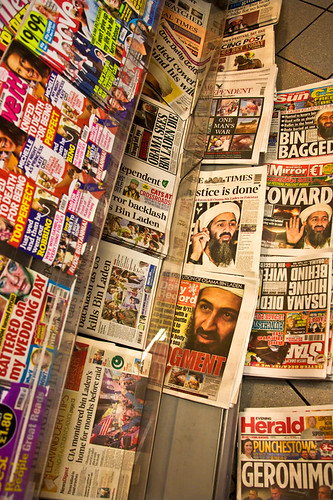
    Geronimo (or I Read the News Today Oh Boy)

    I read the news today oh boy...
    I was in Wexford at my wife's parent's place when I heard. The initial reports seemed muddled or contradictory, and it now appears that many of them were: that OBL was living in a 'luxury compound' (called 'ramshackle' on The News At Ten), that he returned fire with the Navy Seals (apparently he was unarmed), that one of the helicopters was shot down (apparently it made a hard landing and had to be destroyed), that OBL attempted to use his wife as a 'human shield' (it now appears that she was considerably more animated than any shield and got shot in the leg for her pains). Then there is the matter of that strange and speedy burial at sea, though apparently they have genetic proof that the target actually was OBL. More significantly, there is talk of film footage, evidence apparently too gruesome to be released to the public.

    So, the reportage continues, and probably will for some time, a rich compost of fact and rumour, out of which will sprout who knows what conspiracy theories, myths, books, films, etc. As Heaney put it so perfectly in his take on an ode by Horace, 'anything can happen.' A soft-spoken man with a Guru-beard can be responsible for nearly 3000 deaths (in three fell swoops), can in fact be the architect of the slaughter and, not incidentally, the demolisher of that very singular dual-edifice, the 'twin towers', which Norman Mailer so detested, calling them 'two huge buck teeth', declaring 'the ruin more beautiful than the buildings.'

    The act reverberated, and still does, a tuning fork for a different century, a different way of being uncertain. For me (as with most people, I imagine), it also embodies a particular time and place in my own life. I have, at most, a very dim memory of where I was when the Kennedys or John Lennon were killed. But I can recall exactly where I was when September 11 took place. I was with my cousin Isobel, looking for some decent coffee in a supermarket in the little town of Silvesh in Portugal. We were there with our mothers, Sheila and Nuala (both in their early eighties at that stage) and their older, very English sister, Moira. Isobel had arranged the holiday, which turned out to be the last time these sisters would travel together. We had been there perhaps two weeks at this stage, two thirds of our holiday, well-settled in the house we were renting: white arches, cool tiled floors and marble stairs, with a lovely large pool, all nested among lemon groves at the end of a long, loudly crunching stone-and-dirt lane which trailed and twisted under leafy canopies, through a wildly barking farm, before emerging onto the hot, smooth road into town.

    Being the only driver, I had agreed to rent a car at the airport and follow the instructions and map sent by the estate agent. A silly plan. I had never driven outside Ireland and we soon became lost. As evening abruptly switched to night, we ended up in a tiny village off the motorway, with hardly any idea where we were. Stressed and tense, I entered a roundabout the wrong way, and when a lone motorist speeded towards me and honked aggressively I shouted at him (stating the obvious): 'Can't you see I'm a fucking tourist?' Unfortunately, all this occurred under the eyes of a couple of local policemen, so we had to pay an on-the-spot fine of 80 Euro.

    We finally gave in and called the estate agent. She arrived fairly quickly and offered to lead us to the villa, a journey of perhaps twenty minutes or so. When her taillights took a totally obscure turn into the unmarked drive I realised that we would never have found the place. As we followed her car around the narrow bends, we began to discern an odd orangy flickering, as if the whole horizon were aflame and we were entering some ominous fairy tale. I can still hear Moira's queenly, unruffled drawl: 'Oh my god, we're driving into a forest fire.' And there was a forest fire, or a bushfire anyway. But it was far more distant than it had appeared. I came down to breakfast to find the lemon groves untouched, but on a rounded, not-too-distant hillside you could see the damage: a little crest of spent match-sticks.

    So, back to the supermarket two weeks later. We asked a couple of Scottish tourists if they could help us find some coffee, and they did their best. Before parting, they asked us (by the way, as it were) if we'd heard about Manhattan being 'under attack'. We thought they must be regurgitating some half-digested tidbit. Then, a little later, walking through the charming narrow streets, possibly in search of a little café, somewhere with a bit of shade to sit and talk (and drink coffee), we noticed a modest crowd bulging out from a little sports shop. We became curious when we realised they were all gazing at a TV mounted on the wall inside. Then we saw the planes, the orange-black plumes, indelible and unforgettable. I had thought till recently that what we had seen was one of the endless action replays, but Isobel has since told me that she checked the time and is now convinced that we actually witnessed the second plane hitting its target in 'real' time.

    Of course we wanted more information, but we were in Portugal. Back at the house, the only English-speaking TV was an American business channel (might have been CNBC) mainly concerned with stockbroker news, though we were given the occasional update or interview, and endless reruns of the exploding towers along with old footage of OBL, probably taken in Afghanistan. Thus we became familiar with the man's placid features, in his white robe or camouflage-jacket in the Afghan mountains, seemingly at ease, holding some weapon or other. Was OBL a suspect or had he claimed responsibility in those first days of the 'new world order'? I remember wondering why he didn't declare his hand more quickly, since everything had gone so spectacularly to plan. What could be more perfect? Not merely 'terrorism' but, as Martin Amis coined it, 'horrorism', an OTT 'Die Hard' sequel in brutally ironic (though in some ways even less real) flesh and blood.

    Other things conspired to make that holiday memorable. It had been memorable in a good way up till then, the ladies relaxing in the pool, my mother's infernal arthritis all but forgotten.. After The Event, we kept the TV on, hopeful for some more detailed news in between financial updates; the screen followed us around the living room like an unsleeping eye and we were neither there nor there, in an anteroom of one of 'those big words that make us so unhappy.' Then, towards the end of our holiday, the youngest sister, Nuala (Isobel's mother), began to feel a bit shaky in her legs. This occurred perhaps a day before we left. We didn't know the signs, or didn't know them well enough, though Isobel was worried. We managed to get her mother to a doctor on the day of our departure. He didn't appear too concerned, advised a scan as soon as it might be convenient.

    The airport was chaotic, long queues, police and soldiers with automatic weapons, our mothers in wheelchairs. We had to dump anything sharp, so mum sacrificed a pair of decorative old nail scissors, her mother's. Nuala was groggy now. We tried to decide whether we should try to get her back to that doctor; I even made a call, but nobody spoke any English and I hadn't a word of Portuguese or Spanish. And suddenly our queue was on the move, we could be back in Dublin in a couple of hours. So we boarded, and Nuala went into a coma. I asked one of the cabin crew if they could call ahead to have an ambulance ready in Dublin. This was a mistake, and we were a hair from being told to leave the plane (they don't fly gravely ill passengers), but we managed to convince them (or they allowed us to convince them) that it wasn't all that serious after all, no worries, we'd be fine, honestly.

    We did manage to get an ambulance very shortly after landing, and though Nuala had a 'massive cerebral hemorrhage' she survived another decade, and weathered a few more strokes, to die peacefully, and mercifully quickly, in St Vincent's hospital last year. And Moira, the eldest, has recently died at nearly 95. And now they've shot the man who loomed so large in that strange, dislocated holiday. It all might have happened last week, or yesterday.

    A couple of other things Mailer said in the aftermath of September 11: 'I'm always dubious about patriotism.'So am I, though I can understand the jingoistic flag-waving, the celebrations, and even emapthise a little with the festival atmosphere that must prevail in American cities, especially NY. Who could argue with the mother of one of the firefighters who died that day, her belief that this is what he would have wished? Mailer thought Georg W. Bush seemed like 'a man who had never been embarrassed by himself.' Absolutely. So I am very glad it was Obama's terse, grave sentence 'Justice has been done' that helped set the mood, a counterpoint to all the misplaced optimism and gaiety. Imagine if this had happened on GWB's watch; the thick-skulled, insufferable gloating, the victory parades, the great, self-congratulatory banquet of bullshit.

    Tuesday, March 01, 2011

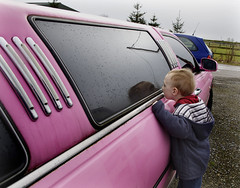
    6 a.m. Question Time

    Pink Stretch Limo

    Daddy?

    [sleepily] Yeah?

    I have a question for you.

    What?

    What are stretch limos for?

    [blank pause]

    Are they for Rock Stars?

    Wednesday, February 23, 2011

    Throw It Away, Why Don't You?

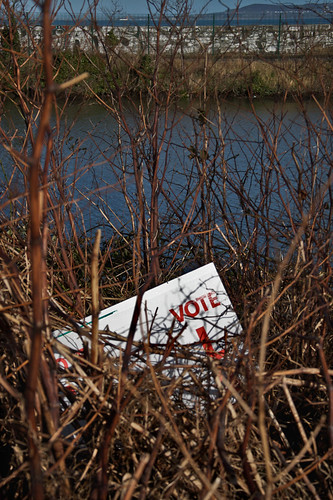
    vote labour
    What is a short memory good for? Forgetting.

    Forgetting that Fine Gáel is part of the same old deeply compromised Civil War machinery that created Fíanna Fáil.

    Forgetting that terms like 'Blueshirt values' are rancid, stinking with irony.

    Forgetting that part of our problem is our gullibility.

    Forgetting that 'liberal economic policies' are what landed us in this.

    Forgetting that our innate conservatism (in thrall to the banks' and big business's Happy Hour) is what landed us in this.

    Forgetting that FG's pride in 'fiscal rectitude and minimal government interference' (not to mention 'liberal economic policies') should make our scalps creep and our hair (if we possess any) stand on end.

    Forgetting that it's high time to change the channel.

    Forgetting that, if we must use terms like 'values', Labour's are worth voting for.

    Forgetting that, if we do not change the channel (or at least modify it), we may get what we deserve: a FG government who have a mandate to do whatever they they like.

    Sunday, February 13, 2011

    A Place On A Map

    River_Nile_and_Bulaq_by_Piri_Reis
    Reading Katy's blog today, about the recent events in Egypt, I found myself commenting rather extensively, so felt it might be more pertinent to say my piece here, since this is not only a blog, but also functions as my personal journal, my space for disentangling thoughts.

    Not that my thoughts are going to amount to very much. Egypt, whether in its present incarnation or as depicted in the 15th Century (above) is, for me, a place on a map. I've read some travelers' accounts (or I think I have, though I can't recall them) and seen numerous programs about the Egypt of the Pharaohs. I love Cavafy's poetry, and in my 20s I raced (and waded) through Durrell's Alexandria Quartet. But I know next to nothing about Egyptian politics or people.

    Mubarak's was, apparently, a horrifyingly corrupt and brutal regime, so good riddance to it. At least 300 people have been killed, but an objective has been achieved; a government has been overthrown by the very people it had thought to govern for perhaps another 30 years. And now what? The Muslim Brotherhood (slogan: 'Islam is the solution') is in the wings, or close to the stage. Should they step into the spotlight, are they likely to bring in a more egalitarian society, or go the way of Iran and steer the revolution into a narrow, airless cul-de-sac?

    Katy also posted this moving Youtube vlog by Asmaa Mahfouz, who is said to have helped 'spark the revolution'. Asmaa is earnest and passionate (and her delivery seems, to me, to have some of the chanting, incantatory music of a poem). Although she begins by mentioning how four men burned themselves in protest, I like the way she insists that people should NOT burn (i.e. 'martyr') themselves, but simply come onto the streets and support each other. The only thing that distances me slightly (due to my own cultural tics and reservations) are the references to peoples' 'manhood' and, finally, God.

    One of the commentators on Katy's blog wrote: Bless the martyrs. Really? What I would wish, if I felt qualified to wish anything, is that the Egyptians somehow wind up with a society we might call democratic (botched, battered and degraded as that word is); a society, in any case, is which martyrdom doesn't play a part, is, in fact as alien to the citizens as the repressions of the police state they are struggling to emerge from. I would also wish for widespread empathy and a tolerance that extends to those who have no religion: the atheists, the agnostics, the hopelessly befuddled or those who barely give a thought to such things. I would wish for the wonderful scope and sanity of human scepticism that recoils in disgust and utter contempt from repressing or persecuting anyone merely because of their race, politics, gender or sexual orientation (or religion). Something along those lines anyway; if I had anyone (or thing) to pray to I'd pray for that, or for the whopping dose of good luck that is long overdue the Egyptians, not to mention the Bahrainis, Iranians, Libyans, etc, etc.

    Photo from Wikipedia: Nile River Valley and the city of Bulaq, as seen by Piri Reis, a Turkish admiral, geographer and cartographer who lived from 1465 to 1555.