כי הא דרבה ב"ר הונא מחתך ליה אתלת קרנתא
The statement that Raba Bar Rav Huna cut meat in a triangular shape occurs three times in the Talmud. 1. Beitzah 28a, 2. Bava Metziah 23b, and 3. Chulin 95b.
In all three cases Rashi explains this in a similar manner, that he cut the meat into three cornered pieces. (אתלתא קרנתא). In Beitzah, Rashi uses the language היה רגיל לעשות כל חתיכה בעלת שלש קרנות. In Bava Metziah Rashi writes that it means עושה החתיכה בת ג' קרנות. And in Chulin, Rashi writes לכל חתיכה ג' קרנות.
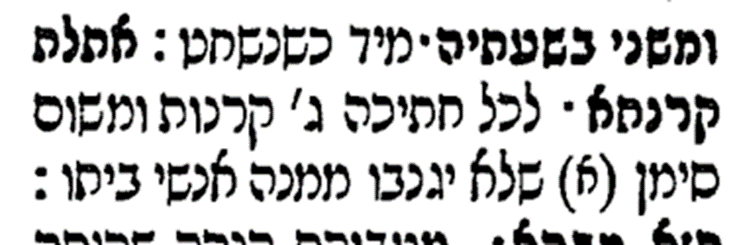
In the Vilna Shas on Beitzah 28a, Rashi helps explain the words” אתלתא קרנתא” by using the word “כזה” and includes a picture of a triangle.

Rashi is presented in a similar manner in Bava Metziah 23b

Curiously, however, on Chulin 95b there is no “כזה” and no picture of a triangle
There is good manuscript evidence that on Beitzah 28a, Rashi included the word כזה and a picture of a triangle
The Palatina Library, Parma, Cod. Parm. 2903 – 13th-14th century

There is also good manuscript evidence that on Bava Metziah 23b, Rashi included the word כזה and a picture of a triangle
Vatican Library, Ms. ebr. 131 – 14th century.
https://digi.vatlib.it/view/MSS_Vat.ebr.131

It turns out that there is compelling manuscript evidence that Rashi included the word “כזה” and a picture of a triangle on Chulin 95 b.
To review, in Chulin 95 the Gemara states that Rav would eat meat which was recognizable by a distinguishing mark on it, in the manner of Rabah bar Rav Huna who would cut the meat into a triangular shape (אתלת קרנתא)
אלא רב היכי אכל בשר? ….אי נמי בסימנא כי הא דרבה ב"ר הונא מחתך ליה אתלת קרנתא
Rashi explains that he cut each piece into a triangular shape as a distinguishing mark so that members of his household would not steal from it.
אתלת קרנתא - לכל חתיכה ג' קרנות ומשום סימן שלא יגנבו ממנה אנשי ביתו:
As mentioned, the way it is presented in the Vilna Shas is without the word “כזה” and without a picture
Vilna 1882

A look at manuscripts indicates that the original Rashi did have “כזה” and did have a picture of a triangle
This manuscript includes the word כזה and it has a triangle
https://www.nli.org.il/en/manuscripts/NNL_ALEPH990001861250205171/NLI
Vatican Library Ms. ebr. 139 – dated 1411
https://digi.vatlib.it/view/MSS_Vat.ebr.139

This manuscript is even more clear as to Rashi’s intent
The Palatina Library Parma Italy Cod. Parm. 2589 – 14th century
https://www.nli.org.il/en/manuscripts/NNL_ALEPH990000951770205171/NLI#$FL17257673
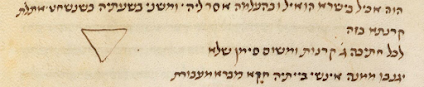
This is manuscript is also clear
The Palatina Library Parma Italy Cod. Parm. 2756- 14th century
https://www.nli.org.il/en/manuscripts/NNL_ALEPH990000836780205171/NLI#$FL20876810

This manuscript has a more complex picture
University Library Johann Christian Senckenberg Frankfurt am Main Ms. Oct. 159 – 13th-14th century (Note: This is the Merzbach manuscript referenced below in Dikdukei Sofrim)
https://www.nli.org.il/en/manuscripts/NNL_ALEPH990001381060205171/NLI#$FL64910830

This manuscript has כזה without the picture, but it clearly indicates that there was one.
Trinity College Library Cambridge England Ms. F 12 17 – 15th century
https://www.nli.org.il/en/manuscripts/NNL_ALEPH990001811970205171/NLI#$FL59969301

Dikdukei Sofrim on Chulin (פרעמישלא 1897) notes the presence of a drawing in Rashi in a manuscript


The first printed edition of Hullin, that of Soncino 1489, does not have “כזה” or the triangle – Either it was copied from a manuscript which did not have it, or the printers decided not to include it. (see comment of Dr Aharon Ahrend below)

The Bomberg Venice edition of 1521 was patterned after Soncino.[i] Therefore, it was not included in this edition and from then on, it was not included in Rashi.

Dr. Aharon Ahrend sent me this comment on the diversity of the manuscripts which were accessed to indicate the presence of a triangle in the “original Rashi”.[ii] He also commented on why possibly the Soncino imprint did not include the picture.
לגבי שאלתך, ההיגיון אומר שאם רש"י נקט ציורים בב"מ וביצה אזי גם בחולין היה ראוי שינקוט, אף כי זה לא מחייב, שכן לפעמים רש"י נוהג כך ולפעמים כך. אבל כשיש חמישה עדים זה הרבה, ושים לב שהעדים לא נכתבו באותה אות אלא הם מאזורים שונים, וגם יש הבדלים ביניהם באשר למילה 'כזה' ובאשר לציור עצמו, מה שמעיד על כך שאינם מאותו מוצא. העובדה שהם כותבים 'כזה' מחזקת את ההשערה שרש"י צייר זאת.
הדפוס פעמים רבות השמיט ציורים, כי בדפוס זה מצריך עבודה של שמירת רווח עבור הציור ואח"כ הכנת הציור וקביעתו במקום.
Modern editions of the Talmud keep the צורת הדף of the Vilna Shas, but they often have a section in which they note variant Girsaot. I would suggest that such a section include the fact that multiple “כתבי יד” of Masechet Chulin 95b include the word “כזה” in Rashi, and have a picture of a triangle.
gmb 090
[i] Printing the Talmud: From Bomberg to Schottenstein. Mintz and Goldstein, Editors, New York, 2005, article by Marvin Heller, page 74.
[ii] Dr Ahrend has authored four critical studies of Rashi on various Masechtot
פירוש רש"י למסכת מגילה: מבוא ומהדורה, 368 עמ', הוצאת מקיצי נרדמים, ירושלים תשס"ח
פירוש רש"י למסכת ראש השנה: מבוא ומהדורה, 370 עמ', הוצאת מוסד ביאליק, ירושלים תשע"ד
פירוש רש"י למסכת סוכה: מבוא ומהדורה, 686 עמ', הוצאת מוסד ביאליק, ירושלים תשפ"א
פירוש רש"י למסכת ביצה: מבוא ומהדורה, 648 עמ', הוצאת מוסד ביאליק, ירושלים תשפ"ד
