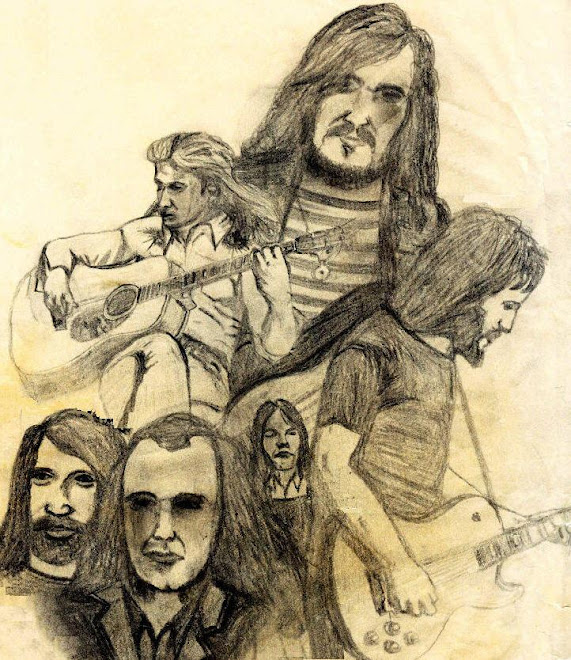
Looking at the music of Dutch rock band Focus, started in the late sixties by Thijs van Leer (b /31/03/48) with Jan Akkerman (b 24/12/46). Van Leer still performs and records under the name today (official site here). Akkerman's site here.

.

.
Showing posts with label Note. Show all posts

20111117

Track by track 115 Remember Mozart/Hurkey Turkey

Archive number: 115
Title: Remember Mozart/Hurkey Turkey
Main Album: Focus 9 (New Skin)
Track number: 3
Genre: Progressive Rock Instrumental
Studio: Fieldwork Studios, Schoten, Belgium
Length: 04:02
Composer: van Leer
Musicians: Thijs van Leer – Hammond organ, piano, keyboard, flute, voice; Niels van der Steenhoven – Guitars; Bobby Jacobs - Bass; Pierre van der Linden - Drums
Producer: Bobby Jacobs and Thijs van Leer
Engineer: Han Nuijten
Label: Red Bullet
Date of recording/release: Summer 2006
Alternative version: None
Notes: Following a drum beat there is a slow, deliberate introduction led by a five note guitar, bass and piano riff, more or less repeated eight or nine times (01:00-0024). Next comes a more tuneful section, hailed by a Mozartian trill and featuring the flute along with the band and harpsichord-like keyboards (from 00:25). This goes on until 01:12 when first the guitar then the keyboard (01:13-01:17) re-introduce the opening theme backed this time by van Leer's improvised flute (01:18-01:40). This leads to the central motif, van Leer's piano and band backed voice, based on the famous Mozart piece Alla Turca (hence the titles). That sections ends at 02:16 (slowing down before speeding up again from 02:02). At 02:17 the opening intro is played in slightly lengthened form for the third and last time, backed this time by squealing and wild electric guitars. At 02:52 we come out again with the tuneful and flute dominated second section broken up only by two brief sections on what sounds like acoustic guitar and keyboard (03:12 03:23) and keyboard with flute (03:41-03:46). The piece ends with a note from the flute.
The third movement of Wolfgang Amadeus Mozart's Piano Sonata No. 11 in A major, K 331 (300i) (from WIkipedia) is a sonata in three movements:
1. Andante grazioso — a theme with six variations 2. Menuetto — a minuet and trio 3. Alla Turca: Allegretto in A minor and major.
All the movements are in the key of A major or A minor; therefore, the work is homotonal. A typical performance of the entire sonata takes about 20 minutes.
It is uncertain where and when Mozart composed it; however, Vienna or Salzburg around 1783 is currently thought to be most likely.
The last movement, Alla Turca, popularly known as the Turkish Rondo or Turkish March, is often heard on its own and is one of Mozart's best-known piano pieces. It imitates the sound of Turkish Janissary bands, the music of which was much in vogue at that time. Various other works of the time imitate this music, including Mozart's own opera The Abduction from the Seraglio.
Repeated notes, repeated ornaments, and loud/soft passages are characteristic of the Alla turca style. The imitation probably came closer with the piano of Mozart's day, whose bass strings made something of a rattle when played loudly, than is possible on modern pianos.
In Mozart's time, the last movement was sometimes performed on pianos built with a "Turkish stop", allowing it to be embellished with extra percussion effects.
Moreover, this third movement is implicitly related to the first one, because the beginning of the "Rondo" can be seen as an additional variation of the "Tema" of the first movement, varied in the Janissary style.

20100531

Track by track 109 Holy Graal

Archive number: 109 [u]
Title: Holy Graal
Main Album: Unreleased
Track number: 2
Genre: Mediaeval
Studio: Bolinha Studio
Length: 02' 28”
Composer: Jan Dumee, Thijs van Leer
Musicians: Thijs van Leer – Flutes; Jan Dumee – Vocals, acoustic Guitars, Drum, Tambourine Producer: Thijs van Leer
Engineer: Unknown
Label: None
Date of recording/release: This track was recorded in 2006 at the start of preparations for the album Focus 9 – after the departure of Bert Smaak but before the departure of Jan Dumee. It has been made available on Jan Dumee's website.
Alternative version: None
Note: We begin with a slow percussion backed flute section (00:00-00:21). The vocal, backed by guitar and some flute begins at 00:22 and ends at 01:57. At 01:04-01:15 a short choir-like non-verbal section comes in backed only by guitar, the flute returning at 01:44. The final instrumental section features guitar, flute and percussion (01:58-02:28). The words appear to be in Old French or something similar.
Note on Holy Graal (From Wikipedia)
The word graal, as it is earliest spelled, appears to be an Old French adaptation of the Latin gradalis or gradale, meaning 'by degree', 'by stages', applied to a dish brought to the table in different stages or services during a meal. After the cycle of Grail romances was well established, late medieval writers came up with a false etymology for sangréal, an alternative name for "Holy Grail." In Old French, san graal or san gréal means "Holy Grail" and sang réal means "royal blood"; later writers played on this pun. Since then, "Sangreal" is sometimes employed to lend a medievalising air in referring to the Holy Grail. This connection with royal blood bore fruit in a modern bestseller linking many historical conspiracy theories. The Holy Grail is a sacred object figuring in literature and in certain Christian traditions, most often identified with the dish, plate, or cup used by Jesus at the Last Supper and said to possess miraculous powers. The connection of Jospeh of Arimathea with the Grail legend dates from Robert de Boron's Joseph d'Arimathie (late 12th century) in which Joseph receives the Grail from an apparition of Jesus and sends it with his followers to Great Britain. Building on this theme, later writers recounted how Joseph used the Grail to catch Christ's blood while interring him and that in Britain he founded a line of guardians to keep it safe. The quest for the Holy Grail makes up an important segment of the Arthurian cycle, appearing first in works by Chrétien de Troyes. The legend may combine Christian lore with a Celtic myth of a cauldron endowed with special powers. The development of the Grail legend has been traced in detail by cultural historians: It is a legend which first came together in the form of written romances, deriving perhaps from some pre-Christian folklore hints, in the later 12th and early 13th centuries. The early Grail romances centered on Percival and were woven into the more general Arthurian fabric. Some of the Grail legend is interwoven with legends of the Holy Chalice. The Grail plays a different role everywhere it appears, but in most versions of the legend the hero must prove himself worthy to be in its presence. In the early tales, Percival's immaturity prevents him fulfilling his destiny when he first encounters the Grail, and he must grow spiritually and mentally before he can locate it again. In later tellings the Grail is a symbol of God's grace, available to all but only fully realised by those who prepare themselves spiritually, like the saintly Galahad. There are two veins of thought concerning the Grail's origin. The first, holds that it derived from early Celtic myth and folklore. Meanwhile, other scholars believe it began as a purely Christian symbol. Another recent theory holds that the earliest stories casting the Grail in a Christian light were meant to promote the Roman Mass. It was around the time of the appearance of the first Christianised Grail literature that the Roman church was beginning to add more ceremony and mysticism to this particular sacrament. This theory has some basis in the fact that the Grail legends are a phenomenon of the Western church. Most scholars today accept that both Christian and Celtic traditions contributed to the legend's development, though many of the early Celtic-based arguments are largely discredited. The general view is that the central theme of the Grail is Christian, even when not explicitly religious, but that much of the setting and imagery of the early romances is drawn from Celtic material. The Grail is first featured in Perceval, le Contedu Graal (The Story of the Grail) by Chrétien de Troyes, who claims he was working from a source book given to him by his patron, Count Philip of Flanders. In this incomplete poem (from some time between 1180 and 1191), the object has not yet acquired the implications of holiness it would have in later works. Though the earliest and most influential account, it was in the work of Robert de Boron that the Grail truly became "Holy" and assumed the form most familiar to modern readers - in the verse romance Joseph d’Arimathie (composed between 1191 and 1202).

20090126

Track by track 81 Indian Summer

Archive number: 81
Title: Indian Summer
Main Album: Focus (1985)
Track number: 4
Genre: Progressive Rock Instrumental
Studio: Studio Spitsbergen, Zuidbroek, Groningen, The Netherlands (mixed at Dureco Studios, Weesp, The Netherlands)
Length: 05' 49”
Composer: Jan Akkerman
Musicians: Jan Akkerman - Synthesiser Guitar, drum machine, Acoustic guitar; Thijs van Leer – Keyboards inc synthesisers, Flute; Tato Gomez – Bass; Ustad Zamir Ahmad Khan - Tabla; Fairlight programmed by Ed Staring.
Producer: Ruud Jacobs with Jan Akkerman, Thijs van Leer and Theo Balijon
Engineer: Emile Elsen, Jan Akkerman and Theo Balijon
Label: Mercury (Phonogram)/Vertigo
Date of recording/release: Recorded 1985 Released LP/CD -1985 CD – 1989
Alternative version: None
Notes: Van Leer took us to Russia and Argentina and here Akkerman turns to India for inspiration. First, we hear a sitar-like lead guitar backed by synthesised drums and electric bass (00:00-00:51). From 00:51 van Leer's keyboards join in with brass and flute sounds of a grand, more western sort. From 01:29 things get very eastern with an energetic flute-led, tabla-backed sound. An Indian-sounding guitar or keyboard also features. From 02:00 a Spanish guitar can also be heard as can other more conventional guitar sounds as the piece moves on. At 02:53 the tablas become more prominent again as the previous themes continue. There is a distinct slowing down from 03:34 in keeping with the flute style. However, just when the music is about to die things revive again with brassy keyboards and later guitar (eg at 05:06). Eventually, we come to the final melt down, the end of which is punctuated by a final strong synthesised drumbeat (05:47-05:49).
Note on tabla (from Wikipedia)
The tabla is a popular Indian percussion instrument used in classical, popular and religious music of the Indian subcontinent and in Hindustani classical music. The instrument consists of a pair of hand drums of contrasting sizes and timbres. The term tabla is derived from an Arabic word, tabl, which simply means "drum".
The instrument's history is uncertain and has been the subject of sometimes heated debate. The most common historical account credits the 13th century Indian poet Amir Khusrau with its invention when he split a single Pakhawaj drum into two parts. However, none of his writings on music mention the drum. Another common history suggests that the tabla is thousands of years old, yet critics assert this is mere conjecture, based on slipshod interpretations of iconography. The most reliable historical evidence places its invention in the 18th century. The first verifiable player of tabla was Ustad Sudhar Khan of Delhi. The smaller drum, played with the dominant hand, sometimes called dayan ("right") but correctly the "tabla" is made from a conical piece of mostly shesham or teak and rose wood hollowed out to approximately half its total depth. One of the primary tones on the drum is tuned to a specific note, thus contributing to and complementing the melody. The tuning range is limited though different dāyāñs are produced in different sizes, each with a different range. For a given dāyāñ, to achieve harmony with the soloist, it will usually be necessary to tune to either the tonic, dominant or subdominant of the soloist's key. The larger drum, played with the other hand, is called bāyāñ ("left"). The bāyāñ has a much deeper bass tone. It may be made of brass (most common) or copper (more expensive but generally held to be best) while aluminium and steel are often found in inexpensive models. One sometimes finds wood used (especially old bāyāñs from the Punjab). Clay is also used, although not favoured for durability (generally found in the North-East region of Bengal). The playing technique for both drums involves extensive use of fingers and palms in various configurations to create a wide variety of sounds. On the bāyāñ the heel of the hand is also used to apply pressure, or in a sliding motion, so that the pitch is changed during the sound's decay. This "modulating" effect on the bass drum and the wide range of sounds possible on the instrument as a whole are the main characteristics that make tabla unique among percussion instruments. Both drum shells are covered with a head (puri) constructed from goat or cow skin. An outer ring of skin (keenar) overlays the main skin and serves to suppress some of the natural overtones. The two skins are bound together with a complex woven braid that also gives the entire assembly enough strength to be tensioned onto the shell. The completed head construction is affixed to the drum shell with a single continuous piece of cow or camel hide strap laced between the braid of the head assembly and another ring (made from the same strap material) placed on the drum's bottom. The strap is tensioned to achieve the desired pitch of the drum. Additionally, cylindrical wood blocks (ghatta) are inserted between the strap and the shell allowing the tension to be adjusted by their vertical positioning. Fine tuning is achieved by striking vertically on the braided portion of the head with a small hammer. The skins of both drums also have an inner circle on the head, the syahi ("ink"). This is constructed using multiple layers of a paste made from starch (rice or wheat) mixed with a black powder. The precise construction and shaping of this area allows modification of the drum's natural overtones, resulting in a clarity of pitch and a variety of tonal possibilities unique to this instrument. The skill required for the proper construction of this area is great and is where the quality of a particular instrument is most likely to differ. For stability, each drum is positioned on a toroidal bundle called chutta or guddi, consisting of plant fibre or other malleable material wrapped in cloth.

20090123

Track by track 80 Le Tango

Archive number: 80
Title: Le Tango
Main Album: Focus (1985)
Track number: 3
Genre: Progressive Rock Instrumental
Studio: Studio Spitsbergen, Zuidbroek, Groningen, The Netherlands (mixed at Dureco Studios, Weesp, The Netherlands)
Length: 04' 49”
Composer: Thijs van Leer/Roselie Peters
Musicians: Jan Akkerman - Synthesiser Guitar, drum machine; Thijs van Leer – Keyboards inc piano and synthesisers; Sergio Castillio – Drum fills; Fairlight programmed by Ed Staring.
Producer: Ruud Jacobs with Jan Akkerman, Thijs van Leer and Theo Balijon
Engineer: Emile Elsen, Jan Akkerman and Theo Balijon
Label: Mercury (Phonogram)/Vertigo
Date of recording/release: Recorded 1985 Released LP/CD -1985 CD – 1989
Alternative version: van Leer has recorded this number more than once elsewhere
Notes: Van Leer has said that he heard the Polish-American pianist Arthur Rubinstein (1887-1982) saying how much he loved the tango (it is in a 1969 documentary on his life L'amour de la vie). It led van Leer to write this number with his then wife. Here, we begin with loud guitar and drums from Akkerman (00:00-00:12) but the track quickly slips into the familiar tango rhythm, provided chiefly by van Leer's piano (00:13-00:38). From 00:39 and a torpedo-like sound that occurs again at times (eg 01:03, 01:36) the two elements combine, staccato rhythm predominating over slight melody (00:40-02:38). A much faster guitar-led section follows (02:39-03:08) before returning to the previous staccato style. Not really getting anywhere the track begins to fade from about 04:30.
Note on the tango (from Wikipedia)
Tango is a musical genre and is used for its associated dance forms. It is traditionally played by a sextet, known as the orquestra typica (2 violins, piano, double bass, 2 bandoneons). Earlier forms of this ensemble sometimes included flute, clarinet and guitar. Tango music may be instrumental or include a vocalist. It is well-known across much of the world, along with the associated dance, which originated in (lower-class districts of) Buenos Aires, Argentina and Montevideo, Uruguay. Early tango was sometimes known as tango criollo.
The music derives from the fusion of various forms from Europe. Jorge Luis Borges (El idioma de los argentinos) writes:"Tango belongs to theRio de la Plata and it is the son of Uruguyan “milonga” and grandson of the “habanera”. The word Tango seems to have first been used in connection with the dance in the 1890s. The music's deep roots cannot be fully known but it is safe to assume that it is a combination of musical traditions from Spain, West Africa, Central Europe and North America, in chronological order.
Even though the present forms are 19th century, there are records of 18th and early 19th century tango styles in Cuba and Spain, while there is a flamenco tango dance that may share a common ancestor in a minuet-style European dance. All sources stress the influence of the African communities and their rhythms, while the instruments and techniques brought in by European immigrants in the second half of the 19th century played a major role in its final definition, relating it to the salon music styles.
The first tango ever recorded was made by Angel Villodo and played by the French national guard in Paris. Villoldo had to record in Paris because there was no recording studio in Argentina at the time. Early tango was played by immigrants in Buenos Aires. The first generation of tango players was called "Guardia Vieja" (the Old Guard). By the end of the 19th century, the music was heard throughout metropolitan Buenos Aires. It took time to move into wider circles. In the early 20th century it was the favourite music of gangsters who visited the brothels, in a city with 100,000 more men than women (1914). The complex dances that arose from the music reflect the habit of men practicing tango together in groups, expressing both machismo and sexual desire, leading to the form's distinct mix of sensitivity and aggression. The music was played on portable instruments (flute, guitar, violins, etc). The organito, a portable player-organ, broadened the popularity of certain songs.
Like many forms of popular music, the tango was associated with the underclass, and the better-off Argentines tried to restrict its influence. In spite of the scorn, some were fans. A poem describes the music as like the "all-absorbing love of a tyrant, jealously guarding his dominion, over women who have surrendered submissively, like obedient beasts".
The tango has attracted many musicians and has become part of the repertoire for some classical musicians. One of the first classical interpreters to "cross over" was baritone Jorge Chamine, who worked with bandoneonist Olivier Manoury. Since then, Yo-Yo Ma, Danile Barenboim, Placido Domingo, etc, have performed and recorded tangos. Among classical composers who have written tangos are Albeniz (in España 1890), Satie (1914), Stravinsky (1918) and John Cage (1984). Many popular songs in the US have borrowed melodies from tango.

20090119

Track by track 79 King Kong

Archive number: 79
Title: King Kong
Main Album: Focus (1985)
Track number: 2
Genre: Progressive Rock Instrumental
Studio: Studio Spitsbergen, Zuidbroek, Groningen, The Netherlands (mixed at Dureco Studios, Weesp, The Netherlands)
Length: 03' 47”
Composer: Jan Akkerman
Musicians: Jan Akkerman - Synthesiser Guitar, Acoustic guitar; Thijs van Leer – Synthesisers, Flute; Fairlight programmed by Ed Staring
Producer: Ruud Jacobs with Jan Akkerman, Thijs van Leer and Theo Balijon Engineer: Emile Elsen, Jan Akkerman and Theo Balijon
Label: Mercury (Phonogram)/Vertigo
Date of recording/release: Recorded 1985 Released LP/CD -1985 CD – 1989
Alternative version: Akkerman incorporates a version into a suite on Live at the Priory
Notes: In the House of the King tradition, this track begins briefly with harp-like synthesiser (guitar?), 00:00-00:05, before breaking into first a more soaring (00:06-00:38) then a more jazzy flute-led element, backed by synthesised and acoustic strummed guitar with percussive sounds (00:39-01:45). When this breaks down we are back with the more soaring (01:46-02:18) then the more jazzy flute parts again (02:19-02:34). Next comes a guitar and (slapped-thigh-like) percussion section with guitar harmonics (02:35-02:49) and a brief drum fill (02:50). Finally, we head back to the soaring flute lead (02:51-03:40) and end with the flute backed by bubbling synthesisers.
Note on King Kong (from Wikipedia)
King Kong is the name of a fictional giant gorilla from the fictional Skull Island, who has appeared in several works since 1933. These include the groundbreaking 1933 film, the film remakes of 1976 (and then 2005) and numerous sequels. His role in the different narratives varies from source to source, ranging from mindless monster to tragic antihero. The rights to the character are currently held by Universal Studios, with limited rights held by the estate of Merian C Cooper (the originator of the character).

Track by track 78 Russian Roulette

Archive number: 78
Title: Russian Roulette
Main Album: Focus (1985)
Track number: 1
Genre: Progressive Rock Instrumental
Studio: Studio Spitsbergen, Zuidbroek, Groningen, The Netherlands (mixed at Dureco Studios, Weesp, The Netherlands)
Length: 05' 50”
Composer: Thijs van Leer
Musicians: Jan Akkerman - Synthesiser Guitar, drum machine; Thijs van Leer – Keyboards inc piano and synthesisers; Tato Gomez – Bass; Fairlight programmed by Ed Staring.
Producer: Ruud Jacobs with Jan Akkerman, Thijs van Leer and Theo Balijon
Engineer: Emile Elsen, Jan Akkerman and Theo Balijon
Label: Mercury (Phonogram)/Vertigo
Date of recording/release: Recorded 1985 Released LP/CD -1985 CD – 1989
Alternative version: None
Notes: This is the popular Focus style but without the yodelling. The track is introduced with what appears to be a synthesised guitar, slow and moody, backed by synthesised keyboards and a drum machine (00:00-00:52). It moves to a guitar-led section (00:53-01:54) where the piano can be heard backing up the main theme. At 01:55 a faster section with synthesised timpani cuts across things (01:55-02:33) before a move back to the slower yearning melody (02:34-03:33). The quicker piece is then repeated (03:34-04:13). At 04:13 we move into another melodic section (04:13-05:30) that picks up on some earlier themes before an abbreviated quick-paced segment comes in for the last time but soon fades (05:31-05:50). Perhaps the Russian part of the title acknowledges a debt to Tchaikovsky or someone similar.
Note Russian Roulette (from Wikipedia) The term is used for a potentially lethal game of chance in which participants place a single round in a revolver, spin the cylinder, place the muzzle against their head and pull the trigger. Russian suggests a country of origin and roulette refers to the element of risk taking, the spinning of the revolver's cylinder being reminiscent of the spinning of a roulette wheel. The game's form can be as varied as the participants or their motives (displays of bravado, suicide, etc), but typically a single round is placed in a six-shot revolver resulting in a 1 in 6 (c 17%) chance of the revolver discharging the round. The revolver's cylinder can either be spun again to reset the game conditions, or the trigger can be pulled again. Using revolvers with fewer chambers (typically 5) or increasing the number of rounds are variations that increase risk. Legends abound regarding its invention. Most, predictably, are set in Russia or occur among Russian soldiers. In one, 19th century Russian prisoners are forced to play the game while prison guards bet on the outcome. In another version, desperate and suicidal Russian Army officers play the game to impress each other. Whether Tsarist officers actually played it is unclear. If the game originated in real life behaviour not fiction, it is unlikely that it started with the Russian military. In Russian literature a book entitled A Hero of our time by M Lermontov (1840, translated Nabokov 1958) mentions Russian Roulette. Russian roulette was made famous worldwide by 1978 movie The Deer Hunter, which features three soldiers captured during the Vietnam war and forced to play Russian roulette as their captors gamble on the results. Their captors demand an especially brutal variation of the game: continuing until all but one contestant is killed. The game takes place in a bamboo room above where other prisoners are held, so that the losers' blood drips down on future contestants. Several teen deaths following the movie's release caused police and the media to blame the film's depiction of Russian roulette for inspiring the youths.

20081124

Track by track 75 Tokyo Rose

Archive number: 75
Title: Tokyo Rose
Main Album: Focus Con Proby
Track number: 7
Genre: Jazz Rock Vocal
Studio: EMI Studios, Hilversum, The Netherlands
Length: 5' 05"
Composer: Roselie van Leer, Thijs van Leer
Musicians: P J Proby – Vocals; Eef Albers- Electric Guitars; Thijs van Leer – Flute, Piano, Hammond organ; Bert Ruiter – Bass; Steve Smith - Drums
Producer: Yde de Jong
Engineer: Jan van Vrijaldenhoven/Mike Stavron
Label: LP – EMI
Date of recording/release: Recorded/released 1978 LP – 1978 CD – 1998
Alternative versions: None
Notes: As with the previous track, we begin with a classical introduction possibly stolen from Brahms. This time the flute joins the piano. (00:00-00:44). The band then kicks in at marching pace and Proby (sounding very like Presley at times) begins to half sing half speak the lyric. The vocal is then punctuated by the guitar-led instrumental as indicated.

Hahaha, hey you know something?
World War II wasn't all that much fun, 
Specially if you didn't even have a gun.
Well, you know you gotta go through it if you wanna get to it,
and I can tell you I did,
but no thanks to a little lady.
She was, uh, she, she kept us up all hours of the night.
Hell, half the time we didn't have time to fight.
But I don't think I would have to expound much further
 'cause everyone knows 'bout Tokyo Rose.
(Instrumental break at 01:32-02:31)
Hehaha, lemme tell you a little more. Scared?
Christ, I was so damned scared I could crawl under a snake's belly,
with a top hat on, without even touching it.
That's how scared I was.
Shit, who wants your ass blown off when you don't even know if it's kosher.
You know, kind of like when you went to school.
Always breakin' the rules, thinkin' nobody knows.
Haha, but don't kid yourself, baby, the lady in the classroom knows, 
nd her name? You got it - Tokyo Rose.
(Instrumental break at 03:20-04:18)
Lord, have mercy. Ha, I feel like I'm teaching class.
I gotta go through it all over again,
'cause you haven't learned your lessons now.
I don't want to give you a bad report card,
so I say, do you know that World War II wasn't fun.
Have you got that down, Jim? Right on,
especially if you didn't have a gun.
Well, you know you gotta go through it
if you wanna get to it.
And I can tell you I did, but no thanks to a little lady,
yeah, she kept us up all hours of the night.
Hell, half the time, we never had time to fight.
And, uh, yeah, there's no sense of me expounding any further.

The end is again quite sudden.
Note on Tokyo Rose (from Wikipedia)
Tokyo Rose (or Tokio Rose) was a generic name given by Allied forces in the South Pacific during World War II to any of approximately a dozen English-speaking female broadcasters of Japanese propaganda. Their intent was to disrupt the morale of Allied forces listening to the broadcast near the Japanese mainland. The name is most strongly associated withIva Toguri D'Aquino, who broadcast under the pseudonym "Orphan Ann" during the 15-20 minute DJ segment of the 75-minute The Zero Hour programme on Radio Tokyo (NHK). Other women who, separately or together, may have warranted the title include American Ruth Hayakawa (who substituted for Iva on weekends) and Canadian June Suyama ("The Nightingale of Nanking"), who also broadcast on Radio Tokyo, and Myrtle Lipton ("Little Margie"), who broadcast from Japan-controlled Radio Manila.
Tokyo Rose has been the subject of two movies and four documentaries. Both in 1969 and 1976 CBS broadcast documentaires on the subject. 1969: The Story of "Tokyo Rose", CBS-TV and WGN radio documentary written and produced by Bill Kurtis. 1976: Tokyo Rose, CBS-TV documentary segment on 60 Minutes by Morley Safer, produced by Imrel Harvath.

Track by track 72 Eddy

Archive number: 72
Title: Eddy
Main Album: Focus Con Proby. Also a single in 1977 b/w Sneezing Bull.
Track number: 4
Genre: Rock Vocal
Studio: EMI Studios, Hilversum, The Netherlands
Length: 5' 49"
Composer: Eef Albers
Musicians: P J Proby - Vocals; Eef Albers - Electric guitars; Thijs van Leer – Hammond, Bass Synthesiser; Bert Ruiter – Bass; Steve Smith - Drums
Producer: Yde de Jong
Engineer: Jan van Vrijaldenhoven/Mike Stavron
Label: EMI
Date of recording/release: Recorded 1977 Released 1978 LP – 1978 CD – 1998
Alternative versions: Roselie van Leer (Peters) sings an earlier version on van Leer's solo O my love and Jo De Roeck sings on a later version on Focus 9
Notes: The band open with bass and drums and 'violined' guitar and organ (00:00-00:09) then Proby comes in pleasantly crooning the lyric as follows

Just like Eddy in the morning
He never said, although he could
I know someone who would, but
He never woke to have an ear

Yes I think of things unnoticed
Like what happens in the egg
As it lies without motion
Just like Eddie's sleeping head

When I come home in the morning
Softly as I tread the dawn
I know things that are important
That have only just begun

I'm gonna fly away
Here I go here I go here I go
I'm gonna fly away
Here I go here I go here I go

Seeing you across the table
Smiles are dying on your face
Being here with my heart open
Seems a little out of place

I'm gonna fly away
Here I go here I go here I go
I'm gonna fly away
Here I go here I go here I go (repeated twice)

All the way, the guitar plays some fine licks against the vocal, which finally becomes breathless, insistent then indistinct, dying with a scream at 4:33, when the band takes over. The vocal is lost a little in the mix.
Note on Eddy
Eddy van Leer is Thijs van Leer's father. He plays with Thijs on the track Hommage (Song for pa) on the Thijs van Leer solo album Reflections. Van Leer senior, a competent classical flautist himself, bought his son a flute and gave him his first lessons when Thijs was around 11 or 12.

Track by track 71 Nightflight

Archive number: 71
Title: Nightflight
Main Album: Focus Con Proby
Track number: 3
Genre: Progressive Jazz Instrumental
Studio: EMI Studios, Hilversum, The Netherlands
Length: 3' 35”
Composer: Eef Albers
Musicians: Eef Albers - Electric guitars; Thijs van Leer – Mellotron, Electric piano, Synthesisers; Bert Ruiter – Bass; Steve Smith - Drums
Producer: Yde de Jong
Engineer: Jan van Vrijaldenhoven/Mike Stavron
Label: EMI
Date of recording/release: Recorded 1977 Released 1978 LP – 1978 CD – 1998
Alternative versions: None
Notes: This lively but unremarkable and rather jazz track zips straight in, led by guitar. The pace quickens and gets jazzier at 00:41. A distinctive hornlike synthesiser sound comes in at 02:44-02:55 followed by a brief guitar solo then a break down and fade.
Note on Nighflight (from Wikipedia)
Nightflight is also the name of a 1975 song with vocals by Led Zeppelin, a 1933 film starring Clark Gable and a 1931 novel by the aviator Antoine Saint-Exupéry.

20081115

Track by track 70 Orion

Archive number: 70
Title: Orion
Main Album: Focus Con Proby
Track number: 2
Genre: Progressive Rock Instrumental
Studio: EMI Studios, Hilversum, The Netherlands
Length: 3' 58”
Composer: Eef Albers
Musicians: Eef Albers - Electric guitars; Thijs van Leer – Hammond organ, Electric piano; Bert Ruiter – Bass; Steve Smith - Drums
Producer: Yde de Jong
Engineer: Jan van Vrijaldenhoven/Mike Stavron
Label: EMI
Date of recording/release: Recorded 1977 Released 1978 LP – 1978 CD – 1998
Alternative versions: None
Notes: This atmospheric track fades in with a hypnotic treble guitar and drums. A heavy, distorted power chord is hit at around 00:17 then takes up the lead with the starting theme continuing in the background. A chord change at 01:19 moves things along without the original background music. Things slow and come to something of a halt at 02:03 before the hypnotic guitar and drums return and the sequence is more or less repeated a second time to the dreamy melting end.
Note on Orion (from Wikipedia)
Orion was a giant huntsman in Greek mythology who Zeus placed among the stars as the constellation of Orion. Ancient sources tell several different stories about him. There are two major versions of his birth and several of his death. The most important recorded episodes are his birth somewhere in Boetia, his visit to Chios where he met Merope and was blinded by her father, Oenopion, the recovery of his sight at Lemnos, his hunting with Artemis on Crete, his death by the blow of Artemis or of the giant scorpion which became Scorpio and his elevation to the heavens. Most ancient sources omit some episodes, several tell only one. These various incidents may originally have been independent, unrelated stories. It is impossible to tell whether omissions are simply for brevity or represent real disagreement.
In Greek literature he first appears as a great hunter in Homer's
Odyssey, where Odysseus sees his shade in the underworld. The bare bones of his story are told by Hellenistic and Roman collectors of myths but there is no extant mythological record of his adventures comparable to that of others.
Orion served several roles in ancient Greek culture. The story of his adventures as the hunter is the one we have most evidence on (though not very much). He was venerated as a hero, in the Greek sense, in the Boetia region. One aetiological passage suggests he was responsible for the present shape of the Straits of Sicily.

20081111

Track by track 69 Wingless

Archive number: 69
Title: Wingless
Main Album: Focus Con Proby
Track number: 1
Genre: Rock Vocal
Studio: EMI Studios, Hilversum, The Netherlands
Length: 5' 32”
Composer: Thijs van Leer, Roselie van Leer
Musicians: P J Proby – Vocals; Eef Albers - Electric guitars; Thijs van Leer – Hammond organ, Electric piano; Bert Ruiter – Bass; Steve Smith - Drums
Producer: Yde de Jong
Engineer: Jan van Vrijaldenhoven/Mike Stavron
Label: EMI
Date of recording/release: Recorded 1977 Released 1978 LP – 1978 CD – 1998
Alternative versions: None
Notes: This vocal track is bookended by a short reverbed instrumental introduction (00:00-00:37) quite dreamy and a heavier, wilder and longer reverbed instrumental conclusion (03:08-05:32) that eventually fades. There is also a reverbed guitar-led instrumental break at 01:33-02:08 between the second and third verses. The words are as follows

I'm a bird but I am wingless
On a treetop way up high
Springtime's coming green and reckless
How I long and long to fly
But my love I get so restless
Thinking of you all the time
While my heart moves free
I'm solid 
Wish that I could move around
While my heart was fixed forever
Fixed in love without the fear
That one day I'll be without you Is it true, and is it near?
Sunlight starlight love your laughter
And the love of gentle hearts
And beyond the face of the loved one
There you'll find the face of God

The words are sung well in a yearning rock ballad style but are slightly overwhelmed by the band until the final line, where everything slows and dies down before taking off again for the final section.
A note on P J Proby (from Wikipedia)
Born James Marcus Smith, November 6, 1938, Houston, Texas, this singer, songwriter and actor is noted for theatrical portrayals of Presley and Orbison and interpretations of old standards in the vein of Nat king Cole or Tony Bennett. His stage name was suggested by friend and songwriter Sharon Sheeley who remembered an old boyfriend with the name.
His father was VP of a big bank. He was educated at various military academies and later moved to California to be a movie actor. As Jett Powers he had minor roles and 2 singles on an independent label went unnoticed. In 1962 he began writing and recording demos for artists such as Elvis and Johnny Cash. Sheeley took him to audition at Liberty Records. He soon created his fashion image of a pony-tail tied back with a ribbon, swashbuckling pirate shirts and buckled shoes. In addition, he wore skin-tight suits of velvet in different colours. London based from 1964 he began to have hits but a royalty dispute broke his run of UK successes.
His career was also affected by controversy. His trousers split during a concert. Women in the audience went wild. Somehow, they split again at the next venue. Critics, and the audience, were divided on whether it was a gimmick or eccentricism. During a 1967 concert they split again and he was dropped from the rest of the tour.
Back in the US he had a hit but poor managerial advice led to him briefly declaring himself bankrupt. He took some rest then but in September '68 recorded Three Week Hero. Released in '69 The Yardbirds (later Led Zeppelin) were his backing band.
In 1971 he had a successful West End run as Casio in a rock musical version of Othello (Catch My Soul). He continued to perform mostly in cabarets and nightclubs, singing 1960s ballads and rhythm 'n' blues material. In 1977, he portrayed Elvis in Elvis - The Musical, which received rave reviews and awards. It was following this that he recorded with Focus, the result chiefly of manager Yde de Jong being a fan.
He then returned to singing in clubs. By 1990 he was suffering from alcoholism, living in Bolton but did produce an album Thanks. He enjoyed minor success with covers of Anarchy in the UK and other unexpected material but was neglected by the media. Following his return to the public eye, in 1991, he suffered a heart attack, curtailing activities until 1993, when he appeared in a Jack Good biomusical Good Rockin' Tonite as himself. In 1995 he was in a Roy Orbison tribute show Only the Lonely. By 1996 he was again doing the Elvis musical. In 1997, he toured with The Who, performing as "The Godfather" in the road production of Quadrophenia. Now into his seventies, he continues to tour. In 2007 he was accused of benefit fraud, something he strongly denies.

20080626

Track by track 64 Sonata for Flute (Live)

Archive number: 64
Title: Sonata for Flute (Live)
Main Album: Live at the BBC
Track number: 5
Genre: Live Classical Instrumental
Venue: New Victoria Theatre, 17 Wilton Road, London SW1V 1LL (now Apollo Victoria)
Length: 02' 45”
Composer: J S Bach (Arranged van Leer)
Musicians: Thijs van Leer – Flute
Producer: BBC
Engineer: BBC
Label: Hux Records
Date of recording/release: Recorded March 21 1976 but only released (on CD) June 1 2004
Alternative versions: A quite different fully orchestrated version can be found on Introspection 2 and a new age setting opens Bach for a New Age
Notes: This is a then rare solo effort from van Leer on flute that now often features in the live act. Bach wrote a number of three movement sonatas for flute and keyboard. This appears to be the siciliano from J S Bach's Sonata for Flute or Recorder and Harpsichord in E flat Major (BWV 1030). Brief applause can be heard at the end.
A note on the Sonata form (from Wikipedia)
Sonata (from Latin/Italian sonare, to sound), in music, literally means a piece played not sung as a cantata (Latin/Italian cantare, to sing). The term, being vague, naturally evolved over time, designating a variety of forms prior to the Classical era. The term took on increasing importance in the Classical period, and by the early 19th Century came to represent a principle of composing large scale works. It was applied to most instrumental genres and regarded alongside fugue as one of two fundamental methods of organising, interpreting and analysing concert music. Though the sound of sonatas have changed since the Classical Era, 20th Century sonatas still maintain the same structure and build.
The Baroque period (when Bach flourished) applied the term to a variety of works, though most works then were fugues and toccatas, including works for solo instrument or groups of instruments. In the transition from Baroque to Classical, the term underwent a change in usage, from being applied to many different kinds of small instrumental work to being more specifically applied to chamber music genres with either a solo instrument, or a solo instrument with piano. Increasingly after 1800, the term applies to a form of large-scale musical argument, and it is generally used in this sense in musicology and musical analysis. Most of the time if some more specific usage is meant, then the particular body of work will be noted: eg Beethoven's sonatas refers to works specifically labelled sonata, whereas Beethoven and sonata form applies to all of his large-scale instrumental works, concert or chamber. In the 20th Century, sonatas in this sense would continue to be composed by influential and famous composers, though many works which do not meet the strict criterion of "sonata" in the formal sense would also be created and performed.
In the Baroque period, a sonata was for one or more instruments almost always with continuo. Later, most works designated as sonatas specifically are performed by a solo instrument, most often a keyboard, or by a solo instrument with a keyboard. In the late Baroque/early Classical period, a work with instrument and keyboard was referred to as having an obbligato part, in order to distinguish this from use of an instrument as a continuo, though this fell out of usage by the early 1800s. Beginning in the early 19th Century, works were termed sonata if, according to the understanding of that time, they were part of the genre, even if they were not designated sonata when originally published, or by the composer.
By the time of Corelli, two polyphonic types of sonata were established: sonata da chiesa(church sonata) and sonata de camera ("ordinary" sonata, literally chamber sonata). The sonata da chiesa, generally for one or more violins and bass, consisted normally of a slow introduction, a loosely fugued allegro and a cantabile slow movement, and a lively finale in somebinary form suggesting affinity with the dance-tunes of the suite. This scheme, however, was not very clearly defined, until Bach and Handel, when it became the essential sonata and persisted as a tradition of Italian violin music – even into the early 19th Century, in the works of Boccherini.
The sonata da camera had consisted almost entirely of idealised dance-tunes, but by the time of Bach and Handel such a composition drew apart from the sonata, and came to be called a suite, a partita
, an ordre, or, when it had a prelude in the form of a French opera-overture, an overture. On the other hand, the features of sonata da chiesa and sonata da camera then tended to be freely intermixed. Bach, however, while not using the titles themselves, nevertheless keeps the two types so distinct that they can be recognized by style and form. Thus, in his 6 violin sonatas, Nos 1, 3, and 5 are recognisably sonate de chiesa; and Nos 2, 4, and 6 are explicitly called partitas, but are admissible among the sonatas as being sonate da camera. Bach is also cited as being among the first composers to have the keyboard and solo instrument share a melodic line, whereas previously most sonatas for keyboard and instrument had kept the melody exclusively in the solo instrument.
The genre – particularly for solo instruments with just the continuo or ripieno – eventually influenced the solo movements of suites or concerti that occurred between movements with the full orchestra playing, eg Bach's Brandenburg concertos. The trio sonatas of Vivaldi, too, show parallels with the concertos he was writing at the same time.

20080613

Track by track 61 Blues in D (Live)

Archive number: 61
Title: Blues in D (Live)
Main Album: Live at the BBC
Track number: 2
Genre: Live Jazz Rock Instrumental 
Venue: New Victoria Theatre, 17 Wilton Road, London SW1V 1LL (now Apollo Victoria)
Length: 3' 46”
Composer: Bert Ruiter
Musicians: Philip Catherine - Electric guitar; Thijs van Leer – Mellotron, Electric Piano; Bert Ruiter – Bass; David Kemper - Drums
Producer: BBC
Engineer: BBC
Label: Hux Records
Date of recording/release: Recorded March 21 1976 but only released (on CD) June 1 2004
Notes: We begin with the drums and straight away the band is into a keyboard led (electric piano over mellotron) groove as strummed guitar, bass and drums accompany (00:00-00:51). A guitar chord then breaks in and proceedings hang a little as the riff is repeated until the original groove is re-established (00:52-01:30). A crisp guitar next takes up the lead role in a similar jazzy exploratory style (01:31-03:00) the rhythm never failing all the while. At the three minute mark the electric piano briefly comes back in (03:01-03:11) but the guitar is soon back and leads the descent into the close of the piece (03:12-03:35). Applause follows and van Leer can be heard saying 'thank you' (00:36-03:46).
A note on the Blues (from Wikipedia)
Blues is a vocal and instrumental music form based on the use of the blue notes. It emerged in African-American communities of the USA from spirituals, work songs, field hollers, shouts and chants and rhymed simple narrative ballads. The use of blue notes and the prominence of call and response patterns in the music and lyrics are indicative of African influence. The blues influenced later American and Western popular music, as it became the roots of jazz, R& B, rock, etc, etc.
The phrase "the blues" is a reference to the blue devils, meaning 'down' spirits, depression and sadness. An early reference to "the blues" can be found in George Colman's farce Blue devils, a farce in one act (1798). Later during the 19th Century, the phrase was used as a euphemism for delirium tremens and the police and was not uncommon in letters from homesick Civil War soldiers. Though the use of the phrase in African-American music may be older, it has been attested to since 1912, when Hart Wand's Dallas Blues became the first copyrighted Blues composition. In lyrics the phrase is often used to describe a depressed mood. There are few characteristics common to all blues, because the genre takes its shape from the idiosyncrasies of individual performances. However, there are some characteristics that were present long before the creation of the modern blues. An early form of blues-like music were call-and-response shouts, which were a "functional expression ... style without accompaniment or harmony and unbounded by the formality of any particular musical structure." A form of this pre-blues was heard in slave field shouts and hollers, expanded into "simple solo songs laden with emotional content". The blues, as now known, can be seen as a musical style based on both European harmonic structure and the African call-and-response tradition, transformed into an interplay of voice and guitar. Many blues elements, such as the call-and-response format and the use of blue notes, can be traced back to the music of Africa. The Diddley bow, a homemade one-stringed instrument found in parts of the American South in the early 20th Century and the banjo are African-derived instruments that may have helped in the transfer of African performance techniques into the early blues instrumental vocabulary.
During the first decades of the 20th Century blues music was not clearly defined in terms of a chord progression. There were many blues in 8-bar form, such as "How Long Blues", "Trouble in Mind" and Big Bill Broonzy's "Key to the Highway." Idiosyncratic numbers of bars are also encountered occasionally, as with the 9 bar progression in Howlin Wolf's's "Sitting on top of the world". The basic 12-bar lyric framework of a blues composition is reflected by a standard harmonic progression of 12 bars, in 4/4 or (rarely) 2/4 time. Slow blues are often played in 12/8 (4 beats per measure with 3 subdivisions per beat). By the 1930s, 12-bar blues became the standard. There would also be 16 bar blues, as in Ray Charles's instrumental "Sweet 16 Bars", and in Herbie Hancock's "Watermelon Man".

20080607

Track by track 59 Father Bach

Archive number: 59
Title: Father Bach
Main Album: Mother Focus
Track number: 12
Genre: Progressive Rock Instrumental
Studio: Decca Studios, Hollywood, Los Angeles, California (later Studio 55)
Length: 1' 32”
Composer: J S Bach arranged Van Leer
Musicians: Jan Akkerman - Electric guitars; Thijs Van Leer – Hammond organ; Bert Ruiter – Bass
Producer: Hubert Terheggen/Focus
Engineer: Eric Prestidge
Label: LP – Polydor, Atco, Philips, EMI
Date of recording/release: Recorded 1975, released October 1975. LP – 1975, 1977, CD – 1988
Notes: The title is a nice joke here as it not only balances the track Mother Focus but also acknowledges the debt to the master Focus owe. Van Leer's organ, Akkerman's mostly 'violined' guitar and Ruiter's bass run through a short piece from the opening chorale of J S Bach's St Matthew Passion of 1729 (BWV 244). Van Leer turns to the piece more than once on his Introspection albums.
A note on the St Matthew passion by J S Bach (from Wikipedia)
J S Bach (185-1750) was a German composer and organist whose sacred and secular works for choir, orchestra and solo instruments drew together the strands of the Baroque period and brought it to its ultimate maturity. Although he introduced no new forms, he enriched the prevailing German style with a robust contrapuntal technique, an unrivalled control of harmonic and motivic organisation in composition for diverse musical forces, and the adaptation of rhythms and textures from abroad, particularly Italy and France. Revered for their intellectual depth and technical and artistic beauty, Bach's works are many. While his fame as an organist was great during his lifetime, he was not particularly well-known as a composer. His adherence to Baroque forms and contrapuntal style was considered "old-fashioned" by his contemporaries, especially late in his career when the musical fashion tended towards Rococco and later Classical styles. A revival of interest and performances of his music began early in the 19th Century, and he is now widely considered to be one of the greatest composers in the Western tradition.
The St. Matthew Passion (Matthäuspassion) (also, Matthæus Passion), BWV 244, is a musical composition written by Bach for solo voices, double choir and double orchestra, with a libretto by Picander (Christian Friedrich Henrici). It sets chapters 26 and 27 of Matthew's Gospel to music, with interspersedchorales and arias.
Written in 1727. Only two of the four (or five) settings which Bach wrote have survived; the other is the St John. The St Matthew was probably first performed on Good Friday (April 11) 1727 in the Thomas Kirche in Leipzig, where Bach was Kapellmeister. He later revised it, performing it again on March 30, 1736, this time including two organs in the instrumentation. The St Matthew was not heard outside of Leipzig until 1829, when Felix Mendelssohn performed an abbreviated and modified version in Berlin to great acclaim. Mendelssohn's revival of the St Matthew brought Bach's music, particularly the large-scale works, to a public and scholarly attention that has persisted into the present era.

20080603

Track by track 50 Mother Focus

Archive number: 50
Title: Mother Focus
Main Album: Mother Focus
Track number: 1
Genre: Progressive Rock Instrumental
Studio: Decca Studios, Hollywood, Los Angeles, California (later Studio 55)
Length: 3' 03”
Composer: Jan Akkerman, Thijs van Leer, Bert Ruiter
Musicians: Jan Akkerman – Acoustic guitars, Electric guitars with talkbox; Thijs van Leer – Piano, Hammond organ, Electric piano; Bert Ruiter – Bass; David Kemper – Drums, Congas
Producer: Hubert Terheggen/Focus
Engineer: Eric Prestidge Label: LP – Polydor, Atco, Philips, EMI Date of recording/release: Recorded 1975, released October 1975. LP – 1975, 1977, CD - 1988
Alternative version: This is a remake of the track originally recorded as Glider, then abandoned but finally preserved on Ship of Memories
Notes: The track begins with acoustic guitar (00:00-00:04) then piano (00:00-00:07) and a high hat (00:08) then bass (00:11) and soon the whole band is playing together with Akkerman working the talk box upfront. At 00:33 van Leer adds classical piano chords and an operatic scat vocal. This all comes to a climax at 01:03. It is followed by a riff from Akkerman while van Leer switches to the organ (01:04-01:36). This eventually winds down before getting back to the original rhythm (01:37-02:09) when it is time for the operatic vocal to come in again (02:10-02:39). This again until drums and voice predominate backed by the band and building to a final climax (02:40-02:57) and the briefest talk box coda (02:58-03:03).
A note on the talk box (from Wikipedia) A talk box is an effects device allowing a musician to modify the sound of his instrument by changing the shape of his mouth. The effect can be used to shape the frequency content of the sound and apply speech sounds (in the same way as singing) onto a musical instrument, typically a guitar or keyboard. An effects pedal is usually used. This contains a speaker attached with an air tight connection to a plastic tube, however, it can come in other forms. The speaker is generally in the form of a horn driver, the sound generating part of a horn speaker with the horn replaced by the tube connection. The box has connectors for the connection to the speaker output of an amplifier and a connection to a normal instrument speaker. A foot-operated on/off switch on the box directs the sound either to the talkbox speaker or the normal speaker. The other end of the tube is taped to the side of a microphone, extending enough to direct the reproduced sound in or near the performer's mouth. When activated, the sound from the amplifier is reproduced by the speaker in the talkbox and directed through the tube into the performer's mouth. The shape of the mouth filters the sound, with the modified sound being picked up by the microphone. The shape of the mouth changes the harmonic content of the sound in the same way it affects the harmonic content generated by the vocal folds when speaking. The performer can vary the shape of the mouth and tongue position, changing the sound of the instrument being reproduced by the talkbox speaker. The performer can mouth words, with the resulting effect sounding as though the instrument is speaking. This "shaped" sound exits the performer's mouth, and when it enters a microphone, an instrument/voice hybrid is heard. The sound can be that of any musical instrument, but the effect is mostly commonly associated with the guitar. The rich harmonics of an electric guitar are shaped by the mouth producing a sound very similar to voice, effectively allowing the guitar to appear to "speak".
Pete Drake, a Nashville mainstay on the pedal steel guitar, first used a talk box in 1964. There is controversy over who invented the commercial device. Bob Heil has claimed he invented it but there is clearly a prior example in the form of the Kustom Electronics device, "The Bag", which is the same concept housed in a decorative bag slung over the shoulder like a wine bottle. This appeared in 1969, two years before Heil's Talk Box. The Bag is said to have been designed by Doug Forbes, who states that the exact same concept (horn driver attached to a plastic tube and inserted into the mouth) had previously been patented as an artificial larynx. In 1973, Heil gave his talk box to Peter Frampton as a Christmas present. Frampton first heard it when Stevie Wonder used it. Then when playing guitar for George Harrison, he saw Pete Drake use it with a pedal steel guitar. He used it extensively on his album Frampton Comes Alive! Due to the success of the album, Frampton became somewhat synonymous with the device. Other early adopters were Jeff Beck and Joe Walsh of the Eagles (in 1973). Akkerman was probably first aware of Joe Walsh though he played with Bogert and Appice who played with Beck.

20080531

Track by track 49 Crackers

Archive number: 49
Title: Crackers
Main Album: Ship of Memories
Track number: 8
Genre: Jazz Funk Instrumental Studio: Decca Studios, Hollywood, Los Angeles, California (later Studio 55)
Length: 2' 38”
Composer: Jan Akkerman
Musicians: Jan Akkerman – Electric and acoustic guitars; Thijs van Leer – Flute; Bert Ruiter – Bass; David Kemper – Drums
Producer: Focus
Engineer: Eric Prestidge?
Label: LP – EMI, Harvest, Sire CD – EMI-Bovema, IRS, Red Bullet, JVC Date of recording/release: 1975. Not released until 1977 (LP). CD – 1988, 1993, 2001, 2006
Alternative version: Other longer fluteless versions appear on Akkerman's self-titled 1977 solo album and his live album of the following year. He also brought it out as a single.
Notes: This jazz funk piece by Akkerman features first his acoustic and electric guitars (with some pedal effect employed) then van Leer's flute leading the band (00:00-00:30; 00:31-00:45). This pattern is repeated (00:46-01:13; 01:14-01:29). The electric guitar then leads off on a riff (01:20-01:45) before returning to the original funky style with acoustic and electric guitars (01:46-02:12). A final all electric coda, which then fades, brings the piece to a close (02:13-02:38).
A note on Funk (from Wikipedia)
Funk is an American music style that originated in the mid- to late-1960s when African American musicians blended soul, jazz and R&B into arhythmic, danceable new form of music. Funk de-emphasises melody and harmony and brings a strong rhythmic groove of electric bass and drums to the foreground. Unlike R&B and soul, which have many chord changes, funk songs are often based on an extended vamp on a single chord. Like much African inspired music, funk typically consists of a complex groove with rhythm instruments such as electric guitar, bass, Hammond organ and drums playing interlocking rhythms. Funk bands also usually have a horn section, which plays rhythmic "hits". In funk bands, guitarists typically play in a percussive style, often using the wah-wah sound effect and muting the notes in their riffs to create a percussive sound. Influential funk performers include James Brown, George Clinton, Curtis Mayfield, etc. The 1970s was probably the era of highest mainstream visibility for funk music. Notable 1970s funk bands include Earth Wind and Fire, The Commodores and Kool and the Gang, though many of these most famous bands in the genre also played disco and soul extensively. Funk music was a major influence on the development of 1970s disco. In the 1970s, jazz music drew upon funk to create a new subgenre of jazz-funk, which can be heard in 1970s recordings by Miles Davis and Herbie Hancock.

20080529

Track by track 44e Hamburger Concerto Part 5 (Well done)

Archive number: 44e
Title: Hamburger Concerto (Part 5 Well done)
Main Album: Hamburger Concerto
Track number: 5c
Genre: Progressive Rock Instrumental (Symphonic)
Studio: Olympic Studios 'B', 117 Church Road, Barnes, London SW13 9HL
Length: 3' 26” (20' 15” the whole)
Composer: Thijs van Leer, Joost van den Vondel, Jan Pieterszoon Sweelinck
Musicians: Jan Akkerman – Electric Guitars (Fenders); Thijs van Leer – Hammond organ, ARP Synthesiser, Voices; Bert Ruiter - Bass; Colin Allen – Drums, Wood block
Producer: Mike Vernon
Engineer: Bob Hall
Label: Polydor, Atco, EMI, Red Bullet, JVC, JVC Victor
Date of recording/release: January/March 1974; April 1974. CD – 1998, 2001, 2001, 2002, 2006
Notes: Hands are clapped three times (15:31) before van Leer sings two verses of the traditional Dutch Christmas Hymn O, Kerstnacht schoner dan de dagen. It is from Joost Van Den Vondel's 1623 drama De Gijsbrecht van Aemstel. The music appears to be by Cornelis Padbrué and Jan Pieterszoon Sweelinck though Jan van Biezen's 19th Century version is preferred today (15:33-16:50). The voice is multi-tracked (tenor and bass on verse 1 then tenor, bass and descant on the second verse) and is accompanied by organ. The words are

O, Kerstnacht schoner dan de dagen
Hoe kan Herodes het licht verdragen
Dat in Uw duisternisse blinkt
En wordt gevierd en aangebeden
Zijn hoogmoed luistert naar geen reden
Hoe schel die in zijn oren klinkt?

Hij tracht d' onnozelen te vernielen
Door doden van onnozele zielen
En wekt een stad en landgeschrei
In Bethlehem en op den akker
En maakt den geest van Rachel wakker
Die waren gaat door beemd en wei

[O, Christmas Eve more beautiful than the days
How can Herod bear the light
That blinks in your darkness
And is celebrated and worshipped.
His pride listens to no reason
How noisily it sounds to his ears.

He tries to destroy the untaught ones
By killing untaught souls
And raises a crying in town and country
In Bethlehem and in the field
And awakes the spirit of Rachel
So that it starts haunting field and meadow.]

A drum roll then announces the whole band - guitars, organ, piano, mellotron choir, synthesisers (16:51-18:57). This builds and builds along with a beautiful melody to prepare for a mighty climax.
Note on van den Vondel (from Wikipedia)
A writer and playwright born 1587 in Cologne to Mennonite parents from Antwerp. In 1595 they fled to Utrecht then Amsterdam in the newly formed Dutch Republic (probably because of religious conviction). He married at 23 and had 4 children (2 survived). After his father's death (1608) he managed the family silk shop. Meantime, he began to learn Latin and got to know famous poets such as Visscher. Around 1641 he became a Catholic - a shock to most of his fellow countrymen - it is unclear why, though love for a Catholic lady may have played a role (his wife had died 1635). In Calvinist Holland Catholicism, Anabaptism and Arminianism were officially forbidden though there was no direct persecution. In his lifetime he became a strong advocate for religious tolerance and wrote many satires criticising the Calvinists. This, with his new faith, made him unpopular with them. He died (1679) a bitter man - though honoured by many fellow poets. Amsterdam's biggest park, the Vondelpark, bears his name. There is a statue in the northern part of the park. The Dutch five guilder banknote bore his portrait 1950-1990.

20080527

Track by track 44c Hamburger Concerto Part 3 (Medium 1)

Archive number: 44c
Title: Hamburger Concerto (Part 3 Medium 1)
Main Album: Hamburger Concerto
Track number: 5c
Genre: Progressive Rock Instrumental (Symphonic)
Studio: Olympic Studios 'B', 117 Church Road, Barnes, London SW13 9HL
Length: 4' 06” (20' 15” the whole)
Composer: Thijs van Leer
Musicians: Jan Akkerman – Electric Guitars (Fenders); Thijs van Leer – Hammond organ, ARP Synthesiser, Flute, Voices; Bert Ruiter - Bass; Colin Allen – Drums, Castanets, Percussion
Producer: Mike Vernon
Engineer: Bob Hall
Label: Polydor, Atco, EMI, Red Bullet, JVC, JVC Victor
Date of recording/release: January/March 1974; April 1974. CD – 1998, 2001, 2001, 2002, 2006
Notes: Next van Leer sings evoking an opera with female and male leads (05:23-06:18). No words are used but a form of scat. In 06:19-06:35 Akkerman's guitar with the effects pedal on leads, joined by various percussive instruments. Next comes a rather eastern section led by organ with castanets, other percussion then trumpet-like guitar (06:57) and rising and falling with more organ, guitar and percussion (06:36-08:04). A flute-led piece comes next with castanets, tambourine and drums backing (08:05-09:03). Akkerman then winds down with the guitar effects and heavy drums then cymbals (09:04-09:29).
Note on castanets (from Wikipedia)
A percussion instrument much used in Moorish, Ottoman, Ancient Roman, Italian, Iberian (especially flamenco) and Latin American music. A pair of concave shells joined on one edge by string are held in the hand and used to produce clicks for rhythmic accents or a ripping or rattling sound consisting of a rapid series of clicks. They are traditionally made of hardwood, though fibreglass is popular. In practice a player usually uses two pairs of castanets, one pair in each hand, with the string hooked over the thumb and the castanets resting on the palm with the fingers bent over to support the other side. Each pair will make a sound of a slightly different pitch. The higher pair (hembra - female), is usually held in the right hand, the larger (macho) in the left. They are sometimes attached to a handle, or mounted to a base to form a pair of machine castanets. This makes them easier to play, but also alters the sound, particularly for the machine castanets. The name (Spanish: castañuelas) is from the diminutive form of castaña, Spanish for chestnut, which they resemble. In Andalusia they are known as palillos (little sticks). The origins of the instrument are unknown. They feature in music by Bizet, Chabrier, Wagner, Rimsky-Korsakov, Ravel and others.

Track by track 44b Hamburger Concerto Part 2 (Rare)

Archive number: 44b
Title: Hamburger Concerto (Part 2 Rare)
Main Album: Hamburger Concerto
Track number: 5b Genre: Progressive Rock Instrumental (Symphonic)
Studio: Olympic Studios 'B', 117 Church Road, Barnes, London SW13 9HL Length: 3' 24” (20' 15” the whole)
Composer: Jan Akkerman
Musicians: Jan Akkerman – Electric Guitars (Fenders); Thijs van Leer – Hammond organ, Electric piano, Mellotron, Vibes, ARP Synthesiser; Bert Ruiter - Bass, autoharp, triangles, Chinese finger cymbals, Swiss bells; Colin Allen – Drums, percussion
Producer: Mike Vernon
Engineer: Bob Hall
Label: Polydor, Atco, EMI, Red Bullet, JVC, JVC Victor Date of recording/release: January/March 1974; April 1974. CD – 1998, 2001, 2001, 2002, 2006
Notes: The piece carries on with the band in unison, alternating the 'rare' theme with the repeated riff (02:00-02:11; 02:12-02:22; 02:23-02:46; 02:47-02:59; 03:00-03:22; 03:23-03:34). Guitar and synthesiser led, the organ is more prominent on the second statement of the theme and extra percussion is heard the first and third time. In 03:35-04:21 we have the final statement of the theme, which now builds then takes off with a mellotron choir, a brief piano phrase and a rising synthesiser part, breaking only to, yet again, give the riff twice over (04:22-04:33). In the next section there is a slowing down as synthesisers, organ and mellotron meld with the vibes and percussion then the guitar with effects too (04:34-05:23) the section ending with the sound of the cymbals.
Note on the ARP 2600 (from Wikipedia)
Monophonic 49-key analogue subtractive audio synthesiser, designed by Alan R Pearlman and manufactured by his company 1971-1981. On initial release it was heavily marketed to educational facilities. Pearlman also provided synthesisers to famous musicians (eg Townshend, Stevie Wonder) for celebrity endorsements. Unlike other modular systems of the time, which required modules to be purchased individually and wired by the user, it was semi-modular with a fixed selection of basic synthesiser components internally pre-wired. Three basic versions were built. 1. "Blue Marvin" (after engineer Marvin Cohen) housed in a light blue/grey metal case, was assembled in a garage during ARP's infancy. 2. Later models were built in a vinyl covered wood case and contained an imitation of Bob Moog's infamous 4-pole "ladder" VCF (later subject of an infamous, threatened lawsuit). Mid-production grey models (the Van Leer era) featured many changes amongst themselves. Various panel lettering and circuitry changes provided at least three different grey panel models. 3. Later models had orange labels over a black aluminum panel. An ARP 2600 was used to create the voice of R2-D2 in the Star Wars movies.

Track by track 44a Hamburger Concerto Part 1 (Starter)

Archive number: 44a
Title: Hamburger Concerto (Part 1 Starter)
Main Album: Hamburger Concerto
Track number: 5a Genre: Progressive Rock Instrumental (Symphonic)
Studio: Olympic Studios 'B', 117 Church Road, Barnes, London SW13 9HL
Length: 1' 59” (20' 15” the whole)
Composer: Thijs van Leer (Based on Brahms/Haydn)
Musicians: Jan Akkerman – Electric Guitars (Fenders), Timpani; Thijs van Leer – Hammond organ, Piano, ARP Synthesiser; Bert Ruiter - Bass; Colin Allen – Drums, Timpani
Producer: Mike Vernon
Engineer: Bob Hall
Label: Polydor, Atco, EMI, Red Bullet, JVC, JVC Victor Date of recording/release: January/March 1974; April 1974. CD – 1998, 2001, 2001, 2002, 2006
Alternative version: Van Leer first made use of the Haydn piece back in the Ramses Shaffy days. It can be heard twice on the album Sunset Sunkiss.
Notes: The opening part draws on the St Anthony Chorale by Haydn later taken up by Brahms who wrote variations on it. We begin with the organ, backed by the guitar acting as a drone and with a timpani roll (00:00-00:14). This leads into a statement of the Haydn theme by 'violined' guitar, backed by a meandering bass (00:15-00:29). The timpani come in again along with a jangling piano (00:30-00:36) before reverting to the guitar and bass alone with the organ in the background and distant timpani (00:37-00:55). The synthesiser then leads (from 00:56). A cymbal is tapped (01:01) and the synthesiser part is repeated, then a guitar with an effect pedal on (used often in the piece) comes in too. At 01:21 the guitar leads the band for the first dramatic statement of Akkerman's main 13-note riff, which is played twice. Next we revert to the earlier theme on 'violined' guitar and bass, first with jangling piano then a drum roll (01:34-01:46) and the riff is again played twice.
Note on Variations on a Theme by Joseph Haydn (from Wikipedia):
Consisting of a theme in B-flat major, eight variations and a finale, it was composed in summer 1873 by Johannes Brahms and published in two versions: variations for two pianos, written first (Op 56b) and the same piece for orchestra (Op 56a). The piece is usually about 18 minutes in length. The first performance of the orchestral version was given November 2, 1873 by the Vienna Philharmonic under Brahms's baton.
Origin of the theme Recent scholarship has revealed that, despite the title of the work, the theme is very unlikely to be by Haydn. In 1870, Brahms's friend Carl Ferdinand Pohl, librarian for the Vienna Philharmonic, was working on a Haydn biography and showed Brahms a transcription he had made of a piece attributed to Haydn (Divertimento No 1). The second movement bore the heading St Anthony Chorale. While current usage still prefers the original title, Variations on the St Anthony Chorale is the name favoured by those who object to perpetuating a misattribution. Even that name, however, tells us very little. To date, no other mention of the so-called "St Anthony Chorale" has been found.
Form The theme begins with a repeated ten-measure passage which itself consists of two intriguing five-measure phrases, a quirk that is likely to have caught Brahms's attention. Almost without exception, the eight variations follow the phrasal structure of the theme and, though less strictly, the harmonic structure as well. Each has a distinctive character.