Showing posts with label CEV. Show all posts

Wednesday, February 28, 2007

CEV Orion and the Moon

The European Pégase CTV I mentioned the other day is (strictly speaking) an invention of its Orbiter add-on developers, although it has some plausible roots and does have the virtue that it assumes a launch vehicle that has actually flown (the Ariane 5). On the other hand, the Orion CEV is real, at least in the sense that some contracts have been issued as part of NASA's Project Constellation (although its assumed launch vehicle does not yet exist). When Orion will fly and in exactly what form remain to be seen, but if all goes well, there will be a NASA crew vehicle to service the ISS and perform other Earth-orbital duties starting around 2014. There may also be some private competition for the same basic job (if all goes well for some of the private companies).

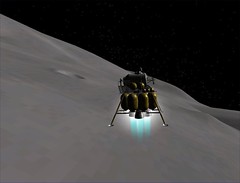
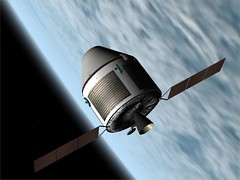
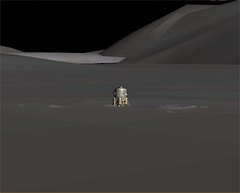
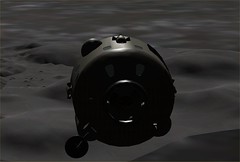
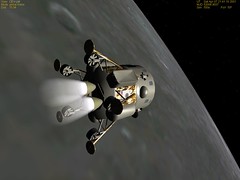
As uncertain as all that sounds, when it comes to the Moon, things are even less certain, with dates like 2020 being kicked around (at least one and a half presidential administrations after this one). There have been graphical renderings of the LSAM (Lunar Surface Access Module, for which NASA is rumored to to be considering the name Artemis). Francis Drake's Orbiter add-on based on the NASA renderings has been around since December 2005, but I have recently revisited it in combination with his newer Orion CEV model (distinguished by the circular solar panels as shown in the most recent NASA and Lockheed renderings). I reinstalled the Taurus-Littrow terrain by jtibirius (avsim.com), undocked the LSAM from Orion in Moon orbit, and used the amazing Land MFD to take the LSAM down to the dramatic Apollo 17 landing site.

P.S. Here's a cool NASA QuickTime animation that shows the landing I've been playing with. When the astronaut climbs down the ladder, you can really get a feel for how big the LSAM will be compared to the Apollo LM.

Thursday, February 08, 2007

More Manned Mars Mania (for Orbiter)


While I continue to be distracted from Orbiter by things like work, others are continuing to work on getting virtual astronauts to Mars in a variety of ways. I wrote about my friend Andy's implementation of a NASA design reference mission (DRM3) back in November, and since then he has greatly expanded this project, with some help on the Mars-landing side of things from another excellent Orbiter add-on builder, "Francis Drake," who is also updating his earlier model of NASA's Orion CEV.

This forum thread discusses the recent Mars/CaTV/lander/etc. developments, including pictures and links to add-on locations. There are several Mars landing options, and the building blocks that Andy and Franz are supplying should allow experimentation with mission architecture variations. Andy has some cool pictures on his web site, and even more on his Flickr site (also some interesting works in progress there). Nice work - now if I can only free up some time to play with this stuff!

Tuesday, September 12, 2006

Orion: The Good, the Bad, and the Ugly

I wanted to also include "something borrowed, something blue" in the title, but it's already too long. Orion is the official name of NASA's Crew Exploration Vehicle (CEV), which we recently learned will be developed by Lockheed-Martin and various partners in a huge multi-billion-dollar, multi-year project that (if it goes as planned) will provide post-Shuttle transportation to the ISS and get US astronauts back to the Moon and (maybe?) to Mars over the next 10-20 years.

There has already been a lot of discussion of what's good, bad, and bogus about the plan. Although the Apollo-capsule-like form has been defended as being "convergent" (it was a good solution in 1969, it's still a good solution), it's still hard to believe this is the best NASA could come up with if its goals were to do the best job possible in building up the infrastructure for future space development, rather than the best job possible consistent with keeping the same level of employment at the agency and at its traditional contractors (with due consideration to getting dollars into key Congressional districts).

That's part of the argument made by Greg Burch in an excellent post on his blog ("The Trouble with Orion," September 2). As a partial counterpoint to this, here is a new Technology Review interview (9/11/06) with a Lockmart business development manager for the Orion project. She says the things you would expect, including the following that seems to echo Greg's point about NASA's fear of a "staffing valley" between the Shuttle program and its successors:
When it gets right down to it, NASA is signing up for a relationship with an industrial partner that's going to last a couple of decades. They wanted to know that it would be a happy marriage, where the spirit of partnership was in real evidence. During Phase I [when NASA paid several bidders to develop designs for Orion], we took the initiative to make sure our project office was co-located in Houston, which made it easy for them to participate in all of our control board meetings and other important events over and above the typical bimonthly reviews. We've got a significant workforce at the Michoud Assembly Facility in New Orleans [where the Shuttle's external tanks are put together]; we made a decision early on to do final assembly and checkout at Kennedy Space Center; we're going to be doing engine testing at Stennis Space Center in Mississippi [NASA's primary rocket propulsion test site]. I think NASA has appreciated that.

Sunday, May 14, 2006

Orbiter Web: Simcosmos

Simcosmos (António Maia) is an Orbiter add-on developer who also maintains the most complete collection of links to the many Orbiter-related resources on the web. From his base in Portugal, he develops and launches Orbiter models of NASA's planned CLV (crew launch vehicles) and many other experiments.

Recently he added a Flickr site where you can easily browse pictures and descriptions of his various projects (sample above). Thanks to Simcosmos for his many contributions to the international Orbiter community!Publish

Sunday, April 30, 2006

Revisioning the Vision

CEV-LSAM Approach on Moon
I’ve been busy with work and with doing space stuff in Orbiter. On the Orbiter side, I’ve been finishing the second edition of Go Play In Space (and beta testing the upcoming 2006 release of Orbiter in connection with this), and working with a team on an Orbiter simulation of the MarsDrive Consortium’s Mars for Less reference mission. Mars for Less has been developed by Grant Bonin as a modular variation of Dr. Robert Zubrin’s well-known Mars Direct approach, and Grant will be presenting a paper on the mission design this coming week at ISDC 2006 in Los Angeles.

Wrapped up in real work and virtual space, I missed a big story on the real side of space, and I’m grateful to Grant for pointing this out. On March 15, Dr. John Marburger, Director of the White House Office of Science and Technology Policy (OSTP) gave a major speech at the 44th Robert H. Goddard Memorial Symposium in Greenbelt, Maryland. In it, he revisited President Bush’s 2004 Vision for Space Exploration (VSE), and spelled out more clearly that a major question answered by VSE is “whether we want to incorporate the Solar System in our economic sphere, or not.”

The VSE’s answer is “yes,” and Dr. Marburger goes on to justify the focus on the Moon as a crucial step, because it and its resources are fairly close at hand, and more importantly, lie far from the bottom of Earth’s deep gravity well. And “resources” are key, because he also talks about how our space program must be made to serve the goals of scientific, security, and economic interests. It is not only about science, although that is part of it, it’s about making space serve the interests of the people of the US, and mankind in general. It’s a long-run view that is really quite progressive, even (dare I say) visionary. It does put Mars on a distant back burner, which is disappointing but also unfortunately realistic from the perspective of an economic return – I’m all for someone going to Mars as soon as they can, but Mars is quite far away and getting there will require solving many more problems than getting back to the Moon (maybe someone will solve those problems before NASA gets to them).

The speech also puts into perspective the reductions in NASA’s budget for science programs – for one thing, I was surprised to learn that due to unexpected successes in the lifetimes of many spacecraft (e.g., the Mars Rovers), that the US currently has 55 viable spacecraft requiring operations support. There are also relative increases for certain non-space science areas important to US competitiveness (DOE, NSF, NIST). These factors (in addition to continued support for the ISS and Shuttle, and development of next generation manned spacecraft) certainly put pressure on NASA’s budget, and a 3% increase just can’t cover everything. Should NASA have gotten more? In part this is a ROI question – would the American people get a good return by investing more in NASA? I don’t know, but the 3% and this speech certainly show the Administration’s opinion.

There is more to it – it’s a good speech. Such a speech from the OSTP director could be seen simply as one of the President’s men defending the President’s policies, and at one level, it is. But at another level, it makes the case that the VSE really is visionary, setting the stage for making the Solar System part of our practical world. Whether NASA will be able to pull it off, and whether future administrations will support its goals, I don’t know. But it goes far beyond footprints and flags and is extremely space-positive. I rarely give him credit for much, but I do have to give the President credit for pointing us in a spacefaring direction.

There was also an interesting analysis of this speech by Dennis Wingo on Saturday in SpaceRef.com.

Thursday, December 22, 2005

CEV-LM at Taurus-Littrow 2019

CEV-LM Into the Valley - Taurus-Littrow
OrbCalc Taurus Littrow 2019
Francis Drake has created another great add-on for Orbiter, his third generation version of NASA’s proposed Crew Exploration Vehicle (CEV). This one is based on the latest NASA ESAS descriptions and visualization graphics, with an Apollo-like command/resource module, and a “super-LM” lunar lander, called the LSAM (lunar surface access module) or informally the CEV-LM. Since this model has hover engines, the Land MFD autopilot add-on by “LazyD” does a great job of landing it on the Moon. I decided to make the approach and the pictures a little more interesting by landing at Apollo 17’s rugged Taurus-Littrow site (using a nice add-on for this by “jtiberius” - search for tauruslittrow.zip at avsim.com). But this required a little experimentation and scenario tweaking since you need a starting orbit that passes very close to the landing site.

The easy thing is to just take the Brighton Beach landing scenario, accelerate time by 1000-10,000 times, and wait for the orbit path to pass over the desired target. This works fine, but it took two weeks of “real time,” and guess what happens in two weeks on the Moon? It rotates and daylight sites get dark! The Land MFD doesn’t care, but I’m sure the astronauts would. Simply turning back the scenario date doesn’t work because Orbiter knows how the Moon and Sun move, and your track no longer passes over the target.

Time for another approach, in this case a very handy utility written by Trevor John, Orbit Calculator 2.0 – not an add-on, but a cool standalone utility. It allows you to specify the body (Moon in this case) and the desired orbit parameters (date/time, periapsis and apoapsis altitudes, and latitude/longitude offsets – also retrograde or “westward” orbit in this case). I specified a 30 x 150 km orbit with latitude offset of -20.19°. I grabbed the RPOS and RVEL cordinates for the calculated apoapsis (high point of orbit) and pasted those into the provided Brighton Beach landing scenario file, replacing the existing values. I got lucky, because this passed directly over Taurus-Littrow (lat. 20.19° N) on the first try (I assumed I would have to experiment with longitude offsets as well). I fired up Orbiter with the Land MFD, and it made a perfect landing.

This “alpha” version doesn’t yet have a separate ascent stage (it's a basic configuration-file vehicle, no custom DLL), so you can’t launch from the Moon and dock with the CEV-CM yet. But it’s a pretty amazing work in progress! More pix at Flickr.

Saturday, December 10, 2005

From Tsiolkovsky to the CEV

New CEV Alpha - Side View - Francis Drake
Jet-lagged rambling from a Lufthansa lounge at Frankfurt - a brief reprieve before the expected India web blackout this week. The Boston snowstorm was a real nightmare - crazy ride to the airport, many canceled flights - but mine was only late. De-icing took about 45 minutes, but you don't want to mess with the shape of those 747 airfoils, so I say take all the time you need and get all the snow and ice off. It was originally an 8 hour layover for the Delhi flight, so even though we were hours late, I still have a few hours to kill.

I just started reading This New Ocean, "pre-history" stuff so far. It's amazing how much Tsiolkovsky got right in his technical predictions of space flight (writing in the late 19th and very early 20th century). It's also amazing how closely his vision of the human future in space matches the vision (if not yet the reality) still held by many modern space advocates (including me, more or less). He was a true visionary.

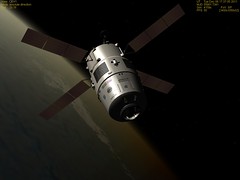
On another note, Francis Drake is continuing his series of CEV models for Orbiter with an alpha release (announced on Orbiter forum) of the Apollo-like CEV that has appeared in recent NASA concept art. I installed it to have a quick look, and it looks pretty good (sample above, "first mission to ISS in 2014" - more views on Flickr). I also read a good article about t/Space in the new Air & Space magazine, and I hope their CEV-alternate (CXV) works out, gets more funding, and is able to start visiting the ISS before 2014! And if not them, then someone else. I know time flies, but 2014 just seems so far away.

Wednesday, November 23, 2005

Orbiter: CEV/LSAM at Taurus-Littrow

CEV-LSAM at Taurus Littrow

CEV-LSAM Over Taurus-Littrow

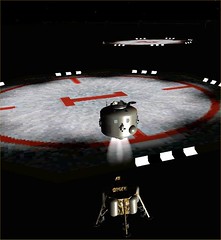
I'm getting back to my CEV "Back to the Moon" practice mission, setting some things up to simulate NASA's planned mission profile. As I understand it, a heavy-lift launcher places the unmanned LSAM (lunar surface access module) along with a "departure stage" for TLI (trans-lunar injection, pretty much using the old Apollo terms) in a parking Earth orbit. The manned CEV is launched separately, and it soon docks with the LSAM in Earth orbit. At the right time, the CEV/LSAM/departure stage stack makes the burn for the Moon. There's more, but from here on, it pretty much follows the old Apollo Moon landing plan. I'm using Francis Drake's "old" CEV add-on, which doesn't have the very latest projected CEV shape but is quite cool.

Good things: I docked the CEV with the LSAM in LEO (don't we love our TLA's! OK, one FLA). I installed a Taurus-Littrow 3D terrain "base" (by jtiberius) to have an interesting place to land (but didn't actually land there yet). I edited scenario files to put the LSAM at this base and practiced taking off for lunar orbit (the LSAM either floats about half a meter above or sinks a little into the 3D mesh for this terrain - not sure if this is fixable).

Not-as-good: I couldn't run the edited scenario to dock the LSAM with the CEV-upper stage stack (not sure why). LSAM has the up-is-forward confusion of many tail-sitter spacecraft, so docking is tricky (both view and controls). Landing would be tricky too except for the Land MFD. No docking port frequencies so docking is all visual (no MFD help). Actually should have the LSAM on a different booster. A few minor problems but it pretty much works.

This is all preparation for a full-up CEV/LSAM Earth-Moon mission soon. More things to figure out, but it's going OK. More pix on Flickr.

Thursday, November 03, 2005

Beating NASA Back to the Moon...

CEV-LM PDI Burn

CEV-LM Ascent from Brighton Beach

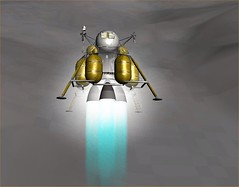
...virtually, of course. I've decided to try my own "back to the Moon" program using Francis Drake's CEV-1 add-on, especially since I found that LazyD's Land MFD works great with this "tail sitting" lunar lander. It brought me hands-off from lunar orbit to pad-1 at Brighton Beach. Not much challenge in that, you say? True, but without a landing autopilot, a tail-sitter with only a main engine is not something I'm ready for. Plenty of other challenges in this, including planning (with IMFD) the whole Earth to the Moon thing for the CEV-CRM (if that's what it's called, command & resource modules), rendezvous in lunar orbit with the separately launched CEV-LM (making sure the resulting orbit is in reach of the desired landing spot), land (easy now), then take off with enough fuel to rendezvous with the CEV-CRM.

In my test launch from the Moon, I ended up with 6% fuel in the CEV-LM ascent stage, and not in a very good orbit to dock with the CEV-CRM. I need better planning (it's all in the timing), because in the test scenario, the CEV-CRM only has 33% fuel itself (after LOI burn), and I don't know how much is needed for TEI (trans-Earth injection burn).

So all the needed parts are there, and I can even install some of the Apollo 3D terrain "bases" for more realistic landing sites (I don't think there will be pads and a control tower for the first few flights). This will familiarize me with the CEV game plan and brush up some of my rusty orbit sync/dock skills. The hardware looks a little different from the current concept - but even that is still artists' conceptions. I think it looks kinda cool.

Wednesday, November 02, 2005

CEV Play for Today

CEV v1 in LEO

Francis Drake's CEV-1 "Odyssey" add-on for Orbiter is modeled on an "old" Lockheed-Martin concept (late 2004), and its shape doesn't quite match the Apollo-like cone that NASA has shown in the most recent concept art. But it is still the most complete CEV add-on for Orbiter that I know of, with the crew capsule, service module, and a lunar descent vehicle, along with starting scenarios for trying them out (and a convenient nose docking port). So until someone decides to create an add-on based on more recent CEV ideas, I'll use this to try out some CEV-type missions, such as visiting the ISS, or doing a Moon flight with a lunar orbit rendezvous and landing.

Sunday, October 30, 2005

Crew Exploration Vehicle (CEV)

My friend Andy told me about a cool space site, NasaSpaceFlight.com. Lots of useful stuff and interesting discussions on the forums. The CEV (Crew Exploration Vehicle) is NASA's proposed next-generation spacecraft that will take crews to the ISS, the Moon, and perhaps even Mars. In one post, an Orbiter user (gladiator1332) showed some Orbiter images of a biconic CEV, commenting that Orbiter provides the means to visualize these next-generation craft in 3D (not to mention you can fly them!). Another application!

Biconic refers to a special crew capsule shape that would provide some controllable lift on reentry without the weight penalty of wings. Francis Drake developed an add-on for Orbiter using this shape, and it's really cool. I played with it a bit, and the picture shows it docked at the ISS (unusual through-the-heatshield docking port). I haven't yet installed the files to mate this to Simcosmos' prototype SRB-derived booster.

NASA's programs may be delayed by funding problems - but not in Orbiter!