Showing posts with label Greek. Show all posts

Thursday, July 22, 2021

Caroline Lawrence Membercast Objects

In July 2021 I was interviewed by fellow children's author Iszi Lawrence (left) for the British Museum Membercast. We talked about artefacts in the British Museum that have inspired my writing. For anyone who wants to know more, here are some of the objects we discussed. Click the photos for links to the objects. 

1. Rock crystal die. Find it in the Greek and Roman Life room (room 69) display case 9. This beautiful little object was a vital clue to the identity of a dog-killer in my first book, The Thieves of Ostia.


2. Wax-tablet and writing things. Greek and Roman Life room (room 69). I try to make some artefacts a matter of life and death, like a wax-tablet for Lupus, a character from my Roman Mysteries series of books. Lupus is mute and illiterate but as he learns to read and write his wax tablet becomes a vital means of communication. My replica wax tablet smells like honey because of the beeswax on it. 


3. Why would you put a scary actor’s mask on a baby feeder? I believe the answer is that it is apotropaic (turns away evil). A face like this, possibly called a mormolukeion, keeps malicious spirits from turning the milk sour. This becomes an object of life or death importance in my book Escape from Rome. Find it in the room next to the Greek and Roman life room, in room 70 and display case 14.


4. Hydria. This beautiful Greek jar for carrying water is one of literally thousands of Greek, Roman and Etruscan vases in the British Museum. Women and slave-girls would take a pot like this to the fountain and bring it back on their heads, full of water. Other Greek vases range from tiny perfume bottles to big mixing bowls for wine. The decoration on them gives us glimpses into daily life, customs and beliefs. For a scene where kids hide in a fountain, check out my book Adventure in Athens


5. Oil-lamps are like snapshots of the ancient world… Many of them also have apotropaic images on them, and the oil-lamps themselves – lights in the darkness – keep away evil. One of my favourite oil-lamps is in the Greek and Roman Life room (room 69) and shows what racing chariots really looked like. I incorporated that knowledge into Roman Mystery 12, The Charioteer from Delphi. 


6. This superb statuette of the ancient Greek philosopher Socrates informed my most recent historical thriller, The Time Travel Diaries, Adventure in Athens. Note that he is only wearing a cloak, probably light linen for those hot Athenian summers. Find him downstairs in Room 22 and display case 6. 


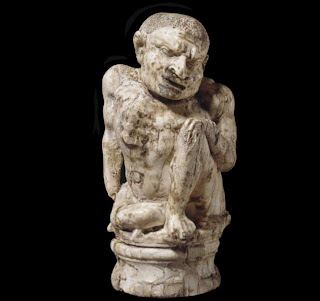
7. Another figurine, a little ivory hunchback from Alexandria, is inspiring my current work in progress, a retelling of Aesop’s Fables. (According to some ancient sources, Aesop was a hideously ugly hunchback.) Note that he is wearing nothing at all. You can find him near the Socrates figurine just mentioned in display case 6 in room 22. 

Thanks to Iszi Lawrence for letting me gush about some of my favourite objects and thanks to the British Museum for inspiring my writing. Find out more about my books at carolinelawrence.com. Find out more about Iszi's books at iszi.com.

P.S. All the photos on this post are copyright of the British Museum. 

Monday, January 31, 2011

Themes & Topics

Themes and Topics in the Roman Mysteries
compiled by the author herself: Caroline Lawrence

These are the various themes and topics I had in mind while writing the Roman Mysteries. But writing is as much an intuitive right-brain exercise as a logical left-brain one. In other words, even the author doesn't always know everything he/she is doing. So if you think you've seen something new or different, you are probably right!


Book 1: The Thieves of Ostia (theme: fear of the unknown)
Roman topic: introduction to a Roman town (Ostia port of Rome) & Roman social structure.
Real historical characters: Cartilius Poplicola (resident of Ostia attested in inscriptions)
Sources: The Aeneid, the Bible, Ostian inscriptions
Greek myths: Aeneas, Cerberus, Perseus and Medusa
featured food: snails, stuffed dormice, dates, fruit
key artefacts and objects: signet ring, wax tablet & stylus, oil lamp, tombs, amphoras, quartz dice
ROMANS Key Stages 2 & 3 - relevant blogs: How to Make a Stola, A Day in Ostia

Book 2: The Secrets of Vesuvius (theme: parentage & adoption)
Roman topic: the eruption of Vesuvius and destruction of Pompeii & surrounding towns
Real historical characters: Pliny the Elder, Titus Tascius Pomponianus, Rectina
Sources: Pliny the Younger, Pliny the Elder, Catullus, Ostian graffito
Greek myths: the return of Vulcan, Thetis, Achilles
Roman festivals: Vinalia, Vulcanalia
Pliny's simple fare: cheese, fruit, eggs; Tascius's rich fare: turbot in dill sauce
key artefacts: scrolls, portable inkpot & pen, flute, pan-pipes, parasol, cushions

Book 3: The Pirates of Pompeii (theme: slavery & freedom)
Nubia's book
Roman topic: Patrons and clients, slaves and freedmen
Real historical characters: The Emperor Titus, Pollius Felix (attested in a poem of Statius)
Historical site: the villa of Pollius Felix on the Cape of Sorrento, Scraio (spa town near Sorrento)
Sources: Pompeian graffiti, Statius's 'Silvae' (poems)
Greek myths: Dionysus and the pirates, Ariadne & Theseus
food: lemons (recently introduced); goat stew, flat bread, chickpeas, mineral water, sage tea
key artefacts: earrings, hairpins, theatrical masks, lyre, flute, kylix (Greek drinking cup)

Book 4: The Assassins of Rome (theme: guilt)
Jonathan's book
Roman topic: Nero's golden house, the destruction of Jerusalem, Jewish slave labour, chariot races
Real historical characters: Emperor Titus, Berenice, Domitian, Josephus
Sources: Suetonius, Cassius Dio, Homer, Josephus, the Bible
Greek myths: Odysseus, Polyphemus the cyclops, Penelope the faithful wife
Jewish festivals: Rosh Hashannah, Yom Kippur, Succot
featured food: exotic oranges; buttermilk; honey dipped apples for Rosh Hashanna
key artefacts: wax tablet & stylus, alabastron, loom & weights, bass lyre, tambourine

Book 5: The Dolphins of Laurentum (revenge & forgiveness)
Lupus's book
Roman topic: a real maritime villa, sponge-diving on the Greek islands
Real historical characters: Pliny the Younger
Sources: Pliny the Younger's letter about his Laurentum villa (letter II.xvii)
Greek myths: Medusa, Arion & the dolphins, Neptune & Amphitrite
Roman festival: Meditrinalia
featured food: honey glazed prawns, chicken soup
key artefacts: sponge-stick, sea-sponges, dolphin earrings, anchors, ball games

Book 6: The Twelve Tasks of Flavia Gemina (love & marriage)
Flavia's book
Roman topic: Love, betrothal and marriage in first century Rome
Historical site: notable buildings in and around Ostia
Sources: Ostian inscriptions, Ovid, Martial, Apollodorus
Greek myths: Twelve Tasks of Hercules, Pygmalion, Cerberus, Atalanta
Roman festival: Saturnalia
food: lentil stew, eggs, plums, oysters, mushrooms, quail pie, boar, ostrich, love potion!
key artefacts: sigilla (figurines), dice, objects in household shrine, strigil & bath set

Book 7: The Enemies of Jupiter (theme: hubris)
Jonathan's book
Roman topic: medicine and doctors in first century Rome
Real historical sites: Tiber Island, Palatine Hill, Capitoline Hill and the Temple of Jupiter
Sources: Suetonius, Cassius Dio, Galen, Pliny the Elder, Hippocrates
Greek myths: Prometheus & Pandora, Aesculapius, Niobe and her children
featured food: food for medicinal properties, light, medium & heavy foods, etc
key artefacts: bleeding cup, votive parts of the body, medical instruments

Book 8: The Gladiator from Capua (theme: blood & sacrifice)
Nubia's book
Roman topic: gladiators, beast-fights and the opening of the Colosseum in spring of AD 80
Real historical sites: the Flavian Amphitheatre (the Colosseum), Domus Aurea, Mons Testaccio
Real historical figures: Titus, Domitian, Carpophorus the beast-fighter, Martial
Sources: Martial, Suetonius, Cassius Dio, Ovid, Statius, Seneca, Pliny
Greek myths: Orpheus, Ganymede, Prometheus, and more
Jewish festival: Passover
featured food: barley porridge for gladiators, snacks sold at games, etc.
key artefacts: gladiatorial arms & armour, ancient souvenirs, lottery balls thrown to crowds

Book 9: The Colossus of Rhodes (theme: vows & promises)
Lupus's book
Roman topics: the seven wonders of the world, ancient 'tourism'
Historical sites: Rhodes, Symi , Kalymnos
Sources: Pliny the Elder, Apollonius of Rhodes, Homer
Greek myths: Jason and the Argonauts by Apollonius of Rhodes
GREEKS KS2 & 3 - relevant blogs: Colossus of Rhodes, Ancient Gum, Hylas

Book 10: The Fugitive from Corinth (theme: jealousy)
Nubia's book
Roman topics: Greeks in the Roman world
Historical sites: Corinth, Delphi, Athens
Sources: Pausanias, Apollodorus, Herodotus, Aeschylus
Greek myths: Theseus's Athenian adventures, Eumenides

Book 11: The Sirens of Surrentum (theme: sex & decadence)
Flavia's book
Roman topics: Roman philosophy and the failed plot to kill Nero
Historical characters: Nero, Seneca, Lucan, Polla Argentaria, Flaccus
Sources: Seneca, Lucan, Suetonius, Tacitus, Statius, Propertius
Greek myths: Dido and Aeneas, Odysseus and the Sirens
ROMANS KS3 - relevant blogs: Villa Limona, Serendipity in Surrentum, Poison
(N.B. THIS BOOK CONTAINS ADULT THEMES)

Book 12: The Charioteer of Delphi (theme: faithfulness)
Nubia's book
Roman topics: chariot races and factions
Historical site: the Circus Maximus
Historical characters: real charioteers like Scopas, Hierax and Crescens
Sources: Ovid, Juvenal, Martial
Greek myths: Pelops and Oenomaus
Roman festivals: Ludi Romani
ROMANS KS2 & KS3 - relevant blogs: Fun Chariot Facts, Roman Horse Names

Book 13: The Slave-girl from Jerusalem (theme: death & birth)
Jonathan's book
Roman topics: childbirth, funerals, wills, Roman law courts, gestures of a rhetor
Historical backstory: destruction of Jerusalem and siege of Masada
Sources: Josephus, Quintilian, Cicero, Juvenal, Seneca, Roman legal documents
Greek myths: Jason and the Argonauts by Apollonius of Rhodes
featured food: pea and leek soup, mastic chewing resin, sage tea, chestnut flour
key artefacts and objects: birthing chair, funeral pyre, bier, tombs, seal-box for wills

Book 14: The Beggar of Volubilis (theme: piety)
Flavia's book
Roman topics: Roman theatre, Cleopatra's descendants, sightings of Nero
Historical sites: Sabratha, Tripolis, Volubilis, Ghadames
Sources: Strabo, Pliny the Elder, Plutarch
Greek myths: Diana and Actaeon
featured food: millet porridge, roast locusts, lizard meat, camel-milk pancakes, senna tea, cola nuts
key artefacts and objects: bow, arrows, quiver, betrothal ring, bath-set, Nero's emerald, lens
EGYPT KS2 & KS3 - relevant blogs: Volubilis, Ugly Cleopatra

Book 15: The Scribes from Alexandria (theme: going home)
Nubia's book
Roman topics: Roman Egypt especially Alexandria, eunuchs, the Great Library, the Nile
Historical sites: Canopus, Alexandria, Giza, Edfu, Aswan, Nubia
Sources: Strabo, Martial, Juvenal
Egyptian myths and legends, including story of Isis, Osiris and Seth
featured food: sun-bread, bean porridge, palm wine, onions, leaf-cups, dom-fruit
key artefacts and objects: hieroglyphs, graffiti, riddles, codes, treasure map

Book 16: The Prophet from Ephesus (theme: redemption)
Jonathan's book
Roman topics: early church in Asia Minor
Historical sites: Halicarnassus, Ephesus, Hierapolis, Laodicea, Heracleia
Historical characters: St John the Evangelist, Tychichus
Sources: Strabo, the New Testament
Greek myths: Pluto and Persephone, Endymion and Selene
featured food: grapes from the vine, cucumber, sour cherry juice, sheep entrail kebabs, pomegranates
key artefacts and objects: dolls, travel baskets, reed flute, lyre, carpets, looms

Book 17: The Man from Pomegranate Street (theme: resolution)
Flavia's book
Roman topics: mysterious death of Titus in September AD 81
Historical sites: Rome, the Sabine Hills, Palace of Domitian and the 'Emissario' on Lake Albanus
Historical characters: Titus, Domitian, Ascletario, Gaius Valerius Flaccus, Gaius Suetonius Tranquillus
Sources: Suetonius, Babylonian Talmud, Apollonius of Tyana
Greek myths: Romulus and Remus, Rape of the Sabine Women, Death of Odysseus
featured food: Sabine olive oil, brown bread, honey, grapes, imported oysters
key artefacts and objects: needle-sharp stylus, graffiti, wedding veil and the spear to part the bride's hair

[The Roman Mysteries books are perfect for children aged 9+, especially those studying Romans as a topic in Key Stage 2. You can watch a television adaptation of some of them on Amazon Prime. For more information about Caroline's other books, go to carolinelawrence.com.]

Friday, June 25, 2010

Embalmed in Honey

As an author of 17 novels and a dozen short stories, the most frequent question I get asked is "Where do you get your ideas?" Well, from books like Vicki Leon's is one place!

I bought the wittily titled Working IX to V a few years ago and have been dipping into it with great pleasure. It's all about strange jobs and careers from Ancient Greek and Roman times. She mentions well-known jobs like Gladiators, Pirates, Vigiles, Bakers, Garum-makers, etc. But she also talks about less well-known careers, that of the Armpit Plucker, Amber scout, Cryptologist and Funeral Clown. In one of her accounts, that of the Stercorarius (manure salesman), she mentions the ancient Roman urban myth of a giant octopus in the sewers. This one line gave me the idea for the entire plot of a new book I am working on called The Sewer Demon.

Vicki Leon's latest book, hot off the press, is called How To Mellify a Corpse. Glancing through it, I see she covers topics such as Gems and Gem fakery (idea there for a counterfeiting gem-maker); Stealth Bombs and Stench Warfare (more ideas for deadly poisons); Model flying dove designer Archytas (would be good for a slapstick plot). There is also a chapter about how Alexander the Great decided to be embalmed in honey (i.e. mellified) rather than be cremated like a good Greek boy. That's where the title of the book comes from. Vicki is also posting more free ideas on her great blog called Historical Detective.

Vicki Leon is erudite and witty. Here are some of her throw-away lines: "The Greeks had an edifice complex", "Entrail reading ... splashy in multiple senses of the word", "In days of yore, honey got a lot of buzz", etc.


Above all she is a genius at linking the ancient and modern.
Witness the following chapter headings:
Religious Syncretism: The Grinch who stole Saturnalia
Refrigeration: The Big Chill B.C.
Acoustics: The first surround sound
Ghosts and worse: Necromancing the Stone
Arena Addiction: Franchising Blood and Sand
Archimedes part 1: Early googling

The Sewer Demon
Vicki's books are a veritable gold-mine of ideas for writers like me.

Teachers can use her fun topics as starting points for projects. 

And if you, a family member or friend is a lover of Classics then this is the perfect book for dipping in and out of in, maybe in the latrine!

How To Mellify a Corpse is fascinating fun and I give it X out of X. Enjoy!

[The first of the new Roman Mysteries Scrolls series for kids 7+ is The Sewer Demon. Future titles include The Poisoned Honey Cake and The Thunder Omen. The 17+ books in the existing Roman Mysteries series are perfect for children aged 9+, especially those studying Romans as a topic in Key Stage 2. There are DVDs of some of the books as well as an interactive game.]

Friday, August 07, 2009

Orpheus & Orphée

In Greek mythology, Orpheus was the Thracian musician who was so talented that he could charm wild animals and trees and even rocks with his music.

He went with Jason on his quest for the Golden Fleece and had a novel way of deactivating the dangerous song of the Sirens: he played his music to drown out theirs.

One day Orpheus (pronounced or-fee-uss) fell in love with a beautiful girl called Eurydice, (pronounced yoor-id-iss-ee). On their wedding day she was running through the grass when a deadly viper bit her foot. She died in the arms of Orpheus, her betrothed. He was so distraught that he decided to go down to Hades and plead with Pluto to let her take him back.

You know the story. With his beautiful music Orpheus charms the ferryman who guides souls across the River Styx. With his beautiful music Orpheus charms Cerberus, the three-headed watchdog. With his beautiful music Orpheus even charms Pluto and Persephone, the King and Queen of the Underworld. They tell him he can take Eurydice back to the land of the living. But there is one condition. He must lead the way and not look back at her until they have safely arrived.

Orpheus sets out on the upward-sloping path, groping his way because it is so dark and silent. As he ascends, he becomes more and more worried. He can’t hear his beloved Eurydice behind him. He begins to wonder if it could be a trick of Pluto to get him to leave peacefully. When the light from the exit up ahead begins to dimly light the way, he is desperate to glance back, just to reassure himself that she is behind him. But he does not dare. He tells himself to be strong and to resist the temptation to look. Just a little longer!

Finally he steps into bright sunshine. Immediately he turns to see if his beloved Eurydice is behind him. She is! But she is still in the passage, still in the underworld. Even as he watches, she recedes from sight, her arms stretched out hopelessly and helplessly towards him. In some versions the messenger god Mercury sadly takes her arm and stops Orpheus from following.

Orpheus is stunned by his wife’s double death. He is in a torment of guilt and grief. If only he had waited a few more moments! Some say he renounced music. Others say he renounced women. For whatever reason, the frenzied followers of Dionysus called ‘maenads’ (pronounced mee-nadz), become angry with Orpheus and eventually kill him and tear him limb from limb.

Nymphs Finding the Head of Orpheus 1900

According to some accounts his head rolls into a stream and floats away, singing as it goes. The artist J.W. Waterhouse has chosen to paint the moment when two startled nymphs discover the beautiful, almost effeminate head with the long hair tangled in the chords of the lyre. Were these two among the crazed women of the night before? Or are they innocent?

We don’t really know. All we know is that Orpheus is finally reunited with his beloved Eurydice. In death.


Another artist fascinated by the myth of Orpheus was a multi-talented French genius named Jean Cocteau who flourished in the 50’s. He was not only a filmmaker but also a brilliant artist (see his head of Orpheus at the top right of this post) and poet. His black and white film Orphée, made from 1949-1950 soon after WWII, is considered a classic. (Orphée, pronounced or-fay, is the French for Orpheus) In Cocteau’s retelling of the myth, Orphée is a handsome poet who is adored by all. He is married to a pretty blonde named Eurydice, whom he loves, but in a twist to the tale, he also falls in love with Death, who is personified as a beautiful almost vampirical woman in black. Death is in love with him, too. When Eurydice dies, Orpheus goes to the underworld with a version of Mercury called Heurtebise, (pronounced... no, there is no way I can transliterate that!). A nice twist is that Heurtebise is in love with Eurydice. The scenes of the underworld were filmed in parts of Paris still in ruins from German bombing. They are some of the most haunting and dreamlike footage you will ever see. Orphée and Heurtebise bring Eurydice back from the underworld, but Orphée is forbidden to look at her ever again. Not just on the way back, but FOR EVER. (see above)

This is too much to ask, of course, and one day he accidentally catches sight of her in the rear view mirror of his car. She instantly returns to the underworld. Orphée goes back a second time and, in a poignant twist, Death decides to give him back Eurydice, even though she must suffer a punishment for this, and even though it means Orphée will not even remember her.

Cocteau introduces elements of other myths. For example, Death is like Persephone, who loved Adonis. Cocteau also likes the Narcissus myth. He uses mirrors a lot, in particular as the entrance to the underworld. These are some of the most breathtaking sequences. My favourite scene is where Orphée must put on magic gloves to pass through the mirror to the underworld. For this effect, Cocteau used a vat of mercury, because the actor’s fingers would have been visible beneath the surface of water. In this sequence there are several tricks. First, the footage of Orphée putting on the gloves is reversed. Second, the cameraman filmed his own gloved hands approaching those of the actor Jean Marais, who is in an identical room on the other side of the ‘mirror’. Third, the camera was tilted 90% to film the hands going into the vat of mercury. You can see the mirror sequence HERE.

The strongest reference to the Narcissus myth is in a sequence where Orphée awakens and hovers over a mirror-like pool. (below)

For me this is especially fascinating as I’m currently working on my own reworking of the Narcissus myth.

I was inspired to write this after visiting a Waterhouse exhibition at the Royal Academy in London. You can watch Orphée on the Criterion DVD (US) and in Europe and the UK there is an excellent DVD produced by the BFI with extras including an audio commentary and booklet about the making and makers of the film.

P.S. Thanks to Rod McKie, my twitterpal, for recommending that I re-visit Cocteau's 1950 masterpiece!

P.P.S. I was so inspired by this painting that I wrote my own Ode to Orpheus called Thracian O.

Wednesday, July 08, 2009

Hylas by Waterhouse

I often steal plots from Greek myths. After all, their authors are long-dead and can't sue me. For my ninth Roman Mystery, The Colossus of Rhodes, I used the Voyage of Jason and his Argonauts as the structure for my Roman detectives' search for a criminal mastermind.

In the myth, Jason is on a quest for the Golden Fleece and he has assembled many heroes on board his ship the Argo. For example Hercules and his special friend Hylas, a beautiful youth.

In The Colossus of Rhodes, I get Flavia and her friends match the crew of their boat, the Delphina, with the crew of the mythical Argo. Here is the list Flavia and her friends compose:

Lupus the ship-owner is like Jason, the Brave Hero on a Quest
Flavia Gemina is like Atalanta, the speedy Heroine
Jonathan would like to be Peleus, a Hero and father of Achilles
Nubia has agreed to be Hercules, because both wear lionskins
Captain Geminus (a twin) is Castor, Pollux's mortal Brother
Aristo (a talented musician) is Orpheus, whose Lyre tamed Beasts
Bato (former junior magistrate) is Mopsus, a Wise Soothsayer
Flaccus (aristocratic snob) is Acastus, arrogant son of King Pelias
Zetes (Flaccus's slave-boy) is Zetes, the Hero who could fly
Silvanus (handsome youth) is Hylas, young Squire of Hercules
Atticus (old and Greek) can be Argus, who built the Argo
Punicus (Phoenician helmsman) is Tiphys, Helmsman on the Argo

(pp 24-25)

In my book, Flavia makes Silvanus, a handsome Ostian youth, correspond to Hylas. This could be bad news for Silvanus. The original story of Hylas goes like this:

Jason and his crew have anchored somewhere on the coast of Bithynia to take on water. Hercules and his boyfriend Hylas go off to fetch water but Juno, Hercules's great enemy, sees a chance to torment him. She makes sure that Hercules and Hylas are separated. She then tells a beautiful huntress nymph called Dryope that there is a handsome boy in the woods who would make a perfect husband. His name is Hylas.


The poet Gaius Valerius Flaccus (played by Ben Lloyd-Hughes above) tells the story like this:

Dryope the huntress nymph flushes a swift deer out of the trackless woods and tricks Hylas into pursuing it, away from Hercules. The stag leads him far away to a place where a bright fountain gushes forth. With a single bound the deer leaps over the pool and is gone. Disappointed, the handsome youth finally stops his pursuit. As sweat bathes his limbs and his chest rises and falls, he greedily sinks beside the pleasant stream. The dappled light that shifts and plays upon the lake shows the gleam of his beautiful body. He does not notice the nymph's shadow or the perfumed scent of her hair or the splash of water as she rises up to embrace him. He cries out to Hercules for help as she throws her smooth arms around his neck, but in vain. Hercules is far away and cannot hear him, and the lovely nymph she draws him down into the water, her strength helped by his falling weight.

In the painting by Waterhouse (below) the painter makes the scene much more watery and adds six more nymphs, bringing their total number to a mystical seven. We see Hylas with his water jug, entranced by their beauty. If you go to the Waterhouse exhibit at the Royal Academy, be sure to invest an extra £3 in the audio guide. The guide tells us that the nymphs eyes are black with desire and that the exchange of looks between Hylas and the head nymph Dryope is almost mesmeric. She is hypnotising him, bewitching him, seducing him. She wants to draw him out of the world, into a life of watery pleasure. He is captivated by her beauty and he is unconsciously leaning forward. At any moment he will plunge into the water.


According to some accounts, Hylas falls in and drowns. According to others he stays with the nymphs to love them and be loved. But in every case, Hercules and the Argonauts never see him again.

In my book, the young Ostian crewmember named Silvanus goes for water on an island and never comes back. Was he also taken by nymphs? Or did something more sinister occur?

Maybe it's a coincidence, but Waterhouse loved water. It appears in at least half the paintings in the exhibition. He also liked to use symbols. For example, long hair. To Waterhouse, long hair was a symbol of feminine seductiveness. Check out his painting of 'La Belle Dame Sans Merci'. She is wrapping her luscious locks around the neck of a handsome, hapless knight. His armour will not protect him against her perfumed tresses.

Notice, too, that the handsome young model Waterhouse uses is the same one who posed for two other archetypes of Greek male beauty: Narcissus and Adonis. I think his is also the head of Orpheus, a painting not in this particular exhibition.


Back to Hylas and the Nymphs. See how that one nymph to the right of Dryope is seductively fluffing her hair? And the nymph between Hylas and Dryope holds something in her hands. Pearls. You don't notice them until you're standing right in front of the painting. She seems to be offering the pearls to Hylas. Or is it something more sinister? Waterhouse knew (and the commentary tells us) that pearls were thought to be the tears of drowned men.

Run, Hylas! Run!

N.B. J.W.Waterhouse: The Modern Pre-Raphaelite was an exhibition at London's Royal Academy in 2009. It has now finished.

Ariadne by Waterhouse

It is a beautiful summer evening on the Greek island of Naxos. We see an adolescent girl sleeping as a boat pulls away from the jetty. The girl’s hair is loose, her tunic in disarray, her cheeks flushed with heat, and she occupies only half the couch. The poppies by her head hint at drugged sleep. It is obvious that she and her boyfriend have been making love. But where is her lover? His garland is there, at the foot of the couch, but he is gone. He is in the ship that is moving out to sea, already catching the wind to sail into the sunset. Having used and abused the girl, he is now abandoning her. When she wakes she will go mad with grief, despair and rejection.

She is Ariadne, the beautiful Cretan princess who risked her life to help Theseus. Having permanently cut her family ties through devotion to the Athenian prince, she then gave herself to him: body, heart and soul. But he used her and deflowered her, and now he is abandoning her.


Poor Ariadne. Who will console her? We know that the beautiful and dangerous god of wine will soon come to her. In fact, he must already be here, just beyond the edge of the picture. We see his pet leopard prowling the foot of her bed. But the leopard is not looking at the girl. The big cat is intent on something beneath the couch. His gaze draws ours and we notice, for the first time, a sleeping female leopard, curled up at Ariadne’s feet. The male leopard eyes her with intense desire. I imagine his master, the god of wine, is just out of our picture on the left, eyeing the sleeping girl with the same intensity. When Ariadne wakes and realises her young Athenian lover has abandoned her, she will tear her hair and beat her tender breasts. What will the leopard’s divine master do? Will he immediately take the distraught girl in his arms and let her vent her rage? Or will he wait until her grief and rage are spent? Will he hold himself back until her self-inflicted scratches and bruises heal and her hair is combed again, and only then console her with love and wine?

We know from a poem of Ovid (Heroides X) that Ariadne will wake that night and see the ship in the distance by the light of the full moon. She will beat her breast and tear her hair and run back and forth over the island in a frenzy of grief. Ovid imagines the letter she might write. She begins by telling Theseus that mitius inveni quam te genus omne ferarum: ‘Every wild beast is gentler than you’. But later she confesses she is she is terrified that there are wild beasts or wild men on the island who will hurt her. She does not know what we know, that a god will find her and console her, and that they will be happy together...

...as far as any abandoned woman can be happy who finds her consolation in Dionysus, the god of wine and madness.

P.S. The Roman Mystery which comes closest in tone to this painting is The Sirens of Surrentum, a book about passion and poison in Sorrento, midsummer of AD 80. See also my blog on the Villa of Pollius Felix in Sorrento.

P.P.S. If you liked reading about Waterhouse's Ariadne, you might enjoy my blogs about some of his other treatments of figures or scenes from Greek Mythology: Circe, Orpheus, Adonis, Narcissus, Hylas and the Nymphs.

P.P.P.S. J.W.Waterhouse: The Modern Pre-Raphaelite was an exhibition at London's Royal Academy in 2009. It has now finished.

Wednesday, April 22, 2009

Riddle of the Roman Vase

The next time you are in central London, you should visit the Portland Vase in Room 70 of the British Museum.

The ‘Portland Vase’ is the modern name for one of the most famous pieces of Roman art in the world. It is a beautiful blue and white glass amphora made in the extremely difficult ‘cameo technique’. In this method of manufacture, opaque white glass covers darker glass (watch a demo HERE) and is then painstakingly carved away to show a scene in relief (i.e. ‘bumpy'). We know from chemical analysis that this beautiful vase was made in Roman times. We know from the glass technique used that it was probably produced around the time of Rome’s first emperor, Octavian Augustus (between about 30 BC and AD 20). We know that the vase used to have a pointy bottom, like all amphoras, but that this was broken during its many adventures (check out Wikipedia or the excellent Mystery of the Portland Vase) and a new flat bottom was fitted.

Everybody agrees that the Portland Vase is a masterpiece, but not everybody agrees about what it was used for or who commissioned it. (A vase this finely-crafted and expensive must have been ordered by a very rich person.) And the biggest mystery is: who are the seven figures on the vase?

Only one of the figures is easy to identify. It is found on the side which scholars call the ‘A-side’. It is the flying baby with the torch and bow: the Roman god of love, Cupid. His presence means that the couple below him are about to fall in love.

But who are the two lovers? Who is the lady with wet or dishevelled hair and a snake in her lap? Who is the young man she is holding on to? And who is that pensive bearded guy over to the right?

On the other side – the ‘B-side’ - are some more mysterious seated figures: a naked youth, a woman with a hairdo datable to around 30 BC, and a woman holding a downturned torch and tearing her hair. Who could they be? And what are they all sitting on?

We can identify Cupid on the A-side by his wings and bow, but none of the others are obvious. This may be because they are real people, rather than Greek heroes or Roman gods. Another interesting aspect is that women are the central figures on both sides. But that still doesn’t help us.

Who are they? Scholars have put forward more than 50 different theories.

Susan Walker, Keeper of Antiquities at the Ashmolean Museum, presents an exciting theory in her book The Portland Vase (Objects in Focus). She believes the woman with the snake is Cleopatra and that Octavia is on the other side. Those of you who have read The Beggar of Volubilis know that Octavia (sister of the emperor Augustus) lost her husband Antonius to Cleopatra, but after their deaths she nobly raised their surviving children as her own. Susan Walker's theory is quite persuasive, but it was an asp that killed Cleopatra, not a sea-snake, and her identification of the bearded man as Mark Anthony's father is also unconvincing.

Other scholars believe the woman with the snake is Thetis, the beautiful sea-nymph and mother of Achilles. It was prophesied that her son would be more powerful than his father. All the gods of Olympus desired her, but Jupiter knew it would be fatal if one of them sired her child: that child would be more powerful than any of them. So he told a mortal, Peleus, the secret of winning Thetis. ‘She can change into any creature,’ warned Jupiter, ‘but if you hang on tight then she will be yours.’ Is the handsome young hero Peleus? And is the man watching Jupiter?

The only problem with that theory is that she’s holding onto the handsome man, not the other way round. And Jupiter does not have any of his trademark identifying symbols. No thunderbolt, staff or crown. And who would have commissioned a fabulously expensive amphora showing the origins of a Greek hero? The Romans believed they were descended from the Trojans, mortal enemies of the Greeks.

Stephen Pollock-Hill is a modern glassmaker. He owns one of the few glass factories in Britain where glass is still blown in the ancient way. His firm – Nazeing Glass – has produced specialty items such as railway signal lenses, glass wall-blocks and laboratory beakers and tubes. (right: Stephen with engraver Lesley Pyke © Lesley Pyke)

One of Stephen’s passions is the Portland Vase. Over the next year, Nazeing Glass is going to produce ten interpretations of the vase. Skilled glass-makers will blow cobalt blue glass and then coat it with opaque white glass at just the right temperature so that the coating sticks and doesn’t make the glass underneath crack. Then ten engravers from all over the world will each carve their version of the figures on the Portland Vase. (You can watch a fascinating clip of one of them, Lesley Pyke, on her website www.lesleypyke.com.) This project will cost over £100,000!

One beautiful spring evening, on Tuesday 22 April 2009, I went to the Art Workers Guild near Great Ormond Street in London to hear Stephen give a talk about the vase. Speaking in a beautiful lecture hall full of portraits of famous craftsmen and artists, Stephen presented his theory about the identity of the seven figures on the vase. Members of The Glass Circle were there, and also Dr Paul Roberts, the Curator of Greek & Roman Antiquities at the British Museum and an expert on Roman cameo glass.

Stephen Pollock-Hill believes the woman with the snake is Atia, mother of Octavian and Octavia. She claimed to have been visited by a snake at the sanctuary of Apollo nine months before the birth of Octavian. (In Roman times a snake was good luck, not bad luck, and Apollo is often associated with a snake.) The man she is clutching is Gaius Octavian, her husband and the man with the beard could be the Trojan hero Aeneas – ancestor of Romulus and Remus. What about the B-side? Stephen believes the woman in the centre is Octavian Augustus’s second wife Scribonia, who was rejected in favour of Livia. The downturned torch could show her failure. The handsome man on the left is Octavian himself, the future emperor, gazing into the eyes of Livia, who would become his empress and mother of Rome’s second emperor, Tiberius.

Who do YOU think the figures are? Can you find other examples of a woman with a snake or a woman with a downturned torch? (Is it a torch of 'love' or a torch of 'life'?) The two handsome men and the bearded man don’t have any special attributes, so they might well be real people. Any ideas about what the woman with the torch is sitting on? Could it be a funeral pyre? Or something else? You should also think about who would commission such a fabulous piece of art. 

I can’t wait to hear your theories.

In the meantime, Stephen and his glassmakers will soon be firing up the furnaces to make modern versions of this mysterious and beautiful Roman masterpiece, the Portland Vase.

P.S. Since I wrote this blog, another magnificent cameo-glass vase has appeared: the Bonham Vase or Newby Vase as it's also called. Read about it HERE.

[The 17 books in the Roman Mysteries series are perfect for children aged 9+, especially those studying Romans as a topic in Key Stage 2. You can watch season one of a BBC adaptation of the Roman Mysteries on iTunes.]

Monday, November 10, 2008

A Career in Ruins

Who’d be an archaeologist?

When Luke Lavan was a boy he discovered Asterix and The Lord of the Rings. Be careful what you read: a book can change your life. The fascination of a once-great civilzation so appealed to Luke that it eventually led him to a career in Archaeology. Luke is now a lecturer at the University of Kent, in Canterbury. As of September 2008 he is co-director of the Berlin-Kent team excavating part of Ostia, the port of Rome and setting of the Roman Mysteries.

I went to meet Luke and his team last week, and it was a fascinating visit. If you think you might want to be an archaeologist when you get older, make sure you read the rest of this.

Luke met me off the train at Canterbury West, and the first thing I asked him was ‘What first got you interested in Ancient History?’

‘Tolkein,’ said Luke, without hesitation. ‘When I was ten I read Lord of the Rings and loved it. The world of Late Antiquity gives the same sense of a great civilization crumbling into anarchy.’

By ‘Late Antiquity’ Luke means the fourth to seventh century AD, when the Roman empire became Christian and started to lose bits of its territory to invaders. Luke told me he went on to read Gibbon’s The Decline and Fall of the Roman Empire when he was about 12.

With Luke is Richard Sadler, a graduate student who is one of the Ostia team. He also loves Tolkein and his current topic of research is ‘death and burial in the ancient world.’ Fun. 


We catch a taxi up the hill to the University of Kent, which Luke describes as ‘Watership Down with bunkers.’ The buildings DO look a bit like bunkers, but the campus has a nice feel. It’s up on a hill with views over Canterbury. In this picture of the two of us, you can see the famous cathedral in the background.

As we walked to the department of Archaeology, Luke told me his dad is a scientist, and his mother a creative dreamer. Both qualities are needed in a good archaeologist. Much of archaeology is data analysis, so you need an ordered mind. But you also have to be able to stand on a patch of paving stones and post-holes and envisage life there centuries before. Luke’s dad often jokes that his son ‘has a career in ruins.’

At the department, I met Ellen Swift, who is the head of the Archaeology section. Ellen is especially interested in ancient decoration. The historical novels of Rosemary Sutcliffe first sparked her interest in the ancient world.

We go to their site room and sit around a big table. Other members of the team come in. Joe has long hair and looks as if he, too, has been influenced by Tolkein, but he says he wasn’t. Michael’s nickname is Dionysus. He has a curly black beard and a mischievous glint in his eye. Bonnie has big blue eyes, bleached hair and trendy piercings. She confesses that she was attracted to archaeology because of Indiana Jones. ‘And is any part of your experience like Indy’s?’ I ask. Bonnie regards me sadly. I can see the answer in her eyes. 


the team from left to right: Luke, Ellen, Richard, Bonnie, Michael, Joe

At the beginning of September, Luke and his team arrived in Ostia. They met some of the other members of the team: Axel Gering, from Berlin. The dig is actually a joint project between Kent and Berlin, hence the name, the Berlin-Kent Project. Also on board was their ‘professional archaeologist’ Kelly Madigan. She is English but part Maori.

The first few days of the dig did not bode well. 
Luke and his team were digging in the Forum of the Heroic Statue, near Ostia’s famous latrines. They are interested in 4th and 5th century levels, long after my fictional Flavia Gemina’s time. But as they settled in, they found they were choked by dust and thwarted by the deep-growing roots of an umbrella pine. (Those trees that give such delicious shade are no friends of the archaeologist.) By the end of the first few days, they were hot, tired and coated with dust. Work was going slowly. The soil would not cut cleanly, but crumbled into dust. This made it hard for them to see the features they were trying to uncover.

If there was one consolation, it was that the campsite they had rented, which initially had few facilities, was finally starting to look good, after a lot of work on the team's part. It had two toilets, showers, a proper water supply for the kitchen, and even a computer room. But a visit from local officials revealed that a camping permit had not been issued for this site, and that the group would have to move. This is when the nightmare really began. They needed to move, and fast. Luke found a registered campsite near Castel Fusano. It sounded nice, but it was expensive, and several miles from Ostia.

Luke and his team spent hours packing up tents and equipment, putting them into cars and moving them a few miles south. As they were settling in to the new campsite, the heavens opened, drenching people and equipment. The campsite was soon a sea of mud. 
It was awful.

‘But in another way,’ says Luke, ‘the rain was a godsend. It stopped our dig being a cloud of dust.’

Now that they had done the preliminary work, and now that the ground wasn’t so dusty, they began to find some fun objects: lots of broken glassware, some coins, precious blue tesserae of lapis lazuli and a single tiny dice (pictured), about the size of the fingernail on your pinky. They also found a very fragile inscription moulded into the mortar of a reused block, a sundial scratched into stone, a slate with Greek writing all over it, and a board game incised in marble. Luke imagines ancient Ostians hanging around the forum, tossing dice and watching life go by. You can see more about the finds HERE.

The team was up and working now, but their troubles weren’t over. Several members of the team became were injured or began suffering from exhaustion. So Luke sent out an appeal to students in Rome. Some enthusiastic Americans, along with a German and an Italian guy, came to the rescue and helped enormously. Luke was extremely pleased with them. (Yay, Americans!)

The team had settled in at the now dry campsite, but it was expensive, and soon they were running out of money. Luke had to dip into his personal savings. And his wife’s. Luckily, a few sympathetic Ostia-lovers sent money, and then the University of Kent came through with a generous donation: enough to tide them over. ‘But for a while there,’ said Luke, ‘we were living on eggs and cake.’ 


Still think you’d like to be an archaeologist?

I discussed it with members of the team and most agreed that you would make a good archaeologist if you:

• Like digging in dirt in wind, rain and baking heat.

• Can survive on little and monotonous food.

• Like camping.
• Don’t mind communal loos and showers.

• Don't value your privacy.

• Like dust in your mouth and bugs in your food.


And that’s just the fieldwork!


The surprising statistic is that 90% of an archaeologist’s life is spent processing data and cataloguing finds in rooms with little or no natural light, often fluorescent lit basements.

If you STILL think you would like to be an archaeologist, Luke’s advice is ‘get yourself to an ancient city as soon as you can and just spend lots of time exploring and imagining.’

To my mind there is no better place to start than Ostia, the port of Rome and home – once upon a time – of Flavia Gemina, Jonathan, Nubia and Lupus. If you succeed, you, too can have a career in ruins.


For information about the Berlin-Kent Ostia Project, go HERE.

P.S. Archaeology isn't for me; I tried it once. But I'm hugely grateful to all those people, like Luke and his colleagues, who get out in the field and then publish their results so I can study them in the comfort of library or home!